
When Can VAR Intervene in Football? Four Steps Explained
This post contains affiliate links. As an Amazon Associate, we earn from qualifying purchases.
VAR can intervene in football only to fix a clear and obvious error or a serious missed incident. Under the 2026/27 Laws, that covers five categories: goals, penalties, red cards (including a clearly wrong second yellow), mistaken identity, and, where a competition opts in, wrongly awarded corners.
That last category is where this season gets messy. IFAB, the body that writes the Laws of the Game, made corner reviews optional, and the Premier League said no thanks. So the answer to “can VAR check that?” now depends on which competition you’re watching. It also depends on whether play has already restarted.
What follows: the five categories with their fine print, the two kinds of review, the restart cut-off that cost Liverpool a goal at Tottenham, and a side-by-side look at where IFAB, the Premier League and Concacaf don’t line up.
Key Takeaways
- A missed second yellow stays missed. VAR only steps in when the referee shows a clearly wrong one that leads to a red.
- The Premier League won’t review wrongly awarded corners, although IFAB allows competitions to opt in.
- Once play restarts, the window shuts for everything except mistaken identity and violent-conduct-type reds.
- Factual calls like offside get a VAR-only review with one TV signal. Judgement calls send the referee to the screen.
- The referee always has to make a first decision. “No decision, let VAR sort it” isn’t allowed.
When Can VAR Intervene in Football Under the 2026/27 Laws?
The IFAB protocol answers the question of when can var intervene in football by giving the video assistant referee one narrow job. It’s allowed to help the referee only in the event of a “clear and obvious error” or a “serious missed incident.” Everything else stays with the officials on the grass.
Under the 2026/27 IFAB Laws of the Game, the VAR protocol covers five categories of match-changing decisions: goal or no goal, penalty or no penalty, red cards including a clearly incorrect second caution, mistaken identity, and incorrectly awarded corner kicks as a competition option. Intervention requires a clear and obvious error or a serious missed incident.
The list grew this year. IFAB’s 140th Annual General Meeting, held in Hensol, Wales, and announced on 28 February 2026, approved three VAR adjustments that apply “where there is clear evidence.” IFAB said the changes would be used at the 2026 World Cup. Concacaf confirms the amendments took effect on 1 July 2026.
The official IFAB VAR protocol is short and worth reading once. I’d put it ahead of any pundit’s summary, mine included.
The Red-Card Category Got Wider
The 2026/27 changes document rewrites “direct red card” as simply “red cards.” Under that heading, a review can cover five types:
- DOGSO, which means denying an obvious goal-scoring opportunity (the position of the offence matters here, and so do the positions of other players)
- Serious foul play, or a reckless challenge
- Violent conduct, biting or spitting
- Offensive, insulting or abusive actions
- A clearly incorrect second caution
That last bullet is new. IFAB’s own example is a defender who goes down in midfield with no contact. The attacker gets a second yellow and a red. After review, both cards are cancelled, the defender is booked for simulation, and play restarts with an indirect free kick to the attacker’s team. If you want the full rundown of red card offences, the list above is only the reviewable slice.
Corners: The One Category a League Can Switch Off
IFAB’s changes document says every match using VAR has to follow the same core rules. Incorrectly awarded corners are the one exception, and competitions choose whether to use them. The Premier League chose not to.
Honestly, I think the Premier League got this one right. Its own handbook says VAR can’t check restarts, and a corner is a restart. Opening that door for one type of kick felt like it would invite arguments about every other one.
| Situation | Reviewable? | What the review can change |
|---|---|---|
| Goal after offside in build-up | Yes | Goal given or ruled out |
| Penalty given for a dive | Yes | Penalty cancelled, IFK, attacker booked |
| Ordinary single yellow | Only to check who did it | Card cancelled, free kick switches |
| Clearly wrong second yellow | Yes | Second yellow and red cancelled |
| Missed second yellow | No | Nothing |
| Wrongly awarded corner | Competition option | Not used in the Premier League |
The single-yellow row trips people up. IFAB’s example is a handball by an attacker’s own team-mate that the referee pins on a defender. VAR can fix who got booked. The defender’s card goes, and the free kick goes to the defending team instead.
Offside Gets One TV Signal, Handball Gets the Monitor
A friend who used to call football dull started coming to weekend matches with me. Within about two months he was spotting offside traps before I did. What clicked for him was that offside is about position. You can see it, freeze it and measure it.
That’s exactly why VAR treats it differently. IFAB says a VAR-only review is usually right for factual decisions: where an offence happened, offside, or whether the ball went out. The VAR tells the referee what the replays show. The referee then makes the TV signal once, right before giving the final decision. If you want the mechanics of the line itself, our guide to offside decisions walks through it.
Judgement calls go the long way round. IFAB’s example is a defender who makes their body bigger and touches the ball with an arm in the box while the referee plays on. The referee waits for the ball to reach a neutral spot, stops play, shows the TV signal, and goes to the referee review area to watch the footage.
Why the split? A factual call has one right answer, and a camera finds it. A subjective call, like most handball decisions, has a range of reasonable answers. The protocol puts the person with the whistle in front of the screen so the judgement stays with them.
VAR-Only vs On-Field Review: Which Wins When
VAR-only wins on facts. It’s quicker, and there’s nothing for the referee to interpret. The on-field review wins on judgement, because the referee who saw it live is the right person to weigh contact and intent. I’d go further. When a factual call takes ages, something’s gone wrong in the booth.
I judge every VAR call by its category first and the replay second. If it’s factual, I want it fast and I want it right. If it’s judgement, I want the referee at the monitor, since that’s where the protocol sends subjective calls.
You can feel the difference inside a ground. On a factual check, the noise sags into a low murmur and then snaps back. When the referee draws that rectangle in the air and jogs to the monitor, a full stand goes quiet enough to hear the substitutes warming up.
Four Steps From Silent Check to Final Decision
Four things happen in this order whenever a call goes to VAR: a decision, a check, a recommendation, and a final call. The VAR is a match official with independent access to match footage. They sit away from the pitch with an assistant VAR (the AVAR, a second set of eyes) and a replay operator who finds the angles.
Here’s the VAR review process, step by step:
- The referee makes a first decision. Playing on counts. Skip it and the review has nothing to check against, which is why IFAB bans “no decision” outright.
- The VAR checks the footage. In the Premier League this includes the attacking possession phase. The handbook says the VAR can’t recommend a review without checking it, so a rushed look breaks protocol.
- The VAR recommends. For a fact, they tell the referee what the replays show. For a judgement call, they recommend an on-field review. Only the referee can start a review; players and coaches can’t ask for one.
- The referee decides. The final call rests on what the referee sees. A review started for a red that shows only a caution-level offence ends in a yellow.
Step 4 is the one fans forget. A review is a fresh look, so it can go either way.
Easy to miss: A referee who waves play on without deciding anything, hoping VAR will sort it later, has broken the protocol before the check even starts. The check needs a first call to compare against, so the problem shows up the moment the VAR reports back.
(The closest my Sunday sides ever got to a review was an argument in the car park afterwards, and nobody’s first decision was ever clear.)
How Far Back Can VAR Look Before a Restart Shuts the Door?
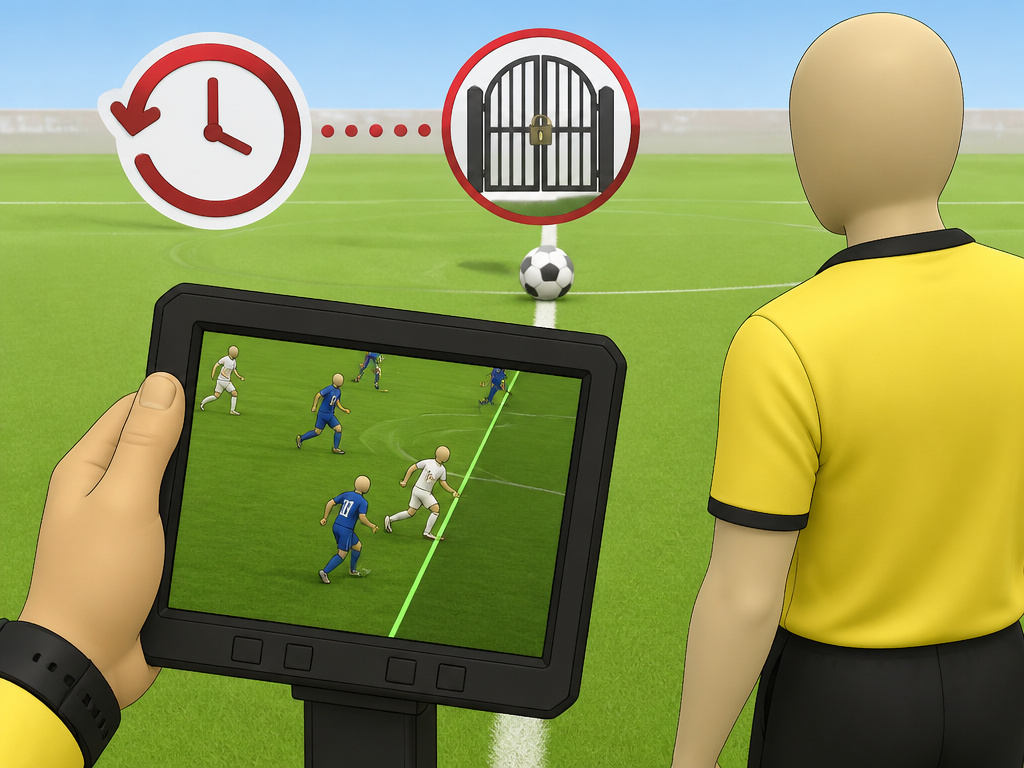
30 September 2023. Tottenham v Liverpool, 0-0, Liverpool already down to ten men. Luis Diaz scores, the flag goes up for offside, and the game restarts after a very quick check with no lines shown on the replays.
Gary Neville was at the ground for Sky Sports. “Then all of a sudden I heard in my ear ‘check complete’ from the VAR officials to the referee. There was no lines. It was so quick.”
PGMOL, the body that ran Premier League referees at the time, made a PGMOL admission of significant human error after full-time. The statement called it “a clear and obvious factual error” that should have led to VAR intervening. Sky Sports understood the VAR wrongly thought the on-field decision was a goal, so they confirmed the check instead of stepping in.
Tottenham won 2-1. The PGMOL statement on Diaz offside decision also promised a full review. Neither changed the result.
Why couldn’t anyone fix it? Rewind a second. IFAB’s rule is that once play stops and restarts after an incident, a review is no longer allowed. There are two exceptions: mistaken identity, and a possible sending-off for violent conduct, spitting, biting or extremely offensive, insulting or abusive actions. An offside goal isn’t on that list.
That’s the night I stopped saying VAR fails on facts. The Diaz call was the easiest kind of decision VAR handles. A communication slip broke it, and the restart rule sealed it. It’s like a mortise cut on the wrong pencil line: every joint after it fits perfectly, and the table’s still wrong.
Where this goes sideways: The VAR misreads what the on-field call was and confirms “check complete.” Play restarts within seconds, and from that moment the error is locked in for the rest of the match.
The Attacking Phase: No Time Limit, No Pass Count
Before the restart, the look-back is longer than people assume. The Premier League handbook limits the attacking possession phase to the play that leads directly to a goal, a penalty incident, a possible DOGSO red, or a second yellow for stopping a promising attack or DOGSO.
There’s no time limit or number of passes. It also doesn’t have to start when the attacking team won the ball. Officials weigh whether the defence had a chance to reset and how much momentum the attack had. That’s a judgement inside a factual check, and it’s where a lot of the VAR controversy actually lives.
The Second-Yellow Rule Most Previews Still Get Wrong
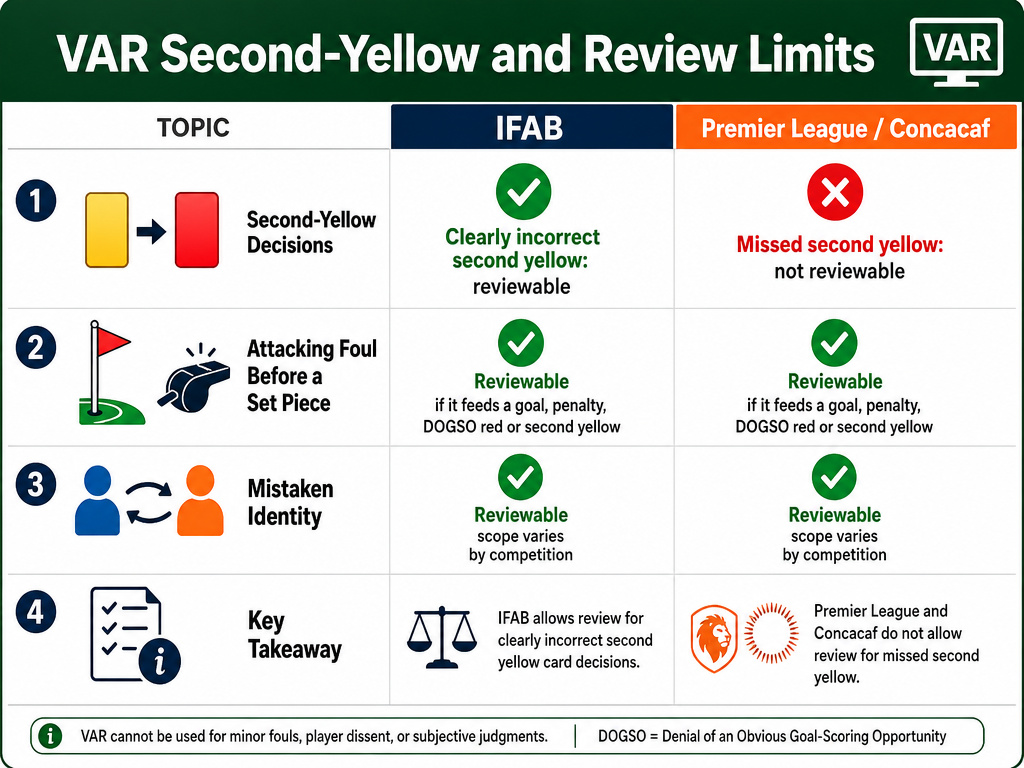
Plenty of summaries this summer said VAR can now review second yellows. That’s half the story, and the missing half matters.
IFAB is precise about it. VAR can help with a clearly incorrect second yellow that results in a red. It can’t help when a potential second-yellow offence was missed. IFAB’s own example is a player already on a yellow who makes a reckless tackle the referee doesn’t see. No review. The Premier League says the same: only clearly wrong second yellows, not potential ones.
Then the Premier League handbook adds a wrinkle. It extends the protocol to review an attacking-team offence that happens before a corner or free kick is taken. The offence must start before the ball is in play, have the potential to be a red card, and directly affect the outcome. The direct effects listed are a goal, a penalty, a DOGSO red for a defender, or a defender’s second yellow for DOGSO or stopping a promising attack.
If an offence did happen, the right card is shown and the kick is retaken. This sits awkwardly next to IFAB’s restart rule. The sources don’t fully reconcile it, so here’s each position side by side:
| Issue | IFAB position | Premier League or Concacaf position |
|---|---|---|
| Wrongly awarded corners | Competition option | Premier League: not adopted |
| Missed second yellow | Not reviewable | Premier League: same limit |
| Attacking foul before a set piece | No review after restart, bar two exceptions | Premier League: reviewable if it feeds a goal, penalty, DOGSO red or second yellow |
| Mistaken identity scope | Laws text: wrong player of offending team; AGM release: wrong team penalised | Concacaf: wrong player of either team |
My read? The handbook’s set-piece rule targets offences before the ball is even live, which is a different moment from a restart that’s already happened. That’s my interpretation, though, and the two documents don’t spell out how they fit together.
Mistaken identity has a similar wobble. IFAB’s AGM release talks about the referee penalising the wrong team, so the card lands on the wrong player. IFAB’s changes document defines it as cautioning or sending off the wrong player of the offending team. Concacaf’s announcement covers a red shown for an offence committed by another player of either team.
If you can’t name the competition, you can’t answer the VAR question. Check the competition’s own rules before you argue about the replay.
What VAR Won’t Touch, and Why the Referee Keeps the Last Word
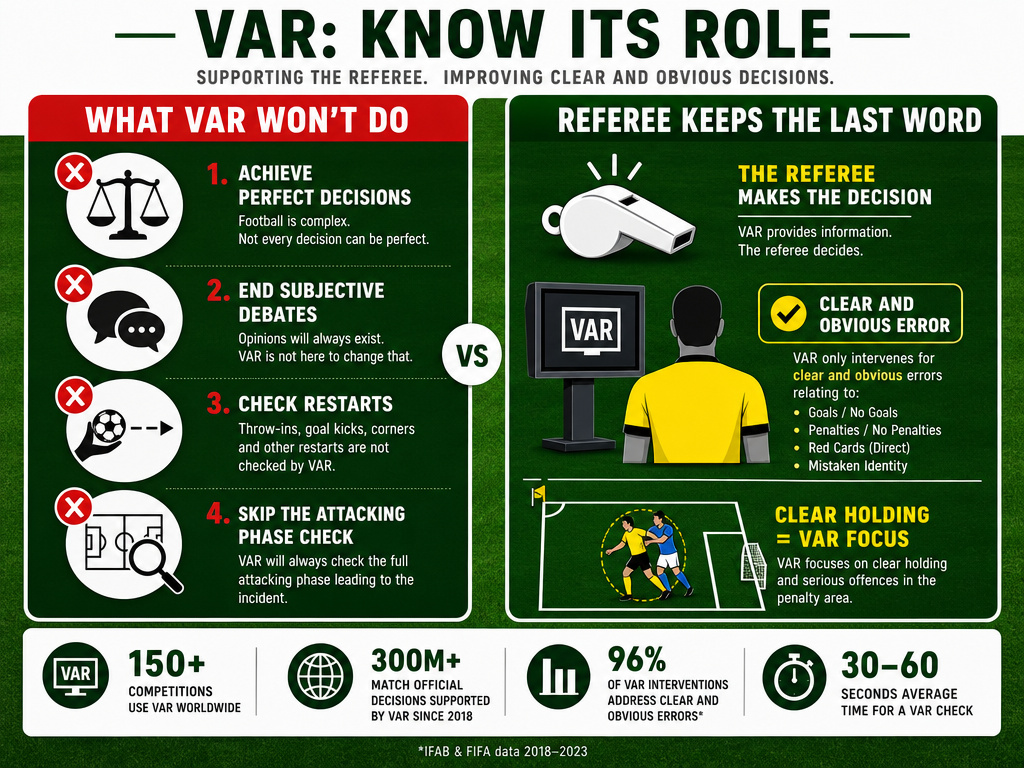
The referee owns every decision. The Premier League’s “Referee’s Call” stands unless the VAR judges, on the evidence readily available, that it’s a clear and obvious error. The handbook is blunt about the limits too:
- Achieve decision-making perfection.
- Stop the debates about subjective calls.
- Check restarts.
- Recommend a review without checking the attacking possession phase.
The same handbook says VAR isn’t there to re-referee incidents. Clear evidence is needed to meet the high bar for subjective calls.
So can a referee ignore VAR? The VAR only recommends. On an on-field review, IFAB says the final decision must be based on what the referee has seen. That’s why a referee can watch the monitor and stick with the original call.
If it takes several replays and a slow-motion loop to convince you, the error was never clear and obvious. Leave it with the referee.
There’s one area where the Premier League is asking VAR to be more active. The handbook gives on-field officials and the VAR a strong mandate to penalise clear holding actions that have a clear material impact, or that are non-footballing acts with no attempt to play the ball. Watch the box at corners this season. That’s where it’ll show up first.
Fans expect technology to deliver perfect justice. It can’t, while judgement calls exist. I’ve watched enough of these to know my own first reaction from the stand is wrong more often than I’d like to admit.
Where Does Semi-Automated Offside Fit Into All This?
Ever noticed the offside graphic now flashing up on the big screen inside the ground?
IFAB’s glossary describes semi-automated offside technology (SAOT) as a system that immediately sends offside-position information to the VAR. In an advanced version, it also goes straight to the assistant referees. The Premier League says it’ll keep using SAOT to cut delays on close onside and offside calls.
It won’t be used for clear offsides, and that’s sensible. The VAR also keeps the option to draw lines by hand as a back-up in tricky edge cases. The handbook’s example is several players blocking the view of the ball.
The legal footing sits in Law 5. Competitions are allowed to use technology to help the referee in three areas: the VAR protocol, ball in or out of play, and offside. Ball in or out includes goal-line technology systems, and offside includes SAOT. It’s worth knowing that clause before arguing about connected ball technology or any other gadget.
I’ll be upfront about my blind spot. I watch with my eyes and a notebook, not an Opta model, so I can’t tell you how much faster checks have become in numbers. What I can tell you is the history. Goal-line technology was built to answer one factual question, and it answers it. SAOT is the same idea pointed at offside, and I think it’s the most underrated tool in the booth.
Every match leaves a clue. Watch the stand react to the SAOT graphic before the players have even turned around.
What is VAR and who introduced it in football?
VAR stands for video assistant referee. It is a team of officials watching the match on video, there to help the referee on the pitch. The rules come from IFAB, the body that writes the Laws of the Game, and its VAR protocol limits the system to a “clear and obvious error” or a “serious missed incident.”
IFAB sets the framework, but it does not run the system in every match. A competition can only use VAR if it meets the implementation requirements in FIFA’s documents and the VAR Handbook. That is why the Premier League, Concacaf and other organisers each apply the protocol their own way, and why some options are left to the competition.
The Laws also let competitions use supporting technology, including goal-line systems and semi-automated offside. For the exact dates VAR arrived at a given tournament or league, check that competition’s own announcement, since the rollout was competition by competition.
Frequently Asked Questions
Can a referee ignore VAR?
The VAR only recommends, and the referee makes the final decision. After an on-field review, IFAB says that decision must be based on what the referee has seen. So a referee can watch the replays and keep the original call.
Can VAR intervene for a free kick?
Not once play has restarted. The only exceptions are mistaken identity and possible sending-offs for violent conduct, spitting, biting or abusive actions. In the Premier League, there’s also an attacking-team offence committed before a free kick or corner is taken. If that offence leads directly to a goal, penalty, DOGSO red or defender’s second yellow, it’s reviewable and the kick is retaken.
Can players or managers ask for a VAR review?
No. Only the referee can start a review, and the VAR can only recommend one. Captains waving imaginary screens changes nothing.
Can VAR give a second yellow card the referee missed?
No. IFAB’s example is a booked player whose reckless tackle goes unseen, and VAR can’t step in. VAR only helps when the referee shows a clearly wrong second yellow that leads to a red.
Does VAR apply in grassroots or youth football?
Only where it’s actually installed and approved. IFAB says VAR use requires meeting all the IAAP implementation requirements in FIFA’s documents and the VAR Handbook. Your local youth league won’t have that setup, so the referee’s call is final.
When did the 2026/27 VAR changes start?
IFAB said the changes would be used at the 2026 World Cup. Concacaf confirms the amendments took effect on 1 July 2026, with its own competitions applying them from 20 July 2026.
Before You Go
So when can VAR intervene in football? Next time the screen says “check,” ask two questions before you shout. Has play restarted? And is this a fact or a judgement call?
If play has restarted and it isn’t mistaken identity or a violent-conduct-type red, it’s over. The Diaz goal proves how final that is, even when everyone agrees the call was wrong.
A concession, too. My view of officiating leans on European football, and competitions are now picking different VAR options. If you follow a league outside the Premier League, read that competition’s own announcement before you trust any summary, this one included.
And here’s the stance I’ll defend over a pint: I’d rather VAR stayed out of more judgement calls and got the factual ones right every time.
So which call would you take away from VAR first?
