
What Gets You a Red Card in Football? The Full List
This post contains affiliate links. As an Amazon Associate, we earn from qualifying purchases.
You get a red card in football for serious foul play, violent conduct, biting or spitting, offensive or abusive language, denying a goal or obvious goal-scoring chance by foul or handball, or collecting a second yellow card. The player is sent off, and after kick-off the team cannot replace them.
Referees read every foul on a ladder: careless, reckless, then excessive force, and that ladder is what gets you a red card in football. Red-card rows are almost always rows about which rung a challenge sits on, or about whether a goal chance was truly “obvious”.
What follows: the full list of offences, the penalty-area exception that trips up even seasoned fans, how a second yellow works, who beyond the outfield players can be sent off, the two new 2026 red cards, and what happens once the card is out.
Key Takeaways
- A handball or foul that denies a goal chance is a red outside the area, but a genuine attempt on the ball that concedes a penalty drops to a yellow.
- Under the 2026/27 Laws, if the referee plays advantage on a goal-denying foul and the team scores, there is no card at all.
- Substitutes, coaches and other team officials can be sent off, and a sent-off named substitute leaves the team’s substitution allowance untouched.
- Covering your mouth in a confrontation is a red at the World Cup but a yellow in UEFA club competitions, because the IFAB made it a competition option.
- From the 2026/27 Laws, VAR can review a red that came from a clearly incorrect second yellow.
What Actually Gets a Player Sent Off Under Law 12?
Law 12 of the IFAB Laws of the Game is the master list of what gets you a red card in football, and it covers players, substitutes and substituted players alike. Anything on it means a sending-off.
Law 12 of the IFAB Laws of the Game lists the sending-off offences for players, substitutes and substituted players. The list includes serious foul play, violent conduct, biting or spitting, offensive or abusive language or actions, denying a goal or obvious goal-scoring opportunity, and a second caution in the same match.
In plain words, the core offences look like this:
- Serious foul play: a challenge that endangers an opponent’s safety or uses excessive force or brutality.
- Violent conduct: excessive force when the player isn’t challenging for the ball, with or without contact, and it covers teammates, officials and spectators too.
- Biting or spitting.
- Offensive, insulting or abusive language or actions.
- Denying a goal or obvious goal-scoring opportunity by handball or by a free-kick offence.
- A second caution in the same match.
Serious foul play and violent conduct
A studs-up lunge at an ankle and a punch thrown after the whistle both end in red, yet the Laws treat them as different offences. Both are reds, but the difference between violent conduct and serious foul play is whether the player was challenging for the ball.
A deliberate strike to the head or face counts as violent conduct unless the force was negligible. IFAB’s own examples include a player who loses control and hits a spectator who ran onto the pitch. Red. Another has a player strike a substitute in the face with the ball in play. Also red.
Spitting, biting and abusive language
Spitting and biting need little explanation. Abusive language and gestures are the offences that surprise newer fans, because the red depends on the words or actions being offensive, insulting or abusive, not on contact.
One oddity: cards can’t be shown until the referee enters the field at the start of the match. In an IFAB example, a player spits at an opponent in the pre-match warm-up before team lists are submitted. No card appears. The player can’t be named or play, and the incident is reported.
Careless, Reckless or Excessive Force: How Referees Pick the Card
Referees grade every foul before they reach for a pocket, and that grading decides what gets you a red card in football. Careless earns a free kick and, on its own, no card. Reckless earns a yellow, which is how IFAB’s own examples treat a reckless challenge. Excessive force earns a red.
Think of it like a kitchen pass. A late tackle is a plate sent back; reckless is a plate that makes someone ill; excessive force closes the restaurant.
Easy to miss: If a careless tackle stops a promising attack and the referee plays advantage, the player isn’t cautioned when play next stops. The tackle alone doesn’t warrant a yellow.
Stop a counter on purpose and the picture changes. A defender who commits a careless tackle in the centre circle that stops a promising attack gets a yellow in IFAB’s example. Fans call that deliberate stop a professional foul.
My take: the tactical foul is a skill, and the Laws put a price on it. The midfielder who clips a runner to kill a counter takes a yellow; the same clip with the goal at the runner’s mercy is a red. I just wish referees paid that price every single time.
That’s opinion, not Law. Same goes for my other soapbox: a team’s total yellow count says little about how dirty it is. Where on the pitch the fouls happen says far more.
Why Can the Same Goal-Denying Foul Be Red Outside the Box and Yellow Inside It?
A defender grabs a shirt just outside the box. The referee’s arm goes out for advantage, the ball breaks to another attacker, and the shot sails over the crossbar. Then the whistle goes and the card comes out. Yellow, for unsporting behaviour.
That is the advantage rule in action, and the sanction depends on what happens next. Law 12 says the offender is cautioned if no goal follows and no other red-card offence occurred. The 2026/27 change, confirmed in IFAB’s Circular 32, covers the other half: no caution if advantage is played and a goal is scored. Circular 32 doesn’t address the no-goal case, so the yellow comes from the Law 12 text.
The test for denying an obvious goal-scoring opportunity weighs four things:
- Distance to goal
- General direction of play
- Likelihood of keeping or gaining control of the ball
- Location and number of defenders
| Situation | Card |
|---|---|
| Deliberate handball denies a goal chance, anywhere | Red |
| Non-deliberate handball denies a goal chance, outside own area | Red |
| Non-deliberate handball denies a goal chance, penalty awarded | Yellow |
| Goal-denying foul, advantage played, goal scored | No card |
| Goal-denying foul, advantage played, no goal | Yellow |
Goalkeepers get no pass for leaving their area. In an IFAB example, a keeper runs out and fouls an attacker 20 m from goal. The attacker is controlling the ball, and two defenders are more than 10 m away. The keeper is sent off, and the team needs a new goalkeeper before play restarts, either a substitute or an outfield player.
The penalty-area exception
Inside the area, a penalty has already been awarded. If the offence was an attempt to play the ball or a challenge for the ball, the sanction drops from red to yellow. Holding, pulling, pushing, or having no chance of playing the ball still means a red.
The usual reasoning is that a penalty kick already hands back the lost chance, so a red on top is double punishment for a genuine challenge. That’s the logic, not a quote from the Laws. A non-deliberate handball that denies a goal and leads to a penalty is also a yellow, as the table shows.
How a Second Yellow Card Becomes a Red
Ever seen a player walk after two bookings, neither of them violent? Two cautions in the same match end in a sending-off, and the second yellow card rule reaches further than most fans expect.
Law 3’s examples show how wide the net is. One caution as a substitute and one as a player counts. So does one as a player and one as a substituted player.
Two real-shaped cases from IFAB’s examples:
- A substituted player leaves, re-enters without permission and kicks the ball to stop a promising attack. That’s two yellows, one for re-entry and one for unsporting behaviour. The player is sent off and the opponents get a direct free kick.
- A player cautioned for a reckless challenge is substituted at half-time. In the second half he leaves the technical area and shows dissent at an offside decision. Yellow, then red.
Protesting every call is the cheapest way to hand opponents a man advantage. I’ve seen it cost sides more than any tackle.
Cautions cover a long list, and what gets you a yellow card is its own story. The short version of yellow card vs red card in football: a yellow is a caution and the player stays on; a red is a dismissal.
Substitutes, Coaches and Goalkeepers: Who Else Sees Red
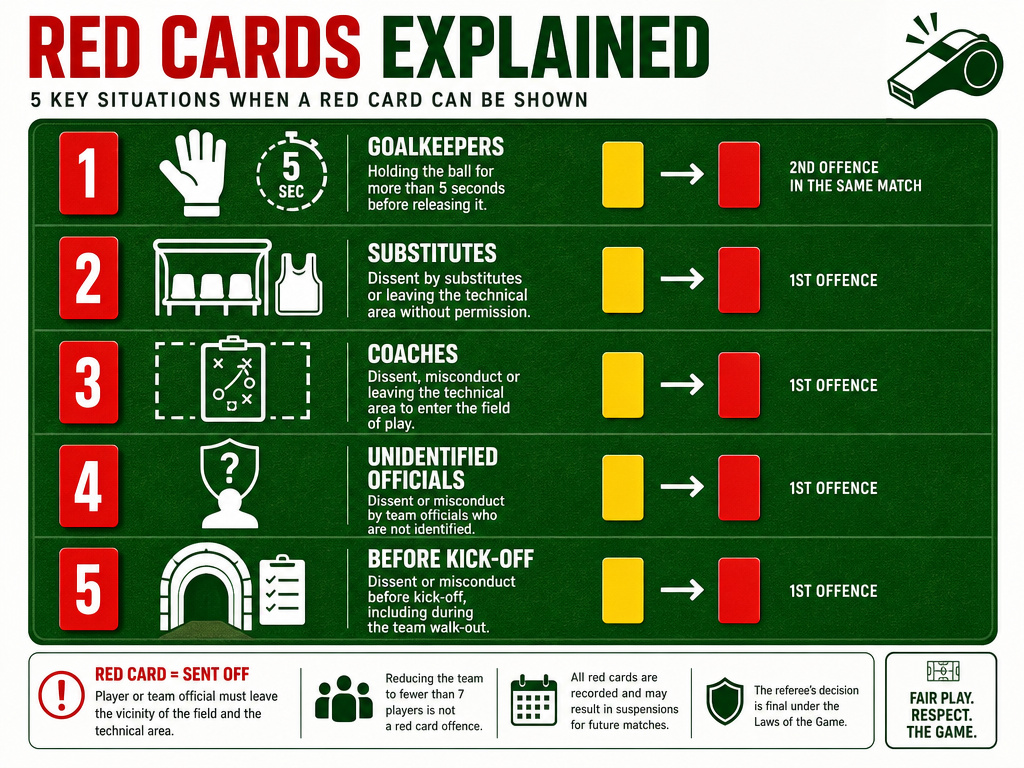
Three groups beyond the outfield starters can be sent off: goalkeepers, substitutes and team officials. Law 12’s list for officials includes, but isn’t limited to, delaying the opponent’s restart, leaving the technical area to show dissent, aggressively entering the opponents’ technical area, throwing or kicking an object onto the pitch, and using unauthorised electronic equipment.
- Goalkeepers who stall. The referee whistles, signals and counts down five seconds with a raised hand. If the goal kick isn’t taken, the opponents get a corner. Only if the keeper then excessively delays the restart after that corner is the keeper cautioned and then sent off.
- Substitutes. A substitute who enters the video operation room is sent off, must leave the technical area and can’t be replaced. A named substitute already on a yellow who kicks the ball away to delay a throw-in gets a second yellow and a red.
- Coaches. A coach who enters the field with the ball in play to interfere with an opponent is sent off. The restart is a direct free kick, or a penalty if it happens in the coach’s own penalty area.
- Unidentified officials. If the referee can’t tell which official offended, the senior coach in the technical area gets the card.
- Before kick-off. A player can be sent off in the warm-up or the tunnel. If already named on the team list, a substitute can replace the player without reducing the team’s substitutions.
The 2026 Additions: Covering Your Mouth and Walking Off
The IFAB’s Special Meeting in Vancouver on 28 April 2026 unanimously approved two new red cards. One is for a player who covers their mouth in a confrontational situation with an opponent. The other is for a player who leaves the field in protest at a referee’s decision, and it extends to team officials who incite players to leave. FIFA’s release framed the mouth-covering rule as a measure against concealed discriminatory behaviour.
Both are at the competition organiser’s discretion. A team that causes a match to be abandoned will, in principle, forfeit it.
UEFA went another way. In the UEFA decision on covering mouth sendoffs reported by ESPN, its club competitions won’t use the red card for this. Covering the mouth is treated as a yellow for unsporting behaviour, with possible discipline later.
| Competition | Mouth-covering | Walk-off in protest |
|---|---|---|
| FIFA World Cup 2026 | Red card | Red card |
| UEFA club competitions | Yellow card | Not used |
| Other competitions | Organiser’s choice | Organiser’s choice |
Where this goes sideways: Assuming the card is the same everywhere. The identical hand-over-mouth moment earns a red at the World Cup and a yellow in UEFA club games, because the IFAB left the choice to organisers.
What Happens After the Red Card: The Man Down and the Ban
Several times I’ve watched a side reduced to ten men defend better for a spell afterwards. The extra focus shows up as tighter lines and louder talk, and I now look for it after any early red.
A red is like a kitchen losing a cook mid-service. Nobody steps in to cover the station, so everyone else tightens up. Here’s the sequence:
- The referee shows the card and the offender must leave the vicinity of the field and the technical area. Linger and the restart stalls.
- A player sent off after kick-off can’t be replaced, so the team plays short for the rest of the match.
- A sent-off goalkeeper means a new keeper before restart, whether a substitute or an outfield player. Without one, play can’t start.
- A match can’t resume after the ball goes out of play if a team has fewer than seven players.
- The incident goes to the competition’s disciplinary authority, which decides any ban.
The part nobody mentions: A red isn’t final until play restarts. After a VAR review the referee can change a red to a yellow, and even cancel a related substitution, but only before the restart. In one IFAB example, a substitute goalkeeper is brought on and the red is then downgraded.
Two further reviews arrive with the 2026/27 Laws. Per Circular 32, VAR can review a red that came from a clearly incorrect second yellow, and cases of mistaken identity. Both are relatively rare.
The ban itself sits outside Law 12. The Laws decide what happens on the pitch. How many matches a player misses is set by the competition’s disciplinary rules, so there is no single number, and I won’t invent one.
Youth, School and College Football: Check the Local Rulebook
Local competitions write their own variations. The IFAB list above is a starting point for them, not a guarantee.
College soccer in the US runs under the NCAA, which publishes NCAA news on soccer penalties. School leagues like Rhode Island’s publish their own rulebooks, such as the RIIL soccer rules page. My own football education is mostly European, so I’m pointing you at those pages instead of guessing. Read them before the season starts.
Frequently Asked Questions
What makes you get a red card in football?
Sending-off offence under Law 12: serious foul play, violent conduct, biting or spitting, offensive or abusive language or actions, denying a goal or obvious goal-scoring opportunity, or a second yellow. At the World Cup, covering the mouth in a confrontation or walking off in protest can also bring a red.
Is a red card a 3 game ban?
No universal number applies. The Laws handle the sending-off on the pitch, and the competition’s disciplinary rules set any ban. Check the rulebook of the league or tournament in question.
What does a yellow card mean in football?
Yellow card is a caution. The player stays on the pitch, but a second caution in the same match brings a red and a sending-off. Stopping a promising attack and a reckless challenge are typical yellow-card offences.
Can a substitute or coach get a red card?
Yes. A substitute who enters the video operation room is sent off, and a coach who enters the field to interfere with an opponent is shown red. A sent-off named substitute can’t be replaced, though the team’s substitutions aren’t reduced.
What is a green card in football?
The IFAB Laws sections on cautions and sending-offs use yellow and red cards only. If a league you play in uses a green card, that’s its own competition rule, so ask the organiser what it means.
Can a player be sent off before kick-off?
Yes, in the warm-up or the tunnel. A player already named on the team list can be replaced by a substitute, but that replacement can’t be replaced. If team lists haven’t been submitted, the player is barred and reported instead.
The Bottom Line
Here’s one test for any dismissal you argue about: where did it happen, was the player challenging for the ball, and did the referee play advantage? Those three answers settle most red-card rows.
All of this assumes the Laws of the Game unmodified. Local rulebooks and competition options, like the 2026 mouth-covering red, change the outcome. This week, find the disciplinary rules for the competition you actually follow or play in, because they set the ban length.
And my contrarian bit: referees should punish the tactical foul every single time. Consistency would settle half the arguments.
