
What Gets You a Yellow Card in Football? Key Offences
This post contains affiliate links. As an Amazon Associate, we earn from qualifying purchases.
What gets you a yellow card in football is misconduct short of a sending-off: a reckless challenge, dissent by word or action, delaying a restart, entering or leaving the field without permission, or persistent offences. Two yellows in one match add up to a red.
The word “reckless” carries the most weight in that list. The Laws define it by what the player ignored, which means the same tackle can earn nothing, a yellow or a red depending on how the referee reads it. “Persistent” is vaguer still. Law 12 says no set number or pattern of offences makes an offence persistent, so the referee decides when a habit has become a pattern.
What follows: the three tiers of challenge, the offences that need no contact, the penalty-area call that splits yellow from red, the ban thresholds, and where grassroots and school rules part ways with the international Laws.
Key Takeaways
- A reckless challenge is the cautionable one. A careless challenge draws no card and excessive force is a red.
- Celebrations bring a caution even when the goal is disallowed, so the yellow stands after VAR rules the goal out.
- In the Premier League, five yellows within the first 19 matches mean a one-match ban. Cup yellows count separately.
- Under the international Laws a cautioned player stays on. English grassroots dissent yellows mean 10 or 8 minutes off.
- From 1 July 2026, a DOGSO offence with advantage played and a goal scored brings no caution at all.
Where Does a Foul Become a Yellow Card?
Law 12 draws two lines, and the referee decides which side of each one a tackle lands on.
Law 12 sorts a foul challenge into three tiers. A careless challenge draws no card. A reckless challenge, one made with disregard to the danger to, or consequences for, an opponent, is cautioned with a yellow card. A challenge using excessive force is a red card. The referee judges the tier from the challenge itself.
That wording is from Law 12 of the Laws of the Game, as published by The FA. Notice what it leaves out. It doesn’t list tackle types, studs or speed. The test looks at disregard for danger and consequences, which puts the focus on how the challenge was made.
That’s why two near-identical tackles get different treatment. One is a mistimed lunge with no real malice. The other comes in with no thought for the opponent’s safety. The first is careless. The second earns the card.
Does that feel subjective? Yes. I wish it didn’t, but a Law that tried to define every tackle would be a phone book.
What Gets You a Yellow Card in Football Without Touching an Opponent?
A player jogs off with the ball under his arm after a free kick is awarded against his side. Nobody has been fouled. The referee is already reaching for the breast pocket, and the crowd’s roar flattens into a groan.
Contact is only one route to a booking. Law 12 lists several behaviours that earn a caution with no tackle involved, and these are where I think teams give cards away for nothing.
Delaying the restart
Law 12 gives three examples of delaying the restart:
- Kicking or carrying the ball away after the whistle, the classic petty one.
- Touching the ball after a stoppage to provoke a confrontation.
- Taking a free kick from the wrong spot to force a retake.
Separately, the 2026/27 Laws add a five-second visual countdown for delayed throw-ins and goal kicks. A late throw-in goes to the opponents. A late goal kick gives the opponents a corner. Those are restart penalties rather than cards, but the direction of travel is clear.
Dissent and persistent offending
Players are cautioned for dissent by word or action. In my view, the player who protests every decision does his side the most damage. The card is one cost, and the other is the disruption, because while he argues, the opposition gets the restart and the space.
Persistent offences work like a pot that only boils when it boils. There’s no fixed temperature, so the referee judges when the pattern has set in.
Entering or leaving without permission
Players are also cautioned for entering or leaving the field without permission. Leaving the pitch is not a free walk to the touchline. Skip the referee’s nod and you hand over a yellow.
Pretending to be fouled is the other offence fans ask about, and diving in football gets its own breakdown.
Does a Goal Celebration Really Cost You a Card?
Yes, and the goal doesn’t even have to count.
Law 12 cautions players for celebrations even if the goal is disallowed. The list is specific:
- Removing the shirt or covering the head with it
- Covering the head or face with a mask
- Provocative gestures
- Climbing a perimeter fence in a way that causes a safety problem
Leaving the field to celebrate is not a caution in itself. Do one of those four things on the way and it becomes one. A striker with his shirt pulled over his face is blind, pinned and booked, all at once.
Never pull the shirt over the head on a celebration that VAR might overturn. The yellow stays on the record even when the goal is wiped out.
The Penalty-Area Gamble: Yellow for Playing the Ball, Red for Holding
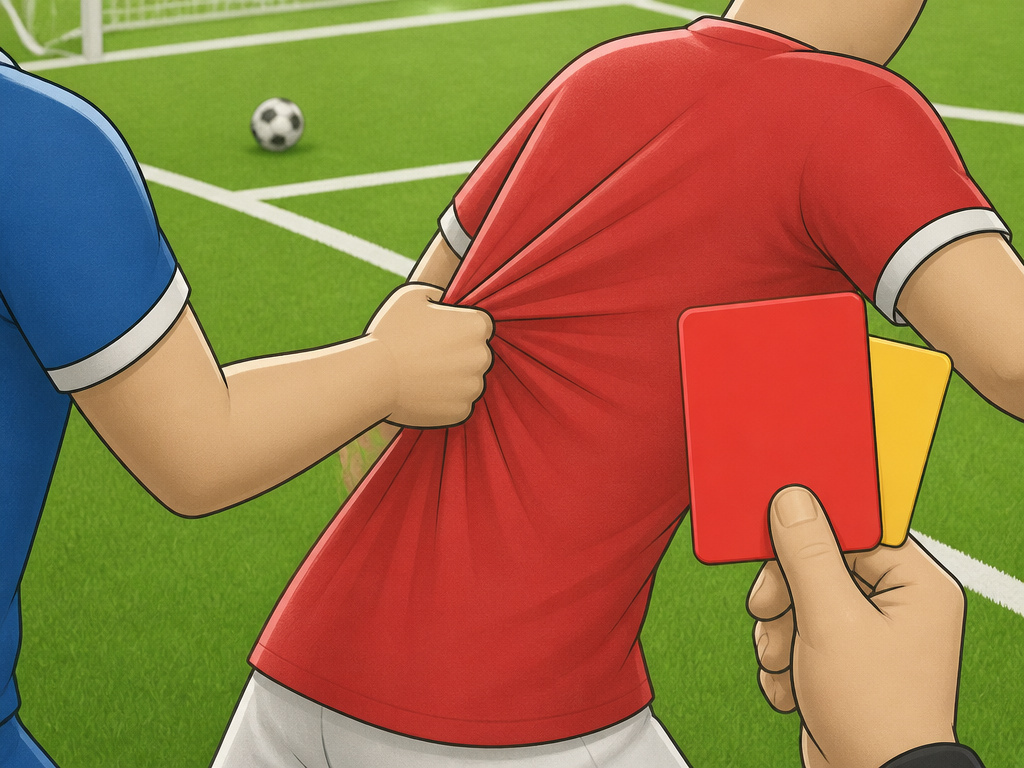
DOGSO, short for denying an obvious goalscoring opportunity, is where cards and red cards get decided in the penalty area. Inside the box, the player gets a yellow only if he was trying to play or challenge for the ball. Holding, pulling, pushing or having no chance of playing the ball means a red.
From 1 July 2026 there’s a new exception. If the referee plays advantage for a DOGSO offence and a goal is scored, the offending player is not cautioned, per the IFAB’s announcement. The reasoning is simple: the offence didn’t prevent a goal.
Where this goes sideways: Grabbing a shirt to stop a forward in the box. Because holding is a red, there’s no yellow to fall back on, and the player is gone for the rest of the match.
Fans call the cynical trip on a counter a professional foul, and I’d argue it’s a legitimate defensive skill that referees should punish the same way every time. Whether a given trip earns a card is a judgment the referee makes on the tiers above. I lean on what I see more than on the models, so check any claim I make against the data.
If you want the full red-card list, the page on what gets you a red card covers it.
What Happens After Two Yellows, and Can VAR Fix a Bad One?
Several times I’ve watched a side drop to ten men and defend better straight afterwards. The extra focus is a pattern I now look for after any early red card.
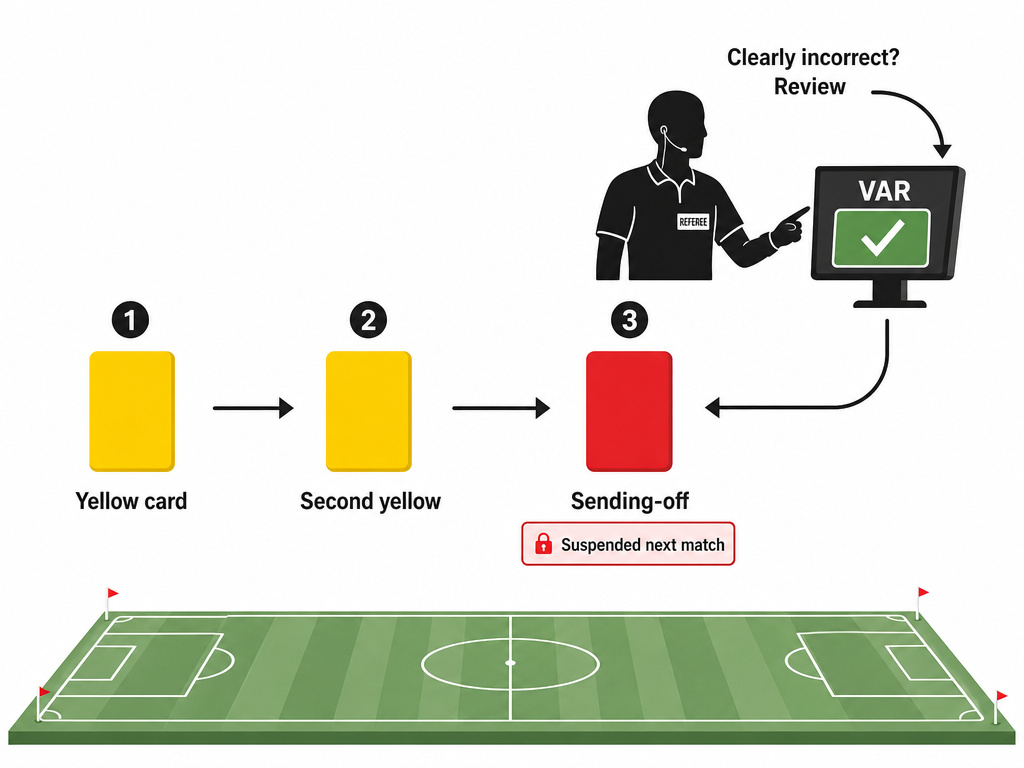
That’s the cost side of a second yellow card. Two cautions in one match mean a sending-off, with the suspension served in the next game, according to NBC Sports. The difference between yellow and red cards is that a yellow warns, a red removes.
Until recently a wrong second yellow couldn’t be fixed. At its 140th Annual General Meeting on 28 February 2026, the IFAB approved VAR review of red cards arising from a clearly incorrect second yellow. VAR can also review mistaken identity, where a card goes to the wrong player. Competitions may let VAR review a clearly incorrect corner kick, as long as the restart isn’t delayed.
Notice the wording: “clearly incorrect”. VAR isn’t a second opinion on judgment calls.
Do Coaches, Substitutes and Team Officials Get Booked Too?
Three things get a team official cautioned: ignoring technical area limits, gesturing excessively for a card, and making the VAR “TV signal” excessively. Only the first is limited to clear or persistent breaches under Law 12. The other two are cautionable when done excessively.
The red or yellow card can be shown only to a player, substitute, substituted player or team official. Spectators and managers’ friends in the stand are outside its reach.
US high school soccer adds its own rule. Under Rule 7-2-4, covered by the NFHS bench decorum rules article, anyone other than the team captain who approaches or speaks to the officials between periods, unless beckoned, gets a yellow card. The NFHS soccer rules changes document for 2026 also swaps “carded” for “cautioned” and “ejected”.
Not gonna lie, that interval rule would have saved a few heated touchline moments I’ve seen.
Does a Yellow Card Mean Leaving the Pitch? It Depends Where You Play
Under the international Laws, a cautioned player stays on. The sources disagree beyond that.
| Rule set | What a yellow does | Source |
|---|---|---|
| IFAB Law 12 | Player stays on the pitch | The FA, Law 12 |
| English grassroots dissent | Off for 10 minutes (8 in other matches) | The FA, Middlesex FA |
| US high school (NFHS) | Any carded player leaves the field | NFHS 2026 Rule 5-3-1 |
English grassroots football runs a sin bin for dissent. The referee shows a yellow in the normal way and points to the touchline, not to a marked area. The player can’t be replaced during the period. It is mandatory in all grassroots football, including youth, after a two-year pilot.
A player on the touchline, hands on hips, watching the referee’s watch, learns fast. The FA’s pilot reported a 38% drop in dissent.
US high school rules say any player shown a card, yellow or red, must still leave the field of play. The summary I read doesn’t spell out how and when a cautioned player returns, so check your state association.
How Many Yellow Cards Lead to a Ban?
Five yellows inside the first 19 Premier League matches mean a one-match ban.
The numbers below are the FA’s published accumulation table for 2025/26.
| Competition | Cautions | Cut-off | Ban |
|---|---|---|---|
| Premier League | 5 | Within 19 matches | 1 match |
| Premier League | 10 | Within 32 matches | 2 matches |
| Premier League | 15 | Last day of season | 3 matches |
| EFL / National League | 10 | Within 37 matches | 2 matches |
| Cups (see below) | 2 | Up to quarter-finals | 1 match |
At 20 cautions by the last day of the Premier League season, a Regulatory Commission sets the ban. The page on yellow card suspensions goes deeper.
In one 2025/26 example reported by FantasyFootballScout from the FA table, a Premier League player on four cautions had to avoid another yellow across the next 14 Gameweeks to dodge a one-match ban.
The part nobody mentions: Friendlies carry no accumulation, and cautions carry over if a player moves between leagues during the season.
League bans and cup bans
League and cup counts are separate. Cup yellows can ban a player only from that cup. The EFL Cup, EFL Trophy, FA Trophy and FA Cup Competition Proper all use two cautions up to the quarter-finals for a one-match ban.
The World Cup’s two clean slates
For the 2026 World Cup, the FIFA Council confirmed that single yellow cards would be wiped after the group stage and again after the quarter-finals, reflecting the extra knockout round in the 48-team format, according to the FIFA World Cup yellow card rule report from AP. Two yellows, in one game or two, meant a one-game suspension, per NBC Sports. A suspension that couldn’t be served during the tournament carried over to the team’s next official national match.
The sources differ on the second wipe. AP says it applies to players with one yellow from the three previous knockout rounds whose teams reached the semi-finals. NBC Sports says all previous cautions were cleared going into the semi-finals. I’d check FIFA’s own regulations before relying on either wording.
What Changed for 2026/27, and What Is Still Unclear?
The calendar tells the story best.
- 28 February 2026: the IFAB’s 140th AGM approves VAR review of red cards from a clearly incorrect second yellow, plus mistaken identity.
- 28 April 2026: a Special Meeting in Vancouver approves a new sending-off offence, but only as a competition option (Circular 33).
- 29 April 2026: the FIFA Council confirms the World Cup yellow-card clean slates.
- 1 July 2026: the new Laws year starts. A DOGSO offence with advantage and a goal means no caution. Substituted players get a ten-second limit to leave the field, or the substitute waits until the first stoppage after one minute. A player treated on the field stays off for one minute after play restarts.
The mouth-covering change is the one to watch. Covering the mouth with a hand, arm or shirt while speaking to an opponent in a provocative, derisory or inflammatory manner is a sending-off offence. It’s optional for competitions, and it is not a yellow-card offence. Where a competition doesn’t adopt it, any sanction falls under general unsporting behaviour at the referee’s discretion. The long-term evidence is thin, so nobody can yet say how referees will apply it.
The Bottom Line
If you want one rule to remember, it’s this: what gets you a yellow card in football is judged on disregard, delay and disrespect, and the same act is sanctioned differently depending on the competition. If you’re on four league yellows, check your own competition’s cut-off dates this week, because the 2025/26 thresholds above change from season to season.
My concession: I’ve leaned on the sources for numbers, and they don’t cover everything. The World Cup clean-slate wording is the clearest example. Where the sources disagree, I’ve said so.
Does the referee write down every yellow card, and when can one be shown?
Yes, in practice the referee notes each caution so the match report matches what happened on the pitch. A usual entry covers who was booked, which team they play for and the reason. That record matters because VAR can now review mistaken identity, where a card goes to the wrong player, and a clearly incorrect second caution that leads to a red.
Who can be shown a card is set out in Law 12. Only a player, substitute, substituted player or team official may receive a red or yellow card. Spectators and anyone else cannot be carded. Team officials can be cautioned for things like clearly or persistently ignoring technical area limits, or excessively gesturing for a card.
The fact sheet gives no exact start or end point for the referee’s card powers, so check the rules of your own competition. As a practical rule, behave as if the referee’s authority is live whenever you are in or around the match setting, because misconduct before kick-off or after the final whistle can still be reported.
Where did football’s yellow and red cards come from?
The cards exist to solve a communication problem. A referee’s decision has to be understood by players, officials and spectators at the same moment, and spoken instructions get lost in noise and across languages. A coloured card held up high is visible from every part of the ground, so nobody has to guess whether a player has been warned or sent off.
The colours borrow from road signals. Yellow works as a warning, and red means stop. That is why a caution leaves the player on the pitch under Law 12, while a red card removes them.
The sources used for this article do not cover who first proposed the cards, the incident that prompted them or the tournament where they first appeared, so those details are left out here rather than guessed. If you want the full origin story, check the official history pages of FIFA or a football museum, and compare more than one account.
Frequently Asked Questions
What counts as a yellow card in football?
Yellow card cautions a player for misconduct short of a sending-off. Reckless challenges, dissent, delaying a restart, entering or leaving the field without permission and persistent offences all qualify.
Do two yellow cards equal a red card?
Two cautions in one match mean a sending-off, with the suspension served in the next game. At the 2026 World Cup, two yellows across separate games also meant a one-game suspension.
Who can be shown a yellow card?
Only a player, substitute, substituted player or team official. Team officials can be cautioned for clearly or persistently ignoring technical area limits, excessive gesturing for a card, or excessive VAR “TV signal” gestures.
What are green, blue and white cards in football?
The Law 12 text I worked from describes only the yellow and red. I couldn’t verify any other colour in the sources, so check your own competition’s rules.
Do yellow cards count in friendlies?
No. Friendlies carry no accumulation. Cautions do carry over if a player moves between leagues during the season.
