
Simulation and Diving in Football Explained
This post contains affiliate links. As an Amazon Associate, we earn from qualifying purchases.
Simulation and diving in football explained: simulation is any attempt to deceive the referee, such as feigning injury or pretending to be fouled, and a dive is one form of it. Law 12 makes it a yellow-card offence. A second yellow in the same match means a sending-off.
The word “attempt” does the heavy lifting in that definition. A referee can’t see intent, so every call rests on reading a fall, a glance, and a split second of contact. Most of the arguments about diving grow out of that gap.
What follows covers the wording of Law 12, the clues that separate a dive from real contact, what the injury data does and doesn’t show, how bans after the match work, and what happened when VAR got involved at the 2026 World Cup.
Key Takeaways
- A failed dive costs a yellow card. A dive that wins a penalty or gets an opponent dismissed can add a two-match FA ban afterwards, if the evidence is clear and overwhelming.
- Sources split on contact. ProReferees says any contact rules out simulation, while UEFA’s guidance lists using slight contact as simulation. Contact alone settles nothing.
- VAR can review a first yellow card only for the player’s identity, not the offence. IFAB has paused using that route against simulation.
- Apparent injuries aren’t proven fakes. In one study of 47 women’s internationals, just 13.7 percent met the “definite injury” test.
Simulation and Diving in Football Explained: What Law 12 Says
Law 12 puts simulation on its list of cautions for unsporting behaviour. The wording covers any attempt to deceive the referee, for example by feigning injury or pretending to have been fouled. IFAB’s Law 12 is worth reading in full; the key line is short.
Law 12 of the IFAB Laws of the Game lists simulation under cautions for unsporting behaviour. The wording covers any attempt to deceive the referee, including feigning injury or pretending to have been fouled. A yellow card follows. A second caution in the same match brings a sending-off, and two separate cautionable offences receive two cautions.
The law punishes the attempt. Nothing in that line asks whether the referee was fooled, so a dive that fails is still a yellow card. Cautions add up, too. A booked dive turns into a red card if the player already has a yellow.
Philosophers Jim Parry and Cesar Torres spotted a wrinkle here. Law 12 never explains the difference between a foul and misconduct, so they rebuilt it themselves and sorted fouls into four kinds. Their scholarly paper on football simulation calls dives and other simulations “essentially deceptive offences” rather than fouls.
The same act travels under plenty of names: a dive, play-acting, a Schwalbe in German (it means “swallow”), or flopping in basketball. I’ll leave the basketball comparison there, since every source behind this piece covers football. Newer fans can get the wider football rules straight first; cards only make sense once fouls and free kicks do.
How Can You Tell a Dive From Exaggerated Contact?
A forward drops in the box, rolls once, and looks straight at the referee. That glance shows up in a referee-association column on the 2006 World Cup, which describes an opponent in England’s first game who went down in the area and looked up for the penalty. Watch the head, not just the fall.
Can anyone read intent from a moment like that? Morris and Lewis ran three studies on exactly this, reported in their paper on the perception of deceptive intentions in football. Non-professional raters agreed on which players were trying to deceive. The tackled players’ own intentions matched what observers judged. The authors conclude that deceptive intent is observable “to a degree.”
I went hunting in the abstract for a neat checklist and found a taxonomy of behaviours instead. Real life is messier than a poster.
Clues Worth Watching
These are the signs fans and explainer videos point to, with how far each one can be trusted.
- Contact first. Was there any? Video explainers split it: a dive means falling with no contact, simulation means exaggerating real contact. That split is anecdotal, and Law 12 doesn’t draw it.
- The glance. Eyes go to the referee mid-fall.
- A delayed reaction. Some explainers say a late response to the challenge, as if the player is waiting for it to feel bigger, signals a dive. Treat it as a hint, not evidence.
- The theatre. The same 2006 column describes players who brushed an opponent and then fell dramatically into the penalty area.
Does Contact Rule Out a Dive?
The sources disagree here, and the disagreement matters more than any checklist.
- ProReferees: any contact or potential contact means it can’t be simulation. It can count as “embellishment,” which need not be cautioned.
- UEFA referee guidance: “deliberately using a slight contact” and “overreacting to a minor offence” are forms of simulation. I only saw this one as a summary.
- IFAB Law 12: any attempt to deceive by pretending to have been fouled is cautionable, and the text carves out no contact exception.
- FIFA’s 2006 instruction: be sure no contact was made before penalising a dive. The Reading column argues this let brush-then-dive players escape.
My read is that the 2006 bar set the trap. Any touch creates doubt, and a referee told to be sure will default to waving play on. Players learned that a small brush buys cover.
Why Players Fake It: What One Injury Study Found (and Didn’t)
Women’s international matches in one video study averaged 5.74 apparent injuries each, against 11.26 in men’s matches. The Wake Forest study on faked soccer injuries, published in Research in Sports Medicine in July 2011, reviewed video of 47 televised games. An apparent injury counted as “definite” if the player withdrew within five minutes or bleeding was visible. Everything else was “questionable.”
Apparent injuries cover everything from a genuine knock to an act. “Questionable” just means the study couldn’t confirm either way.
| Measure (women’s international games) | Figure |
|---|---|
| Games reviewed | 47 |
| Apparent injuries observed | 270 (5.74 per game) |
| “Definite” injuries per match | 0.78 |
| “Questionable” injuries per match | 4.96 |
| 2007 World Cup, video vs team physicians | About 6 vs 2.3 per match |
The share classed as definite ran nearly twice as high for women, 13.7 percent against 7.2 percent for men. Some secondary coverage gives 13.6 percent and says “at least five minutes.” I’m using the university release’s figures. Numbers aren’t my home turf (I’m a notebook-and-eyes writer), so I’m quoting the release rather than reinterpreting it.
Two findings stand out. Questionable injuries were more likely than definite ones to come with contact and referee sanctions, which the authors read as a possible sign that players use them to deceive the referee. And the study found no evidence that teams who feigned often won more, or that players used it to rest or kill time.
Where this goes sideways: Treating a long stay on the grass as proof of faking. The researchers needed a five-minute withdrawal test and a visible-bleeding test just to sort definite injuries from questionable ones, and even then they said it was hard to know for certain.
Whether simulation buys a tactical edge is still open. The study’s lead author said only the players know the answer.
I’d put the incentive plainly: a dive that works can win a penalty, and one that fails costs a yellow card. That’s my reading of the gamble, not a finding from any study here.
FIFA saw the problem coming. In 2008 it issued a directive urging the football family to unite in denouncing injury simulation.
Retrospective Bans: The Two-Match Rule and the Eduardo Reversal
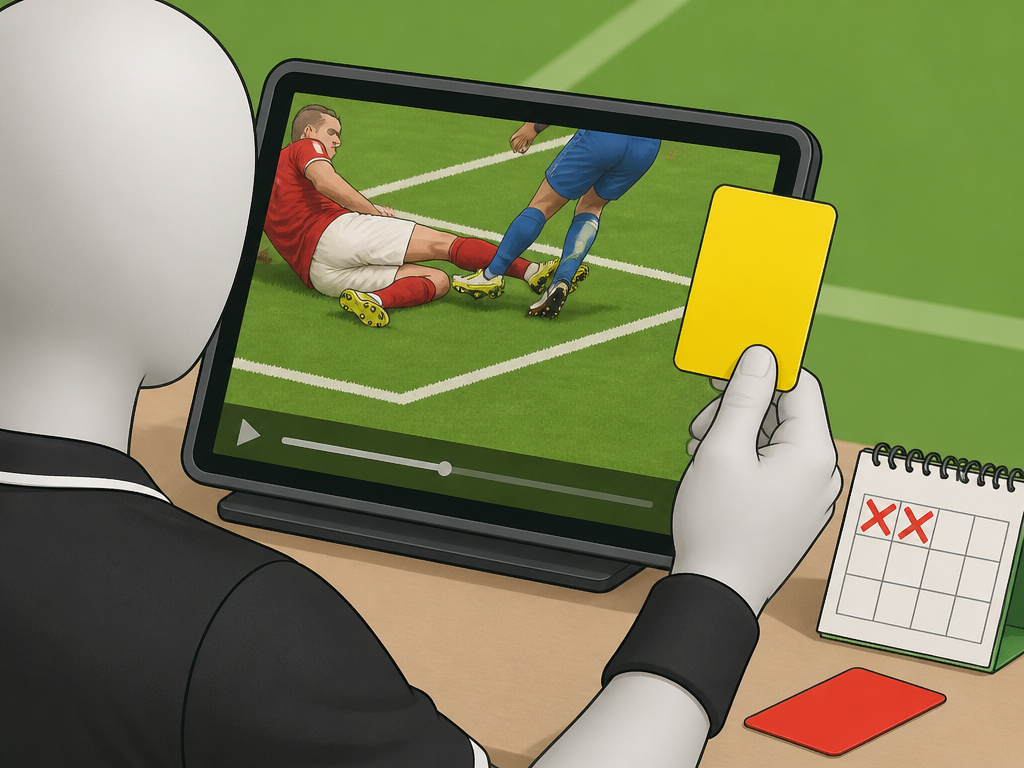
A dive that works gets punished harder than a dive that fails. That’s the logic of the FA’s 2017 announcement, which said success in fooling an official justifies a more severe penalty than a caution, acting as a deterrent. A yellow card stops being the ceiling once the deception pays off.
How the FA Rule Works
From the 2017-18 season the FA can act after the match under its Fast Track system. It needs clear and overwhelming evidence that a match official was deceived by simulation. As a direct result, the player’s team must have been awarded a penalty and/or an opponent dismissed.
The offence is named “Successful Deception of a Match Official.” In accepted or proven cases the player gets a two-match suspension. If the charge is admitted or proven, the Independent Regulatory Commission can also rescind the opponent’s caution or dismissal, if it chooses.
| Situation | Law 12 on the day | FA retrospective rule |
|---|---|---|
| Dive fails, referee reads it | Yellow card | Outside the rule |
| Dive wins a penalty | Caution if spotted | Two-match ban possible |
| Dive gets an opponent sent off | Caution if spotted | Ban possible; card can be rescinded |
The Eduardo Reversal
Retrospective action had a rough rehearsal in 2009. UEFA’s disciplinary body banned Eduardo for two matches over a penalty he won against Celtic in a Champions League qualifier. The ban was quashed on appeal.
Here the two sides tell different stories. Arsenal said it showed contact between the keeper and Eduardo and called the ban “deeply flawed.” UEFA cited the declarations of the referee and the referees’ assessor plus video footage. On appeal it said it was “not established to our satisfaction that the referee had been deceived.”
The reporting at the time raised three worries: inconsistency, a lack of precedent because very few players had been banned retrospectively for diving, and legality. In the match itself, Eduardo would have got only a yellow card, and only if the referee judged he dived.
The part nobody mentions: Proving deception means proving what was in the referee’s head. UEFA’s own appeal ruling turned on that point, which is why “clear and overwhelming” is such a high bar. Weak cases fall apart at the appeal stage.
I’ve come around on the FA’s rule for that reason. It only fires on the cases where the outcome changed, so it asks a narrower question than “was that a dive?”
What Happened When VAR Told a Referee There Was No Foul
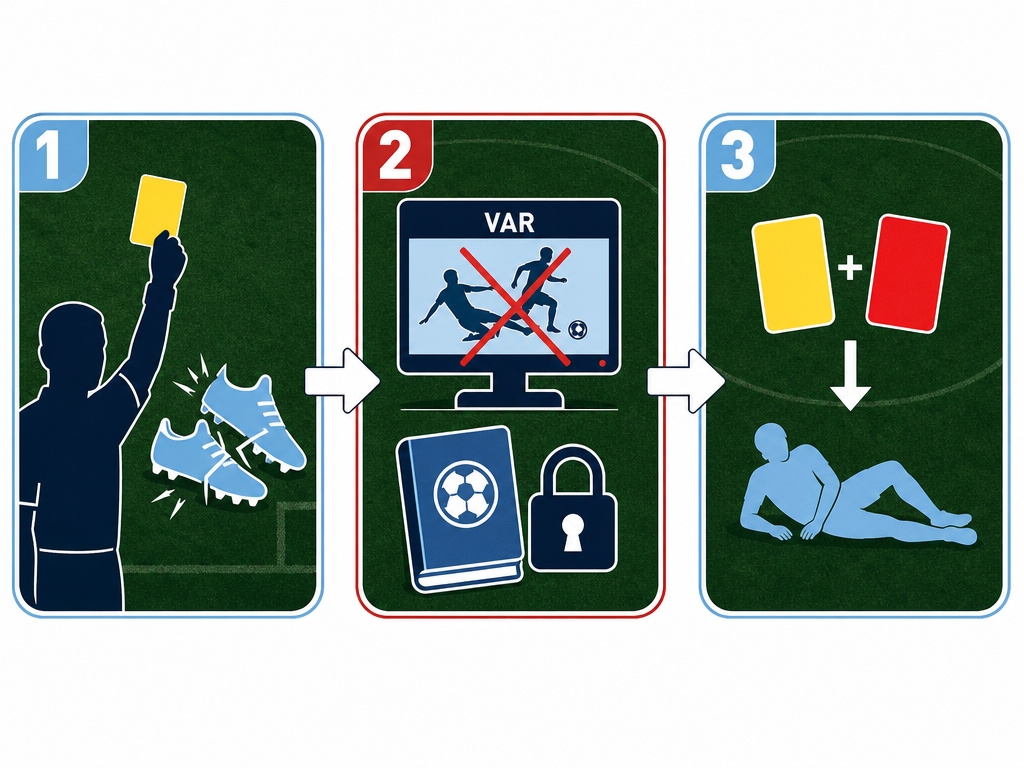
Three calls came in quick order in the 2026 World Cup quarter-final between Switzerland and Argentina in Kansas City, with the score level at 1-1. The sequence shows how awkward simulation is for video review.
- Paredes challenges Embolo, who goes down. Referee Joao Pinheiro books Paredes. A defender picks up a card for a foul that, per VAR, never happened.
- VAR tells Pinheiro that Paredes didn’t foul Embolo. IFAB’s rule is that a first yellow can be reviewed only to identify the player, not the offence. That limit pushed the sequence onto the mistaken-identity clause.
- Pinheiro books Embolo for simulation. It’s Embolo’s second yellow, so he’s sent off. Switzerland played extra time with ten, and Argentina won 3-1.
IFAB later said Embolo should not have been sent off. It added that using the mistaken-identity clause against simulation was well received and will feed into the detailed review of the VAR protocol, but it may not be used that way until that review ends. Switzerland coach Murat Yakin called the rule behind the sending-off “unacceptable.”
A search snippet attributes a different view to FIFA, that it wasn’t a refereeing or VAR error. I haven’t seen the full statement, so treat that as unconfirmed. The match is also a fair test case for how VAR is used on cautions: the technology saw the missing foul, but the rulebook limited what could be done about it.
Why Do Referees Miss Dives? The 2006 Clampdown That Fizzled
Ever wondered why a referee who suspects a dive will wave play on? Before the 2006 World Cup, FIFA told referees to give five areas special attention, and diving came last of the five. The Reading Referees column on that tournament says the clampdown failed.
The column cites two moments. In England’s first game a referee mimed a dive from the touchline of his own judgement but showed no card. In the semi-final, Ronaldo threw himself through a mass of opponents in a dive the writer compared to an Olympic swimmer’s, and that drew no sanction either.
That mime is a signal without a sanction. It tells the player “I saw it” and costs him nothing, so it teaches nothing. Anyone studying referee signals should notice that gap between what is communicated and what is punished.
The column also makes a fair point about innocent contact. A player can go down without a foul and still not be trying to deceive anyone. That’s why the instruction to be sure no contact was made is understandable, even though it helped the brush-then-dive crowd.
Part of the problem is geometry. A referee on the wrong side of a challenge sees a body fall but not the boot. I’d argue referee positioning explains more missed dives than any lack of nerve, though none of my sources measures that. Reading that old column changed how I see the 2006 failure: I used to blame the whistle, and now I blame the angle and the rule.
Cheating or Gamesmanship? Whether Harsher Sanctions Would Work
Diving is cheating, and I’ll defend that. Parry and Torres characterise diving and other simulations as ‘essentially deceptive offences’ rather than fouls. They also note it seems entrenched.
My stance on the tactical foul is different. A well-timed cynical foul is a skill, because the player accepts the card as the price. A dive asks the referee to hand over something the opponent never earned.
Would harsher punishment fix it? The long-term evidence is genuinely thin. The 2006 clampdown fizzled according to the column, and the Eduardo ban collapsed on appeal. The FA’s rule was built as a deterrent, but none of the sources I used measures whether dives dropped afterwards.
The Morris and Lewis finding gives some hope, since intent shows up in behaviour that observers can read. That favours review-based approaches over blanket crackdowns. Still, I wouldn’t bet on a quick fix.
How does diving in football compare with flopping in the NBA?
The fact sheet holds nothing on basketball, so this comparison sticks to what football’s own rulebook does, and the contrast is easy to draw from there. Football treats simulation as misconduct. Law 12 makes any attempt to deceive the referee, such as feigning injury or pretending to have been fouled, a yellow-card offence, and a second caution in the same match means a sending-off. Because the card comes from the referee’s call in the moment, the whole question turns on reading intent.
Football has also gone further than a single in-match sanction. The FA can punish simulation after the game under its Fast Track system, but only with clear and overwhelming evidence that an official was deceived and that a penalty or a dismissal followed. The offence is called Successful Deception of a Match Official, and it carries a two-match suspension. If you want to compare any sport with football, check three things: who decides, when they decide, and whether a failed attempt is punished as well as a successful one.
Frequently Asked Questions
What does diving mean in football?
Diving means going to ground to trick the referee into awarding a foul or penalty. Law 12 files it under simulation, which covers any attempt to deceive the referee, such as feigning injury or pretending to have been fouled. A dive is one form of simulation.
What are the rules for simulating in football?
Law 12 lists simulation among the cautions for unsporting behaviour, so the punishment is a yellow card. A second caution in the same match is a sending-off. Some competitions can also punish it afterwards: the FA can issue a two-match suspension in qualifying cases.
Can you get a penalty for simulation?
Dive can win a penalty if the referee is fooled. The FA can then act retrospectively when there’s clear and overwhelming evidence the official was deceived and the penalty followed directly. If the charge is admitted or proven, the Independent Regulatory Commission may also rescind the opponent’s caution or dismissal, at its choice. For the on-field restart after a booked dive, check the full current text on the IFAB site.
What is dive play in football?
“Dive play” is a loose search phrase for a dive: a player going down to win a decision. The laws use the word simulation.
Can VAR overturn a dive?
VAR can’t review the offence behind a first yellow card. IFAB says a first yellow can be reviewed only to identify the player who committed the offence. After the 2026 quarter-final, IFAB paused the mistaken-identity route for simulation pending its VAR protocol review.
The Bottom Line
That’s simulation and diving in football explained in practice: a yellow-card offence for the attempt, and a possible two-match ban when the trick succeeds. If a fall wins a penalty or gets a player sent off, the FA’s clear-and-overwhelming test is the one that matters. If nothing changed, it’s a yellow-card matter.
Your first step this week is to ask three questions on any suspicious tumble, in order. Was there contact? Did the referee’s decision change? Would a charge survive an appeal? Competitions differ, and VAR’s role in simulation is paused for now, so the answers shift by league.
Does a dive that fools the referee deserve a bigger punishment than one that fails, when the intent was identical?
