
Referee Positioning in Football Explained
This post contains affiliate links. As an Amazon Associate, we earn from qualifying purchases.
Referee positioning in football explained in one rule: the referee stands wherever they can make the correct decision, according to IFAB, normally on a wide diagonal that keeps play and the lead assistant referee in view. Distance matters too. In a 2021 study of 42 potential penalty calls, referees under 10 m away got 83% right.
That word “normally” carries a lot of weight. IFAB, the International Football Association Board that writes the Laws of the Game, calls its own positioning diagrams basic guidelines. The areas in them can grow, shrink or change shape with the match.
What follows: the diagonal and why it exists, what three sources say about distance (they don’t agree), where the assistants stand at each restart, and how it all shifts with VAR or a lone grassroots referee.
Key Takeaways
- The diagonal is a crew system, not a painted running line. A USSF-affiliated Q&A says there’s no fixed diagonal run at all.
- Referees under 10 m away with a good angle and clear view did best in a 2021 penalty study, though it only looked at 42 incidents.
- The FA’s 20 m ceiling is the only hard distance from a governing body in the research I used. IFAB gives no figure.
- With goal-line technology or VAR, the assistant on a penalty stands level with the penalty mark so a rebound doesn’t leave offside unjudged.
- Penn researchers suggested in 2010 that referees avoid switching diagonals at half-time, because leftward play drew more foul calls.
Why Won’t IFAB Give the Referee a Fixed Spot?
A fixed spot in the referee positioning in football explained debate would be wrong half the match. Teams lean one way, wingers hug one touchline, and the trouble moves with them.
Under the IFAB Laws of the Game guidelines, the best referee position is the one from which the correct decision can be made. The positioning diagrams are basic guidelines, and the recommended areas change size or shape with the match. The referee stays close enough to see play without interfering, and normally works a wide diagonal with the lead assistant in view.
That first line from IFAB reads like a dodge until you watch a few games with your eyes on the official instead of the ball. The guidelines tell the referee to adjust every recommendation using what they know about the teams, the players and the events in the match. I read that as permission to think. A diagram is a starting point.
Here’s the bit people skip. IFAB says “what needs to be seen” is not always near the ball. The referee also has to track the assistant referees and any additional assistant referees, which means looking away from the ball on purpose.
I think of it like checking a joint in a piece of furniture. Look straight down on a mitre and it seems flush; tilt your head and the gap shows. Good positioning is finding the tilt.
My own view goes a step further than IFAB’s wording. Once the ball has been played, it’s the least interesting thing on the pitch for a referee.
The Wide Diagonal: Why the Lead AR Has to Stay in View
The diagonal system of control is a three-person arrangement: one referee and two assistant referees (ARs), one on each touchline. A US Soccer state association’s policy page says the Laws recognise only this system, and that every U.S. Soccer-sanctioned competition requires it.
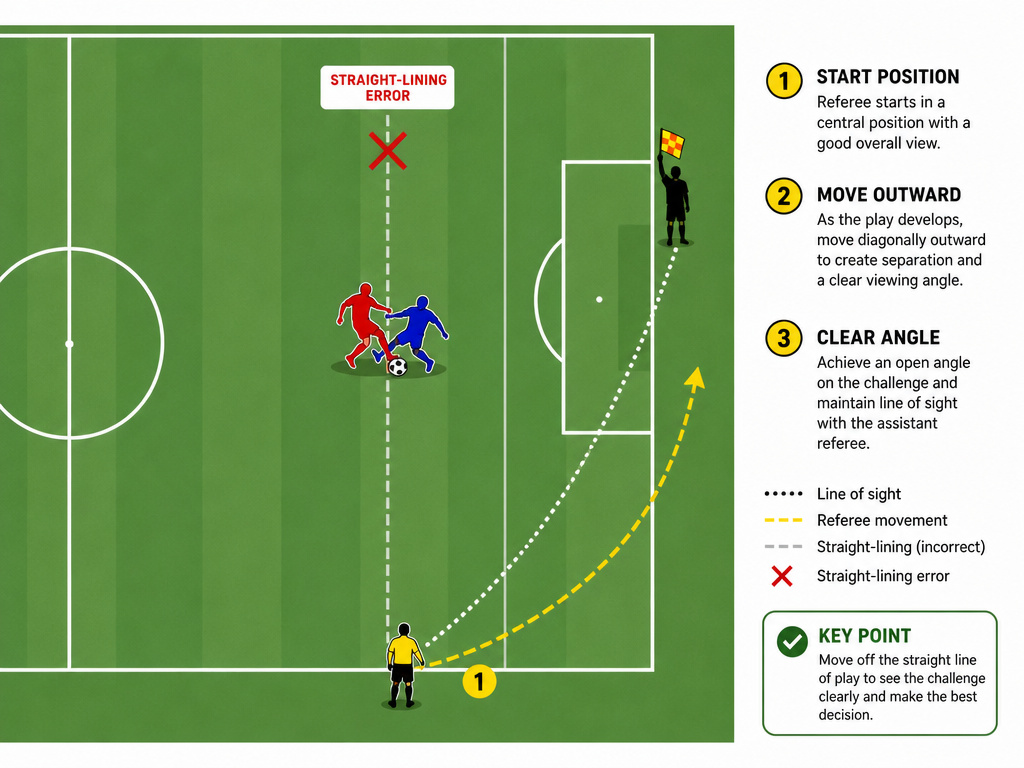
The “lead” AR is the assistant on the half the attack is heading into. IFAB wants that assistant in the referee’s field of vision, which is why the referee normally runs a wide diagonal. Staying towards the outside of play keeps the action and the lead flag in one look.
Picture it from above. Play in the middle, the referee on the edge, the lead AR on the far touchline. One frame.
Drift into the centre circle and the referee has to turn their head to find the assistant. That glance away is where the late tackle happens.
Left Diagonal or Right?
Ask A Soccer Referee, a USSF-affiliated Q&A, calls the bottom-right-to-upper-left run the “standard” diagonal, the one shown in the Law book diagrams. It also says no rule stops a referee running the other one. The opposite diagonal can suit the referee’s personality or the state of the pitch.
Its bluntest line: “there is no actual fixed diagonal run.” The same answer cites the 2009-2010 Guide to Procedures, which calls positioning during play flexible and discretionary. The referee follows the diagrams and picks other spots when the game demands it.
The 2010 Study That Says Pick One and Keep It
In July 2010, a University of Pennsylvania team led by Alexander Kranjec published a study in PLoS ONE. Soccer experts made more foul calls on right-to-left action than on left-to-right action, even though the images were identical and simply flipped.
The mechanism follows from the diagonal. A referee on the left diagonal sees more attacks moving right-to-left, so the authors say that system would favour the offence, and the right diagonal would favour the defence. Switch at half-time and you tilt the second half.
How sure should we be? Not very. The participants were soccer experts looking at images, so the effect in real matches is not established.
Here’s where each source lands:
- IFAB: normally a wide diagonal, with positions treated as guidelines.
- US Soccer, via a state association policy page: the diagonal system is the only recognised system.
- Ask A Soccer Referee: either diagonal is fine, and the run isn’t fixed.
- Kranjec and colleagues: choose one and don’t switch at half-time.
My take: pick a diagonal before kick-off and keep it for both halves. The direction-bias evidence comes from images rather than live matches, but holding one diagonal costs nothing and removes one argument from the post-match pint.
How Close Should the Referee Be to the Play?
Eighty-three percent. That’s the share of potential penalty calls referees got right from under 10 m away in a 2021 study by Johansen and Erikstad in Frontiers in Sports and Active Living. A panel of two expert referees reviewed 42 situations against IFAB’s 2019 criteria.
Why focus on penalties? Bar-Eli and colleagues (2007, as cited in the study) put the chance of scoring from a penalty at about 80%. One whistle, one goal, near enough.
The trouble is the sources don’t line up on distance:
| Source | Distance advice | What it rests on |
|---|---|---|
| Football Association (UK), as cited | Never more than 20 m from play | Governing-body guidance |
| Johansen & Erikstad 2021 | Under 10 m did best (83% correct) | 42 penalty situations, 2-referee panel |
| IFAB guidelines | Close enough to see, without interfering | No figure given |
In that study, referees were under 10 m in 12 situations, 10-20 m in 22, and over 20 m in 8. So most calls came from the middle band, and eight broke the FA’s ceiling.
Distance wasn’t the strongest number, though. A good angle produced 88% correct decisions and good insight produced 86%. “Insight” here means a clear view of the contact itself. Referees were poorly placed for angle, insight or both in 9 of the 15 wrong decisions.
So my reading of the paper puts angle first. From the wrong side of a crowded six-yard box, a shirt-pull looks like two players leaning on each other. Shift a few steps and you can see the fabric stretch.
What most people get wrong: Chasing the ball until the referee is standing on top of it. IFAB wants the referee close enough to see without interfering, and a referee parked in a passing lane changes the very play they’re meant to judge.
Now the honest caveat. The authors call their work a preliminary qualitative analysis with a limited number of situations, and they describe earlier research, including Mallo and colleagues’ 2012 study of top-class referees and ARs, as inconsistent. The full soccer referee distance and angle analysis is open on PubMed Central if you want the method in detail. I’m a notebook-and-eyes analyst rather than a data person, so I’d treat these figures as a strong hint, not a law.
Where Do the Assistant Referees Stand at Restarts?
A friend of mine used to call football dull. He started coming to weekend matches with me, and within about two months he was spotting offside traps before I did.
What changed? He stopped following the ball and started watching the line. The back four stepping up, and the assistant on the touchline sliding with them. If you want a head start on how to spot offside from the stand, that’s the trick: watch who the AR is level with.
Restarts are where the AR’s position gets precise. IFAB spells most of them out:
| Situation | AR position | Why |
|---|---|---|
| Clear goal | Runs 25-30 m toward halfway, flag down | Confirms the goal after eye contact |
| Goal, but ball looks in play | Flag up first, then the 25-30 m run | Grabs the referee’s attention |
| Penalty with GLT or VAR | Touchline, level with penalty mark | Ready to judge offside on a rebound |
| Free kick right beside the AR | Steps on, normally when asked | Helps set the 9.15 m distance |
| Substitution, no fourth official | Halfway line | Referee waits before restarting |
| Direct consultation | 2-3 m onto pitch, both facing field | Not overheard, eyes on players |
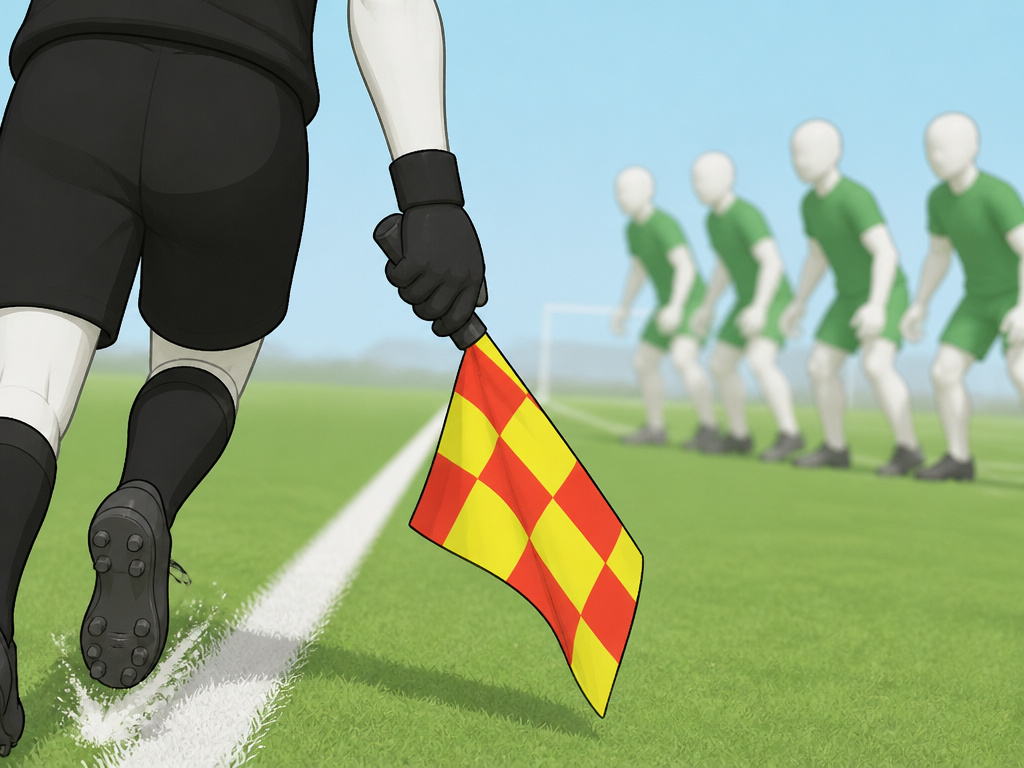
That clean-goal run is worth watching live. The flag hangs at the AR’s side, boots thudding along the chalk, and the sprint itself is the signal. Next time you’re in the ground, look for it before the celebration finishes.
Goal kicks follow a strict order:
- Check the ball is inside the goal area first. Skip this and a misplaced ball goes unchallenged, with the restart taken from the wrong spot.
- If it’s wrong, stay put, make eye contact and raise the flag. Moving off first risks the referee restarting before seeing the problem.
- Once it’s placed correctly, move to the offside line. Stay on the goal line and a quick long kick leaves the AR out of line for the first offside call.
With an additional assistant referee (an extra official behind the goal line), the jobs split. The AR goes straight to the offside line, and the AAR stands where the goal line meets the goal area to check the ball’s placement.
Small things matter in communication too. For disciplinary issues, IFAB says eye contact plus a discreet hand signal from the AR can be enough, which is why the subtle referee hand signals are worth learning alongside the big ones. The flag work, from offside to throw-ins, is its own language, and the linesman flag signals cover most of what you’ll see from the stand.
When the two officials need a direct consultation, both face the field. That habit keeps players from overhearing and keeps the officials’ eyes on the pitch, and it’s a neat window into how referees communicate without a microphone. At bigger games, substitutions run through the fourth official, which keeps the AR on the line.
Offside judgement has its own research trail. The FIFA and Belgian assistant referee research indexed on PubMed is one strand of it. I couldn’t get past the page wall to read it properly, so I won’t put words in its mouth.
VAR, AARs and the Penalty-Mark Rule
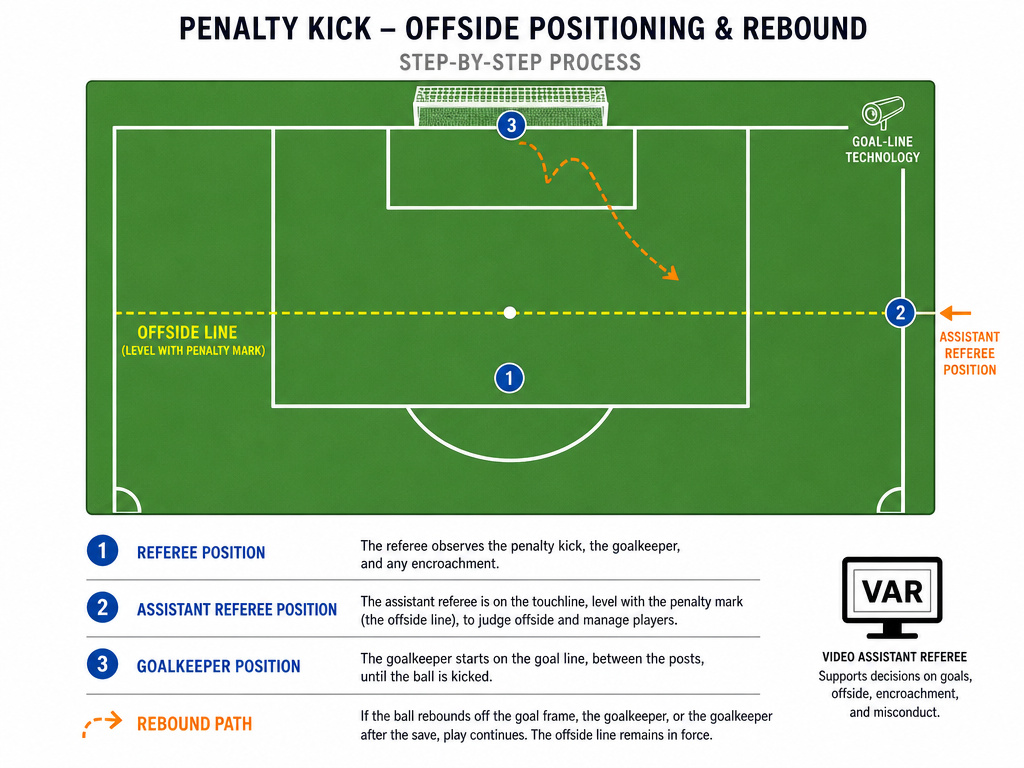
Technology moved the assistant referee further from the goal line on penalties. Sounds backwards.
IFAB’s reasoning is practical. Where goal-line technology (GLT, the system that tells the referee whether the whole ball crossed) or VAR can check goalkeeper encroachment and goal or no goal, the AR stands on the touchline level with the penalty mark. That’s the offside line. Stand on the goal line instead and the AR risks not getting back to judge offside if the kick rebounds.
I like this kind of officiating technology. It answers a yes-or-no question and frees a human to stand where judgement is needed.
VAR works best on factual calls like that. It struggles when it’s asked to settle interpretation, and interpretation still depends on where the referee stood. One habit drives me mad: fans judging a VAR call from the broadcast replay instead of the protocol. The TV camera sits somewhere no official stands.
Mass confrontations get their own plan from IFAB:
- The nearest AR is allowed onto the field to help the referee.
- The other AR stays out and observes and records details of the incident, which matters later when reports get written and nobody agrees on who threw the first shove.
- The fourth official stays near the technical areas.
The part nobody mentions: A quick free kick right next to the touchline can stall. If the AR steps on to help set the 9.15 m distance, IFAB says the referee must wait until that AR is back in position before restarting play.
Referee Positioning With One Official or a Youth Crew
Five staffing options, ranked from standard to last resort. The U.S. Soccer Referee Committee lists them in order: three Federation referees at the top, then mixes of Federation referees and club linesmen, and finally a lone referee when nobody else is available.
That bottom rung changes everything. With no lead AR, the main reason for the wide diagonal disappears, because there’s no flag to keep in view. A lone referee still wants the outside of play and a clear angle, but offside calls come from wherever they happen to be. (On my muddy Sunday mornings, that was rarely anywhere useful.)
With club linesmen tied to the teams, I’d lean on my own angle more and the flags less. That’s my opinion, not a rule. Anyone refereeing youth football will face some version of this every season.
The same mistakes show up at every level:
- Ball-watching. IFAB is clear that what needs seeing isn’t always near the ball.
- Straight-lining, which means standing directly behind a challenge so one player hides the contact. It’s the “insight” failure from the 2021 study.
- Parking in the middle of play.
- Losing the lead AR by drifting inside, so the flag goes up and nobody sees it for a beat.
- Arriving late because the legs went in the second half, which is why referee fitness is a positioning issue as much as a fitness one.
If you can’t see both the contact and your lead assistant in one look, move outward before you move closer.
One more grassroots thought. A youth match is where a young referee learns shape and angles, the same way it’s where young players should learn the game rather than chase wins.
Seen Letters Like R, U and LJ? That’s American Football
Wrong sport, but an easy mix-up. American football crews give each official a lettered position, such as Referee (R), Umpire (U) and Line Judge (LJ), each with its own zone on the field.
Association football works differently. One referee roams, two assistants patrol the touchlines, and bigger matches add a fourth official, AARs and VAR. When someone asks about “referee positions” in soccer, they mean where that one roaming referee stands, which is everything above.
How do referees read the game and anticipate what happens next?
Good positioning starts before the ball arrives. The IFAB says what needs to be seen is not always near the ball, so a referee who only follows the ball is usually a step late. Look at where the attackers are drifting, which defenders are out of shape, and whether a long switch of play is coming. Then move toward the spot where the next contact will happen, not the one where the last one did.
Match information feeds this. The IFAB wants recommended positions adjusted using what the referee knows about the teams, the players and the events in the match. A side that likes to counter quickly needs a referee who starts moving early. A team that sends every set piece into the box needs a referee who picks a clear angle before the delivery.
Stay close enough to see play without getting in its way, and keep the lead assistant in your field of vision. Treat the diagram as a starting point and the game in front of you as the real instruction.
Frequently Asked Questions
What is the proper positioning for a referee in football?
IFAB defines the best position as the one from which the referee can make the correct decision. In practice that means a wide diagonal, staying towards the outside of play, with play and the lead assistant referee in view. The referee should be close enough to see without interfering.
What are the different referee positions in football?
Association football has one referee, two assistant referees on the touchlines, and at higher levels a fourth official, additional assistant referees and VAR. The lettered positions like R, U and LJ belong to American football, where each official has a fixed zone.
Does a referee have to run the left diagonal?
No. Ask A Soccer Referee says the bottom-right-to-upper-left run is the “standard” one from the Law book diagrams, but no rule prevents running the other. Penn researchers in 2010 suggested choosing one and not switching at half-time, because direction of play affected foul calls in their study.
How far should a referee be from play?
The sources disagree. The FA (UK) says never more than 20 m, a 2021 study of 42 penalty situations found the best results under 10 m, and IFAB gives no figure at all. That study also found the angle mattered at least as much as distance.
What does a referee position mean?
It means the spot on the pitch the referee chooses in order to see an incident clearly. IFAB treats its diagrams as flexible areas rather than exact spots, adjusted for the teams, players and events in the match.
Before You Go
Here’s the threshold I’d use. The moment a referee can’t see both the challenge and the lead assistant in one look, they’ve lost the position, whatever the distance reads. Move out first, then in.
Fair enough to admit that the distance and angle numbers here rest on a small, qualitative study of 42 incidents, and the direction-bias work used images rather than live matches. Strong hints, honest limits.
This weekend, try watching the referee instead of the ball for one half. You’ll see referee positioning in football explained better by a single referee’s feet than by any diagram.
So who’s right on half-time: the referee who keeps one diagonal all match, or the one who switches?
