
Assistant Referee Flag Signals Explained
This post contains affiliate links. As an Amazon Associate, we earn from qualifying purchases.
Assistant referee flag signals explained in one line: a raised flag means the assistant has seen something the referee needs to act on, and the next movement tells you what. IFAB says the flag goes up in the right hand for offside and for the ball crossing the goal line, and a clear goal gets no flag at all.
That next movement carries the actual decision. A point toward one goal, a short waggle, a walk toward the corner flag, a jog up the touchline. Each one means something different, and the referee can still overrule any of it.
What follows is a one-glance chart of every common signal and the offside sequence step by step. After that come the two goal procedures that look like opposites, and the spots where IFAB and US Soccer guidance still pull in different directions.
Key Takeaways
- The offside flag goes up in the right hand first. It points to where the offence happened only after the whistle, and it stays up until the referee sees it or the defenders clearly have the ball.
- A clear goal gets no flag at all: eye contact, then a 25-30 metre run toward the halfway line.
- In the Premier League, assistants hold the flag on tight calls during a clear attack and let VAR check later. A clearly offside player is still meant to be flagged.
- IFAB and US Soccer disagree on switching hands and on how to show a penalty-area foul.
- Discreet hand signals only count if they were agreed before kick-off.
What Does Each Assistant Referee Flag Signal Mean?
Every signal starts the same way. The assistant stops running, faces the field, catches the referee’s eye and lifts the flag. IFAB, the body that writes football’s laws, wants that lift deliberate, never hasty or exaggerated, with the flag working like an extension of the arm.
The assistant referee’s flag must always be unfurled and visible to the referee, and it’s carried in the hand closest to the referee. For offside and for a ball that wholly crosses the goal line, IFAB guidance says to raise it in the right hand. If the next signal needs the other hand, the flag switches hands below the waist.
An unfurled flag matters more than it sounds. On a wet, windy afternoon a flag wrapped around its stick looks like a bare pole from the far side of the pitch. A referee who can’t see it can’t act on it.
Simple point. Easy to forget.
Here’s the quick reference. I’ve added a source column, because some of these signals are written down by IFAB and some are just long-standing practice you’ll find in most manuals.
| Situation | What the flag does | Where it comes from |
|---|---|---|
| Offside | Right hand up, then points far, middle or near | IFAB; USSF (2008) |
| Ball out over goal line | Right hand up; can skip if obvious | IFAB |
| Throw-in | Up, then points the way the throwing team attacks | IFAB same-hand rule |
| Corner kick | Angled down toward the near corner flag | Common manual practice |
| Goal kick | Points toward the goal area | Common manual practice |
| Foul | Waggle, then points the free-kick direction | IFAB; USSF (2009) |
Throw-ins, Corners and Goal Kicks: Near Side vs Far Side
Distance from the ball decides how much the assistant does. When the ball crosses the goal line far from the assistant, IFAB’s instruction is to make eye contact and follow the referee’s decision. When it’s close, the assistant is the one with the best view, so the flag gives the direction.
Obvious calls don’t need a flag. IFAB says that if a goal kick or corner is clear, no signal is necessary, especially when the referee has already pointed. I like that rule. It keeps the flag meaningful.
For throw-ins, the key is IFAB’s same-hand principle: raise the flag in the hand that will make the next signal. That way the point toward the throwing team’s attacking direction flows straight out of the raise, with no awkward swap above the shoulder.
The Substitution Signal
The substitution signal in most manuals is the flag held flat above the head in both hands, telling the referee a change has been requested. With no fourth official on duty, IFAB sends the assistant to the halfway line to help run the substitution.
The Offside Flag: Up, Hold, Then Point Far, Middle or Near
Three movements, in this order: raise, hold, point. The signal only makes sense once you’re comfortable telling if a player is offside, because the assistant is judging involvement in play as well as position. (My own offside appeals as a Sunday full back were mostly an arm raised in hope.)
- Raise the flag in the right hand. IFAB picks the right hand because it gives the assistant a better line of vision toward the referee. Use the left and the raised arm sits across the view of the play between assistant and referee.
- Hold it until it’s seen. IFAB says the signal stays up until the referee acknowledges it or the defending team is clearly in control of the ball. Drop it early and the referee may never know the offence happened.
- Point to the area once play stops. A 2008 US Soccer answer describes pointing the flag to the far, middle or near side, then moving back in line with the restart spot. Skip this and the free kick gets taken from the wrong place.
- Never drop the flag and sprint upfield. US Soccer was blunt about it: that’s the goal procedure, and it can’t count as an offside signal. Do it after an offside and the referee may think you’ve confirmed a goal.
Easy to miss: The point to far, middle or near comes after the whistle. IFAB’s sequence is raise first, then indicate the area “if the referee stops play,” so pointing early tells the referee where before they’ve decided whether.
I have to be honest about one gap. Diagrams everywhere show the flag angled up for the far side, level for the middle and down for the near side. I couldn’t confirm those angles in the IFAB text I worked from, so check the diagram in your own federation’s Laws before copying them.
Rewind a second. On 26 January 2021, IFAB issued a clarification after Rodri’s challenge on Tyrone Mings in Manchester City against Aston Villa. A player in an offside position who immediately impacts an opponent who has deliberately played the ball should be penalised. The same guidance said Ollie Watkins’ goal against Newcastle on 23 January 2021 was correctly allowed, because he received the ball from Fabian Schar’s deliberate play.
That’s why the assistant waits. The offence depends on what happens after the pass. NISOA, the US college officials’ association, warned in 2009 that an assistant who snaps the flag up too quickly can cause a row when the player who receives the ball turns out to be someone else entirely.
My favourite tip from that NISOA piece is about the back line. Memorise the numbers of the defenders who set your offside line, so you can tell a protesting forward exactly which number played him onside or caught him. I love that. It treats the back four as a unit, which is how the best ones defend.
Why Does the Assistant Sometimes Keep the Flag Down?
Anthony Elanga is in an offside position. The flag stays down, the ball goes across, and Taiwo Awoniyi stretches for it at the back post and hits the upright. That was Nottingham Forest’s draw with Leicester in May 2025. Awoniyi needed urgent abdominal surgery and was placed in an induced coma.
Assistant Sian Massey-Ellis was following guidance, and the Forest manager Nuno said exactly that afterwards. On Sky Sports’ Ref Watch, Dermot Gallagher read her explanation to the Leicester goalkeeper as “he’s not far enough offside, I have to hold my flag.” Gallagher called it a directive rather than the law.
None of this changes the offside rule itself. What changes is when the assistant tells everyone. According to Sky Sports, the delayed flag has been in place in the Premier League since 2021, to stop valid goals being wrongly ruled out by an early flag.
The trouble is that the official bodies and the pundits don’t describe the policy the same way:
- IFAB’s VAR protocol (as relayed by Sky Sports): delaying the flag is “only permissible in a very clear attacking situation,” such as a player about to score or with a clear run toward the opponents’ penalty area.
- The Premier League website (as quoted by PA): keep the flag down where there’s a “clear opportunity to score or very obvious attacking phase and tight judgement for onside/offside.” A clearly offside player still gets the flag.
- PGMOL, the body that runs Premier League refereeing (per Sky Sports): raise it if you’re 100 per cent sure. Any doubt, keep it down.
- NISOA (2009): ‘better late-right than early-wrong’ works in most cases. Call it early when a speedy forward is about to bear down on the goalkeeper.
- Stephen Warnock, on Ref Watch: at three or four yards, get the flag up.
Tight call during a clear attack: the flag stays down and VAR checks it later. Clear offside: the flag goes up, attack or no attack. That’s the Premier League’s own wording, and it’s the line worth remembering.
My take sits with the protocol. VAR is good at factual questions, and an offside position is a factual question. The delay makes sense for the tight ones. Where the system creaks is the judgement of what counts as “tight” in real time, at full sprint. Ola Aina told the Daily Mail he felt Elanga was “miles offside.”
What happened next? PA reported that the PFA would seek observations from IFAB and PGMOL, and that IFAB was likely to consider reviewing the VAR protocol. I couldn’t confirm the outcome of that review in the sources I used, so I won’t pretend to know.
Fouls: The Waggle, the Walk and the Wait
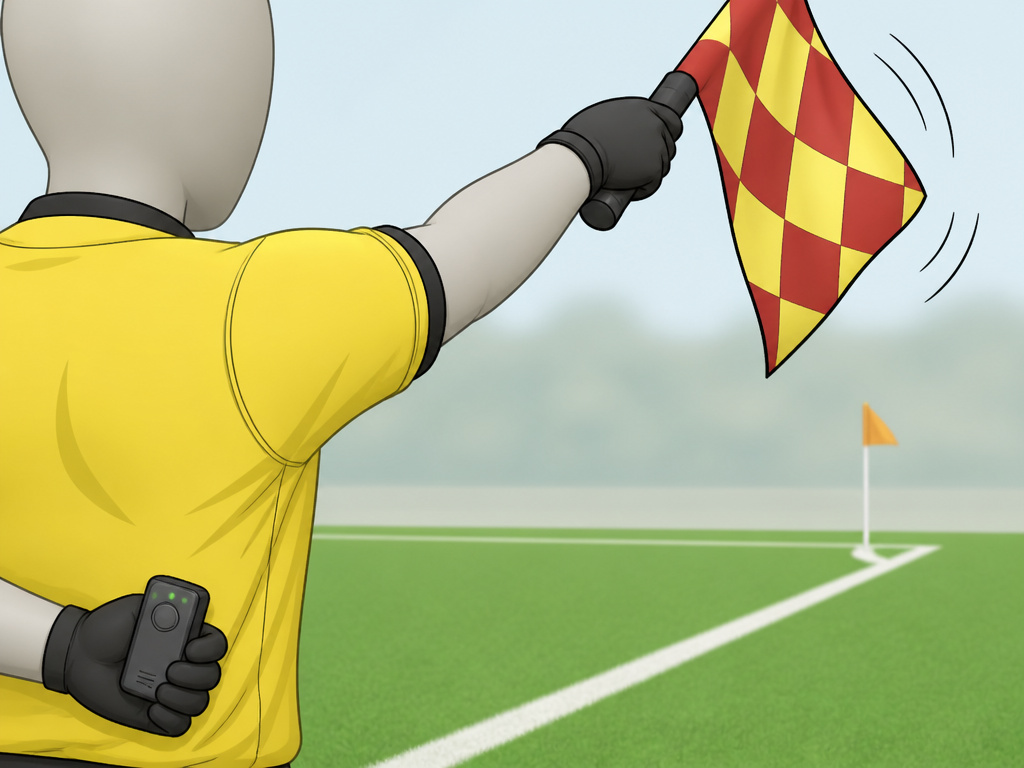
Foul signals ask more of the assistant than any other. IFAB says the flag goes up when a foul or misconduct happens in the assistant’s immediate area or out of the referee’s sight. Everywhere else, the assistant waits and offers an opinion if asked.
When the flag does go up, IFAB wants it raised in the same hand that finishes the signal. That way the referee knows straight away which team gets the free kick. US Soccer’s 2009 guidance describes the next part as waggling the flag to show the foul.
Where this goes sideways: Raising the flag the instant a foul happens near the touchline while the fouled team is still breaking. The flag stops an attack the referee would have let run, and the team you meant to protect loses the advantage on the spot.
That’s IFAB’s “wait and see technique.” The assistant holds the flag down when the fouled team benefits from advantage, which is why IFAB calls eye contact with the referee very important. Raising and lowering the flag in quick succession looks indecisive and helps nobody.
Penalty-area fouls get their own routine. If a defender fouls inside the box out of the referee’s view, IFAB has the assistant make eye contact first. If the referee hasn’t acted, the assistant flags, presses the electronic beep and visibly walks toward the corner flag. Foul just outside the box? The assistant moves clearly along the touchline toward the halfway line instead.
From the stands, the giveaway is the walk rather than the flag. The home end sees the assistant set off toward the corner flag first, and you can hear the noise climb before the whistle goes.
One more foul job. If a free kick is awarded close to the assistant, IFAB allows them to step onto the field and help push players back the full 9.15 m (10 yds). The referee waits until the assistant is back in position before restarting.
Goals Have Two Procedures That Look Like Opposites
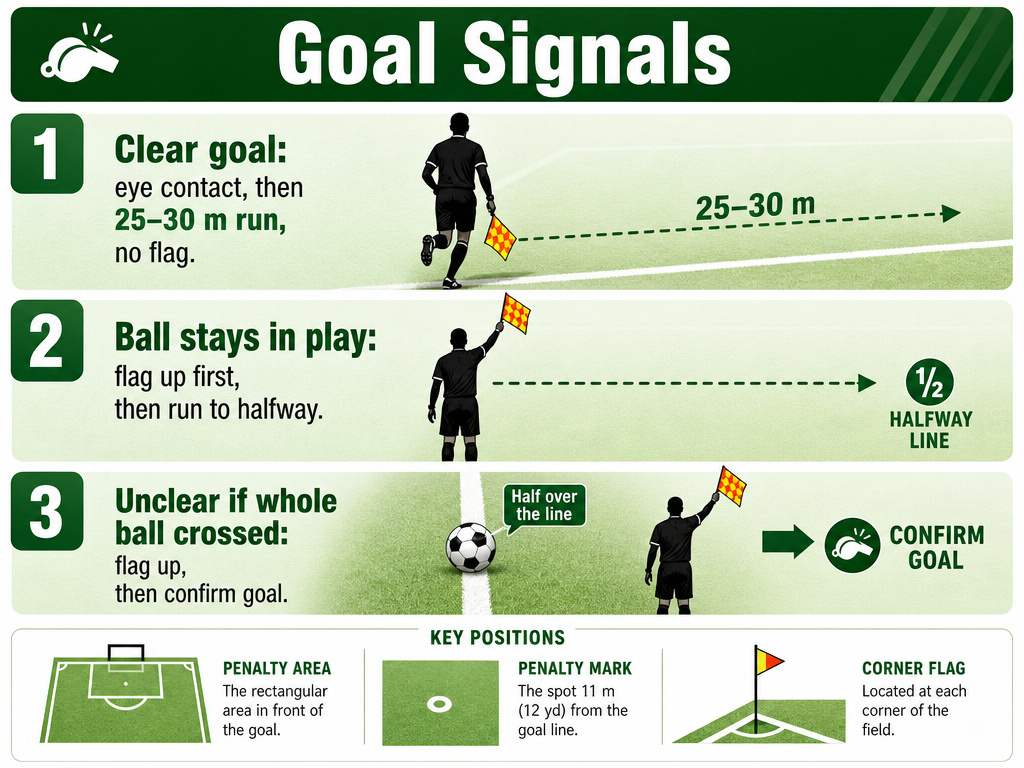
Twenty-five to thirty metres. That’s how far IFAB tells the assistant to run along the touchline toward the halfway line after a clear goal, once eye contact is made. The flag stays down the whole way. I find it the most satisfying signal in the game, because the assistant’s already jogging off before the celebrations have started.
The trouble starts when the goal isn’t obvious. IFAB’s positioning, movement and teamwork guidelines and its signalling guidance cover three cases:
- Clear goal: eye contact, then the 25-30 metre run with no flag.
- Goal scored but the ball seems to stay in play: flag up first to get the referee’s attention, then the normal run toward halfway.
- Unclear whether the whole ball crossed the line: flag up first, then confirm the goal.
So the same flag that’s absent on a clean goal becomes the opening move on a messy one. Fans read that as a disallowed goal more often than they should.
Penalties show how much the technology on site matters. The standard position is where the goal line meets the penalty area. Where goal-line technology or VAR can check the line, IFAB recommends the touchline, level with the penalty mark, because that mark is the offside line. Stand on the goal line and you may not get back in time to judge offside if the kick rebounds.
That shift is a neat example of referee positioning in football changing to suit the tools in the stadium. For corners, IFAB puts the assistant behind the corner flag, in line with the goal line, checking the ball sits in the corner area without getting in the kicker’s way.
Which Hand Holds the Flag? IFAB and US Soccer Still Disagree
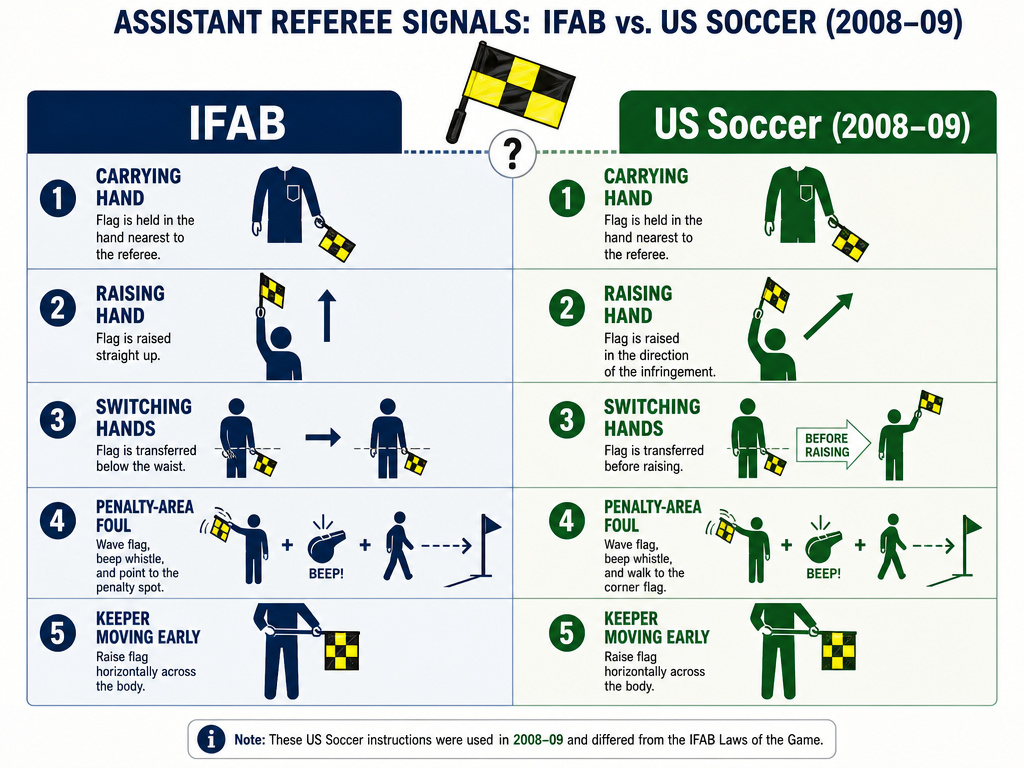
You’d think the hand question was settled decades ago. It’s still argued. According to a 2008 US Soccer answer, IFAB and UEFA have assistants carry the flag in the left hand on the standard diagonal, switching to the right if the restart goes the other way. The flag hangs straight down, not swung while running, and the whole thing reverses if the referee runs a left-hand diagonal.
Since 2007, the same answer says, IFAB guidance has been to raise the flag in the right hand for offside and goal kick signals. US Soccer’s own line was different. Carry the flag in the hand nearer the referee, lift it in whichever hand shows the direction, and do any switching before the flag goes up.
| Issue | IFAB | US Soccer (2008-09 answers) |
|---|---|---|
| Carrying hand | Closest to referee; left on standard diagonal | Hand nearer the referee |
| Raising hand | Right for offside and goal-line calls | Hand that shows the direction |
| Switching hands | Below the waist, if circumstances change | Before the flag goes up |
| Penalty-area foul | Flag, beep, walk toward the corner flag | Waggle, flag across lower body, then move |
| Keeper moving early at a penalty | Different interpretation, per USSF | Lower-body signal, only if it mattered |
That lower-body signal dates from 2009, when US Soccer described it as a change from the previous year. It openly admitted its goalkeeper-movement signal was at odds with the IFAB interpretation.
There’s a weakness in my sources here. These US Soccer positions come from answers dated 2008 and 2009, and I couldn’t pull current US manual text. Treat them as history unless your assignor confirms they still apply. If you’re working through assistant referee training, ask which version your league follows before your first game.
My advice: settle the hand question in the pregame and then stop thinking about it. A clean, deliberate signal in the “wrong” hand beats a fumbled switch at shoulder height.
A referee team works like good joinery. The strength comes from how the three pieces fit together, and the pregame is where you cut the joints. NISOA makes the same point in its own words: hold a thorough pregame discussion about how offside will be managed.
Assistant Referee Flag Signals Explained: Why They Differ From the Referee’s Own
The NFHS 2024-25 signals sheet makes the split between the two jobs plain. Open the 2024-25 NFHS soccer signals PDF and you’ll find referee signals: direct and indirect free kick, corner, penalty, goal kick, caution, goal, timeout, play on. The text I could extract showed no assistant flag signals on that page at all.
That’s the whole relationship in one page. The referee decides, and the assistant informs. The referee hand signals announce a decision to everyone in the ground. The assistant’s flag is a message to one person.
The referee can overrule the flag. A 2009 US Soccer answer quotes the rule that a referee may change a decision, including on an assistant’s advice, only before play restarts. NISOA adds a sensible habit. If the referee waves off an offside flag (say, the goalkeeper has collected the ball easily), they should say why, loudly enough for players to hear.
Beep Flags, Radios and Discreet Hand Signals
The beep matters as much as the flag at higher levels. IFAB’s penalty-area foul procedure includes the electronic beep, and additional assistant referees (the extra officials stationed on the goal line) use a radio system instead of flags. If the radio fails, they fall back on an electronic beep flagstick.
IFAB’s guidelines on body language, communication and whistle say obvious hand signals should be avoided. A discreet one can help, but only if its meaning was agreed in the pre-match discussion. That’s a big part of how referees communicate during a match: most of the language is settled before anyone kicks a ball.
For a face-to-face chat, IFAB allows the assistant to step 2-3 metres onto the field, with both officials facing the play. In a mass confrontation, the nearest assistant may go in to help. The other one watches and records details.
Not the Same as an NFL Penalty Flag
A soccer assistant never throws the flag. In American football, an official tosses a yellow flag onto the field to mark a foul. The soccer flag stays in the assistant’s hand and asks the referee to look.
Frequently Asked Questions
What are the flag signals for an assistant referee?
The main ones cover offside, ball out of play (throw-in, corner, goal kick), fouls, substitutions and goals. Offside is a right-hand raise followed by a point to the area of the offence. A clear goal is shown by the assistant running toward the halfway line with the flag down.
What flags do assistant referees use?
Assistants carry a plain flag, and at higher levels it’s often fitted with an electronic beep that alerts the referee. IFAB’s penalty-area foul procedure includes using that beep. Additional assistant referees on the goal line use radios instead, with a beep flagstick as backup.
What does it mean when the flag goes up but play continues?
Either the referee has chosen to overrule it or hasn’t seen it yet. IFAB tells the assistant to keep an offside flag up until it’s acknowledged or the defenders clearly have the ball. The referee can wave it away, and NISOA advises saying why out loud.
Do youth and high school assistant referees use the same signals?
Mostly, but the details vary by federation. US Soccer guidance has differed from IFAB on switching hands and on the penalty-area foul signal. NFHS publishes its own signals sheet for US high school soccer, so check your league’s manual and agree the details in the pregame.
Why didn’t the assistant flag an obvious offside straight away?
Under the VAR protocol, assistants keep the flag down on tight calls during a clear attack so a wrongly disallowed goal can’t happen. The Premier League’s wording says a clearly offside player should still be flagged. The Awoniyi injury in May 2025 put that line under heavy scrutiny.
Before You Go
One thing to try at your next match: after a goal, watch the assistant instead of the scorer. Flag down and jogging toward halfway means the goal stands. Flag up first means something needs checking. You’ll know before the stadium does.
My stance on the delayed flag is less popular with pundits. I’d keep it. The wording already says clear offsides get flagged, and it’s the in-the-moment judgement of “tight” versus “clear” that needs work, not the policy itself. A full scrap would bring back the old problem the protocol was built to fix, with forwards flagged when replays later showed they were onside.
One honest limit on all of the above: the US Soccer material here is more than fifteen years old, and the assistant referee flag signals explained in your league’s current manual outrank anything I’ve written. Every match leaves a clue, and the touchline is where the assistant referee’s flag shows it.
So, would you rather see the flag go up early and risk a wrongly ruled-out goal, or stay down and risk another Awoniyi?
