
How to Become an Assistant Referee: Step-by-Step
This post contains affiliate links. As an Amazon Associate, we earn from qualifying purchases.
How to become an assistant referee starts with a formal course, not just knowing the rules. You must complete a certified entry-level program, pass a fitness test, register with your national or state federation, and then start working games under the guidance of an assignor. The exact path, including minimum age and required experience for progression, varies between countries and governing bodies.
The core of the job isn’t the big calls. It’s the hundreds of small, correct decisions about the ball being in or out, and holding a perfect line for offside. That takes a specific kind of discipline, one that’s trained, assessed, and revalidated every single year, which is central to the question of how to become an assistant referee.
What follows is the map for how to become an assistant referee: the official course prerequisites from Football Australia and U.S. Soccer, the mandatory yearly revalidation that catches people out, the gear you actually need, and the on-pitch mechanics that separate a competent AR from a confused one.
Key Takeaways
- Start with your national or state federation’s entry-level course (often called JFMO or Grade 8); the minimum age is usually 13 or 16, depending on the level.
- Yearly revalidation is mandatory and requires 30 CPD points from a Laws of the Game update, a quiz, and a tutorial, miss it and your qualification lapses.
- Your primary duty is tracking the second-last defender for offside; official guides state you must check their position at least once every ten seconds, even during active play.
- Positioning is essential: stay in line with that defender. Sources disagree on what to do if all defenders push into the attacking half: the Southern Soccer Referees Association states the AR remains at the halfway line, while anecdotal advice similarly advises never passing the halfway line.
- Getting games requires proactive contact with a local referee assignor; certification alone doesn’t guarantee assignments.
The 7-Step Certification Pathway (From Course to Pitch)
Forget the idea of just turning up with a flag. Every federation has a structured, bureaucratic path. It’s designed to ensure a baseline of competency and safety. Here’s how it works, step by step, using Football Australia’s M-REF 3.0 framework as a clear example.
Step 1: Find Your Governing Body and Course.
Your first stop is the website of your national football federation (like Football Australia, The FA, or U.S. Soccer) or your state/regional referee association. Look for “Become a Referee” or “Match Official Courses.” You’re looking for the entry-level offering, often called the Junior Football Match Official (JFMO) or Senior Football Match Official (SFMO) course.
Step 2: Meet the Prerequisites.
You can’t just sign up. For the JFMO course, Football Australia requires you to have successfully completed the current year’s Laws of the Game update. For the SFMO course, you must already hold a current JFMO qualification and be competent at that level. The minimum age for JFMO is 13 years; for SFMO, it’s 16 years.
Step 3: Complete the Course.
These are almost always hybrid: online modules followed by a mandatory face-to-face field session. The online part covers the Laws; the field session is where you learn basic positioning, flag signals, and how to move.
Step 4: Register and Pay Fees.
After passing the course, you must register as a match official with the federation for the current season. This involves a membership fee, which often includes insurance coverage. This step makes you “active” in the system.
Step 5: Get Your Gear.
You’ll need an official uniform (shirt, shorts, socks), footwear, and an assistant referee flag. Don’t buy the cheapest flag, it will fall apart. More on the specific kit list later.
Step 6: Contact an Assignor.
This is the step new referees miss. Certification doesn’t magically get you games. You need to find and introduce yourself to the local referee assignor, the person who appoints officials to fixtures. Email them, express your availability, and attend any local referee meetings.
Step 7: Work Your First Games.
You’ll likely start with youth matches as a club assistant, where the pressure is lower. Your job here is to apply your training, make clear signals, and nail your positioning. Treat every game as a learning session.
The pathway from beginner to higher levels is competency-based. According to Football Australia’s M-REF 3.0 document, to progress to the ‘Assistant Referee’ component, a candidate must hold a valid Emerging Education qualification and a current SFMO qualification with at least one year of active, competent experience at that level.
Official Prerequisites: Age, Experience, and the Yearly Grind
The rules on paper are precise. They’re not suggestions. Ignoring them is how you spend a season qualified but unable to move up, or worse, let your accreditation expire.
| Qualification | Minimum Age | Pre-requisite Experience | Yearly Revalidation |
|---|---|---|---|
| Junior Football Match Official (JFMO) | 13 years | Current Laws of the Game (LOTG) update | 30 CPD points |
| Senior Football Match Official (SFMO) | 16 years | Current JFMO qualification + competency | 30 CPD points |
| Community Referee Coach – Junior (CRC-J) | 16 years | Current JFMO + 2 years active experience | 30 CPD points |
| Assistant Referee (Emerging) | 17 years (Football Australia) | Current SFMO + 1 year active experience | Varies by level |
The age requirement is a hard floor. Notice the jump for the Assistant Referee component itself: Football Australia sets it at 17, while the U.S. Soccer Federation requires applicants to be 21 years of age or older for national certification. Compare that to the U.S. Soccer Federation’s pathway for National certification, where applicants must be 21 years of age or older. This is a major point of variation, always check your own federation’s current year documents.
The yearly revalidation is the trap. It’s not optional CPD; it’s mandatory for keeping your qualification current. For JFMO, SFMO, and coach levels, Football Australia requires 30 CPD points each season, earned through a Laws of the Game Update (10pts), a Revalidation Quiz (10pts), and a Tutorial (10pts).
Where this goes sideways: Assuming your qualification is forever once you have it. Football Australia’s policy is clear: if your account shows no activity for one full season, it moves into a two-year “extended maintenance” period, after which the qualification expires. Stay active, complete the revalidation package.
Essential Gear Checklist: What You Actually Need to Buy
You can know every law, but if you show up in the wrong kit or with a flimsy flag, you’ve lost credibility before kick-off. Here’s the shopping list, in priority order.
- Assistant Referee Flag. This is your tool. Avoid toy-like versions. Look for a sturdy, vinyl flag with a solid plastic handle. The flag should be bright red, yellow, or a checkerboard pattern, as specified by your league.
- Official Uniform. This almost always means a colour-coordinated shirt, shorts, and socks. The brand and colour will be dictated by your local association. Start with a black kit; it’s the most common.
- Footwear. Football boots (cleats) or turf shoes are essential for traction on grass. For artificial surfaces, turf shoes or quality running trainers are acceptable. They must be predominantly black.
- Watch and Notebook. A reliable stopwatch (or two) for timing the match. A small notebook and pen for recording goals, cautions, and substitutions.
- Bag. A dedicated gear bag to keep everything organized and dry.
Hold off on buying communication equipment (budget earpieces) until you’re working at a level that requires it. For your first few seasons, clear verbal and visual signals are your communication system.
Mastering the Basics: Positioning, Signals, and That “Second-Last Defender”
This is where the course ends and the real craft begins. The manuals are surprisingly specific about mechanics that most beginner guides gloss over.
Your Prime Directive: The Offside Line.
Your most important, ongoing duty is to track the second-last defender (usually the last outfield defender, unless the goalkeeper is ahead of them). The Southern Soccer Referees Association guide is blunt: you must not forget to check this position, and you should check at least once every ten seconds even during active play. Even when play is active near your sideline, you should check at least once every ten seconds.
Positioning Disagreement – Where Do You Stand?
Here’s a conflict you’ll find between sources. The Southern Soccer guide states: “If all defenders enter the attacking half of the field, the AR remains at the halfway line.” A common anecdotal tip from experienced ARs echoes the Southern Soccer Referees Association guidance: you never pass the halfway line. You plant at the centre line until a defender drops back. However, always defer to your pre-match briefing from the referee. They may have a different preference.
Flag Mechanics – It’s in the Details.
How you hold and signal with the flag communicates professionalism. Key points from official guides:
- Default Carry: When moving along the sideline, keep the flag in the hand closest to the field (towards the referee). This keeps it visible.
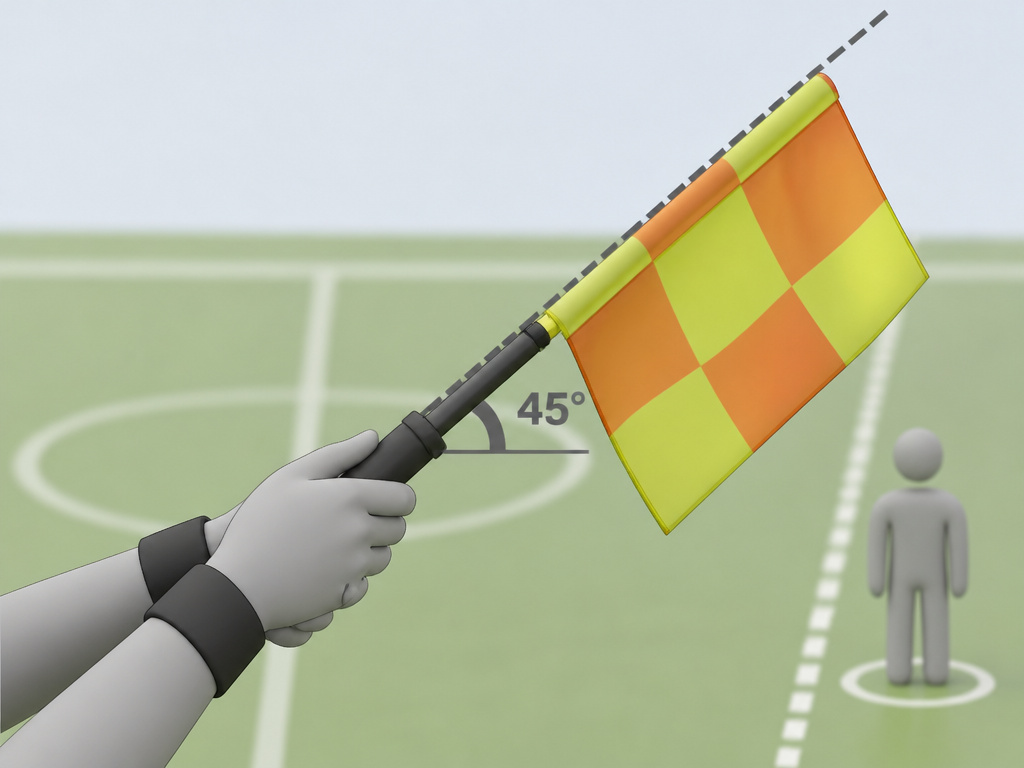
- Corner Kick Signal: Always point the flag at a 45-degree angle to the ground. Don’t point directly at the corner flag from a distance, it can look like a goal kick signal.
- Ball Back In Play: Anytime the ball returns to the field after being fully out, raise the flag straight up (vertical) until the referee acknowledges you, then signal the direction of the restart.
Common mistake: Swinging your arm while running with the flag. It looks amateurish. Hold the flag steady in your hand closest to the pitch and let your other arm do the running motion.
These technical specifics are what a good assistant referee positioning guide breaks down, and they’re the difference between looking like you belong on the line and looking like you’re just holding a flag.
Getting Your First Games and Building Experience
You’re certified, kitted up, and you’ve practiced your signals. Now you need matches. This is a sales and networking exercise as much as a sporting one.
Find the Assignor.
Your local referee association will have a Referee Appointments Officer or Assignor. Get their contact details from the association website or at a meeting. Send a concise, professional email: introduce yourself, state your new qualification level, attach your availability, and express enthusiasm for any assignments, starting with youth games.
Embrace the Lower Levels.
Your first assignments will likely be as a club assistant on youth games or in lower-tier adult leagues. This is perfect. The pace is slower, the stakes are lower, and you can focus on your mechanics without intense pressure. View every match as a training session where the outcome matters less than your own performance.
Seek Feedback.
After the game, ask the referee for one piece of feedback. A simple “What’s one thing I could do better next time?” shows initiative and accelerates your learning. If your association has a mentor system, use it.
The Fitness Gatekeeper.
As you progress, fitness becomes a formal barrier. For higher national certifications, you must pass a rigorous fitness test as specified by that federation. Even at grassroots levels, your referee fitness dictates how well you can maintain position and focus for 90 minutes. Start conditioning early. AR work involves explosive sideways shuffles and sprints to keep the line.
This early career phase is also where you learn to deal with abuse. It happens, even on the line. Learning to tune out sideline noise, report serious misconduct through the referee, and manage your own emotional response is a critical, unglamorous skill.
Frequently Asked Questions
How much do assistant referees get paid?
Pay varies wildly by country, league level, and age group. In many grassroots youth leagues, payment is a small match fee. Professional league ARs receive compensation as determined by their league. Always confirm the fee with the assignor before accepting a game.
Is the assistant referee test hard?
The “test” is usually the combination of passing the online laws exam and demonstrating competency in the practical field session. The laws exam is straightforward if you study the materials. The practical assessment is where people struggle, it tests your ability to apply the laws in real-time movement and positioning. Focus on your flag mechanics and offside line.
What is the best way to learn assistant referee signals?
Study your federation’s official guide, then practice physically. Stand in your garden or living room and run through the signals for offside, throw-in, goal kick, corner kick, and substitution until they become muscle memory. Watch professional games and focus solely on the ARs.
Can you become an assistant referee without being a referee?
Yes, absolutely. Many federations offer dedicated assistant referee courses or modules within the broader referee pathway. Your training will focus on line duties, flag signals, and communication with the referee, not on managing the entire field of play. The progression through referee levels can happen separately.
Before You Go
The path to becoming an assistant referee is more structured than most people think, but the initial hurdles are low. The real challenge isn’t passing the course; it’s the yearly discipline of revalidation and the on-field precision of holding a line for ninety minutes.
One rule that reframes the entire endeavour: your job isn’t to be invisible. It’s to be so predictably, boringly correct in your positioning and signals that the only time anyone notices you is when you raise the flag. Everything else is just keeping up.
Start with your local federation’s website today. Find the next available entry-level course date. That’s the first and only step that matters right now. The rest, the gear, the first game, the moment you correctly flag a tight offside, follows from that.
