
Football Referee Levels Explained: The Official FA Pathway
This post contains affiliate links. As an Amazon Associate, we earn from qualifying purchases.
Football referee levels in England are defined by The Football Association across a 14-tier operational pathway, ranging from Trainee Referee (Level T) to FIFA Referee (Level 1). Promotion requires a combination of match experience, observed assessments, fitness tests, and written exams, with the system shifting from optional advancement in the grassroots game to a mandatory, merit-based climb in the semi-professional tiers.
That structure is the official map. But if you’ve ever tried to look it up, you’ve probably found three different numbering systems that don’t quite match. One FA document lists 8 governance levels. Another shows 14 operational tiers. Wikipedia describes 13. They’re all technically correct, but each serves a different purpose: one for rules, one for day-to-day appointments, and one for public explanation. Understanding football referee levels explained can help clarify these differences.
What follows is a walk through the pathway as it actually works, the games you’ll officiate, the 71.5 average observation mark you need to hit, and the point where the ladder stops being something you choose to climb and starts climbing for you.
Key Takeaways
- The FA’s operational pathway has 14 tiers, from Level T (Trainee) to Level 1 (FIFA). Upon qualifying, referees aged 16+ start at Level 7, while 14-15 year olds begin as Youth Referees.
- Promotion for grassroots levels (Y1-Y2, 7-6, 6-5) is optional with four annual windows (Oct, Dec, Feb, Apr). From Level 4 upward, promotion is mandatory and merit-based, using club and observer marks.
- The jump to Level 4 requires a punishing fitness test: 40 repetitions of a 75m sprint (≤17s) and 25m walk (≤22s), plus four 40m sprints each under 6.20 seconds.
- Observer marks are critical. For promotion to Level 4 or the Women’s National League, you need a minimum average mark of 71.5 across multiple assessments.
- The pathway splits into Men’s, Women’s, and Assistant Referee streams after Level 3, with The FA directly appointing officials to competitions like the FA Women’s National League.
The 14-Tier Operational Pathway
Start from the touchline and work up. The clearest view of the English system comes from The FA’s own “Overview of English Refereeing” document. It outlines 14 operational tiers that correspond to specific leagues and responsibilities. This isn’t about prestige; it’s a practical guide to where you’ll be appointed.
Here’s the core structure for the men’s game:
| Level | Title | Typical Appointments |
|---|---|---|
| 1 | FIFA Referee | Internationals (FIFA/UEFA), English Premier League |
| 1 | Select Group Referee | English Premier League |
| 1 | Select Group 2 Referee | EFL Championship |
| 1 | National List Referee | EFL Leagues 1 & 2 |
| 2a | Panel Select Referee | National League (Step 1 of NLS) |
| 2b | Panel Referee | National League North/South (Step 2 of NLS) |
| 3 | Contributory League Referee | Steps 3 & 4 of the National League System (NLS) |
| 4 | Supply League Referee | Steps 5 & 6 of the NLS |
| 5 | Senior County Referee | Step 7 of the NLS & Senior County Football |
| 6 | County Referee | County League Football |
| 7 | Junior Referee | County League Football |
| Y | Youth Referee | Youth Football (U15 and below) |
| T | Trainee Referee | Undergoing the FA Referees Course |
| D | Referee Developer | Non-active role as Coach, Mentor, Observer, Tutor |
This operational pathway is your practical map. It tells you that a Level 4 referee is appointed to Steps 5 and 6 of the National League System, while a Level 7 referee starts in local County League football. The titles are job descriptions.
Notice Level 1 has four sub-categories. FIFA, Select Group, Select Group 2, National List. They’re all Level 1, but they denote different panels within the professional game managed by the PGMOL (Professional Game Match Officials Limited). This granularity matters for appointments. It also shows why simply “reaching Level 1” isn’t the end of the journey.
The women’s game runs on a parallel, integrated pathway with its own designations like Women’s National Referee (3W). The FA directly appoints these 3W referees and the newer 3W Assistant Referees to fixtures in the FA Women’s National League. The principles of promotion are the same, but the competitions are distinct.
Where the Confusion Comes From: 8, 14, or 13 Levels?
You read that right. Depending on which FA document you pick up, you’ll get a different number. This is the single biggest point of confusion for anyone trying to understand the football referee levels explained.
The FA’s official Rules of the Association (Section 23) lists governance levels including International, 1, 2, 3, 4, 5a, 5b, 5c, Y1/Y2, and D. This is the regulatory framework, the “law of the land” for administration.
The 14-tier operational pathway we just outlined is the day-to-day reality. It’s how referees are categorized for appointments. Then there’s the common public explanation, like the Wikipedia article on English football refereeing, which describes a 13-level system (10 through 1, plus three elite levels). That’s a simplified, descriptive model for the football referee levels explained.
They’re not wrong. They’re different lenses. The 8-level system is for rule-making. The 14-tier system is for operations. The 13-level description is for public understanding. When discussing progression, we stick to the operational 14-tier model because it’s what determines your next game.
Starting the Whistle: From Trainee to Level 7
Your entry point is determined by age. Around 4,000 people start their refereeing journey each season by taking The FA Referees Course. While on the course, you’re classified as a Trainee Referee (Level T).
The FA’s overview states that upon completing the FA Referees Course and passing assessments, you become a Level 7 referee, unless you are 14 or 15 and become a Youth Referee. However, another FA source defines a Trainee Referee (Level T) as a candidate undergoing the FA Basic Referee Course. This clears up a common discrepancy where older rules defined a “Trainee” as an ongoing status.
Where this goes sideways: Assuming qualification automatically makes you a “Level 9” or “Trainee” referee indefinitely. The modern pathway moves you immediately to Level 7 (or Y) to start gaining real match experience in County League football.
As a new Level 7, your focus is on managing adult local games. This is where you learn to control the tempo, practice your referee communication signals, and build the match count needed for your first promotion. Your local County FA is your guide here, and starting your path to becoming a football referee with them is the only route.
The Grassroots Climb: Levels 7 to 4

This is where you have control. Promotion through the grassroots levels (Y1-Y2, 7-6, and 6-5) is optional and application-based. The FA’s progression pack states promotion windows for Levels Y1-Y2, 7-6, and 6-5 are at the end of October, December, February, and April. You’re not waiting until May.
The criteria are specific and cumulative. For example, the 2022/23 nomination criteria required:
- Level 7 to 6: 25 refereeing appointments (min. 10 in adult football), 2 online modules, 2 referee developer reports, 1 Laws of the Game test.
- Level 6 to 5: 25 refereeing appointments (min. 15 adult), 5 games as an assistant referee, 4 online modules, 1 face-to-face training session, 2 developer reports, 1 test.
All games must be 9v9 or 11v11 with offside in operation. This period is also where you might explore the specialist assistant referee pathway by getting those required assistant appointments.
The process is supported by Referee Developers (coaches or mentors) who provide feedback. It’s a structured apprenticeship.
The Semi-Professional Gate: The Level 4 Leap
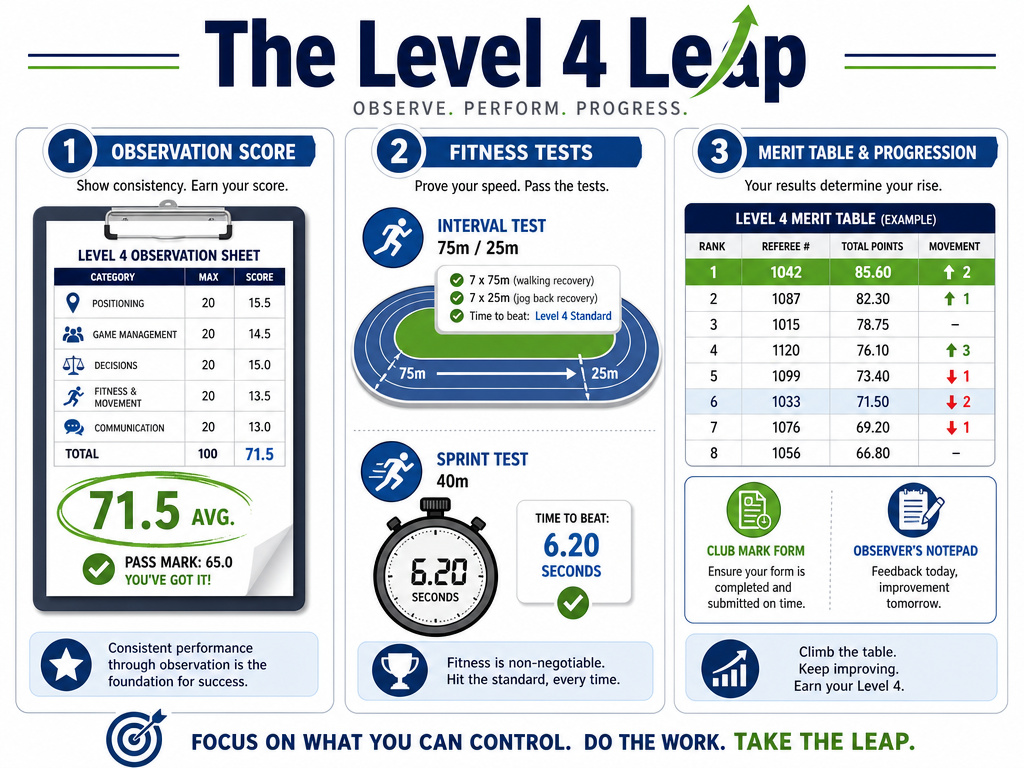
Reaching Level 4 is the single biggest transition in a referee’s career. The FA is explicit: “Upon being promoted to Level 4, promotion is not optional.” You enter a meritocratic system where you are ranked against your peers based on performance.
Your season is built around three pillars: observed assessments, club marks, and a severe fitness test.
The Observation Hurdle
To be nominated for promotion from Level 5 to 4, you must receive a minimum of 4 observations from FA-appointed observers. Your average mark across them must be at least 71.5. The same 71.5 average is required for promotion from Women’s Grassroots Referee to National League Referee (3W), which requires 3 observations. These aren’t pass/fail visits. Every decision, your positioning, and your game management are scored.
The Fitness Barrier
The fitness requirements for Level 5-4 promotion are the most cited physical benchmark. For the Men’s Game Pathway, the test has two parts:
- Interval Test: 40 repetitions of 75m run (max 17 seconds) / 25m walk (max 22 seconds).
- Sprint Test: 4 x 40m sprints, each in ≤ 6.20 seconds.
Fail this, and your promotion stops regardless of your match marks. It’s designed to ensure you can maintain the intensity of the semi-professional game. Preparing for this demands specific training, not just general fitness.
The Merit Table
Once you’re in the Level 4-3 pool, you’re judged on a merit table that combines club marks and observer marks. After each match, competing clubs file a “Club Report on Match Referee,” giving a mark out of 100. If the mark is 60 or less, or any category is marked “disappointing,” they must provide detailed constructive comments. This report must be returned within 48 hours.
Your season-end ranking in this combined table dictates promotion, retention, or demotion. The game becomes about consistent, measurable performance.
Specialising and Fast-Tracks
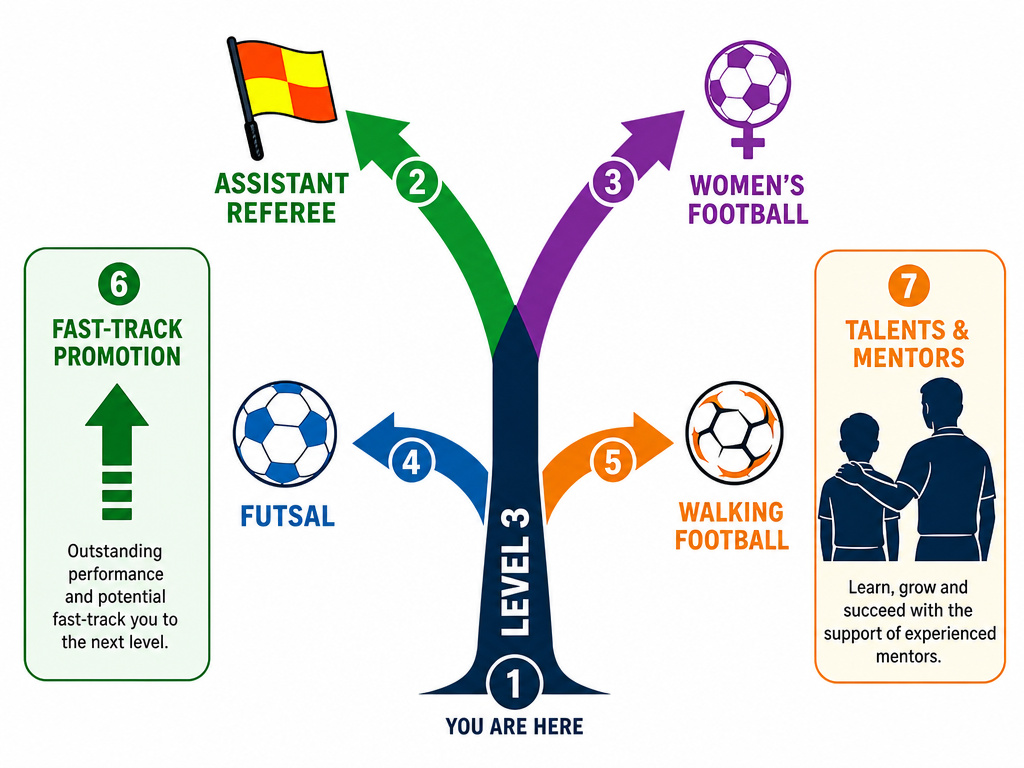
After Level 3, the pathway branches. Officials can specialise as Assistant Referees, mirroring the referee pathway all the way to FIFA. Others may focus on the women’s football pyramid. There are also pathways for Futsal, Disability Football, and Walking Football.
The UEFA Referee Convention also formalises two key development concepts:
- Fast-track promotion: Unusually rapid, potentially mid-season promotion based on excellent performance, a playing background, or other high-potential indicators.
- Talents and mentors programme: A structured programme within each national association that pairs talented referees with experienced mentors at all levels.
These concepts acknowledge that progression isn’t always linear. Exceptional talent, coupled with the right guidance, can accelerate the journey. This is also the stage where dedicated training as a VAR official becomes a possibility for those with the requisite experience and technical understanding.
The Professional Game and The PGMOL
Upon promotion to Level 2a (Panel Select Referee), you enter the professional game and become part of the PGMOL. This body, formed by The FA, the Premier League, and the EFL, manages all appointments, training, and development for the top tiers.
Promotion here is entirely performance-based within the closed PGMOL system. The pinnacle is Level 1, which includes FIFA Referees (international and Premier League), Select Group Referees (Premier League), Select Group 2 Referees (EFL Championship), and National List Referees (EFL Leagues 1 & 2).
How have referee grading systems changed over time?
Official grading systems are not static and evolve to meet the needs of the game. In England, The FA’s operational pathway uses a tiered system including levels 1, 2a, 2b, 3, 4, 5, 6, 7, Y, T, and D. This structure is designed as a practical map for appointments, linking each level to specific leagues like the National League System or youth football. It replaced older, simpler numbering schemes to provide clearer progression and specialization, including separate pathways for the men’s and women’s games. The core principle remains linking a referee’s grade directly to the level of competition they are qualified to officiate, but the modern system offers more granular steps and defined criteria for advancement between each stage.
Frequently Asked Questions
What is a Level 7 referee?
Level 7 referee is the entry point for most newly qualified officials aged 16 and over. They officiate in local County League football (adult and youth games). It’s where you apply the basics from your course, build experience, and work towards your first promotion.
What is the hierarchy of referees in football?
The hierarchy is best understood as the FA’s 14-tier operational pathway. It starts with Trainee (T) and Youth (Y) referees, progresses through County levels (7-5) to Supply League (4) and Contributory League (3) referees in the semi-pro National League System, then to Panel referees (2b, 2a) and finally the Level 1 professional referees on the EFL and Premier League.
How long does it take to become a Premier League referee?
There’s no fixed timeline; it’s a meritocratic climb. Reaching the semi-professional Level 4 requires meeting specific criteria over time, including match experience, observations, and fitness tests. The progression from Level 4 to the Select Group (Premier League) requires sustained elite performance, fitness, and assessment at the highest levels of the game below the Premier League.
Can you skip referee levels?
In some cases, yes. UEFA’s convention also recognises “fast-track promotion” for high-potential officials.
What do referee observers look for?
Observers score referees on a detailed mark sheet that typically covers application of the Laws, match control, fitness & positioning, communication, and personality/management. They provide written feedback on key decisions and overall performance, with the aggregate score determining promotion eligibility.
Before You Go
The pathway isn’t a mystery. It’s a published, if sometimes confusing, set of ladders. The real shift happens at Level 4. Before that, you’re learning the craft and choosing when to step up. After that, the system takes over, and your position is decided by a spreadsheet of marks from clubs and observers.
My advice? Don’t fixate on the level number. Focus on the next set of criteria, the required matches, the fitness standard, the feedback from your next observer. The levels are just mile markers on a very long run. The job is the same at each one: manage the game in front of you, communicate your decisions, and keep up with play. Everything else is just admin.
