
How to Become a Football Referee: Step-by-Step
This post contains affiliate links. As an Amazon Associate, we earn from qualifying purchases.
*To become a football (soccer) referee in the United States, you must be at least 13 years old, register on the U.S. Soccer Learning Center, complete an online course (taking 3-6 hours), pass a background check if 18+, attend a mandatory in-person field session, and pay a course fee.* Your certification is valid for a registration year running from July 1 to June 30.
This process is national in framework but local in execution. The U.S. Soccer Federation sets the minimum standards, but your specific deadlines, field session locations, and exact fees are controlled by your state referee committee. Understanding how to become a football referee requires navigating these local requirements. Missing a local deadline by one day can delay your start by months.
What follows is the real-world walkthrough for how to become a football referee, the specific numbers, the common tripwires, and the state-level variances that generic guides skip. By the end, you’ll know exactly where to click, what to budget, and how long it takes from signing up to blowing your first whistle.
Key Takeaways
- The minimum age is 13, a hard rule enforced at the U.S. Soccer Learning Center account level, the system will not let you proceed if you’re 12.
- Course fees start around $170, not including a uniform kit or a potential $24 domestic background check (required for anyone 18+).
- You must complete all online modules 3 days before your scheduled webinar, miss this deadline and you’re dropped from that session.
- The mandatory in-person field session has geographic constraints; you cannot take an online course from one state association and attend a field day in another without prior planning.
- Certification validity depends on when you qualify: Fall certifications last until the end of the following year, Spring certifications expire at the end of that same year.
The 5-Step Certification Process
Forget vague advice about “contacting your local association.” The path is a locked sequence on a single website: the U.S. Soccer Learning Center. Your state association merely controls the timing and location of one piece.
The Technical Snippet: First-time referee certification requires sequential completion of five modules in the U.S. Soccer Learning Center: account creation & course registration, online learning modules (3-6 hours), a live webinar, an in-person field training session, and final processing. Candidates 18 and older must also complete a background screening and SafeSport training prior to receiving their badge. The entire process is managed digitally, with physical elements only at the field session.
Step 1: Create Your Learning Center Account & Find a Course
Go to the U.S. Soccer Learning Center and create an account. The system will ask for your date of birth. Here is the first hard stop: if you are not yet 13, the platform will not let you proceed. This is a hardened age rule from U.S. Soccer.
Once your account is active, use the “Find a Course” tool. Search for “First Time Referee” courses in your state. Do not enroll in a course run by a state association where you do not live or cannot travel to for the field session. This sounds obvious, but people click the first available slot.
Step 2: The Online Coursework (The 3-6 Hour Window)
The modules cover the Laws of the Game, the “Safe and Healthy Playing Environments” course, and, for those 18+, the mandatory SafeSport training. This isn’t passive video watching; there are knowledge checks throughout.
Common mistake: Assuming the online work has a flexible deadline. The South Carolina committee, for example, requires you to finish all modules three days before your scheduled webinar. Fail to hit that mark, and you are automatically removed from that webinar. You then wait for the next one.
Step 3: Attend the Live Webinar
This is usually a Zoom session. It’s not another lecture on the laws. Instructors use this time for logistics: how to get your uniform, how to connect with local assignors, and how to sign up for the required field session. They’ll also answer specific questions about build-out lines or other local league quirks. It’s your first direct contact with the referee community.
Step 4: The In-Person Field Session
This is the only physical requirement, and it’s absolute. You will not get a badge without it. You’ll practice signals, positioning for a diagonal run, and managing a simulated restart. It feels awkward. Everyone is new.
The critical, under-reported detail is geography. The Eastern NY Soccer Referee Association explicitly states: “if you don’t live in Eastern New York, you should plan to attend a session accordingly before enrolling in the course.” You cannot shop for online courses across state lines without a plan to travel.
Step 5: Final Processing & Getting Your Badge
After the field session, the lead instructor submits your completion. Your badge and official registration are processed. You’ll also get access to RefInsight or another assigning system, and a discount code for a starter uniform kit from a supplier like Official Sports International.
| Step | Key Action | Deadline to Watch |
|---|---|---|
| 1. Account & Enrollment | Create Learning Center account, pay course fee (~$170) | Before course fills |
| 2. Online Modules | Complete 5 modules, SafeSport (if 18+), Laws update | 3 days before webinar (SCRC rule) |
| 3. Live Webinar | Attend Zoom for logistics & assignor connection | As scheduled after module completion |
| 4. Field Session | Attend in-person training, practice signals & movement | Scheduled by state after webinar |
| 5. Badge & Access | Receive badge, assigning system login, uniform code | After field session completion |
Costs, Fees, and What You Actually Pay
The published course fee is just the entry ticket. The Eastern NY Soccer Referee Association lists a new referee course fee of $170. That covers the U.S. Soccer license fee and the state association’s course fee. It does not cover your uniform, whistle, or cards.
For referees 18 and older, add a $24 domestic background check. This is a mandatory, annual cost. The edge case that blows up budgets is the international background check. If you’ve lived abroad, the standard $24 check doesn’t apply. The ENY association notes an international check “may be as high as $150 (typically $70 per country).”
Then there’s the starter kit. A basic uniform package from a supplier like Official Sports International (shorts, two jerseys, socks, flags, bag) is an additional cost. Your total outlay before blowing your first whistle can be significant.
Navigating State-Specific Rules and Deadlines

The national pathway for how to become a football referee is a template. Your state referee committee fills in the dates. This is the single biggest source of confusion and delay.
The South Carolina three-day pre-webinar module deadline is a perfect example of a hard, local rule that doesn’t appear in national materials. Similarly, the Eastern NY association has a final deadline of May 15 to complete all assignments for that cycle.
The registration year itself is a fixed window: July 1 to June 30. When your certification expires depends on when you certified. Fall certifications are valid until the end of the following year. Spring certifications expire at the end of that same year. Mark that date.
Where this goes sideways: Assuming “certified for a year” means 365 days from your field session. It doesn’t. It means until the end of the current or next registration year. A Spring candidate who certifies in April might only have a valid badge for two months before the annual June 30 expiry.
From Grassroots to Regional: The Advancement Path
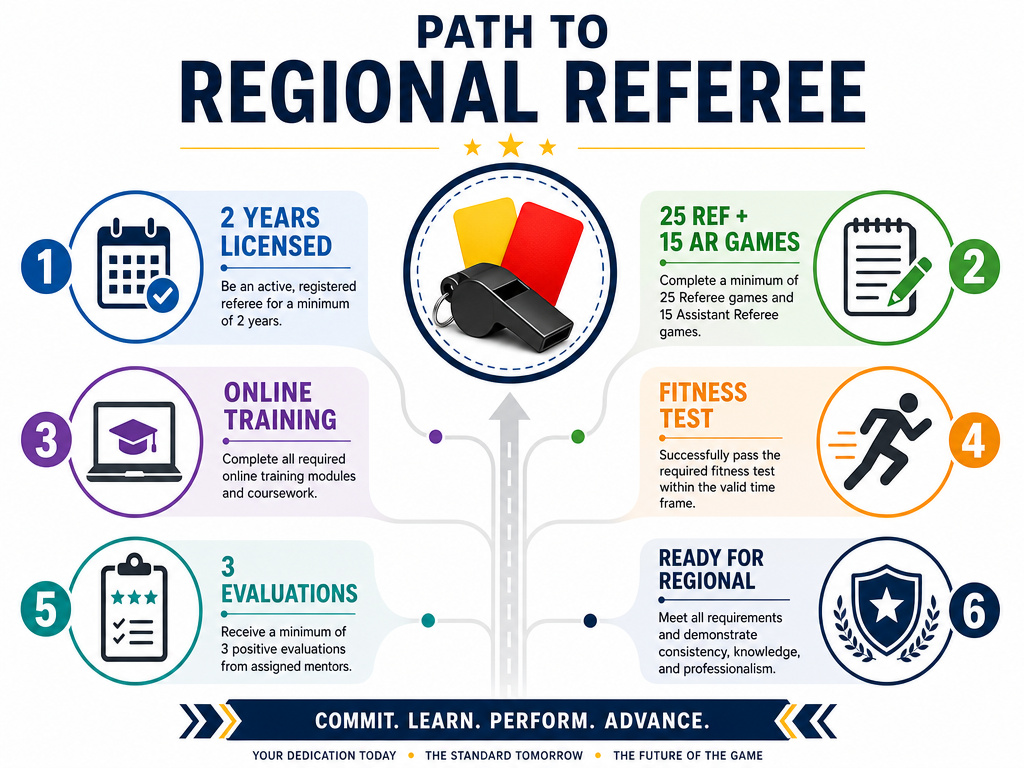
Your first badge allows you to officiate youth and adult amateur games. The next formal step is the Regional Referee grade. This isn’t just “more experience.” The requirements form a concrete wall.
According to the U.S. Soccer Federation’s 2025 pathway document, to become a first-time Regional Referee you must:
- Be at least 18 years old.
- Have held a Referee license for each of the two previous registration years.
- Have 25 games as a referee and 15 as an assistant referee at the adult amateur level.
- Complete Regional Referee online training and in-person field training.
- Pass the Regional fitness test (the FIFA Women’s Referee Test: Male candidates must meet Category 1, female candidates Category 3).
- Obtain a minimum of three passing evaluations within the previous year: two at the adult amateur level, one at the highest youth level (U18/U19).
The fitness test is the gatekeeper. It’s a series of sprint/interval tests that measure repeatable high-intensity running, the kind you do tracking a counter-attack. This is where many good grassroots referees stop.
If you’re aiming for this path, your game log and fitness become your resume. Start tracking your assignments from day one.
Essential Gear for Your First Season
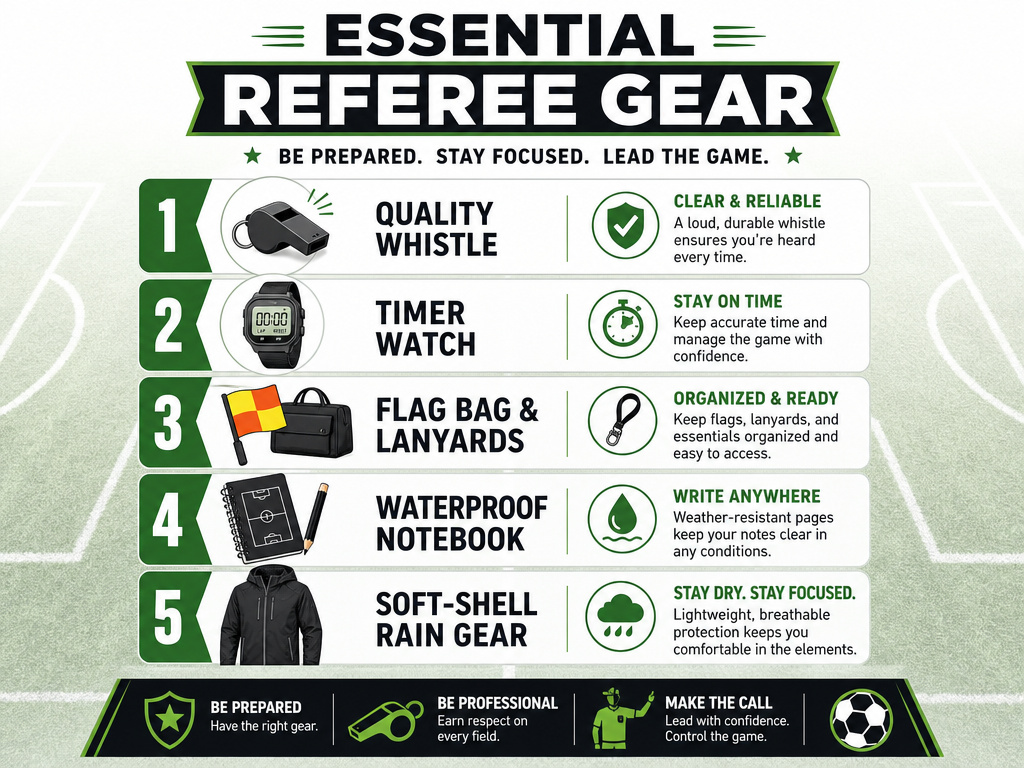
You need more than a whistle. The starter kit gets you on the pitch, but a few extra items save headaches.
- A Fox 40 Classic or Acme Thunderer Whistle: The free one is tinny. Upgrade to a Fox 40 Classic or Acme Thunderer. The sound carries on a windy pitch.
- A Watch with a Countdown Timer: Not your phone. A simple digital watch with a loud beeper for half-time. You’ll be timing substitutions, too.
- Flag Bag & Lanyards: The starter flags often come with basic clips. A dedicated flag bag keeps them neat, and quick-release lanyards prevent tangles.
- A Notebook and Pencil: You think you’ll remember the caution numbers and goals. You won’t. A waterproof notebook is gold.
- Proper Rain Gear: A cheap rain jacket that sounds like a crisp packet with every movement is distracting. A soft-shell jacket is worth the investment.
This isn’t about looking professional. It’s about removing friction. When your gear works without thought, you can focus on the players and the game.
Before You Start: Navigating the Realities
The course teaches you the laws. The field session teaches you the mechanics. Nothing teaches you the Saturday morning reality.
You will make a wrong call. A coach will yell. A parent will question your eyesight. The part nobody talks about is the thirty-second rule: after a controversial moment, the next thirty seconds of game management decide everything. Do you clamp down with technical fouls? Do you use a calm word with the captain? Do you just wave play on? The manual doesn’t say.
Your first ten games will feel like you’re running a marathon while solving a physics equation. Your brain is processing positioning, the offside line, the score, the time, and the temperament of the number 9 who’s been chirping all half. It’s overwhelming. Then, around game eleven, a switch flips. You start to see patterns, not just incidents.
The best referees aren’t the ones who never make mistakes. They’re the ones who manage the game so well that a mistake doesn’t define the match. That’s the real skill, and it’s only learned on the pitch.
How to Find Your Local Referee Association
Your journey starts with the U.S. Soccer Learning Center, the central hub for all certification. However, the practical administration of courses, field sessions, and assignments is handled by your state or local referee association. These bodies set the specific schedule, fees, and deadlines for your area. For instance, the registration year often runs from summer to the following summer, and in-person field sessions are a mandatory requirement. If you don’t live in that specific region, you should plan to attend a session there before enrolling. To find the correct group, search for your state name followed by ‘soccer referee association’ or check the U.S. Soccer Federation’s officiating resources for direct links to these local administrators.
What Are the Benefits of Being a Soccer Referee
Becoming a referee offers more than just a way to earn money on the pitch. It provides a unique leadership role, placing you at the center of the game with the authority to manage play and ensure fairness. The position develops sharp decision-making skills, confidence under pressure, and a deep, practical understanding of the Laws of the Game that surpasses that of a spectator or player. It’s a way to stay actively involved in soccer, contribute to your local community by facilitating youth and adult sports, and can serve as a stepping stone for those interested in advancing through the officiating pathway to higher levels of competition.
Frequently Asked Questions
How long does it take to become a football referee?
From the day you register on the Learning Center to receiving your badge, the timeline depends on how quickly you complete the online modules and the schedule of webinars and field sessions.
How much do football referees get paid?
Game fees vary wildly by location, age group, and competition level. Game fees vary wildly by location, age group, and competition level. Higher-level amateur competitions and tournaments pay more. It’s piecework, not a salary.
How hard is it to become an NFL referee?
This article is about soccer (association football) refereeing. The pathway to become an NFL official is completely separate, exceptionally competitive, and typically requires 10+ years of officiating experience at the collegiate level before even being considered for the NFL’s development program.
What if I need an international background check?
If you’ve lived outside the U.S. For a significant period, you will likely need an international background check. Contact your state referee administrator before you pay for the domestic check. The fee is separate and significantly higher, the Eastern NY association notes it can be as high as $150.
Can I referee if I wear glasses or contacts?
Yes. Many referees wear glasses or contacts. If you choose glasses, consider a sports strap to keep them secure. Your vision must be correctable to a standard that allows you to see play clearly from your positioning; there is no specific visual acuity standard published by U.S. Soccer for grassroots referees.
Do I have to referee every weekend?
No. You are an independent contractor. You accept or decline assignments through the assigning software based on your availability. Most assignors appreciate knowing your regular availability (e.g., “Saturdays only”).
The Bottom Line
Start with your state. Before you dream of a World Cup final, find your state soccer referee committee’s website. Read their specific guide, like the Eastern NY Soccer Referee Association guide or the South Carolina Referee Committee page. Their deadlines and field session locations are the real schedule you must follow.
The initial investment includes the course fee, background check, and uniform costs. The return is a front-row seat to the game, a way to stay involved, and a surprisingly deep lesson in pressure and decision-making. You won’t remember the easy games. You’ll remember the one where you kept control after a bad call, when the game could have tipped into chaos. That’s the skill that transfers everywhere.
Your first assignment will likely be a U10 match on a muddy pitch. The parents will be louder than the players. Go blow the whistle.
