
Offside Rule in Football Explained: A Simple 3-Step Check
This post contains affiliate links. As an Amazon Associate, we earn from qualifying purchases.
Offside rule in football explained in one breath: a player is in an offside position when any part of their head, body or feet is nearer the opponents’ goal line than both the ball and the second-last opponent. Standing there is legal. The offence comes only when that player plays the ball or affects an opponent.
The phrase “second-last opponent” does the heavy lifting. When the goalkeeper is the last opponent, the second-last is the deepest outfield defender, and that defender moves the line every time the defence steps up or drops off. That’s why a broadcast replay can fool you. The line only exists at the instant the pass is played.
What follows: a three-step check you can run from the terrace, the exceptions that switch offside off, the deliberate-play call that settles close ones, what the technology does and doesn’t decide, and the debate over scrapping the rule.
Key Takeaways
- Offside position is fixed at the moment a team-mate plays the ball. An opponent’s touch doesn’t count.
- Hands and arms never count, and the armpit line marks where the arm ends for this purpose.
- Goal kicks, throw-ins and corners are exempt restarts for the receiver. The corner taker can still be caught on a return pass.
- The punishment is an indirect free kick to the defending team, taken where the offence happened.
- A defender’s deliberate play wipes out the offence. A mere deflection doesn’t.
What Actually Puts a Player in an Offside Position?
The offside position test looks at three reference points: the player, the ball and the second-last opponent. Everything else is noise.
An offside position exists when any part of a player’s head, body or feet lies in the opponents’ half and nearer the goal line than both the ball and the second-last opponent. Hands and arms are excluded for every player, goalkeepers included, with the arm’s upper boundary set in line with the bottom of the armpit.
That second sentence is the one I’d tattoo on every fan’s forearm (arms don’t count, so it’s a safe spot). I think the armpit line is the best-kept detail in IFAB’s Law 11 text.
Which Body Parts Count
- Head, body and feet all count. A nose or a boot toe past the line is enough.
- Hands and arms are ignored for everyone.
- A player whose only part beyond the halfway line is an extended arm isn’t in an offside position at all.
- A player with nothing in the opponents’ half, not even a toe, can’t be in an offside position, even when nearer the goal line than the ball and second-last opponent.
Counting Defenders Without Getting Fooled
Count opponents, not shirts. The goalkeeper is one opponent, so the line sits at the deepest outfield defender when the keeper is last. If the keeper wanders upfield, a different defender can become the second-last.
Posture doesn’t matter either. An injured defender lying beside the goal line still counts, as long as he’s on the field.
And “nearer” means strictly nearer. A player level with the second-last opponent isn’t nearer, so the position isn’t offside.
Offside Rule in Football Explained as a 3-Step Check
Picture a long ball dropping over the defence. The whole stand holds its breath, and the flag either rises or stays down.
I once explained a pressing system in so much jargon that a reader told me they were lost. Since then I test every explanation with one question: could a casual fan follow each line? So here’s offside the casual-fan way.
- Freeze the pass. Pause at the instant a team-mate plays the ball. Judge a later moment, such as when the receiver controls it, and you’ll flag perfectly legal runs, because position is fixed when the ball is played.
- Draw the line. Imagine a line across the pitch at the second-last opponent, then check the ball too. Skip the ball and you’ll clear a player who is nearer the goal line than the ball, which is half the test.
- Ask what the player did next. Only playing the ball or affecting an opponent is an offence. Flag mere standing and you’ll punish players the Law leaves alone.
If you can’t say where the ball was when the pass left the foot, you can’t call the offside.
The Playground Version
Think of a restaurant kitchen. A cook can stand by the pass all night without trouble. Trouble starts when that cook grabs a plate that isn’t theirs.
Standing past the line is standing by the pass. Grabbing the plate is touching the ball, blocking the keeper or crowding a defender. Kids get that in ten seconds.
Where this goes sideways: Judging by where the receiver finishes. A runner who ends up beside the keeper can have started level with the defence, and calling it at the finish line flags a legal goal.
Three Restarts Where Nobody Can Be Offside
Three restarts never produce an offence for the player who receives the ball directly: the goal kick, the throw-in and the corner kick. The Law leaves no room for offside from a throw-in, a goal kick or a corner.
Picture the corner: attackers jostling at the near post, no whistle, no flag, the keeper shoved off his line. Legal, all of it.
| Restart | Offside for the receiver? | Catch to know |
|---|---|---|
| Goal kick | No | Applies to direct reception only |
| Throw-in | No | Still fine after a defender’s deflection |
| Corner kick | No | The taker can be caught on a return pass |
| Free kick | Yes | Playing it directly from offside is an offence |
| Dropped ball | Yes | Not an exempt restart |
The table is the shortest answer to when a player cannot be offside, though not the only one. A player standing entirely in their own half is also clear, and so is a player who receives the ball from an opponent who deliberately played it.
The dropped ball surprises people (me included). A team-mate’s long pass after a dropped ball, then a further pass to a player in an offside position, is an offence.
Easy to miss: The corner taker isn’t protected after the corner is taken. If a team-mate passes back and the taker plays it from an offside position, the defending team gets an indirect free kick.
Active Play: Three Ways Standing Offside Becomes an Offence
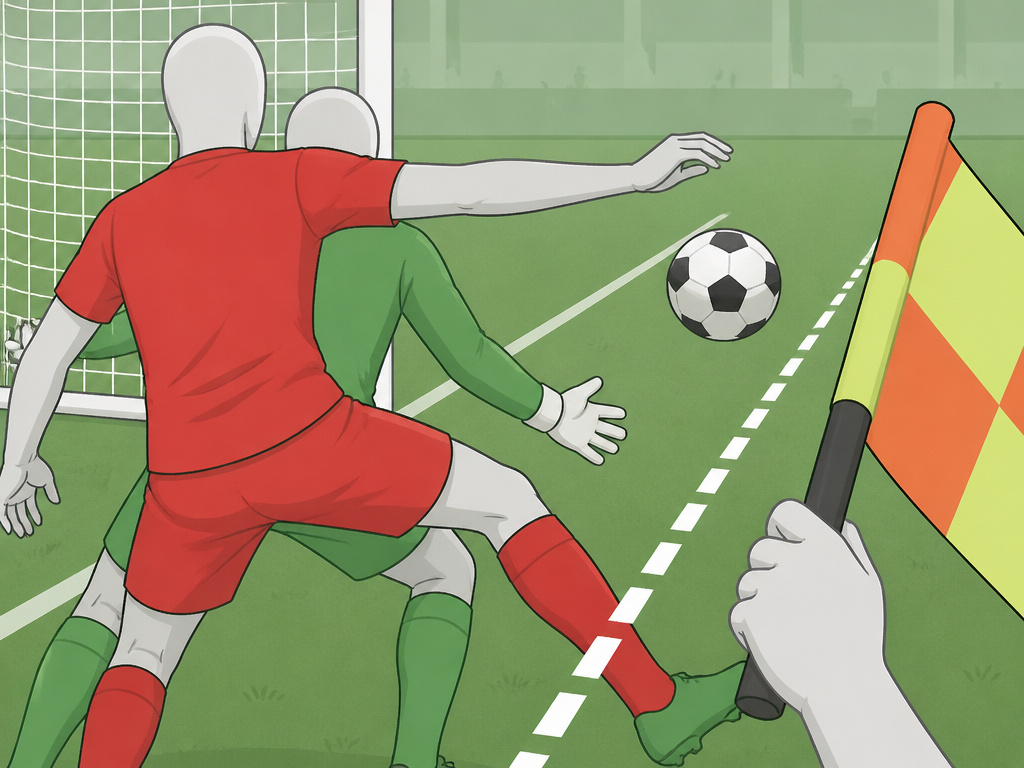
Three things turn a harmless position into an offence:
- Playing the ball. Touching a ball a team-mate passed or touched. Receive a free kick directly from an offside position and play it, and you’re caught.
- Affecting an opponent. Blocking the goalkeeper’s line of vision counts. So does clearly trying to play a close ball and putting a defender or the keeper off, even without a touch.
- Gaining an advantage. The ball comes back to the offside player off a post, the crossbar or a goalkeeper’s save. Indirect free kick, even though the player did nothing to cause the bounce.
The Law groups the first two as interfering with play or with an opponent.
Running toward the ball without playing it, and without affecting anyone, is not an offence. An offside-position player can also challenge a defender who has gained clear control and moved with the ball.
What Happens After the Flag
The restart is an indirect free kick to the defending team, taken where the offence occurred. That spot can be in the offender’s own half. If the offender received the ball inside the goal area, the kick can be taken anywhere in that area.
An indirect free kick can’t score directly. Kick one straight into the opponents’ goal and the restart is a goal kick.
Offside Versus Fouls: Which Comes First
Whichever offence comes first is penalised. If both happen together, the foul wins because it’s more serious. A foul on an offside-position attacker before he plays the ball or challenges anyone is a foul, penalty kick included.
If the attacker plays the ball first, offside wins, and the foul becomes an indirect free kick instead of a penalty. A defender also can’t be cautioned for stopping a promising attack when the attacker was offside.
Deliberate Play or Deflection? The Call That Decides Close Ones
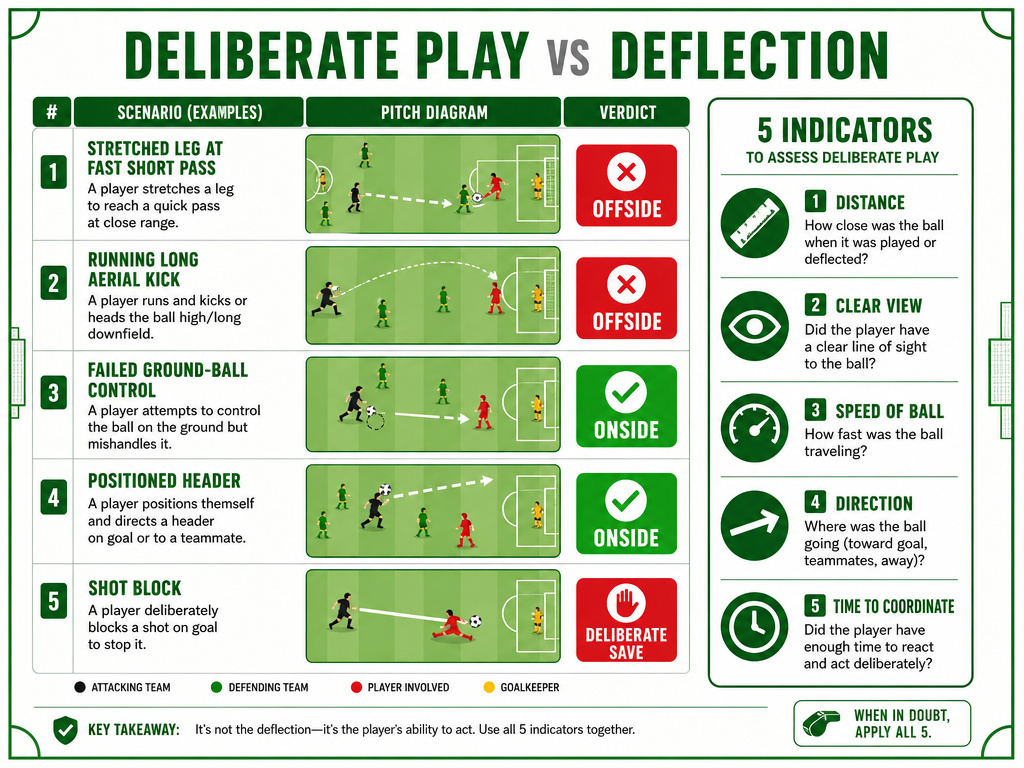
I rate this the most underrated corner of Law 11. A player in an offside position who receives the ball from an opponent who deliberately plays it, including by deliberate handball, hasn’t gained an advantage. The exception is a deliberate save.
A “save” means stopping, or trying to stop, a ball going into or very close to the goal. A defender intercepting a pass isn’t making a save.
IFAB’s Circular 26 (27 July 2022) clarified the guidelines without changing the Law. Its indicators are distance, a clear view of the ball, slow ball speed, expected direction and time to coordinate the body. A ground ball is easier to play than an air ball, and a failed pass or clearance still counts as deliberate play.
| Defender’s touch | Offside player penalised? | Why |
|---|---|---|
| Stretches a leg at a fast, short pass | Yes | No control, no time to coordinate |
| Runs and kicks a long ball in the air | Yes | Running, no time to coordinate |
| Anticipates a ground ball, fails to control it | No | Failed attempt is still deliberate |
| Heads a long ball after positioning | No | Had time, so in control |
| Blocks a shot heading for goal | Yes | Deliberate save exception |
The reason is simple. A reflex touch hands the attacker a free ball he didn’t earn, while a planned touch means the defender made a choice and owns the consequence.
ESPN coverage of controversial offside goals argued that Mbappe’s Nations League goal would now be offside, because Garcia’s stretch was instinctive. IFAB’s own announcement issued general guidelines only and made no ruling on that incident. So that one is an opinion, not a precedent.
The part nobody mentions: Deliberate play doesn’t wash away interference. PGMOL guidance from 26 January 2021 says an offside player who impacts an opponent who has deliberately played the ball commits an offence. Rodri’s challenge on Tyrone Mings was penalised. Ollie Watkins after Fabian Schar’s deliberate play (Villa v Newcastle, 23 January 2021) was not.
Playing the Line: How Attackers Dodge Offside and Defenders Set Traps
Standing level with the defence is the beginner’s answer to offside. The better trick is to start behind the line and arrive in front of it. Because the position is judged when the ball is played, a runner who accelerates as the pass leaves the boot can finish a yard clear and still be onside.
I’ll say it plainly: the attackers I enjoy most don’t just beat the line, they bend it. A feint, a check back toward the ball, and the defender steps up a beat early. That’s craft, and it only exists because the rule does.
For attackers working on timing your runs the habits are few:
- Start from level or behind, and go as the pass is released.
- Stay level with or behind the ball when it’s played forward.
- Remember that a defender’s deliberate touch puts you back onside.
For defenders, the offside trap means stepping up together as the pass is played, leaving the receiver nearer the goal line than the second-last opponent. It’s a restaurant line: one cook slipping on timing ruins every plate. One defender who stays back becomes the new second-last opponent, and the whole trap collapses.
Defenders also need to watch their own touches. A deliberate play by a trapped defender can put the attacker back onside, so a lazy poke can undo the work of the other three.
Who Makes the Call? Assistant Referees, VAR and Semi-Automated Offside
The assistant referee signals the offence with the flag, and the referee then stops play and awards the free kick. For judgement calls, such as whether an offside player interfered, the referee decides.
Technology changed how fast the position gets checked. FIFA’s own explainer says that with semi-automated offside technology, VARs only validate an automatically selected kick point and an automatically drawn line, which takes a few seconds. FIFA’s explainer on its offside technology adds that complex scenarios can still need a longer review.
The stadium still goes through its ritual: a long held breath while the lines go on, then a second roar.
What the Machine Decides
The system flags only an attacker who was offside when the ball was played and then receives it. Whether an offside player interfered with an opponent stays with the referee.
It draws the line at the second-last defender’s closest body part that can legitimately score a goal. If the ball is nearer the goal line, the ball defines the line. In very tight cases, VARs check the exact first touch using sensor data from inside the ball, where available. If VARs disagree, they can pick the kick point manually, and if the system fails they fall back on crosshairs and triangulation.
FIFA says its Qatar 2022 system used 12 cameras tracking up to 29 data points per player 50 times a second, with a 500 Hz ball sensor. Those are FIFA’s own figures and haven’t been independently checked.
The Premier League went live with its version on 12 April 2025, at Matchweek 32, after a live trial in the FA Cup fifth round. It was built with Genius Sports. I wouldn’t assume it tracks the same 29 points. The only source I found for that is a single unconfirmed Spanish report.
The 5 cm Wrinkle
Reports say the Premier League has applied about 5 cm of tolerance in the attacker’s favour since 2021-22, created by drawing thicker broadcast lines, and that it stayed after the new system arrived. Gamereactor reports that Florian Wirtz’s goal for Liverpool against Fulham on 4 January 2026 was given after a VAR check, and the Key Match Incidents panel backed it, citing the thicker lines.
The same report says La Liga, the Bundesliga and Ligue 1 use stricter systems that would have ruled that goal out. It doesn’t say how those leagues set tolerance, so I won’t either.
A 2020 proposal for a 10 cm margin would have let 9 of the 25 goals ruled out by VAR that season stand, according to PGMOL’s Mike Riley. It was never adopted.
Human error still happens. PGMOL called the VAR handling of Luis Diaz’s goal in Spurs 2-1 Liverpool a “significant human error”. The VAR believed the on-field decision was a goal, so the offside flag stayed, and the protocol didn’t allow stepping back in once play restarted. The audio was published after Liverpool asked for it.
Why Does the Offside Rule Exist, and Could Daylight Replace It?
Ever wondered what football looks like with no line at all? Marco van Basten, FIFA’s technical director from 2016 to 2018, campaigned to abolish offside, pointing to field hockey, which dropped it in 1998. My own picture is strikers parked beside the keeper waiting for a long ball. The rule exists to make attackers earn the space.
A Short History, With the Gaps Showing
The history of the offside rule has more dates than anyone agrees on. Here is where my sources split:
- Early laws: The Conversation says the 1866 version made a player onside if three opponents were between him and goal, or he was behind the ball. Another source I found says the 1863 FA law banned forward passes in the opponents’ half.
- “Level is onside”: The Conversation dates it vaguely to the 1990s. A Spanish source pins it to IFAB in 1990.
- Body parts: The Conversation dates the rule that only parts able to legally play the ball count to 2005.
- The 1925 change: The Conversation says too many games ended scoreless. A secondary source gives English Football League goals rising from 4,700 in 1924-25 to 6,373 the next season.
Check exact years against the IFAB archive before quoting any of them.
The Daylight Trial
The Canadian Premier League began a “daylight” offside trial on 4 April 2026. After 11 matches, Inside World Football reported that non-penalty set-piece goals rose from 0.54 to 0.73 per game, and set-piece shots from 1.65 to 2.27 per game. Set-piece expected goals were 0.92 per match. A corner goal by Alejandro Diaz for Pacific FC against Halifax would have been disallowed under the normal law.
I found no data from later in the season, so treat those as early numbers. I also lean on my eyes more than on models, so weigh my reading accordingly. Even so, the set-piece jump looks real.
The wording isn’t settled either.
| Version | Source | Rule in short |
|---|---|---|
| Wenger’s proposal | The Conversation | Onside if any scoring body part is level |
| CPL trial | Inside World Football | Onside unless a visible gap separates attacker and last defender |
| Floated compromise | Source unclear | Offside only if the torso is beyond the defender |
Changing the Law needs six of IFAB’s eight votes, and FIFA holds four, so FIFA plus two British associations is the practical route. That corrects coverage saying two of the four British associations are enough. IFAB’s Circular 32 records that the 140th AGM in Hensol, Wales, on 28 February 2026 agreed offside trials will continue. No offside law change is listed.
My lean is against changing it. The contest between runner and line is half the fun, and I’d rather see that survive.
Frequently Asked Questions
What is the offside rule in football in simple terms?
Player is in an offside position if any part of the head, body or feet is in the opponents’ half and nearer their goal line than both the ball and the second-last opponent. That’s judged when a team-mate plays the ball. The player is only penalised for then playing the ball or affecting an opponent.
How do you explain offside to a kid?
Say the last two defenders are holding a rope across the pitch. When the pass is kicked, anyone past the rope in the other team’s half has to stay out of the play. Standing there is fine. Grabbing the ball or bumping a defender is not.
Can a player be offside without touching the ball?
Yes. An offside-position player who clearly obstructs the goalkeeper’s line of vision, or clearly tries to play a close ball and puts a defender or the keeper off, commits an offence without touching it. The restart is an indirect free kick to the defending team.
Can you be offside in your own half?
No. A player with no part of the head, body or feet in the opponents’ half isn’t in an offside position, even if nearer their goal line than the ball and second-last opponent.
What is the stupidest rule in football?
The complaint is usually about marginal calls, where a toe or shoulder decides a goal. Defenders of the rule say it stops goal-hanging, and the daylight trial shows how much even a small change moves set-piece numbers. Van Basten wanted it scrapped, so the argument is old and unsettled.
Before You Go
You now have the offside rule in football explained as three questions: when was the ball played, where was the line, and what did the player do next. Everything else, from the corner-taker catch to deliberate play, is a refinement of those three.
Here’s a first step for this week. The next time a goal is chalked off, ignore the replay of the receiver and find the instant the pass left the foot. Draw the line there. Then ask whether the player did anything.
One concession: the law text I used came from IFAB’s current online page, which offers both the 2025/26 and 2026/27 editions. Circular 32 lists no offside law change, only continuing trials, and the 2026/27 Laws are on IFAB’s app from 1 July 2026. Check the edition before you argue with a mate.
Am I right? Probably (and yes, I was wrong about it last week too).
