
Offside Trap in Football Explained: How It Works and Fails
This post contains affiliate links. As an Amazon Associate, we earn from qualifying purchases.
The offside trap in football is a defensive tactic: the back line steps up together just before a pass is played, leaving an attacker nearer the goal line than the second-last opponent. Assistant referees misjudged 26.2% of offsides at the 2002 World Cup, so the line is hard to read even for officials.
In the offside trap in football explained here, that second-last opponent is the moving part. A player level with the second-last defender counts as onside, a change dating to 1990, so a back line stepping forward shifts the boundary under the runner’s feet. Time the step to the pass and the runner is stranded. Miss it by a beat and he’s through on goal.
What follows: the trap step by step, where it came from, the Law 11 clauses that break it, how attackers beat it, and what VAR and camera tracking did to it.
Key Takeaways
- A trap can’t work from a goal kick, throw-in or corner, because no offside offence exists there. A free kick is fair game.
- A defender who steps off the pitch to spring it gets a yellow card, and the goal stands.
- A defender’s deliberate play resets offside. A deflection with no control does not, and neither does a deliberate save.
- Barcelona’s trap produced 4.8 offsides per game over 2024-25, but their fast-break goals conceded in La Liga rose from 0.21 to 0.36 per game.
- Wrong flags on onside players made up 86.6% of assistant referee errors in the 2002 World Cup study.
Offside Trap in Football Explained: The Step-by-Step Version
Every trap rests on one fact: offside is judged when the pass is played, not when it lands. The trap exploits that offside rule by moving the defensive line during the gap between the pass being played and the ball arriving.
An offside trap is a coordinated step toward the halfway line by defenders as an opponent passes the ball. Offside position is judged at the moment a team-mate plays the ball, so an attacker caught ahead of the stepped-up line is offside. The punishment is an indirect free kick to the defending team, taken where the offence occurred.
Why does this work? Position is frozen at the instant of the pass. The runner is already moving, and he can’t un-run his position once the ball has left the boot. Right, so here is the sequence:
- Hold a straight line. Defenders set at the same depth. A defender sitting one stride deeper keeps the attacker onside, because level with the second-last opponent is legal.
- Read the passer. Watch the player on the ball. Step when no pass is coming and you’ve handed the runner free grass for nothing.
- Call it and step together. One defender, usually a centre-back, shouts or signals. You hear it before you see it: a hard bark, then studs lifting off the turf at the same instant. Skip the call and one boot stays planted, which puts the whole line back onside.
- Hold, then look to the flag. Stop at the new depth and turn to the assistant referee. Keep drifting backward and you’ve undone the trap yourself.
The Kid-Friendly Version
I once explained a high press with so much jargon that a reader told me they were lost. I rewrote it around one simple image, and I’ll do the same here.
Picture a row of kids holding a skipping rope across the pitch. The striker has to stay behind the rope when the ball is kicked. The rope-holders take a big step forward at the exact moment of the kick. The striker is now ahead of the rope, and the referee blows. Could a casual fan follow every sentence of that? That’s the test.
Three Shapes of Trap
There’s no official list, so this split is my own:
- Step-up trap: the line pushes forward as the pass is played. It’s the one everyone pictures.
- Hold-the-line trap: the line stays put while the runner commits early, so the runner’s own momentum puts him offside.
- Press-triggered trap: pressure on the ball stops the passer looking up, and the line steps with the press.
Step-up versus hold-the-line is a straight contest. The step-up wins when the passer is under pressure and the back line is quick enough to move together. Hold-the-line wins when your defenders are slower than the attackers, because it asks for discipline instead of speed. Mixing them mid-game is how a line gets confused.
Who Invented the Offside Trap, and Why Did the Law Change in 1925?
February 1925, a 0-0 draw at Bury. One Arsenal fan blog calls that match the “final straw” for the three-defender law. The FA then trialled the two-defender version at Highbury, one half under each law.
The origin of the trap itself is disputed. Many credit Newcastle’s Bill McCracken, and the Wikipedia entry on Bill McCracken tells that version. The Woolwich Arsenal blog says Notts County full-backs Morley and Montgomery started it and McCracken perfected it. Even his Newcastle exit date varies by source, 1923 or 1924.
Goals after the 1925 change are just as murky. One source says First Division goals rose 42.3%, another says about 35%, and others say they “doubled”. I couldn’t verify the original data behind any of them, so treat all three as claims, not facts.
The rule history from The Conversation (University of East London) shows how often the line moved:
- 1863: first FA offside law
- 1866: the three-player rule
- 1873: offside judged when the ball is played
- 1903: “interfering with play” added
- 1925: two players instead of three
- 1990: level counts as onside
- 2005: only body parts that can legally score count
Each change made the trap harder to spring or easier to beat. That is where the story really lives.
The Law 11 Details That Decide Whether a Trap Works
Restarts kill the trap before it starts. There is no offside offence when a player receives the ball directly from a goal kick, throw-in or corner kick. A free kick is different: the receiver can be offside, which is why back lines still step on set pieces.
Defenders can’t cheat the geometry either. A defender who leaves the pitch without permission still counts as standing on the goal line or touchline until the next stoppage, or until the defending team plays the ball toward halfway outside their penalty area.
Where this goes sideways: A defender who deliberately walks off to put an attacker offside is cautioned, and the goal stands. The attacker was never offside, because the defender counts as on the line until the next stoppage.
Here is the part where the rules turn on a technicality.
| Situation | Ruling | Trap works? |
|---|---|---|
| Goal kick, throw-in or corner | No offside offence | No |
| Direct free kick pass | Offside applies | Yes |
| Defender deliberately plays ball | Attacker not penalised | No |
| Defender deflects, no control | Offside still called | Yes |
| Defender saves a shot | Attacker penalised | Yes |
Deliberate play versus deflection decides more trap outcomes than most fans realise. A defender who anticipates a ball from distance and has time to coordinate his body is deemed to have deliberately played it, even if he fluffs it. The attacker is then onside. If the ball comes quickly from a short distance and the defender has no control, offside is still penalised. A save is separate: only stopping a ball going into or very close to the goal counts, and it doesn’t reset offside.
An attacker also isn’t automatically guilty. Merely running toward the ball without affecting an opponent is no offence. He is punished only for interfering with play by playing the ball or impacting a defender. That includes clearly attempting to play a close ball, or blocking the goalkeeper’s line of vision.
And hands don’t count. The upper boundary of the arm sits at the bottom of the armpit, so an outstretched arm can’t give a runner away.
Why Do Assistant Referees Flag Players Who Were Onside?
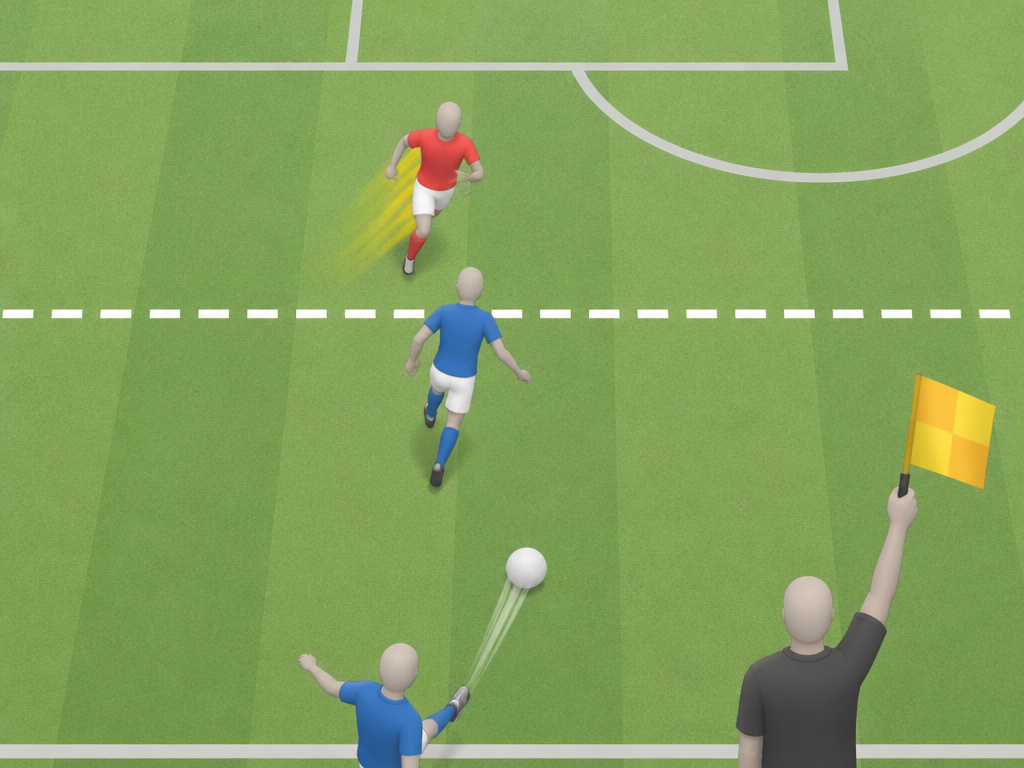
Helsen, Gilis and Weston checked 337 offside decisions across all 64 matches of the 2002 World Cup. They found 26.2% were wrong.
The pattern matters more than the total. Flag errors, flagging a player who was onside, made up 86.6% of mistakes, against 13.4% for failing to flag. Errors peaked in the first 15 minutes at 38.5%. The authors tested whether bad positioning explained it. It didn’t: assistants stood 0.81 m ahead of the line on correct calls and 0.77 m on incorrect ones.
Their explanation is the flash-lag effect, where the eye places a moving object further ahead than its real position at a given instant. In plain terms, a sprinting runner looks closer to the goal than he is. The Helsen, Gilis and Weston offside research is peer-reviewed, though I only worked from the abstract.
I’m not a numbers person, so these figures stay with the study and I won’t extrapolate. A defence that steps up creates a fast-moving picture for the assistant to judge. Whether that raises errors is my guess, not their finding.
At home, the fix is easy. To judge an offside position, freeze the replay at the instant the pass leaves the boot, not at the moment of the touch.
Not the broadcast angle. The moment of the pass.
How Do Attackers Beat the Trap?
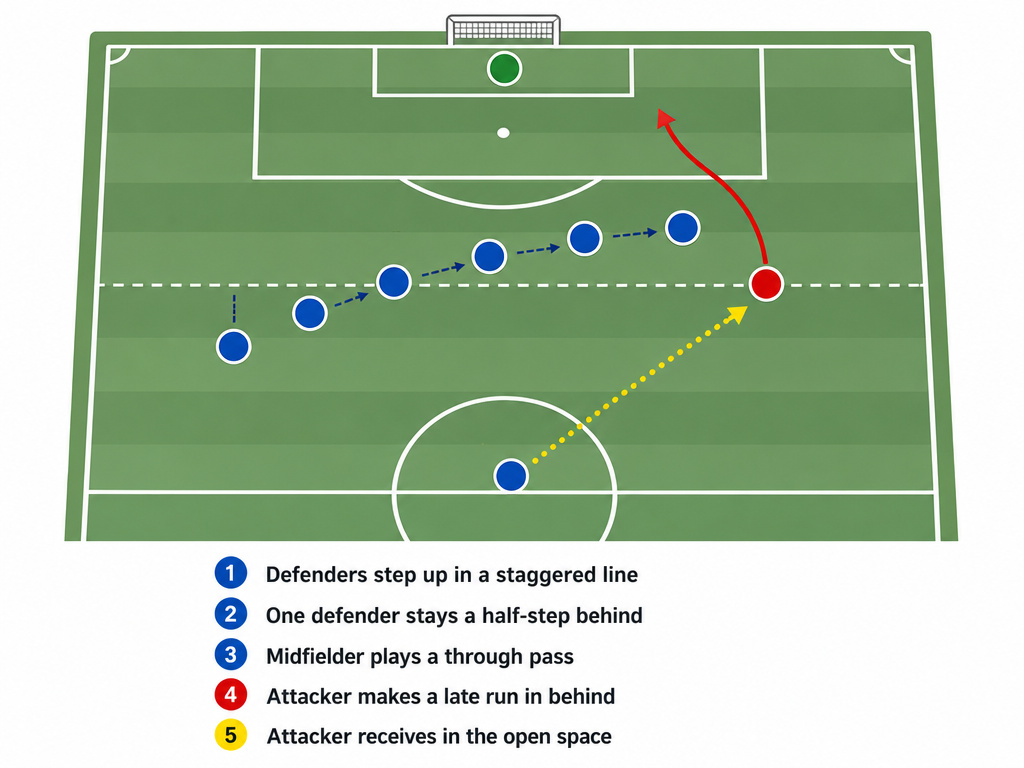
They stay patient, then explode. Strikers who want to beat the offside trap wait until the ball has left the passer’s foot before committing to a run.
- Hold the run until the pass is played.
- Start from deep. Elche were one of the sides that beat Barcelona’s trap in 2025-26.
- Check the line, not the ball. One defender out of step is all it takes.
I’d argue the best attackers manipulate the line instead of just beating it. A slow check, a drift sideways, a half-step feint: each can bait the step-up. That’s my view, not a sourced fact, and it’s easier to say than to do.
Case File: Barcelona’s High Line
Barcelona under Hansi Flick showed both sides. According to Opta Analyst, they provoked 7.0 offsides per game early in 2024-25 and 4.8 over the full season, nearly 10% above any other top-five-league team’s full-season figure since 2017-18. In the 26 October 2024 Clasico they caught Real Madrid offside 12 times, with Mbappe flagged 8 times.
Their average trap depth was 33.8m from their own goal line in 2024-25 and 31.6m in 2025-26.
Then it broke. In 2025-26, Levante, Sevilla (4-1), Elche and Club Brugge all got through. At 3-3 in Brugge on 5 November 2025, Kounde played Forbs onside. Flick said the first Brugge goal would have been “100% offside” the season before. Barcelona’s fast-break goals conceded in La Liga rose from 0.21 to 0.36 per game.
Watch a beaten trap on replay and you’ll see the quiet part. The line steps, one boot stays planted, and a lane of open grass appears behind it.
I’d bet on the trap working only as long as the press ahead of it works. Flick blamed midfield pressing, not the trap, and I think that’s right. Drop the line deep and you’ve given up the gamble, but you’ve also given up the control.
What VAR and Semi-Automated Offside Changed
Genius Sports, working with PGMOL, switched on the Premier League’s semi-automated system on 12 April 2025. It uses up to 30 cameras, some at 100fps, and up to 10,000 mesh points per player. FIFA’s version at Qatar 2022 used 12 cameras and a ball sensor. The two don’t detect the kick the same way.
| Feature | FIFA, Qatar 2022 | Premier League, 12 April 2025 |
|---|---|---|
| Cameras | 12 under the roof | Up to 30, some at 100fps |
| Tracking detail | 29 points per player, 50 times a second | Up to 10,000 mesh points per player |
| Ball sensor | Yes, 500 times a second | None |
| Kick point | Auto-chosen, checked by hand | Optical tracking only |
The ball sensor is the practical difference. FIFA’s centre-of-ball sensor reports 500 times a second, and video officials check the automatically chosen kick point and offside line by hand. The Premier League gets the kick point from cameras alone.
How much time does it save? The Premier League expects about 30 seconds per close call. Other reports say 31 seconds, or from 70 seconds down to 25 in an estimate from the Arab Cup and Club World Cup. These come from different measurements, so don’t treat them as one number.
Two limits matter for trap watchers. When players block the cameras in a crowded box, Premier League VARs go back to drawing lines by hand. And semi-automated offside technology can’t decide deliberate play by a defender or interference without touching the ball. Those need a subjective referee review, which is exactly where traps live or die.
Offside calls have also been falling. The Frontiers in Psychology offside trends paper covered 18,259 match observations over 10 seasons in the top five European leagues and found a clear decline. Offside offences per match were higher in the Bundesliga and La Liga than in the Premier League and Ligue 1.
| League | 2009/10 | 2018/19 | Drop |
|---|---|---|---|
| Serie A | 6.2 | 3.7 | 40% |
| Bundesliga | 6.3 | 4.0 | 36% |
| Ligue 1 | 4.3 | 3.1 | 27% |
| La Liga | 5.9 | 4.5 | 23% |
| EPL | 4.6 | 4.1 | 11% |
The paper notes the decline came after VAR. But offsides were already falling before VAR, and Premier League offsides rose in 2017-19 without it. VAR can’t take all the credit.
When Should a Team Spring the Trap, and Should Anyone Scrap It?
Coaches file the trap under defending. It belongs with pressing. It works best against teams that play through balls and not against teams that cross or dribble, and it needs a back line that is compact and quick to move.
The coordination is the coaching. One leader, usually a centre-back, calls the step. A discreet signal beats a shout when the other team can hear. Train it in small steps, because one slow defender or an exposed goalkeeper hands over a one-on-one.
I’d teach the basics to youth sides but not the gamble. Kids need to learn to read the pass before they learn to bet on it. That’s my view, not research.
The part nobody mentions: A trap that works nine times and fails once usually ends in a goal. The cost sits in the one miss.
Then there’s the question of whether to keep offside at all. Arsene Wenger’s “daylight” proposal would make an attacker offside only if there is clear space between him and the defender. IFAB moved trials to the Canadian Premier League for 2026, and adoption needs at least two of the four British FAs to vote for it. Jamie Carragher says it “will be terrible for the game” and will make teams more negative. A torso-only compromise has also been raised.
Van Basten, FIFA technical director from 2016 to 2018, wanted offside scrapped and pointed to field hockey dropping it in 1998. These are opinions, not data. Mine is that a trap only exists while the line matters.
How do you coach and train the offside trap?
Start with body positioning, because a trap usually fails at the feet. Teach defenders to stand side-on, with a half turn toward the ball and an eye line that takes in both the passer and the runner. A flat-footed defender facing the striker cannot step up in time.
Then drill the call. Set a back line against a passer and a couple of runners, and make the same defender bark the signal on every rep until the whole line moves on one sound.
Vertical compactness comes next. The trap only works if midfield squeezes up behind it, so train the full unit, not just the defenders. Play a small-sided game where the team must keep the gaps between lines tight, and stop play whenever the distance stretches. Pressure on the passer is the other half, since a free passer picks the moment at leisure.
Finally, rehearse the exceptions. Goal kicks, throw-ins and corners carry no offside, so the line drops and marks instead. Free kicks still count, so the trap stays live there.
Frequently Asked Questions
How does the offside trap work?
The back line steps toward halfway just before a pass is played. Offside is judged at the moment of the pass, so any attacker beyond the new line is offside when the ball is played. Timing and communication are everything.
Is the offside trap risky?
Yes. One slow defender plays the attacker onside, and a mistimed step leaves a runner through on goal. Barcelona’s fast-break goals conceded in La Liga rose from 0.21 to 0.36 per game while running a high line.
How do you explain offside to a kid?
Use the rope image. The striker must stay behind a rope held by defenders when the ball is kicked. If the defenders step forward as the ball is kicked, the striker is suddenly beyond the rope and the referee blows.
What are the three types of offside trap?
There’s no official list. My split is the step-up trap, the hold-the-line trap, and the press-triggered trap. Each uses the same rule but gets the timing from a different cue.
Can a defender step off the pitch to trap an attacker?
No. A defender who leaves without permission still counts as on the goal line or touchline until the next stoppage. If he left deliberately, he’s cautioned and the goal stands.
The Bottom Line
Offside trap in football explained comes down to a threshold: if any defender is half a step late, the trap is off and the whole line is exposed. Don’t spring it unless the press ahead of the line is working. That’s what Flick’s critics and defenders can both agree on.
Your first step this week: pick one match, pause at the instant of a through ball, and count which defenders have stepped and which haven’t. You’ll start seeing traps before they succeed or fail.
One concession. Everything here assumes the current law. If daylight offside ever arrives, the trap changes shape and most of this changes with it.
