
How to Tell If a Player Is Offside in Football
This post contains affiliate links. As an Amazon Associate, we earn from qualifying purchases.
To tell if a player is offside in football, freeze the moment a team-mate plays the ball, then check whether any part of the attacker’s head, body or feet is nearer the opponents’ goal line than both the ball and the second-last opponent. Level is onside. Hands and arms never count.
That freeze-frame is the hard part of how to tell if a player is offside in football, and the Laws pin it down: the position is judged at the first point of contact when a team-mate plays or touches the ball. Your eyes want to chase the ball into the net instead. Train them to stop one beat earlier and most offside calls stop looking mysterious.
What follows is a five-step routine you can run on any pass, the body-part rules, the situations where offside can’t be called, and how the VAR lines get drawn. Where the studies and sources disagree, I’ll show both sides.
Key Takeaways
- Being in an offside position isn’t an offence. A player is penalised only on becoming involved in active play.
- Position is read at the first point of contact. Goalkeeper throws use the last point of contact instead, a change in the 2025/26 Laws.
- A player can’t be offside receiving the ball directly from a goal kick, throw-in or corner kick. Free kicks aren’t on that list.
- Studies of officials disagree: a 26.2% error rate at the 2002 World Cup, 17.5% in a Premier League study, and the mistakes lean in opposite directions.
- The punishment is an indirect free kick where the offence happened, even in the offender’s own half.
How to Tell if a Player Is Offside in Football, Step by Step
Five checks, run in order, settle most passes you’ll ever argue about. The full offside rule in football has more branches than this routine, but the routine covers the everyday calls.
An attacker is in an offside position when any part of the head, body or feet is nearer the opponents’ goal line than both the ball and the second-last opponent. Hands and arms are ignored. Standing level with that opponent is onside. The position is judged when a team-mate plays the ball, and the position alone is not an offence.
- Freeze the pass. Pick the instant a team-mate first touches the ball. Judge where the attacker stands then, not where he ends up. Skip this and you’ll flag runners who were perfectly onside when the pass left the boot.
- Check the half. The attacker must be in the opponents’ half, and the halfway line counts as your own half. Forget that and you’ll shout offside at a midfield pass that can’t be offside.
- Find the second-last opponent. The goalkeeper is usually the last opponent, so the second-last is normally the last outfield defender. If the keeper has wandered out, two outfield players can be the reference. Also check the ball: an attacker level with or behind it is onside.
- Compare head, body and feet. Ignore the arms. Level with the second-last opponent, or with the last two, is onside. Count a stretched arm and you’ll invent an offside that doesn’t exist.
- Ask what happened next. An offside position only becomes an offence when the player gets involved in active play. A pass directly from a goal kick, throw-in or corner kick can’t be offside either. Punish position alone and you’ll flag players who never touched the move.
Plenty of short explainer videos boil step three down to “the last defender”. That shortcut works most of the time because the keeper is normally the last opponent. The Law’s wording, though, is second-last opponent, and the difference shows up the second a keeper sprints off his line.
Which Body Parts Count, and Where Does the Armpit Come In?
Arms never count. Picture a winger sprinting through with one arm flung out ahead of his shoulder while half the stand howls for the flag. The stand is wrong.
The Law is explicit that hands and arms of all players, goalkeepers included, are ignored. For offside, the upper boundary of the arm sits in line with the bottom of the armpit. Head, body and feet are what you judge.
| Body part | Counts? | Detail |
|---|---|---|
| Head | Yes | Any part of it |
| Body | Yes | Everything above the armpit line |
| Feet | Yes | The nearest part to goal |
| Hands and arms | No | Arm starts at bottom of armpit |
Common mistake: Judging offside by the furthest-forward fingertip. The arm is ignored entirely, so a goal ruled out on a hand or sleeve is a wrong call, and it will stand out on the replay within seconds.
I’m not a numbers person, so I’ll say plainly that a tight call is really a question about one boot or one knee. The rest of the body is just decoration.
Level, Own Half and Restarts: Where the Flag Stays Down
A long throw-in drops into the six-yard box, the striker is clearly past every defender, and the flag stays down. He did nothing wrong. The restart gave him a free pass.
Own half and level
An attacker can’t be offside in his own half, and the halfway line counts as his own half. Standing level with the second-last opponent, or with the last two opponents, is onside too. If you want the full list of safe situations, the guide on when a player is not offside goes through them.
Restarts that protect the receiver
There’s no offside offence when a player receives the ball directly from:
- a goal kick
- a throw-in
- a corner kick
Free kicks aren’t on the list. That catches out plenty of fans. The detail on offside from a throw-in covers what happens on the second phase of play, once the ball has moved on from the restart.
Level is onside, arms are ignored, and a goal kick, throw-in or corner kick can’t make you offside.
Position Is Not the Offence: What Turns It Into One?
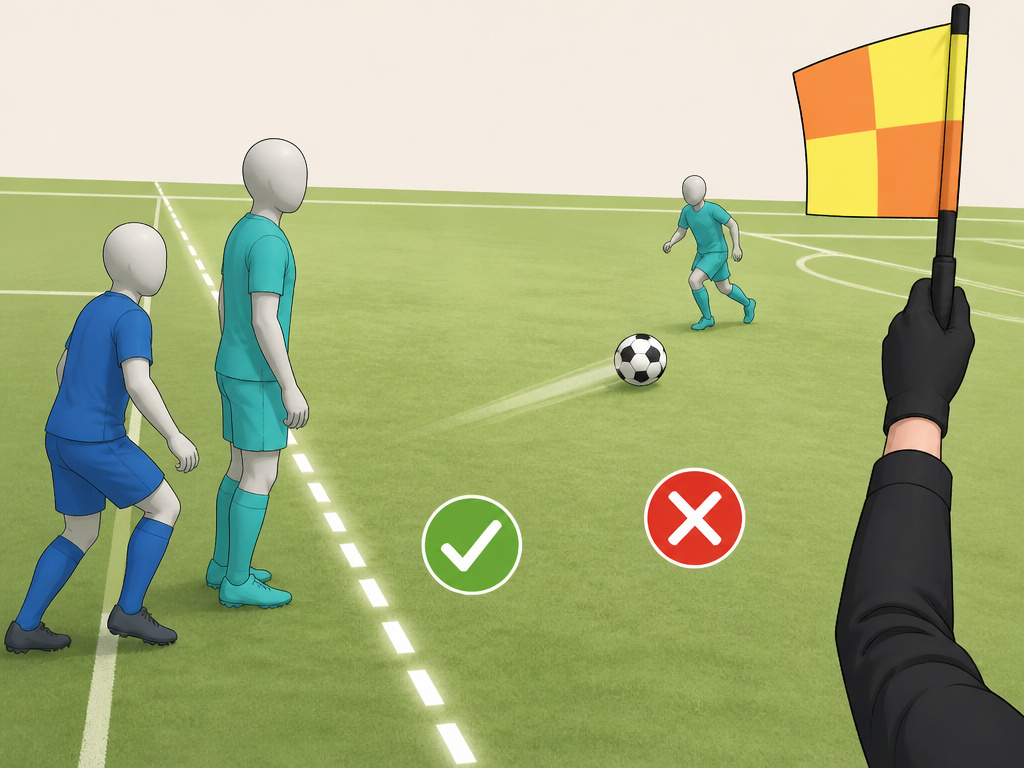
Law 11 draws a firm line between standing in an offside position and being penalised for it. A player in that position at the moment a team-mate plays the ball is penalised only on becoming involved in active play. That means interfering with play, interfering with an opponent, or gaining an advantage.
When it happens, the assistant referee’s flag goes up and the referee stops play. The sanction is an indirect free kick where the offence occurred. That can be in the offender’s own half.
Some tangles are worth knowing:
- Blocking is a foul, not offside. If an offside-position player moves into an opponent’s way and impedes him, the referee penalises it under Law 12. Interfering with an opponent’s movement towards the ball is offside only if it affects his ability to play or challenge for it.
- Who gets there first wins. Foul an offside-position player before he plays or tries to play the ball, and the foul stands. If he’s already playing the ball when the contact happens, offside comes first.
- Leaving the pitch. A defender who leaves without permission is treated as on the goal line or touchline until the next stoppage, or until his team plays the ball towards the halfway line and outside its penalty area. If he left on purpose, he’s cautioned.
- Stepping off as an attacker. An attacker who steps off and re-enters from the goal line counts as on the goal line for offside. Doing it deliberately without permission to gain an advantage earns a caution.
- Standing still in the goal. If an attacker stays stationary between the posts and inside the goal as the ball enters, the goal stands unless he commits an offside or Law 12 offence.
Easy to miss: A player who is offside and does nothing gets nothing. If he doesn’t touch the ball, block a defender or draw a challenge, play carries on and the goal counts.
Deliberate Play, Deflection or Save? The Distinction That Decides Close Calls
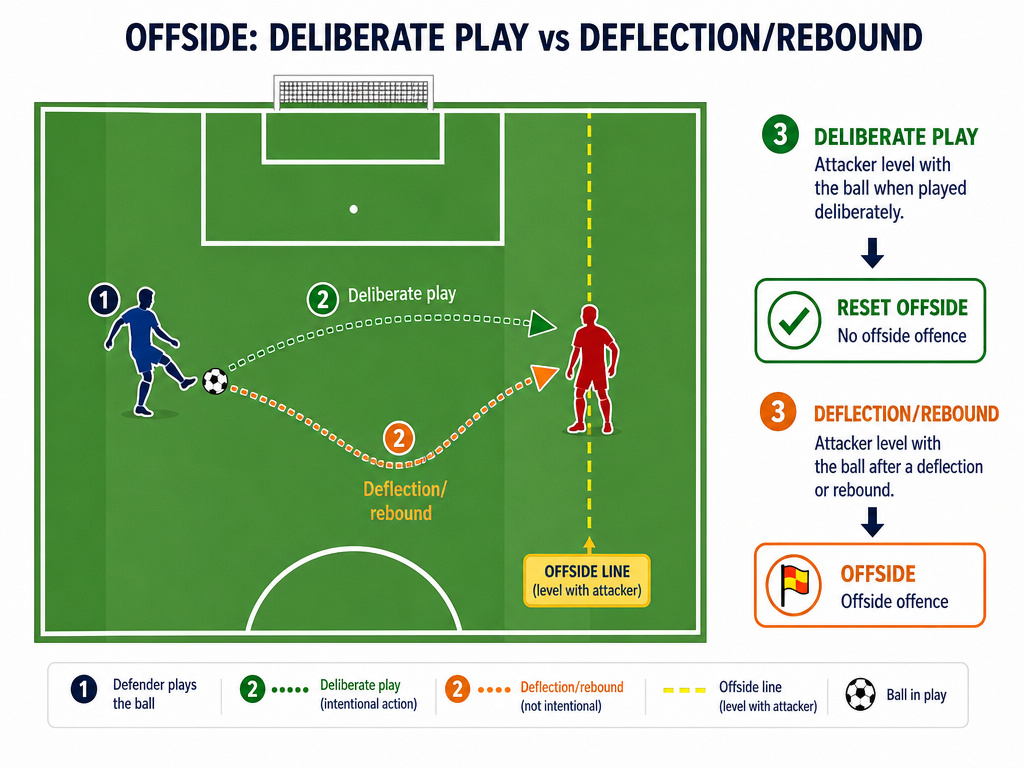
Three things point to deliberate play: the ball travelled from a distance, the player had a clear view of it, and he had time to coordinate his body. Stay with me on this one, because it settles more disputes than any line on the pitch.
If the ball reaches an offside-position attacker from an opponent who deliberately played it, including by deliberate handball, the attacker isn’t considered to have gained an advantage. A deliberate save is the exception. A “save” means stopping, or trying to stop, a ball going into or very close to the goal with any body part except the hands or arms, unless it’s the goalkeeper inside his own penalty area.
An inaccurate or unsuccessful pass, attempt to gain possession or clearance still counts as deliberately played. The clue is control, not quality. A scuffed clearance by a defender who clearly saw the ball and had time to set himself resets offside.
A defender instinctively stretching or jumping is a different case. That’s a deflection, not deliberate play, and the attacker stays in an offside position. The same goes for a rebound off the post or crossbar.
Why does this decide so many verdicts? Because it asks the officials to judge a defender’s intent in a split second, while the offside line itself is just geometry. I’d say it’s the most underrated piece of Law 11.
Which Frame Counts? First Touch, Goalkeeper Throws and a Swedish Loophole
Swedish third-tier club Torns IF spotted a hole in the offside footnote in 2023. The Law said to use the first point of contact with the ball. So a player could control the ball, wait for a team-mate to run, then play a delayed pass, and the runner wouldn’t be flagged because the first contact was the initial control.
The club kept pushing IFAB for about two years before the wording was tidied up. The 2025/26 Laws now say that when the ball is thrown by the goalkeeper, the last point of contact is used instead. IFAB’s own explanation is that it gives a clearer and more consistent reference point.
So kicks and passes are judged at first contact, and goalkeeper throws at release. That’s one rule to remember. It also explains why a keeper’s quick throw can’t be abused the way a delayed pass once could.
Why Do Officials Still Get Offside Wrong?
In the 2002 World Cup, 26.2% of 337 offside calls across 64 matches were wrong, according to Helsen and colleagues in 2006. A later Premier League study found a 17.5% error rate. Both appeared in the Journal of Sports Sciences, and I’ve only seen the headline figures in the published abstracts.
The two studies disagree about which way the mistakes lean.
| Measure | 2002 World Cup (Helsen 2006) | Premier League (2010 study) |
|---|---|---|
| Overall error | 26.2% of 337 calls | 17.5% (868 of 4,960 situations) |
| Wrong flags | 86.6% of errors | 95 |
| Missed offsides | 13.4% of errors | 773 |
| Explanation | Flash-lag effect | Optical error covered 45.4% of missed ones |
The first column is a percentage of errors, the second a raw count, so don’t compare them line for line. Flash-lag means a moving player is seen further ahead than he really is, which pushes assistants towards flagging.
Not gonna lie, the pattern surprised me. One reading is that the bias depends on how each competition tells its assistants to handle doubtful cases. That’s a reading, not a proven cause, so don’t quote a single error rate as if it settles the matter. If you want to start on the academic literature, there’s a PubMed record on football officiating accuracy you can begin with.
If a replay makes the flag look daft, check the moment of the pass before blaming the official. Judging from where the attacker ended up is the most common slip I see.
What Do the Red and Green Lines on a VAR Replay Actually Show?
A 3D replay shows an offside decision with a red line and onside with a green one. A white vertical wall marks the offside line, and when an attacker is offside the offending body part pokes through that wall, outlined in red.
How the tracking works
FIFA’s semi-automated offside technology (SAOT) uses 12 dedicated tracking cameras under the stadium roof. At Qatar 2022 they tracked the ball and up to 29 data points on each player, 50 times per second. Inside the match ball, an IMU sensor sent data 500 times per second to pinpoint the kick.
The video match officials then manually check the automatically chosen kick point and offside line before telling the referee. That takes a few seconds. SAOT was trialled at the FIFA Arab Cup 2021 and Club World Cup 2021 first, and the Premier League first used it on Saturday 12 April 2025, in Manchester City v Crystal Palace.
Where the sources disagree
FIFA’s page says up to 29 data points per player. Crystal Palace’s announcement of the Premier League rollout says up to 10,000 surface “mesh” data points per player. Those describe different deployments, so I’d treat them as separate systems rather than one contradicting the other.
They also disagree on accuracy. FIFA calls the tool a support that helps officials make decisions that are faster, more reproducible and more accurate. The club announcement says it does not change the accuracy of decisions but speeds the process up.
I couldn’t find a published tolerance figure in these sources, so I won’t invent one. If you meet a confident number online, ask where it came from.
Timing Runs and Holding Lines: How Attackers and Defenders Play the Rule
My habit, kept up for years, is to give the first 15 minutes of a match to one player away from the ball. It’s the fastest way I know to see how a team presses and where it leaves space. Watch a forward that way and offside stops being a rule and becomes a conversation between runner and line.
The Laws make that conversation possible. Because position is read at first contact, a runner who starts level with the defensive line and accelerates as the pass is struck is onside when it counts, however far ahead he is by the time the ball arrives. Good timing runs work like a kitchen line: plate a half-second early and the whole dish is ruined.
Defenders have the same lever. A coordinated offside trap steps up together as the ball is played, and a single defender dropping off wrecks it for everyone.
Arsene Wenger’s “daylight” proposal would change the contest. An attacker would be onside if any scoring body part is level with the defender. IFAB approved a trial in February 2026, and it began in the Canadian Premier League around 4 April 2026, a league with no VAR. I found no published results. My own view, and only a view, is that the tug-of-war between runner and line is half the fun, and I’d like to see the data before anyone rewrites it.
Frequently Asked Questions
How do you determine if a player is offside?
Freeze the moment a team-mate plays the ball. Check that the attacker is in the opponents’ half, then compare his head, body and feet with the second-last opponent and the ball, ignoring his arms. If he’s level, he’s onside, and he’s only penalised if he then becomes involved in active play.
How do you explain the offside rule to a child?
Imagine the last defender holds a rope across the pitch. You can’t be past the rope when your team-mate passes to you, unless the ball is already ahead of you. You can run past it after the pass, and you can’t be offside in your own half.
When can a player not be offside?
In his own half, when level with the second-last opponent or the last two opponents, and when receiving the ball directly from a goal kick, throw-in or corner kick. He’s also fine when the ball comes from an opponent who deliberately played it, apart from a deliberate save.
What does offside look like in football?
On the pitch, the assistant referee’s flag goes up and the referee stops play. On a VAR replay, offside appears as a red line with the offending body part poking through a white wall, and onside as a green line.
Does semi-automated offside technology make decisions more accurate?
The sources split on this. FIFA says the technology helps make faster, more reproducible and more accurate decisions, while Crystal Palace’s Premier League announcement says it doesn’t change accuracy and only speeds the process up.
The Bottom Line
You now know how to tell if a player is offside in football: freeze the pass, find the second-last opponent, compare head, body and feet, and ask whether the player got involved. This week, pick one match and pause every through-ball at first contact. Do it ten times and your eye will start doing it unprompted.
There’s one switch to remember. If the pass is a goalkeeper throw, move your pause to the moment of release, because the last point of contact is used. And if you’re watching the Canadian Premier League’s daylight trial, drop everything above: any scoring body part level with the defender is onside there.
I’d keep the line where it is for now. Would you trade the arguments for a simpler rule?
