
Offside From a Throw in Goal Kick and Corner Explained
This post contains affiliate links. As an Amazon Associate, we earn from qualifying purchases.
Offside from a throw-in, goal kick or corner kick isn’t an offence when the player receives the ball directly: Law 11 of the IFAB Laws of the Game removes it for all three. The exemption ends once a teammate plays the ball, and it never covers free kicks, which still carry an offside offence.
That word “directly” carries the whole rule, and it is central to how offside from a throw in goal kick and corner explained in practice. A throw-in flicked on by a teammate, or a corner played short and returned, isn’t received directly. The player’s position at the moment of that second touch is what counts.
What follows: each restart in turn, the muddy history of why they’re exempt, the Brentford flick-on that took VAR about a minute and a half to check, and the deflection question where the written Law and old guidance point different ways.
Key Takeaways
- Free kicks are the odd one out: an attacker in an offside position who receives the ball directly from one is still penalised.
- A teammate’s touch after the restart brings offside back, which is exactly what the Brentford goal tested.
- The corner taker can be offside if a teammate passes the ball back and the taker plays it.
- On deflections off a defender, the written Law and USSF guidance don’t agree, so check who you’re asking.
- Since 2019/20, a goal kick is in play when kicked, with opponents outside the penalty area.
Offside From a Throw-In, Goal Kick and Corner: Where Law 11 Switches Off
Law 11.3 in the IFAB Laws of the Game is blunt: there’s no offside offence if a player receives the ball directly from a goal kick, throw-in or corner kick.
Law 11.3 of the IFAB Laws of the Game removes the offside offence for a player receiving the ball directly from a goal kick, throw-in or corner kick. The exemption covers only the direct receipt. An offside position remains punishable at a free kick, and the restart for any offside offence is an indirect free kick.
Read that again and notice what’s missing. There’s no mention of where the player stands, how far upfield, or how obvious it looks. Position stops mattering for the first touch only.
| Restart | Offside directly from it? | What changes that |
|---|---|---|
| Throw-in | No | Ball not received directly |
| Goal kick | No | Ball not received directly |
| Corner kick | No | Taker plays a return pass |
| Free kick | Yes | Nothing; the offence stands |
Throw-In
Drop a long throw onto a teammate standing past the last defender, and the flag stays down. The Law covers some messy versions too. If an attacker offside when the ball was thrown swings at it, misses, and the ball goes in untouched by anyone else, there’s no offside. A goal can’t come directly from a throw-in, so the restart is a goal kick.
The mechanics of taking a throw-in have their own rules, but offside from a throw in goal kick and corner explained isn’t one of them. A quick throw to a teammate in an offside position who is then fouled in the penalty area earns a penalty kick.
Goal Kick
In offside from a throw in goal kick and corner explained terms, a goalkeeper’s long goal kick to a teammate standing nearer the goal line than the ball and the second-last opponent is fine. If that teammate receives it, runs on and scores, the goal stands. The goal kick rules say nothing that changes this.
Fouls still count. If that teammate is fouled outside the area after controlling the ball, the foul is penalised with a direct free kick. A promising-attack stopper gets a yellow card.
Corner Kick
A corner can go short to a teammate standing close in an offside position. If that teammate then passes to an onside player who heads in, the goal is awarded. A corner kick is exempt from the first touch, and the teammate received it directly.
Free kicks work the opposite way. A goalkeeper’s free kick from inside the penalty area, played long to a teammate in the opponents’ half nearer the goal line than the ball and second-last opponent, gets the goal disallowed. The restart is an indirect free kick for the other side.
The One-Sentence Version for Kids, and the Law Behind It
Picture a kid on the touchline asking why the flag went up. You’ve got one sentence before their attention wanders to the chips.
I once explained a pressing system with so much jargon that a reader told me they were lost. I rewrote it around a single image, and now I ask whether a casual fan could follow every paragraph. Offside from restarts gets the same test.
The kid version: nobody is offside straight from the throw, kick or corner. Once a teammate touches it, the line is back.
The grown-up version rests on the offside rule, which Law 11 builds from a few pieces:
- An offside position means a player is in the opponents’ half and nearer their goal line than both the ball and the second-last opponent.
- Head, body and feet count. Hands and arms don’t, and for this purpose the upper edge of the arm is level with the bottom of the armpit.
- Standing there isn’t an offence. A player is only penalised for playing the ball or clearly affecting an opponent’s ability to play it.
- Position is judged when a teammate plays or touches the ball, not an opponent.
Own-half cases and the other exceptions sit in the wider list of situations where a player is not offside. Tell a kid that part later.
A tidy rule, then. Why does it exist?
Why Are These Three Restarts Exempt From Offside?
The sources I could check don’t give a documented reason. One US Soccer answer says the exemptions were “installed in the Laws in the 1880s”, with “no known documentation” of why. Some explainers offer reasons for the exemption, but I couldn’t trace any of them to the Laws. That’s plausible, but I couldn’t trace it to the Laws.
The dates are worse. Three sources give three different histories for the goal kick alone:
- A USSF answer (Jim Allen, 2012) says goal kicks became exempt in 1866.
- The nachspielzeiten.de chronology says the FA ruled no offside at a goal kick in 1873. It then says an offside position became possible at a goal kick in 1920 (IFAB), which would mean the exemption was removed and later restored.
- A separate US Soccer answer says the 1880s.
Treat them as three conflicting claims. I won’t pick a winner.
The free kick is cleaner. The same chronology says an offside position has been possible at a free kick since 1997 (IFAB). Dropped balls are murkier: the 1938 IFAB wording exempted them alongside the other three restarts, reworded in 1978-79 per a USSF answer. Today’s IFAB FAQ penalises an offside-position player after a long pass following a dropped ball.
The Brentford Flick-On That Took 1 Minute 28 Seconds to Check
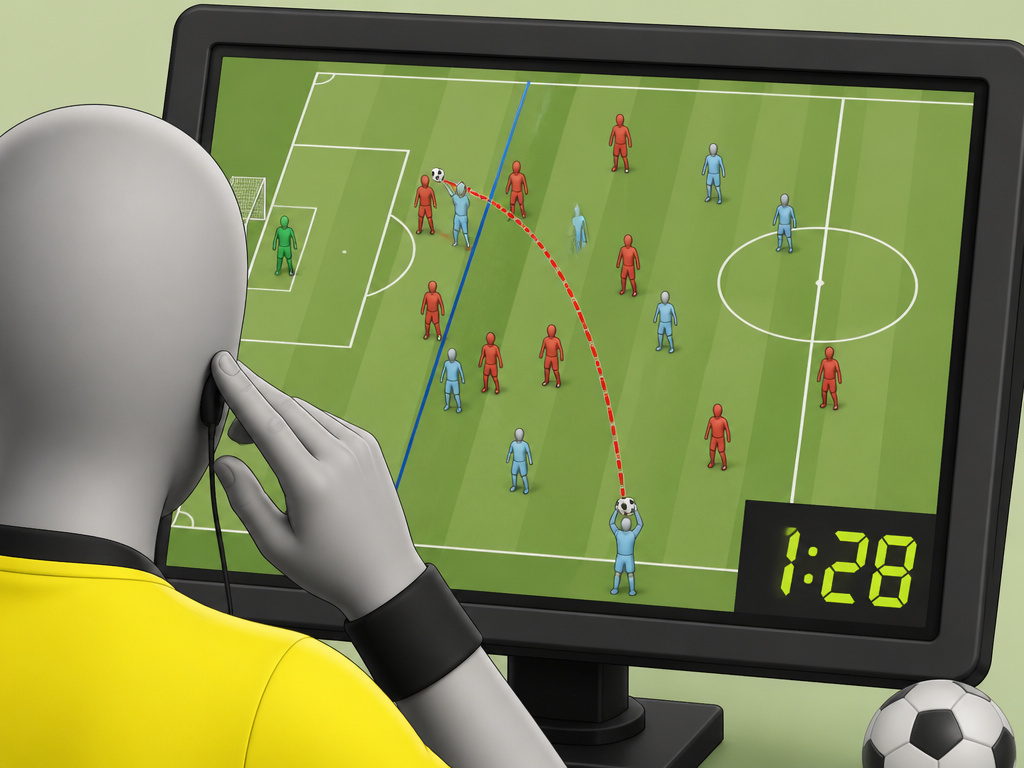
Stay with me here, because this is the case that explains everything above.
In Brentford’s 2-2 draw with Chelsea, Kayode took a long throw and Ajer flicked it on. Carvalho scored three minutes into stoppage time. VAR then checked Ouattara’s offside for about 1 minute 28 seconds before the goal stood.
The ESPN VAR review of the Brentford offside goal (dated 15 Sep 2025) puts it plainly: you can’t be offside from a throw-in, but Ajer’s touch “creates a phase”. Ouattara stuck out a leg without touching the ball. Whether that affected Reece James was “a subjective judgement”.
I’d rather you remember this goal than the textbook line. “No offside from a throw-in” is true for the thrower’s pass only. The second touch starts a fresh question, and fans watching the broadcast angle tend to forget which touch they’re judging.
A minute and a half feels like a week when a stadium is holding its breath. The check wasn’t about the throw. It was about everything after it.
Can the Corner Taker Be Offside After a Return Pass?
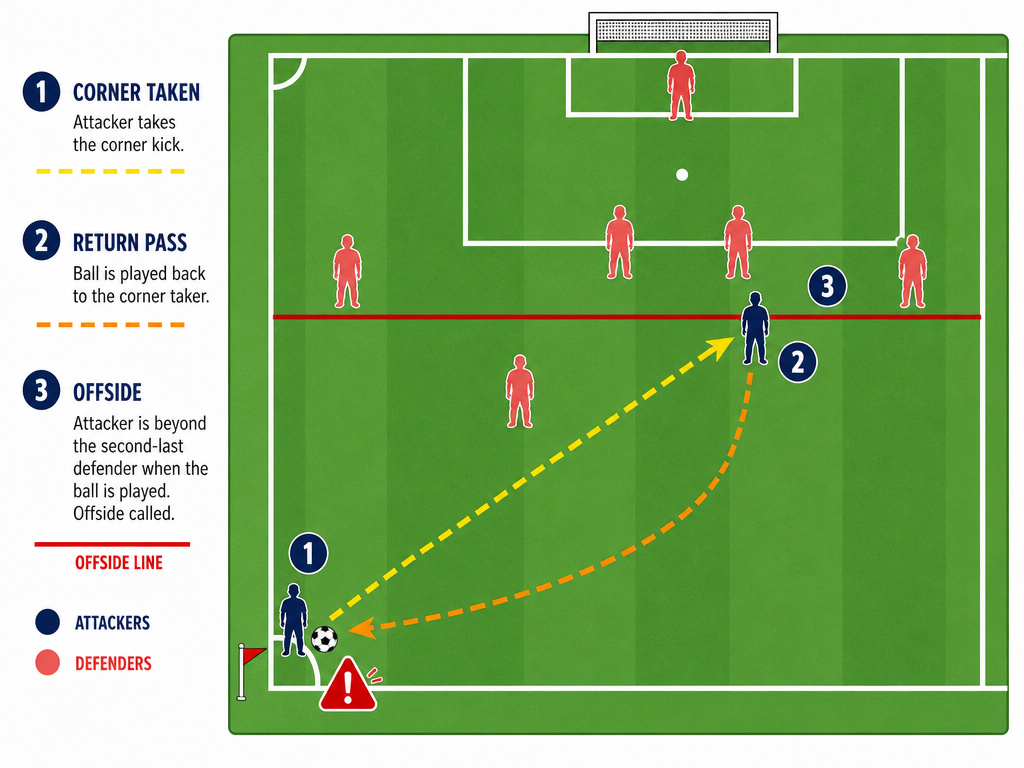
Yes. This is the one that catches people out in Sunday league and the Premier League alike.
An attacker takes a corner to a teammate. The teammate passes it back, and the kicker, now in an offside position, plays the ball. IFAB’s FAQ says Law 11 exempts receiving the ball directly from a corner, but once the corner has been taken, the taker can be offside. The referee awards an indirect free kick to the defending team for interfering with play.
Where this goes sideways: Assuming the exemption follows the ball around. It protects the first receiver only. Everything after that is judged as ordinary play, and the corner taker standing beside the byline gets no special treatment.
USSF’s 2011 answer goes further, saying it is physically impossible to be offside directly from a corner. That’s true, and it’s exactly why the return pass is the trap.
What Does a Deflection Do to the Exemption?
The written Law and the old US guidance point opposite ways here. Law 11.2 says a ball that rebounded or was deflected off an opponent can lead to an offside offence. Yet IFAB’s own FAQ clears a throw-in that deflects off a defender to an attacker offside at the throw, provided no Team A player touched it after the throw-in.
USSF guidance (2001, cited in 2011) said to disregard an opponent’s deflection or misplay at these restarts. If a teammate of the thrower or kicker deflects it, that player must be declared offside. The answer admits it rests on “tradition and custom”. In a 2017 incident, the assistant referee and referee wanted offside under the rebound wording, though the referee named in the debrief said no, and the article sided with no offside.
| Source | Position | Receiver offside? |
|---|---|---|
| IFAB Law 11.2 text | Deflection off opponent can be offence | Possible offence |
| IFAB FAQ, throw-in | No Team A touch after throw | No |
| USSF (2001, 2011) | Disregard opponent’s deflection | No |
| USSF, teammate deflects | Teammate’s touch ends exemption | Yes |
| 2017 match officials | Applied written deflection rule | Wanted offside |
The cleanest test: did a teammate touch it after the restart? If yes, judge offside normally. If only a defender touched it, the IFAB FAQ says play on.
In open play, the line between deflection and deliberate play decides a lot. A defender with no control and no time to coordinate his body, such as one running onto a fast ball from short range, is deflecting, and the receiver is offside. A defender who plays it deliberately but unsuccessfully, with the ball travelling from distance and time to react, still counts as deliberate play, so the receiver isn’t penalised. I’d argue that distinction is the most underrated piece of the Law. Nobody’s published a neat single answer for the restart version, which is why the table above has five rows and no winner.
The Goal Kick Change That Made the Ball Live Straight Away
Since the 2019/20 Laws, a goal kick is in play as soon as it is kicked and no longer has to leave the penalty area. Opponents must stay outside the area until then. IFAB’s stated reason was a faster restart and an end to defenders wasting time by playing the ball early to force a retake.
For offside, that means the exemption applies from the first touch, even if the kick never leaves the area. A teammate’s pass on afterwards is a new play. IFAB’s clarification on Law 16 adds the details:
- An opponent who stays in or enters the area and plays, challenges or touches the ball before the kick forces a retake.
- If the kick is quick and an opponent genuinely had no time to leave, the opponent may intercept once it’s in play but can’t interfere with the taking of it.
- Deliberate offenders gain no advantage, and the retake carries no card unless it happens repeatedly.
- A goalkeeper “lifting” the ball for a teammate to head or chest back should not be permitted or penalised; the kick is retaken without discipline, pending IFAB discussion.
Referees are told to manage goal kicks like free kicks, using the same 9.15m skills.
A Three-Question Check You Can Run From the Terrace
Run these in order when a restart leads to a goal or a flag:
- Was it a throw-in, goal kick or corner? If it was a free kick or a dropped ball, an offside position can be punished. Skip this check and you’ll wrongly allow a goal that should go back for an indirect free kick.
- Did the receiver get it directly? If yes, no offside, whatever the position. Miss this and you’ll flag a legal goal, as with the goalkeeper’s long goal kick that stands.
- Did a teammate touch it first? If so, judge position at the moment of that touch. Ignore it and you’ll misjudge a Brentford-style flick-on.
- Is anything else going on? A foul, a defender off the pitch, a deflection. Each of these can overrule your first answer.
A goalkeeper’s throw in open play isn’t on the exempt list. For that, the offside position is fixed at the moment the goalkeeper releases the ball.
Defenders Who Step Off the Field
A defender who leaves the pitch without permission counts as on the goal line or touchline until the next stoppage, or until the defending team plays the ball towards the halfway line and outside their penalty area. A defender who deliberately leaves to put an attacker offside at a free kick gets a yellow card, and the goal stands. An attacker stepping off to stay out of play is treated the same way when re-entering from the goal line.
Fouls Beat Offside When They Come First
If the offside offence and the foul happen at the same time, the foul is penalised. Otherwise whichever comes first wins. That’s why a throw-in recipient fouled in the area gets a penalty, while a player fouled after touching a ball passed from an offside position gets an indirect free kick instead.
What does the assistant referee do on a throw-in, goal kick or corner?
On these three restarts the assistant referee’s job gets lighter on the direct ball, but it doesn’t disappear. Law 11.3 says there’s no offside offence when a player receives the ball directly from a throw-in, goal kick or corner kick, so a raised flag for a first touch from the restart would be a mistake. The flag stays down.
The work starts once a second player touches the ball. If a team-mate of the taker deflects it to someone who was in an offside position, the exemption is gone and the offence can be called. The same goes for a corner taker who plays the ball again after a pass back while sitting in an offside position. The assistant has to watch who touched the ball, and when.
Offside position is judged at the moment a team-mate plays or touches the ball, and for a goalkeeper’s throw, at the moment of release. Good flag work means freezing that picture, then checking whether the exemption still applies. If the flag does go up, the restart is an indirect free kick to the defending team.
Frequently Asked Questions
How do you explain offside from a throw-in to kids?
Say it this way: nobody can be offside straight from the throw. If a teammate touches the ball after that, the offside line is back. Skip the second-last-opponent talk until they ask.
Can a goalkeeper’s throw or free kick put a teammate offside?
Goalkeeper’s throw isn’t on the exempt list, and its offside position is judged at the moment the goalkeeper releases the ball. A goalkeeper’s free kick played long to a teammate in an offside position gets the goal disallowed, with an indirect free kick to the opponents.
What are the new offside rules in 2026?
The sources I worked from show no change to the three exemptions. The most recent restart change they document is the 2019/20 goal-kick change. Check the current IFAB Laws of the Game for anything newer.
What happens when offside is called after a restart?
The restart is an indirect free kick to the defending team from where the offence happened. If the player received the ball inside the goal area, the free kick may be taken anywhere in that area.
Do school and college rules treat these restarts the same way?
One secondary source describes the NFHS and NCAA lists of exempt restarts as closely parallel to IFAB’s. I haven’t checked either rulebook directly, so confirm with your own league’s text.
The Bottom Line
Offside from a throw-in, goal kick and corner comes down to one test: did the ball reach the player directly? If a teammate touched it first, or the taker is playing a return pass, judge position the moment that touch happens.
I’ll concede the deflection question isn’t settled. The written Law, USSF guidance and match officials have all landed in different places, so treat any one confident answer with suspicion, including mine.
This weekend, watch the next throw-in near the box and note who touches it second. That one habit beats any diagram.
