
Throw in Rules in Football: Legal, Foul and Delayed
This post contains affiliate links. As an Amazon Associate, we earn from qualifying purchases.
Throw in rules in football require the thrower to face the field, keep part of each foot on or behind the touchline, and throw with both hands from behind and over the head. Opponents must stand at least 2 m away. A goal cannot be scored directly, and a foul throw goes to the other team.
That phrase, “part of each foot”, does more work than any other in Law 15. A heel on the line keeps a throw legal. A foot planted fully inside the field makes it a foul throw, and the opponents take over. The referee judges the throw at the moment the ball leaves the hands.
What follows: the step-by-step procedure, a table of foul throws, the restarts after goals and handballs, the five-second countdown, the long throw boom, and the places where US high school rules disagree with IFAB.
Key Takeaways
- A heel on the line counts. A foot fully inside the field and off the line makes the throw incorrect.
- Dropping the ball instead of throwing it hands the throw to the opponents.
- When the ball bounces outside before entering, the same team retakes under IFAB Law 15. US high school rules give the throw to the opponents instead.
- The referee’s raised hand starts a five-second countdown. Miss it and the throw goes to the other team.
- In a study of 71,220 throw-in phases, backward throws won first contact 99.5% of the time, against 71.3% for forward throws.
Step by Step: How a Legal Throw-In Is Taken
Law 15 sets four conditions that must all hold when the ball leaves the thrower’s hands. Think of a throw as a dovetail joint: feet, hands, start point and spot all have to fit, or the whole thing loosens.
A legal throw-in requires the thrower to face the field of play, keep part of each foot on the touchline or on the ground outside the touchline, and deliver the ball with both hands from behind and over the head. Delivery happens at the point where the ball left the field. Opponents stand at least 2 m away.
IFAB’s Law 15 text also settles who gets the throw. It goes to the opponents of the last player to touch the ball, once the whole ball crosses the touchline, on the ground or in the air.
Here is the sequence a referee checks, with what goes wrong at each stage:
- Take it from the exit point. Stand where the ball left the field. If you throw from the wrong spot, the opponents get the throw, unless they win the ball and the referee lets play run on.
- Face the field. Chest toward the pitch. Anything else is an incorrect throw-in and goes to the other side.
- Plant both feet. Part of each foot stays on the line or on the ground outside it. Lift one foot and the opponents get the throw.
- Start behind the head. If the ball’s movement begins in front of or above the head, the throw is incorrect and the opponents take it.
- Throw it with both hands. Drop it, and it’s not a throw.
Once the ball enters the field, it’s in play. If it hits the ground outside the line first, the same team retakes from the same position. Any player can take that retake.
I’d argue the start point of the ball is the hardest call for a referee to make live. From the stand, a heel-on-the-line throw looks wrong, with toes inside the pitch and the whitewash visible only under the back of the boot. It’s still legal.
Which Mistakes Turn a Throw-In Into a Foul Throw?
In 1895 the rulebook told throwers to stand with part of both feet on the touchline. The wording moved to outside the touchline in 1925, then to on or outside the touchline in 1932, which is the version we play today. That timeline comes from referee Q&A site askasoccerreferee.com, which also dates the two-handed throw in any direction to the first IFAB meeting in 1882.
Every foul throw breaks one of the four conditions above. Here is how IFAB’s published decisions treat the common cases:
| What the thrower does | Ruling | Restart |
|---|---|---|
| Drops the ball instead of throwing | Incorrect throw-in | Opponents take it |
| Lifts one foot off the ground | Incorrect throw-in | Opponents take it |
| One foot fully inside, off the line | Incorrect throw-in | Opponents take it |
| Heel on the line, toes inside | Legal | Play continues |
| Ball starts in front of the head | Incorrect throw-in | Opponents take it |
| Somersault, legal feet and hands | Legal | Play continues |
In each “opponents take it” case, IFAB says the referee can apply advantage if the opponents win the ball anyway. No stoppage needed.
Easy to miss: Expecting a second attempt after a foul throw. Referee Q&A guidance says a throw can’t be redone because the referee dislikes a technical detail. The ball goes to the other team the moment play stops, and your side loses the touchline possession it started with.
Does the thrower ever get a second go? That depends on whose wording you read. IFAB’s FAQ says the same team retakes only if the ball did not directly enter the field. If it entered, the opponents take the throw. Askasoccerreferee.com adds that a throw that’s “good enough” stands, and one that isn’t goes to the other team, though some local rules allow a retake for very young players.
One-handed throws deserve a mention. Law 15 wants both hands. Referee Q&A guidance says a player who lacks normal use of one or both hands can still throw legally, provided the ball goes over the head and everything else in Law 15 is met. US high school guidance makes the same exception for a physical impairment.
What Happens After the Throw: Goals, Handballs and Second Touches
Law 15 treats the throw-in as a restart that can never score on its own. If the ball goes straight into the opponents’ goal, the referee gives a goal kick. If it goes into the thrower’s own goal, the restart is a corner kick.
IFAB’s own example makes the second case vivid. A player takes a quick throw back toward the keeper, the keeper reacts late, and the ball rolls in. Corner to the opponents.
The thrower faces a few more traps once the ball is in play:
- Second touch: the thrower touches the ball again before another player does, and the opponents get an indirect free kick.
- Handball by the thrower: a direct free kick, or a penalty if it happens inside the thrower’s own penalty area.
- Goalkeeper catching a team-mate’s throw: an indirect free kick to the opponents, with no card.
- Opponent handling a ball heading for goal: a penalty and a yellow card, never a red. No goal can come directly from a throw-in, so there’s no goal to deny.
The second-touch rule has a nasty edge. IFAB describes a thrower who takes a correct throw, sees an opponent about to win the ball, then runs on and kicks it away. That’s an indirect free kick for touching the ball again before another player has touched it.
Then there’s offside. A friend of mine who called football dull started coming to matches with me and, within about two months, was spotting offside traps before I did. The throw-in is the one place that skill goes quiet. IFAB confirms there’s no offside from throw-ins when a player receives the ball directly from the thrower.
Why Does the Two-Metre Gap Matter?
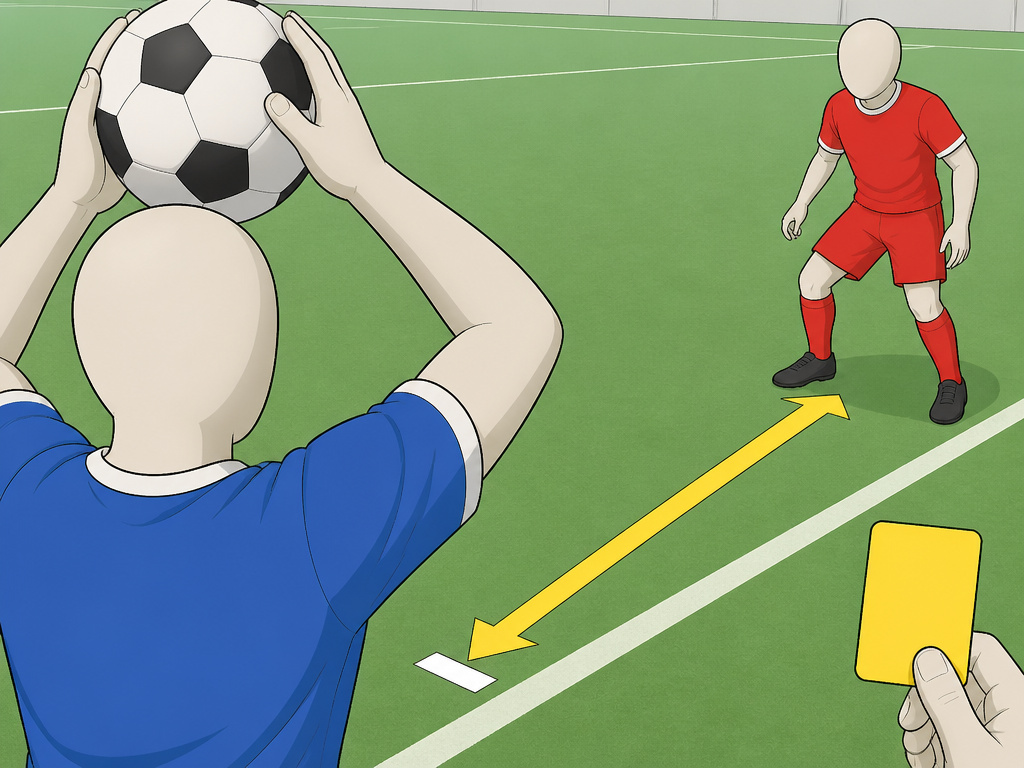
Space is the whole point of that gap. Opponents must stand at least 2 m (2 yds) from the spot on the touchline, so the thrower has room to pick a target.
An opponent who unfairly distracts or impedes the thrower, including by moving closer than 2 m, is cautioned for unsporting behaviour. If the throw has been taken, the restart is an indirect free kick.
IFAB’s trickiest example involves a thrower who loses patience. An opponent stays close and blocks the throw, so the thrower fires the ball at him. Both players are punished. The opponent gets a yellow card. The thrower gets a yellow if the throw was reckless, or a red for violent conduct if the force was excessive.
I’d tell any young full-back the same thing I’d tell my younger self: don’t throw at a defender out of frustration. Law 15 allows a deliberate throw at an opponent to play the ball again. Careless, reckless or excessive force turns it into a direct free kick and a card.
A related case helps speed merchants. If an opponent picks up the ball and takes a quick throw before the referee intervenes, the correct team retakes from the same position. The opponent gets no sanction.
Does Taking a Throw-In Fast Help? The Data From 71,220 Phases
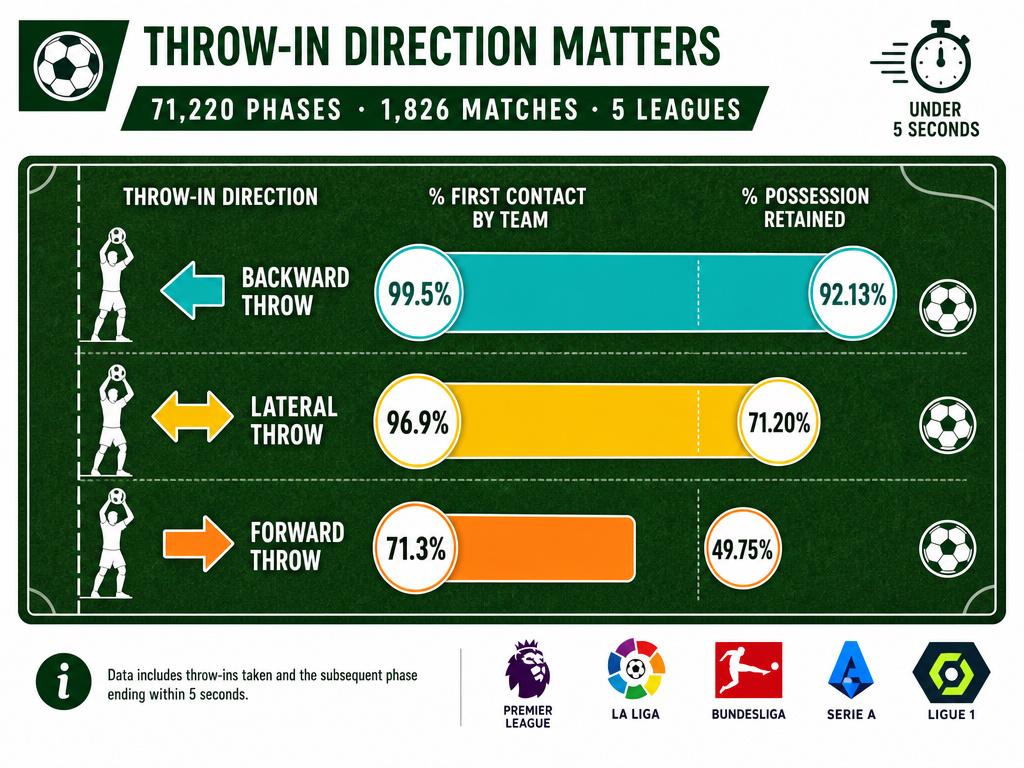
Backward throws won first contact 99.5% of the time, against 71.3% for forward throws. That comes from a peer-reviewed throw-in strategy performance analysis by Stone, Kubayi, Smith and North (2025).
The researchers used data from 1,826 matches across five European leagues in 2022/23. That gave 71,220 phases of play starting from a throw-in, at an average of 39 throw-ins per match. A total of 42,287 throws came from the middle zones of the pitch.
Direction mattered even more than speed. Here’s what the study found:
- Backward throws: 99.5% first contact, 92.13% possession retained.
- Lateral throws: 96.9% first contact, 71.20% possession retained.
- Forward throws: 71.3% first contact (p < 0.05), 49.75% possession retained.
Shot creation was also more likely from backward or lateral throws than forward ones.
Be careful with these numbers. First contact isn’t a goal, and the study didn’t test the new countdown. I’m an eyes-and-notebook observer with little feel for data models, so I’m leaning on the researchers’ own figures and not reading further into them.
Even so, it fits what I’ve long believed: quick restarts are underused, because defenders are often still organising in the first few seconds. A throw taken in under five seconds also happens to beat the new countdown.
How Does the Five-Second Countdown Change Throw In Rules in Football?
The referee does three things: signals, counts, and decides. When a player is unfairly delaying a throw-in, the referee starts a visible five-second countdown with a raised hand. If the throw hasn’t been taken by the end, it goes to the opposing team.
The change came from the 140th AGM in Hensol, Wales, reported in IFAB’s announcement of the match-flow measures on 28 February 2026. IFAB said it would be used at the FIFA World Cup 2026 and other competitions. It extended the same countdown to goal kicks, where a delayed restart means a corner for the opponents.
The part nobody mentions: The countdown can start without a whistle or voice cue first. If the ball isn’t in play after five seconds, the throw goes to the opponents from the same position, and the delaying side gets no extra warning.
Two IFAB texts stress different parts of the sanction. The AGM release says the opponents get the throw if the ball isn’t in play at the end of the count. Law 15 adds that a player is cautioned only for excessive delay after the throw has been awarded to the opponents. Read together, losing the throw is the sanction for delay, and a caution is given only if the player excessively delays the restart.
Five seconds counted aloud, with a raised arm, feels longer than it sounds. Players who stroll to the line and stare at teammates are about to find that out.
The study from the last section never tested a countdown. Still, a thrower who restarts inside five seconds sits on the fast side of those first-contact numbers.
Are Long Throws and Flip Throws Legal?
Long throws were once sneered at as the weapon of sides who couldn’t pass.
The same four Law 15 conditions apply to every throw, long or short.
The long throw
The Premier League counts a long throw as a throw-in of at least 20 metres aimed toward the inside of the opposition penalty area. Across the first nine Matchweeks of 2025/26, teams averaged 3.99 long throws per match, up 162% from 1.52 per 90 in 2024/25. The league’s own piece counted eight goals from long throws by Matchweek 9.
The frequency of goals also moved. In 2024/25 a goal arrived from a long throw once every 27 games, against once every 11.25 in 2025/26. Brentford propelled 47 long throws into the area in those nine weeks, and Michael Kayode launched 54 long throws into the box in 2025/26, with six leading to a shot and two to goals. Jensen’s 45.38m throw against Nottingham Forest topped the season’s distances.
Trust the shape, not the hype. The Analyst’s definition differs from the league’s: at least 20 m in length ending in the opposition box, which leaves out shorter throws. I’d call the long throw a useful trick, not a system.
Flip throws
IFAB’s FAQ answers this directly. A somersault before throwing is allowed if both feet are on the touchline or on the ground outside it at delivery. The thrower must face the field and use both hands from behind and over the head. US high school guidance adds that the throw must be one continuous motion, with no stopping partway.
Do Youth and High School Throw-In Rules Differ?
Coaching an under-9 side next weekend? Check the rulebook, because the rules can change at the level you coach. The US high school body NISOA published guidance (in 2011, so confirm the current wording) that differs from IFAB in several places:
| Situation | IFAB Law 15 | US high school (NISOA) |
|---|---|---|
| Ball bounces before entering | Same team retakes | Opponents throw from release spot |
| Feet at release | Part of each foot on line or outside | Both feet on ground, on or behind line |
| Throw from wrong spot | Opponents; advantage possible | Opponent gets ball at correct spot |
| Motion | Both hands, behind and over head | One continuous motion |
| Opponents’ distance | 2 m (2 yds) | 2 yards |
NISOA even warns officials against giving a second throw, noting that retaking the throw is a mistake that creeps in when referees mix up rules from different organizations. I couldn’t verify the latest US rulebook text, so treat the table as a warning and not the final word.
Youth leagues
Askasoccerreferee.com notes that some local rules allow a retake for very young players. Your league’s rules decide, not Law 15.
Kick-ins: the experiment that came and went
The Dutch FA (KNVB) proposed a 2023/24 pilot in the Keuken Kampioen Divisie that included kick-ins instead of throw-ins. A club-history blog, which is a low-authority source, says England’s Isthmian League tried kick-ins in 1994/95. There was no direct goal and no offside, and the trial lasted one season. Throw-ins have survived every attempt to replace them.
Frequently Asked Questions
Can you step on the line on a throw-in?
Yes. Part of each foot has to be on the touchline or on the ground outside it. A heel on the line with the rest of the foot inside the field is correct. A foot fully inside, off the line, is not.
Can you lift your leg on a throw-in?
No. Lifting one foot off the ground as the ball is delivered gives the throw to the opponents under IFAB guidance. US high school guidance is stricter in wording and also says the foot must not lift.
What are the basic rules for throwing in football?
The whole ball must cross the touchline, and the opponents of the last toucher get the throw. The thrower faces the field, plants both feet properly and uses both hands, starting from behind the head. The ball is in play when it enters the field.
Can you score directly from a throw-in?
No. If the ball goes into the opponents’ goal, they get a goal kick. If it goes into the thrower’s own goal, the opponents get a corner kick.
What happens if the ball hits the ground before entering the pitch?
Under IFAB Law 15, the same team retakes from the same position, and any player can take it. US high school rules differ and give the throw to the opponents.
How long can a team delay a throw-in?
If the referee decides a throw is being unfairly delayed, a five-second visible countdown starts. If the ball isn’t in play at the end, the opponents get the throw.
The Bottom Line
Try this test this week. Ask a teammate to watch only your back foot and the first movement of the ball across ten throws. Foot position and the ball’s start point are where the table’s trickiest cases sit.
One limit on everything above: it’s IFAB Law 15. If you referee or coach under US high school rules, a ball that bounces outside goes to the opponents, not back to you. Check your own league’s rulebook before match day.
Learn the throw in rules in football well enough that the legal throw is automatic, and the quick one gets easy. I’d rather see a clean throw inside a few seconds than a long walk to the line. The data backs the quick throw on first contact, even if it doesn’t prove it wins matches.
A throw you can take in three seconds is worth more than one you can launch forty metres.
