
Long Throw Tactics in Football: The Data-Backed Approach
This post contains affiliate links. As an Amazon Associate, we earn from qualifying purchases.
Long throw tactics in football turn a simple restart into a targeted set piece by using distance, trajectory, and coordinated movement to create scoring chances. The most effective approach prioritizes possession retention, throwing backwards or laterally with a short, fast delivery, but a direct, long throw into the box remains a potent, high-variance weapon that top teams are increasingly using.
The data tells a clear story. Throwing the ball forwards over a long distance is a high-risk play, while a quick, safe pass backwards almost guarantees you keep the ball. The real tactical choice isn’t between one style or the other; it’s knowing when to use each. A team that can do both, secure possession under pressure and launch a dangerous, rehearsed long throw, forces opponents to defend two completely different problems.
Key Takeaways
- Throw backwards to keep the ball. A peer-reviewed throw-in performance analysis found backwards throws decrease the odds of losing possession by 60.8% compared to forwards throws.
- Speed beats deliberation. The same study notes the optimal time to take a throw-in is about five seconds after the ball goes out; fast throws decreased the odds of losing possession by 24.5%.
- Long throws are a calculated gamble. Long throws that led to goals increased from 0.03% in 2020-21 to 0.38% in 2024-25 in the Premier League, but the chaos they create leads to many more chances.
- Routines are everything.
- Any player can be a weapon. While specialists like Rory Delap exist, even average defenders can be coached to make a 35-yard throw a reliable tactical option with targeted training.
The Simple Math: Why Backwards Beats Forwards
The numbers tell a clear story. A study of five European leagues found that throwing the ball backwards increased first contact success to 99.5% compared to throwing forwards (71.3%). Throw it forwards, and that rate plummets to 71.3%. This isn’t a small difference; it’s the chasm between keeping play alive and handing it away.
The reason is geometry and pressure. A forward throw, especially a long one, travels a greater distance in the air. That gives the defending team time to react, to push up, and to contest the landing zone. A short, sharp throw backwards, often to a teammate who has checked back to the touchline, covers less space and arrives faster. The defender is already facing their own goal and can’t close the space in time.
Fast throw-ins decreased the odds of losing possession by 24.5% in favor of continuing possession, compared to slow throw-ins. Throw-ins without pressure decreased the odds of lost possession by 55.8%.
The PLOS One tactical throw-in study spells out the cost of the ambitious option. A long throw increases the probability of losing possession by 70% compared to a short one. A medium-length throw still increases the risk by 30%. For a coach whose philosophy is built on control, these numbers are a deal-breaker. This is why most top teams, when in doubt, will take the safe option and recycle possession.
However, the data also shows that context changes everything. One study found that throwing backwards or laterally actually increased the chance of shot creation compared to throwing forwards, while another suggested backwards throws decrease the chances of a goal or attempt despite helping possession. It seems that securing possession first, then building an attack, is more fruitful than a hopeful punt into a crowded box. The key is what you do after you safely catch the ball.
| Throw Direction | First Contact Success Rate | Possession Retention | Best Used When… |
|---|---|---|---|
| Backwards | 99.5% | 92.13% | Recycling possession, beating a high press, managing game state. |
| Lateral | 96.9% | 71.20% | Switching the point of attack, moving the defensive block. |
| Forwards | 71.3% | 49.75% | Launching a counter-attack, exploiting space behind a high line, set-piece long throw. |
So, the “math” tells coaches to default to the safe, backwards throw. The art lies in knowing when to defy the percentages for a bigger reward.
When to Defy the Percentages: The Long Throw as a Weapon
If the data says long, forward throws are low-percentage, why is there a clear resurgence? Because sometimes, a 0.38% chance of a direct goal is worth the risk if it also creates a 20% chance of a shot, a corner, or a defensive panic. The long throw is less about the initial header and more about the organized chaos that follows.
The modern revival of long throw tactics in football isn’t about desperation. It’s a cold, calculated choice. In the 2024-25 Premier League season, the average number of long throws (at least 20 metres) ending in the opposition box was 1.5 per game, up from 0.9 just four seasons prior. More teams are practicing it, because more teams see the value.
Where this goes sideways: Using a long throw as your only attacking plan. Defenses adapt. The true threat comes from being unpredictable, mixing safe possession with the occasional, well-rehearsed bomb into the box.
The most famous example remains Stoke City’s Rory Delap, whose flat, javelin-like throws yielded 25 goals in four years. The threat was so potent that Hull City goalkeeper Boaz Myhill once deliberately kicked the ball out for a corner to avoid facing a Delap throw-in. That’s the psychological impact, it changes how the opponent defends standard goal kicks and clearances.
Today, Brentford have become the modern masters. Last season, they scored five goals directly from throw-ins, generating 48 chances with an expected goals (xG) value of 7.2. They don’t do it every time. They pick their moments, often after a sustained period of short throws, to suddenly change the tempo and the target.
Building Routines: Beyond the Chaos
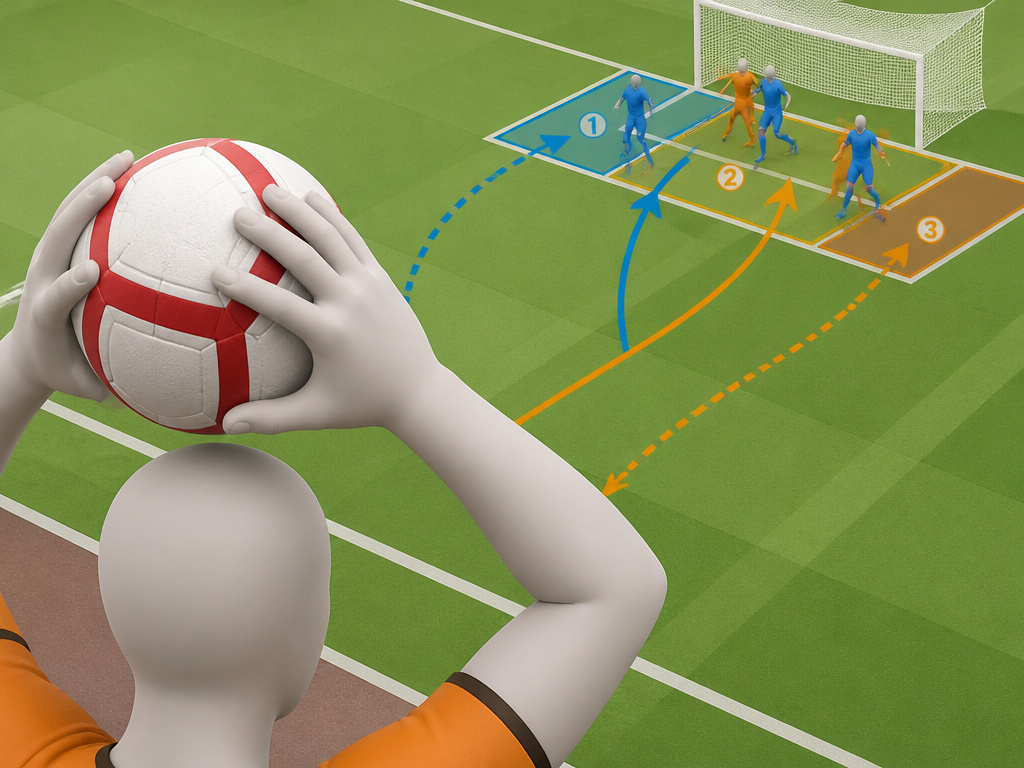
A long throw tossed hopefully into a melee is just a 50/50 ball. A long throw executed as a set-piece routine is a structured attack. The best teams treat it with the same seriousness as a corner kick routines.
Look at the analysis of Cheltenham Town’s League Two promotion season. Their thrower, Ben Tozer, had seven direct assists and six indirect assists from his long throws. Their success wasn’t accidental; it was choreographed. Their typical setup involved:
- Two players outside the penalty area to mop up clearances and prevent counter-attacks.
- Two players at the edge of the six-yard box making central runs to attack flick-ons.
- Three players crowding the goalkeeper on the goal line, hindering his movement and vision.
The throw wasn’t aimed at a single target man. It was fired into a specific zone, between the penalty spot and the six-yard box, where the clustering of attackers and the obstruction of the keeper turned a simple catch into a complex problem for the defense.
This mirrors the evolution of free kick routines. It’s no longer just about the taker’s technique; it’s about the decoy runs, the blocking schemes, and the second-phase positioning. A long throw routine forces the defense to make a series of decisions under physical pressure, and that’s where mistakes happen.
Training the Throw Itself
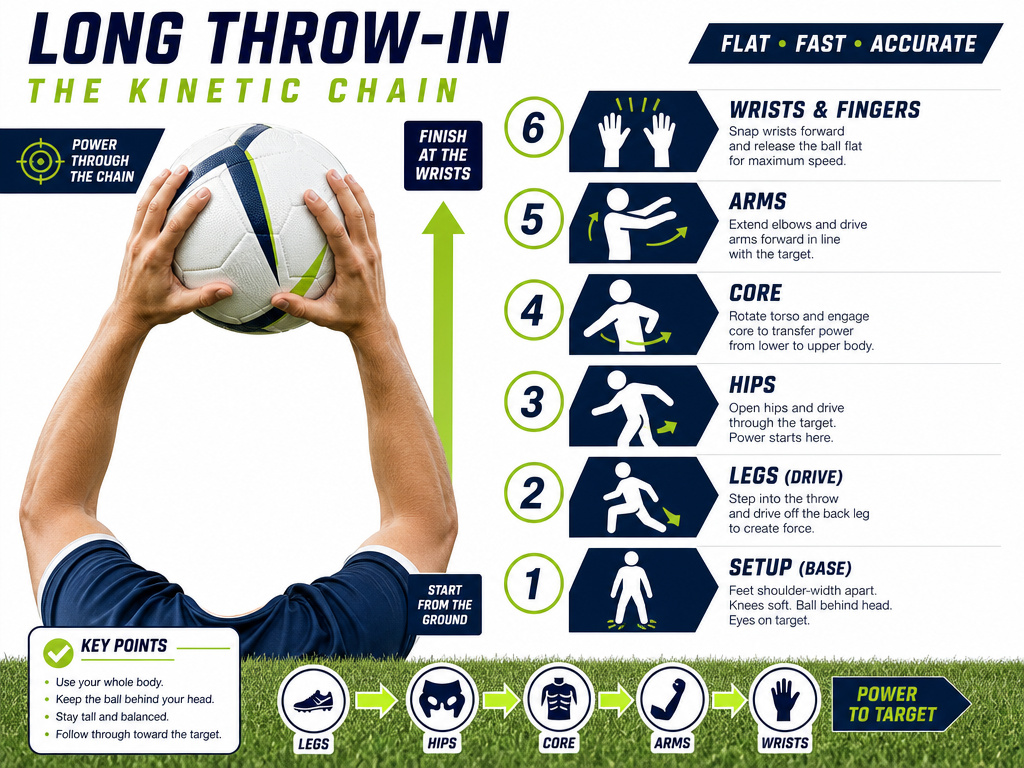
You can’t run a routine if the ball doesn’t reach the mixer. While a Rory Delap-level specialist is rare, any outfield player can be trained to make a 35-yard throw a reliable tool. It’s less about brute arm strength and more about technique, coordination, and repetition.
The classic long throw uses an over-the-head, soccer-style motion. The key is generating power through a kinetic chain: leg drive, core rotation, and a final whip of the arms and wrists. It’s closer to a long pass with the hands than a simple throw. Coaches at all levels now dedicate time to this.
A practical drill used by some academies involves a simple, heavy ball. The idea is to overload the specific muscles used in the throwing motion. By repeating the technique with a heavier implement, the player builds strength in the exact movement pattern. When they switch back to a regular ball, the throw feels easier and travels farther. The focus is always on consistent, flat trajectory, not just maximum distance.
I once tried to coach a youth team throw-in without this kind of specific drill. We just practiced throwing. The result was a lot of looping, hanging deliveries that gave defenders all day to get organized. It took watching a specialist coach for me to see the gap: we were training the idea of a long throw, not the physics of it.
This specificity matters. Liverpool’s hiring of throw-in coach Thomas Gronnemark was seen as eccentric in 2018. The results weren’t. Under his guidance, Liverpool’s possession retention from throw-ins jumped from 45.4% to 68.4%, taking them from 18th to first in the league on that metric. He didn’t just work on long throws; he worked on the decision-making and technique for every single throw, turning a weakness into a strength.
Defending the Long Throw: A Hybrid Approach
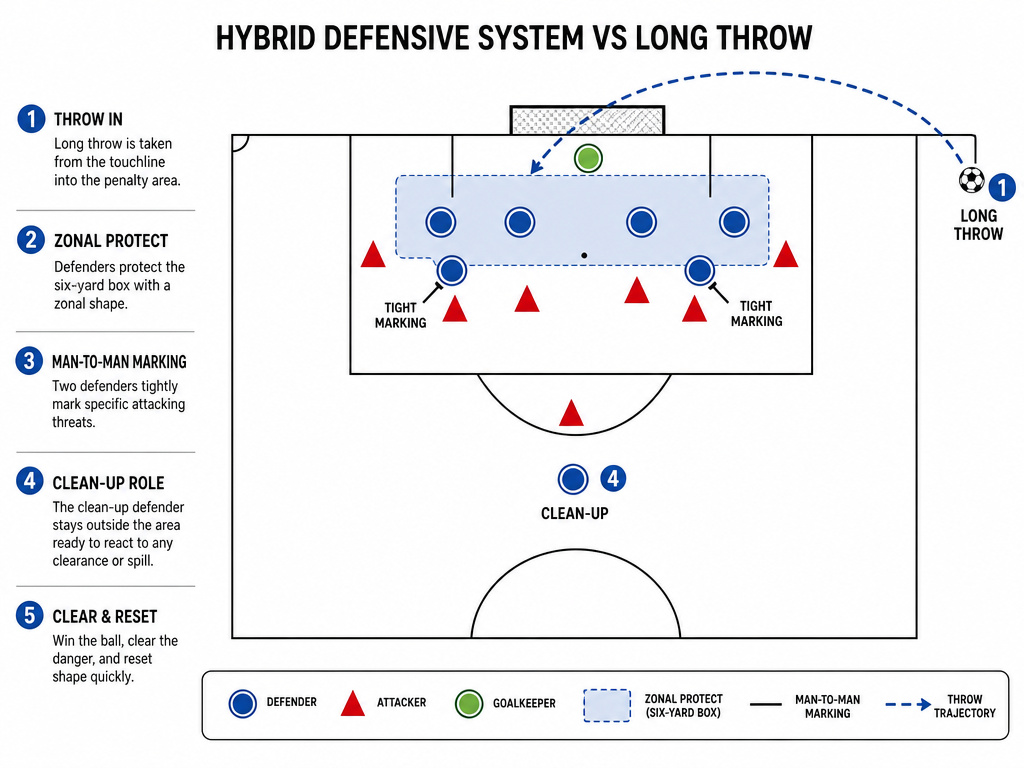
Facing a team with a dangerous long throw is a unique challenge. It combines the aerial threat of a corner kick with the close-quarters chaos of a goalmouth scramble. Defending it purely with zonal marking leaves you vulnerable to clever blockers. Defending it purely man-to-man is asking for a mismatch or a pick play.
The most effective approach against long throw tactics in football is a hybrid system. The general principle is:
- Zonal coverage for critical spaces. Assign two players to patrol the six-yard box and the space in front of the keeper. Their job isn’t to follow a man, but to attack any ball that enters their zone.
- Specific man-marking on key threats. Identify the one or two primary attacking targets, usually the players making the near-post run or the main aerial threat, and stick to them.
- A dedicated “clean-up” player. One midfielder should be stationed just outside the penalty area, with the sole instruction to win the second ball. So many goals from throws come from knockdowns that fall to this zone.
The defensive team must also decide on their level of pressure. Applying immediate pressure on the thrower and his short options can force a hurried, less accurate long throw. However, it also pulls defenders out of their organized shape in the box. Sometimes, the better choice is to drop, get set, and focus on winning the first header, which is where winning headers technique becomes paramount.
| Defensive Strategy | Pros | Cons | Best Against… |
|---|---|---|---|
| High Pressure | Forces rushed throw, can cause turnovers high up the pitch. | Leaves space in behind, disrupts zonal shape in box. | Teams with a hesitant thrower or poor short options. |
| Organized Drop | Maintains compact defensive shape, good for winning first header. | Gives thrower time to pick his spot and measure delivery. | A specialist thrower with excellent accuracy. |
| Mixed/Hybrid | Balances risk, can adapt to the thrower’s choice. | Requires excellent communication and discipline. | Any capable long-throw team. |
The goal is to turn a high-variance set piece back into a 50/50 duel, and then win that duel.
The Broader Tactical Picture: Throw-Ins as Micro-Moments
A throw-in is never just a throw-in. It’s a micro-restart that offers a brief moment of controlled possession. The top teams see it as an opportunity to probe, switch, or reset. Anthony Barry, now a coach with the England national team, underlined this by analysing every one of the 16,380 throw-ins from the 2018-19 Premier League season.
His conclusion was that higher-ranked teams used backwards and lateral throws more often because they valued possession. This philosophy transforms a throw from a mere restart into a tactical tool. A quick throw can exploit a defender who has switched off. A lateral throw can switch the point of attack and stretch a compact low block. A safe throw backwards is a way to reset the attack and draw the opponent out.
Even the act of taking the throw can be tactical. The rules for a throw-in allow the taker to move up the line, changing the angle of delivery. This simple movement can open a passing lane that didn’t exist a second before.
The final layer is game state. Research shows that when a team is losing by more than two goals, their probability of success from a throw-in sequence actually increases. The logic is simple: they have to take more risks, and the defending team may sit deeper. This is when the long, forward throw becomes not just an option, but a necessity. Understanding this, that the “correct” throw depends on the score, the time, and the opponent’s mindset, is what separates a functional team from a tactically intelligent one.
Using Short Throws to Disrupt Defenses
While long throws aim for the penalty area, a short throw can be a highly effective alternative. They allow for a quicker restart, reducing the time defenders have to organize. This makes short throws an excellent tool for maintaining control, especially in the defensive third. Teams can use the threat of a long throw to draw defenders into the box, then take a short one to a free player and build a more controlled attack.
The Psychological Pressure of a Long Throw
A long throw into the penalty area creates a unique form of chaos. The trajectory and crowded landing zone force defenders to make quick, pressured decisions in a confined space, often while backpedaling towards their own goal. This environment is prone to defensive errors, misplaced clearances, and panic. The sheer physical presence of multiple attacking players challenging for the ball disrupts defensive shape and focus. Teams that consistently deliver dangerous long throws cultivate this anxiety, knowing that even if a direct goal doesn’t come, the resulting scramble can lead to secondary chances like corners or shots from loose balls, turning a simple restart into a sustained threat.
Frequently Asked Questions
How do you train for a long throw-in?
Focus on technique over strength. Practice the over-the-head motion with a focus on leg drive and a follow-through that ends with your chest facing the target. Drills include using a slightly heavier ball to build specific strength, and repetitive throwing at a target zone from increasing distances. Consistency and a flat trajectory are more important than maximum distance.
Who is the most famous long-throw expert?
Rory Delap of Stoke City is the most iconic. Between 2008 and 2012, his long throws were a primary attacking weapon, leading directly to 25 goals. In the modern game, coaches like Thomas Gronnemark (formerly of Liverpool, now with Brentford) and analysts like Anthony Barry have pioneered the data-driven study and coaching of throw-ins.
Are long throws like corner kicks?
Yes, in their attacking intent and routine-based design. Both are set pieces aimed at creating goal-scoring chances from a static start. However, corner kick routines have the advantage of the ball being stationary and placed closer to the goal. Long throws offer a flatter, faster trajectory and, crucially, are not subject to the offside law.
What makes a good long-throw taker?
While upper-body strength helps, the primary attributes are technique and consistency. A taker needs a repeatable motion that generates a fast, flat ball into a predictable area. It also helps if they are a defender or midfielder, as their primary position on the pitch often aligns with where throw-ins are awarded. Psychological composure under pressure is a bonus.
Why don’t more teams use long throws?
Many teams prioritize possession retention, and the data shows long, forward throws significantly increase the chance of losing the ball. There’s also a lingering stylistic snobbery associating long throws with “direct” or “ugly” football. Finally, developing a truly dangerous long throw requires dedicated training time for a skill that might only be used a few times a match.
Before You Go
The modern game has room for both philosophies. The possession-focused team will master the quick, safe throw to control the game’s rhythm. The pragmatic, chance-creating team will hone the long throw as a surprise weapon. The most dangerous teams, as The Athletic long-throw tactics article suggests, are learning to do both.
The next time you watch a match, don’t tune out during the throw-ins. Watch the taker’s decision. Is it a fast, backwards tap to retain control? Or is it a deep breath and a run-up, signaling a rehearsed routine is about to unfold? That split-second choice is a tiny window into the manager’s entire game plan. It’s a small moment with big implications, and that’s the beauty of it.
