
Free Kick Routines in Football: Designing and Practicing
This post contains affiliate links. As an Amazon Associate, we earn from qualifying purchases.
A free kick routine in football is a pre-planned, rehearsed pattern of play designed to create a scoring chance from a dead-ball situation. It moves beyond a simple shot, using player movement, decoys, and specific passes to outsmart an organized defense.
That definition is the starting point, but the real game is in the margins, the 9.15 meters of space the defense must give you, and the few seconds you have to decide how to use it. The ones that score rehearse their free kick routines in football.
What follows is a breakdown of the types of kicks, the core routines you can steal, and a practical 7-step framework for designing and drilling your own. This isn’t about copying Barcelona; it’s about giving a youth team or Sunday league side three reliable ways to turn a foul into a goal.
Key Takeaways
- The minimum defensive distance of 9.15 meters (10 yards) is your tactical canvas, use the space it creates.
- For direct kicks within ~25 meters, focus on beating the wall with curl, dip, or a driven shot underneath.
- Sources disagree on the effectiveness of indirect free-kick routines: a ResearchGate study found they require almost 36 attempts per goal, while the FIFA Training Centre notes teams often favour indirect routines because direct goals from 25m+ are rare.
- Design 5-7 core routines with variations, and use hand signals to call them live.
- The most effective training uses a 10v10 setup, replicating the game’s chaos and teaching players to recognize triggers.
Direct vs. Indirect Free Kicks: Choosing Your Weapon
The first decision any taker makes is dictated by the referee’s signal. A direct free kick means you can shoot straight at goal. An indirect free kick means the ball must touch another player before a goal counts.
The rules are simple, but the tactical implication is everything. A direct free kick within roughly 25-30 metres of goal is a clear shooting opportunity. From further out, teams increasingly favour indirect routines or crosses.
From a central position inside 25 meters, you’re in shooting range. The job is to beat the wall and the goalkeeper. The classic techniques are the curl over the wall, the driven shot under it, and the knuckleball. Each requires a different technique, from foot placement to follow-through.
Indirect kicks, especially those awarded for technical offenses like offside, force creativity in free kick routines in football. The data from a ResearchGate study of professional football shows just how tough they are: almost 36 indirect free kicks are needed to score a single goal. But when they go in, they count, 64.3% of those goals helped win points. The study also found success was more common when three or four players touched the ball before the shot, emphasizing dynamic, multi-pass routines.
| Kick Type | When Awarded | Primary Objective | Key Consideration |
|---|---|---|---|
| Direct | Fouls, handball | Shoot directly on goal | Beat the wall with technique (curl, power, dip) |
| Indirect | Offside, dangerous play, goalkeeper offenses | Create a shot via a teammate’s touch | Multi-player sequences are more effective than two-touch plays |
Beating the Wall: Shooting Techniques from Prime Positions
When you get a direct free kick in a central area, the wall is your main obstacle. It’s typically three to five players, depending on the angle. Your technique decides how to clear it.
The curl-over-the-wall is the standard. It uses controlled spin to combine height, curve, and accuracy, bending the ball up and around the defenders before it dips down. It’s a game of millimeters and requires hours of practice to make the ball’s flight consistent. Then there’s the driven low shot. This is about timing and observation. If you see a defender in the wall who is eager to jump, or if there’s a gap under a jumping player’s feet, you drive the ball hard and low.
For longer-range specialists, the knuckleball, a shot with almost no spin that moves unpredictably, remains a threat, though goals from 25 meters or further have become increasingly rare at the top level. Whether you’re trying a knuckleball free kick or curving the ball, the principle is the same: you’re not just kicking a ball, you’re manipulating physics to outwit the last line of defense.
Indirect and Wide Free Kicks: Routines for Crossing Positions
When the ball is too wide or too far out for a realistic shot, the kick becomes a crossing opportunity. The principles of delivery and targeting are similar to corner kicks, but the angle is different.
Common mistake: Treating a wide free kick exactly like a corner. The angle is sharper, which changes the flight path and the optimal target area. A driven, lower-trajectory ball to the near post can be more effective than a lofted cross to the penalty spot.
The best wide free kick routines in football use the defense’s expectation against them. The key is rehearsing the timing between the taker’s delivery and the attacker’s run so they meet at the perfect moment.
For indirect free kicks, especially those just outside the box, complexity can pay off. A common and effective routine is the layoff. One player taps the ball a yard to the side, and a second player strikes it first-time. This small movement changes the angle, can wrong-foot the wall, and gives the shooter a cleaner sight of goal. The quality of that first pass is crucial. If it’s off, the whole move collapses.
The 7-Step Framework for Designing a Free Kick Routine
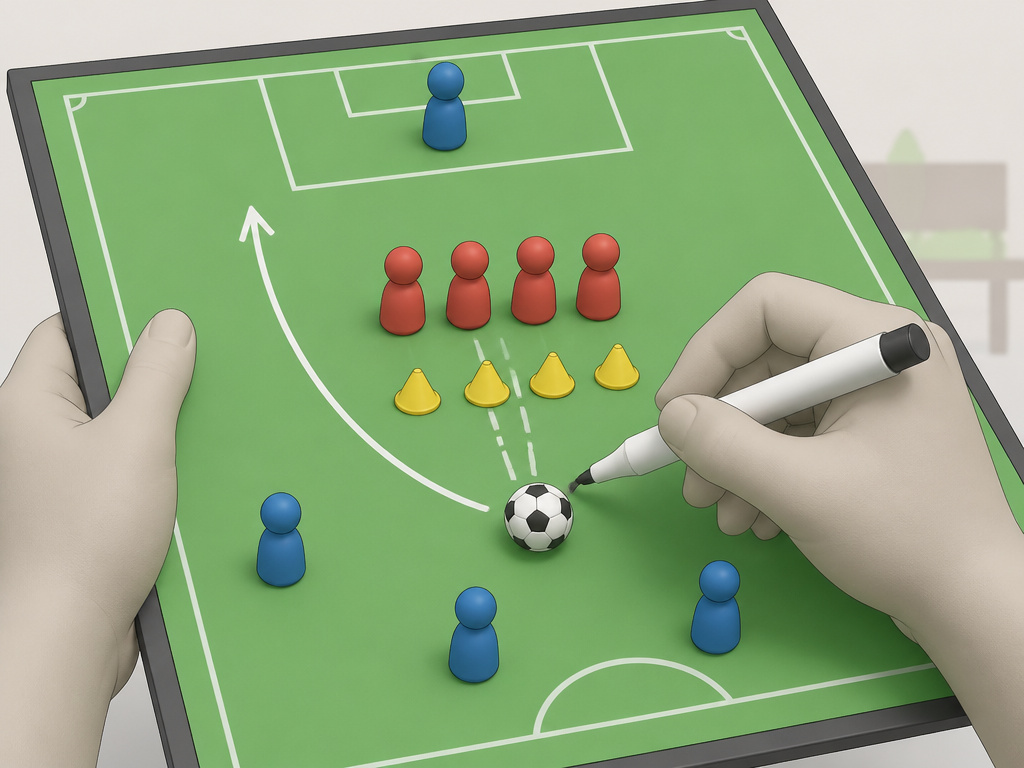
You don’t need to be a set-piece coach to design something that works. This framework breaks it down into coachable steps.
- Analyze the Position. Is it direct/indirect? Central/wide? This decides everything. The closer the ball is to goal, the more important it is to get a shot or one-touch shot.
- Define the Objective. Are we shooting, crossing to a target, or playing short to keep possession?
- Assign Player Roles. Every player in the attacking half has a job. Common roles include: The Taker, The Decoy Runner(s), The Screen/Blocker, The Primary Target, and The Rebound Hunter.
- Map the Trigger Movement. What starts the routine? Is it a hand signal from the taker? A specific run from a decoy? Every attacker must recognize this trigger.
- Rehearse the Timing. This is where drills come in. The sequence from trigger to delivery to attack must be drilled until it’s automatic.
- Build in a Variation. Have a Plan B. If the defense marks your primary target out, can the taker switch to a secondary option signaled differently?
- Practice Under Pressure. Finally, run the routine in a 10v10 opposed drill. Add defenders who know something is coming. The move must work when someone is actually trying to stop it.
Common Player Roles and Movements
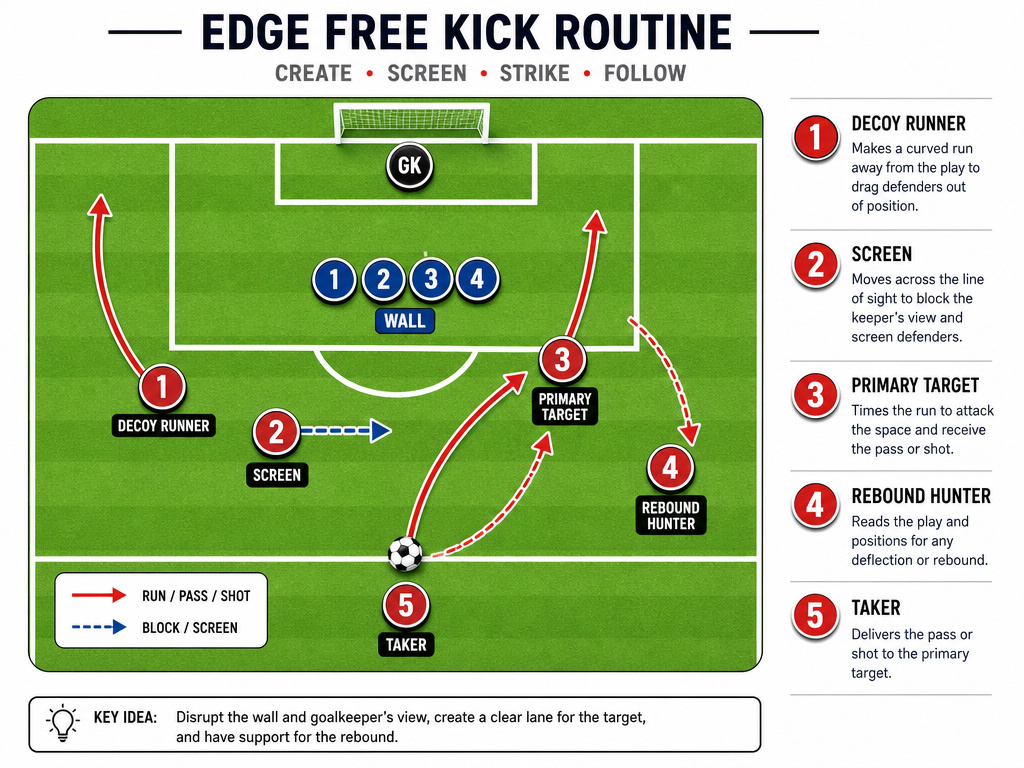
Routines are built from a small set of core movements. Knowing these roles helps you design your own or understand what you’re seeing on TV.
- The Decoy Runner. This player’s only job is to pull a defender out of position. They might sprint over the ball, draw the wall’s attention, or make a run to the near post to clear space behind them. Their movement must be convincing.
- The Screen/Blocker. A player who positions themselves legally near the wall, not to receive the ball, but to obstruct the goalkeeper’s view or impede a defender’s run. They create the space or time for a teammate.
- The Primary Target. The player the ball is intended for, whether for a shot or a header. Their run needs to be timed perfectly with the delivery.
- The Rebound Hunter. Often a player starting from deep or wide, their role is to attack any second ball, knockdown, or rebound with pace.
Where this goes sideways: The decoy runner forgetting their role and accidentally becoming an offside player for the second phase of play. Drill the movements so everyone knows their exit path after their initial action.
Good teams mix these roles. A routine might use two decoys to pull the wall apart, a screen to block the keeper, and a target arriving late. So the taker’s run-up isn’t just ceremony; it’s a calculated part of the movement sequence.
How to Practice: Drills for Repetition and Recognition
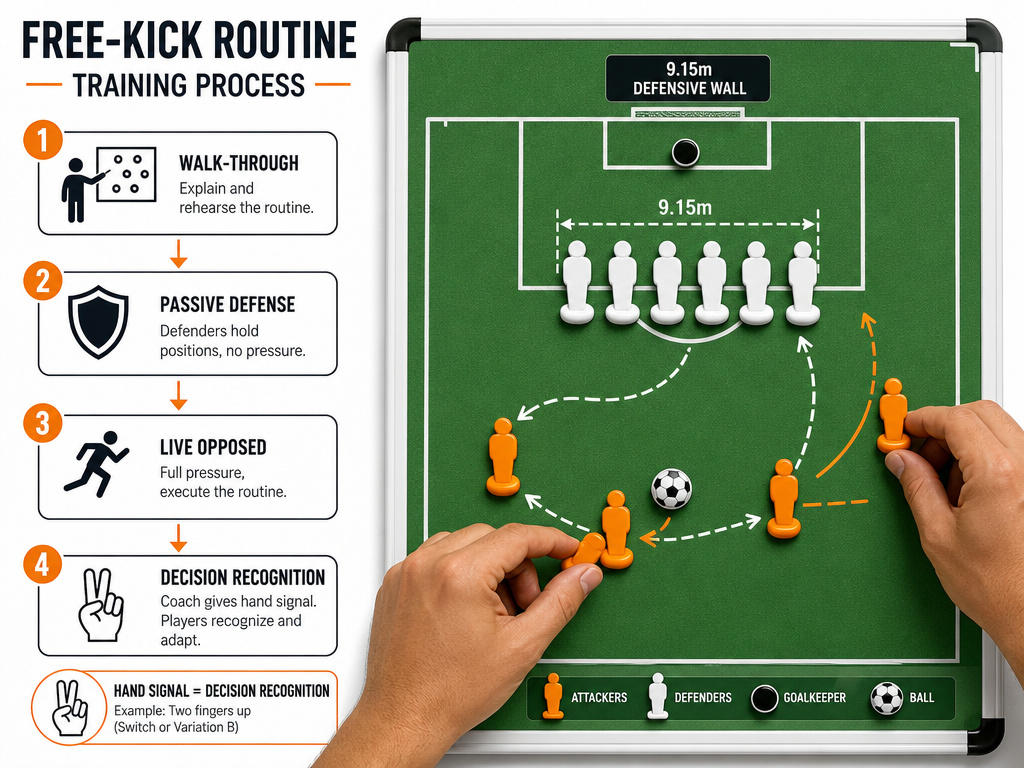
You can design the cleverest routine in the world, but if you don’t practice it, it’s useless on Saturday. Effective training moves from unopposed repetition to pressured execution.
Start with walk-throughs. No defense, no pressure. Place the ball, position your players, and run through the movements at half-speed. Focus on timing and communication. Where should each player be looking? What’s the trigger?
Then, introduce a passive defense. Use mannequins or cones to represent a wall and basic defensive positions. Run the routine against this static setup, working on the weight of passes and the accuracy of delivery.
Finally, go live and opposed. This is where the Elite Soccer Coaching model of a 10v10 set-up is perfect. Play a small-sided game, but award free kicks in realistic areas. The attacking team must call and execute a routine against a live, organized defense trying to stop them. This trains the trigger recognition under pressure and the defensive team’s organization, including key defensive strategies.
On game day, they won a free-kick in the perfect spot. The taker looked at his teammates, everyone froze, and he ended up hitting a weak shot straight at the wall. They had rehearsed the movements but never the decision-making signal. Now, their coach uses a simple hand signal system.
A drill from zone14.ai is particularly effective: use three free-kick takers positioned around the penalty area and a wall of 3–4 defenders plus a goalkeeper. Rotate takers and defenders, focusing on both the attacking technique and the defensive organization, including the critical defensive wall distance of 9.15 meters.
Defending Against Free Kick Routines
A good attacking routine puts equal pressure on the defense. Your job is to stay organized, communicate, and never switch off.
The first rule is to set the wall correctly and quickly. The goalkeeper usually orchestrates this, ensuring the wall covers one side of the goal while they cover the other. Players in the wall must stand shoulder-to-shoulder, resist the urge to turn their backs, and jump together on the strike. One player breaking early is how driven shots under the wall find the net.
Beyond the wall, zonal marking is often safest. Assign players to cover specific zones in the box (near post, penalty spot, far post) rather than tracking runners man-for-man, which can lead to blockers screening you off. Always leave one or two players high up the pitch as a counter-attack threat; it forces the opposition to keep players back.
The most important thing? Don’t be fooled by decoys. Defenders must watch the ball, not the runners, until it is played. If a player runs over the ball, hold your position. The real danger is often a beat later.
Examples of specific free kick routines
Teams typically develop a handful of core routines with variations. Effective indirect routines often involve three or four players touching the ball before the shot. Common tactics include using decoy runners to pull the wall apart or placing a player legally near the wall to block the goalkeeper’s view. For the routine to succeed, the quality of the first pass must be excellent. After the delivery, quick combination play and one-touch precision are essential. It is ideal to have both a good right-footed and a good left-footed player involved around the ball, and teams often use hand signals to communicate which attacking option they will execute.
Quick free kicks
Players have the option to take a quick free kick to catch the opposition off guard. This can be effective before the defensive wall is properly organized. However, the kicker must wait for the referee’s whistle before taking the kick; failure to do so may result in a caution and the kick being retaken. When taking a quick kick, the fundamental principles remain: ensure the ball is properly placed and that your teammates are ready and in legal positions. The closer the ball is to goal, the more critical it becomes to get a shot or a one-touch shot away quickly to exploit the disorganization.
Frequently Asked Questions
What are the best free kick techniques?
The “best” technique depends on distance, angle, and the taker’s skill. For central positions inside 25 meters, the curled shot over the wall is the most reliable. For wider angles, bending the ball around the wall is key. The driven shot under the wall is a high-risk, high-reward option if you spot a defender jumping early.
What is the new free kick rule?
There is no single “new” rule, but enforcement has tightened. Referees ensure the defensive wall is the full 9.15 meters (10 yards) away. They also insist the kicker waits for the whistle, especially in dangerous areas, with quick free kicks only allowed if the attacking team explicitly foregoes the distance measurement.
What are the different types of kicking skills in football?
In the context of free kicks, the main types are the instep curl (using the inside of the foot for bend), the knuckleball (strike with the laces for minimal spin), the driven shot (powerful, low trajectory), and the chip (lofted for indirect routines). Each requires different foot placement and follow-through.
What are the different types of free kicks in football?
The two official types are direct and indirect. Understanding the difference between direct and indirect free kicks is fundamental. Direct kicks can be shot straight at goal. Indirect kicks require a second touch. The referee signals an indirect free kick by raising one arm vertically until the ball is touched.
Before You Go
Designing a free kick routine isn’t about drawing complex plays on a whiteboard. It’s about identifying one vulnerability, a goalkeeper slow to cover his near post, a defender who always jumps in the wall, and building a simple, repeatable movement to exploit it.
Start with one direct routine for central areas and one indirect routine for the edge of the box. Drill them until the trigger is instinctive and the timing is crisp. The difference between a hopeful punt and a rehearsed goal often comes down to ten minutes of focused practice each week. That’s a trade any coach should take.
