
How to Defend Free Kicks in Football: Step-by-Step
This post contains affiliate links. As an Amazon Associate, we earn from qualifying purchases.
To defend free kicks in football, build a wall of four or more players at least 9.15m from the ball, assign zonal and man-marking defenders around the box, and let the goalkeeper decide whether to protect the goal line or claim space. The setup shifts with distance, angle, and the taker’s foot.
The goalkeeper’s call between defending the goal and defending the space is where most amateur teams lose the duel before the ball moves. Get that read wrong, and no wall configuration saves you. This is a fundamental principle of how to defend free kicks in football.
What follows: the wall build, the keeper’s decision tree, the rule traps referees actually enforce, and the wide-area adjustments that separate a clean sheet from a Trippier special.
Key Takeaways
- A wall must sit at 9.15m from the ball; attackers within 1m of a three-player wall concede an indirect free kick
- The wall costs goalkeepers 1.5cm of extra hand error (skilled) to 3.6cm (naive) by blocking the first 150-250ms of ball flight
- Goalkeepers at the 2024 Olympic tournament averaged 0.73 interventions per 60 minutes when defending free kicks
- Liverpool’s wide free-kick block uses a seven-player high line with a dedicated runner-blocker; Newcastle switched to man-marking near the six-yard line
- A quick free kick taken before opponents retreat is fully legal, and the referee allows play to continue.
Four Defenders, One Gap: Building the Wall
Minute 23, a Thursday night in the lower divisions, and I watched a back four shuffle into a wall so loosely spaced that the taker threaded it like a needle through a curtain. The ball hit the net before anyone jumped. That gap between the second and third defender is the whole ballgame.
The wall exists to shrink the shooting angle and force the taker over the top, a core part of how to defend free kicks in football. IFAB’s Law 13 requires opponents to stand at least 9.15m (10 yards) from the ball until it enters play. The referee measures that distance with strides, not a tape, but the number is fixed in the official free kick rules.
The 9.15m requirement applies to all opponents unless they are on their own goal line between the goalposts. Where three or more defending players form a wall, every attacker must stay at least 1m from that wall until the ball is in play. A violation by an attacker results in an indirect free kick to the defending side.
Here is the build sequence:
- Count the shooting angle. The goalkeeper or the nearest defender marks the outside post with the outermost wall player. The rest fill inward. Skipping this alignment leaves a sliver of goal visible on the far side, and a curled shot finds it within a single strike.
- Set the number of players. The defensive wall must be dense enough that no ball passes between legs.
- Jump on the strike, not the run-up. Defenders who leap early land flat-footed and lose the second block. The timing cue is the boot making contact, not the approach.
- One player lies flat behind the wall. This is the “Crocodile,” first used by Figueirense defender Ricardinho around 2013 to stop low curls under a jumping wall. Marcelo Brozovic carried it into a 2018 Champions League match against Luis Suarez, and now it is standard. The prone player blocks the ground-level trajectory the jumpers cannot cover.
- The wall holds until the whistle or the strike. If the referee has signalled a direct free kick and the attackers are set, the wall stays. Moving forward early draws a caution for failing to respect the distance.
The Crocodile and the Low Shot
The prone defender has one job: cover the ground-level curl that clears the jumping wall by centimetres. If the taker strikes under the wall, the Crocodile’s body absorbs the shot. If the ball goes over, the jumpers deal with it. Assigning this role to a player who panics and stands up is how you concede a low driven shot into the bottom corner.
Here is the bit most people miss. The wall is not a free win. A peer-reviewed free-kick defense study published in PLOS ONE measured what happens to a goalkeeper’s hand accuracy when the wall blocks the first 150-250ms of ball flight. Skilled keepers showed a 1.5cm larger spatial hand error with a wall present. Naive participants showed 3.6cm. Under short flight times (elite shots exceed 28m/s), those errors grew to 2.8cm and 4.5cm respectively. The study’s authors urged goalkeepers to continuously evaluate whether the wall is their best option, particularly against takers whose shots consistently scale it. This creates a tension with the anecdotal consensus from coaching channels, which often treats the wall as a fundamental and universally used defensive tool. The data says the wall can cost you centimetres of reaction time against a specialist.
Pascal Zuberbuhler’s Rule: Defend the Goal or Defend the Space
Pascal Zuberbuhler, the goalkeeping expert in FIFA’s Technical Study Group, laid out the decision tree in his analysis of the 2024 Men’s Olympic Football Tournament. The first question the keeper asks: can the taker shoot with the first strike? If yes, the priority is the goal. If a delivery into the box is more likely, the priority flips to defending the space.
The numbers back the pro-active approach. Goalkeepers at that tournament made an average of 0.73 interventions per 60 in-play minutes when defending free kicks, counting both aerial controls and defensive line supports. Morocco’s Munir El Kajoui topped the table at 2.41 interventions per 60 minutes. That is a keeper reading the play three times as aggressively as the tournament average.
Zuberbuhler’s framework asks the keeper to scan before the ball is struck:
- How many players stand over the ball, and which might take it
- Whether the designated taker is a free-kick specialist
- The exact distance and angle relative to the goal
Argentina’s Geronimo Rulli illustrates the space-defence read. Facing a free kick over 36m from goal with two takers standing over the ball, Rulli positioned himself 3.71m off his goal line and just over 12m from his defensive line. The distance meant a direct shot was unlikely, so he prioritized claiming the delivery zone. When the right-footed cross came, he had time to judge the flight and punched clear with two hands.
The disagreement here is instructive. The same FIFA source shows that even with a possible attempt at goal from long range, the keeper’s main priority can still be the space. That contradicts the simple “if they can shoot, stay on your line” rule. The distance and the taker’s profile override the binary.
For your own keeper, the practical tool is video. I run free-kick clips through Hudl Sportscode to tag the taker’s preferred foot, curve direction, and whether they aim over or around the wall. Pair that with Wyscout scouting reports on the opposition’s set-piece takers, and the keeper walks onto the pitch already knowing the likely trajectory. For sketching the block before training, TacticalPad allows you to drag defenders into positions and show the players the gap you are concerned about.
The 9.15m Trap and the Quick-Kick Loophole
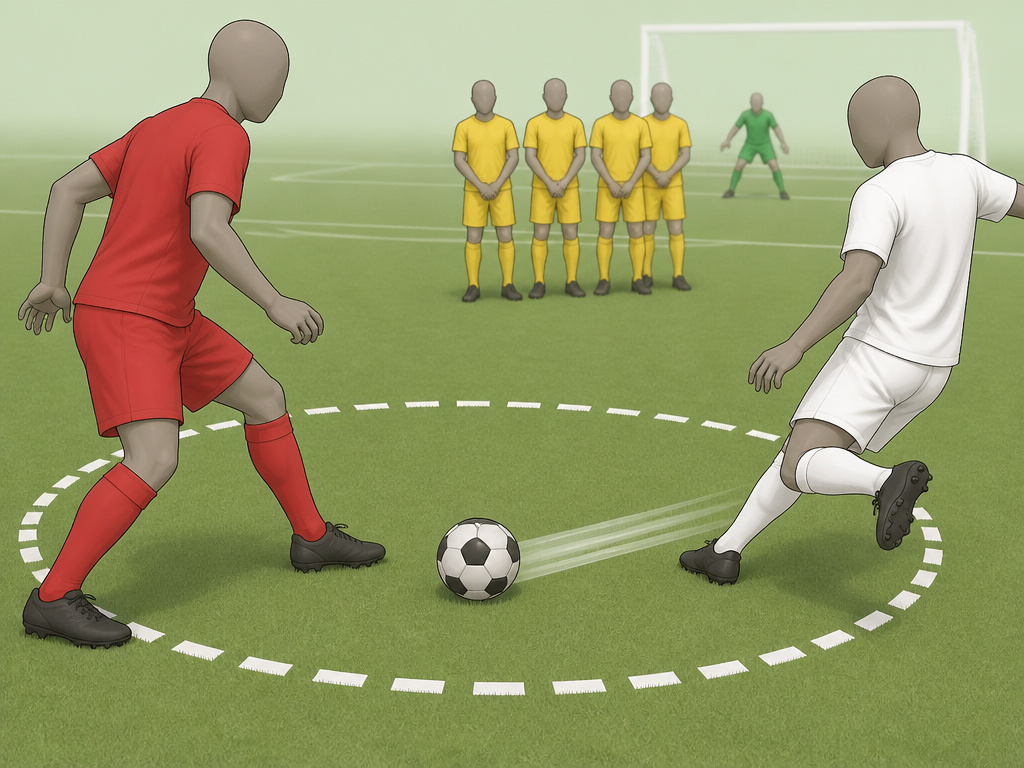
9.15m. That number governs everything, and most youth teams get the enforcement wrong.
IFAB’s Law 13 states that opponents must remain at least 9.15m from the ball until it is in play. The referee can retake the kick if an opponent is closer. However, there is a critical exception: if the taker plays the ball quickly and an opponent inside 9.15m intercepts it, the referee allows play to continue. The taker accepted the risk.
That exception changes how you defend. A wall still forming is a wall that can be bypassed in two seconds. The free kick rules also protect the defending side in the penalty area: if a defending team takes a quick free kick from inside their own box and opponents are still inside because they lacked time to leave, play continues. But if an opponent deliberately stays inside and intercepts, the goal is disallowed and the kick is retaken.
A defender who deliberately prevents a quick restart gets a yellow card for delaying the restart of play. That is a caution, not a foul. The referee does not award the free kick again; the offender simply carries a card.
Charging the Taker: When to Send a Presser
Some teams send one or two players to close down the taker before the strike, cutting the shooting angle from the front.
The direct-vs-indirect distinction matters here. On an indirect free kick, the ball must touch another player before a goal counts. A presser who blocks the shot but does not touch the ball cannot prevent a goal if the taker lays off to a teammate. Check the direct vs indirect classification before you decide whether a presser is worth the wall disruption.
Wide Free-Kicks: Why Liverpool and Newcastle Set Up Differently
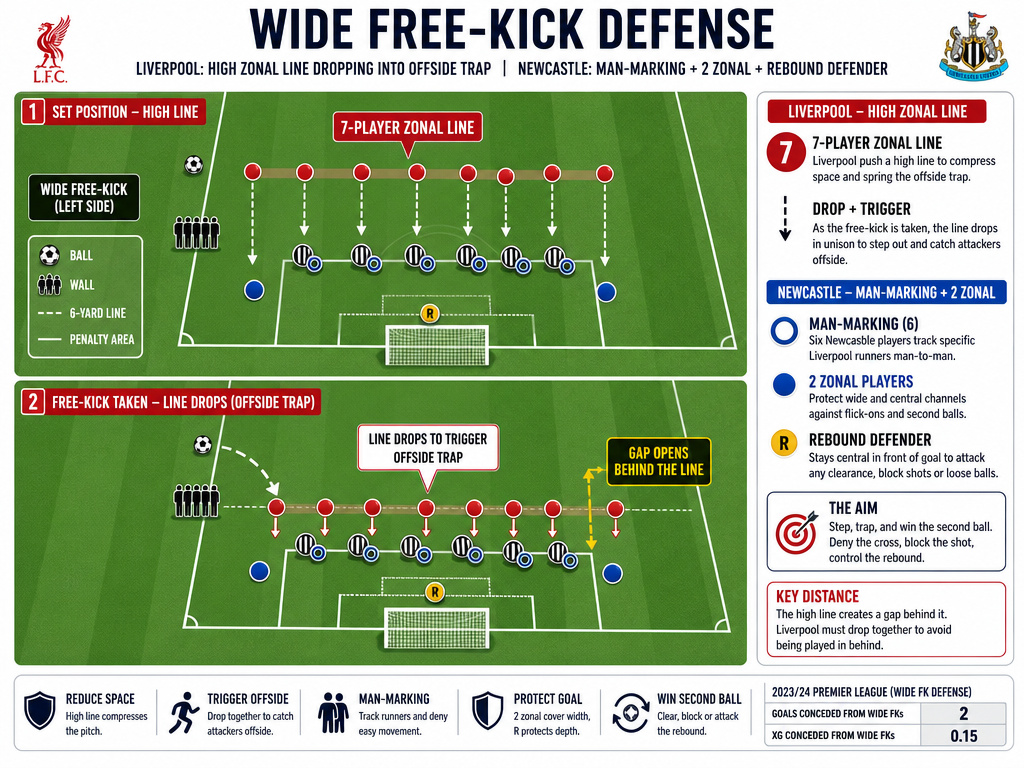
Have you ever noticed that the same free kick, same angle, same distance, produces two completely different defensive shapes depending on which team is in the blue shirt? That is not inconsistency. That is a read of the opposition’s routine.
Total Football Analysis broke down Liverpool’s main system against wide free kicks: a high line of seven players who drop late on the offside trap, plus one player standing in front of the line to block a pacey runner.
The scheme depends on two variables: the distance of the kick from the goal (near versus far) and the location on the field (central, outer flank, or half-space). As the free kick approaches the goal and moves parallel to the six-yard line, the gap between the defensive line and the rebound zone widens. One player cannot cover both functions.
Newcastle took a different path entirely. Facing the same six-yard-line geometry, they abandoned the zonal system and switched to man-marking with only two zonal players plus a rebound defender.
| Element | Liverpool (main system) | Newcastle (near six-yard line) |
|---|---|---|
| Line type | High zonal line, seven players | Man-marking, two zonal players |
| Rebound coverage | Dedicated blocker between line and wall | Single rebound player |
| Trigger to switch | Opponent uses two delivery options | Kick parallel to six-yard line |
| Weakness exploited | Gap between wall and line widens | One player cannot cover line and rebound |
The disagreement between these two approaches is the point when studying how to defend free kicks in football. There is no single correct system for defending a wide free kick. The defending corners logic applies here too: a hybrid of zonal and man-marking is harder to attack than either in isolation, and the shape must respond to what the opposition is actually rehearsing.
Where this goes sideways: As the free kick nears the six-yard line, the gap between the defensive line and the rebound zone widens. If you keep a single second-zone player covering both, an attacker who runs into that channel arrives unmarked within one touch. Newcastle’s switch to man-marking was a direct response to that geometry.
Five Mistakes That Turn a Clean Sheet Into a Conceded Goal
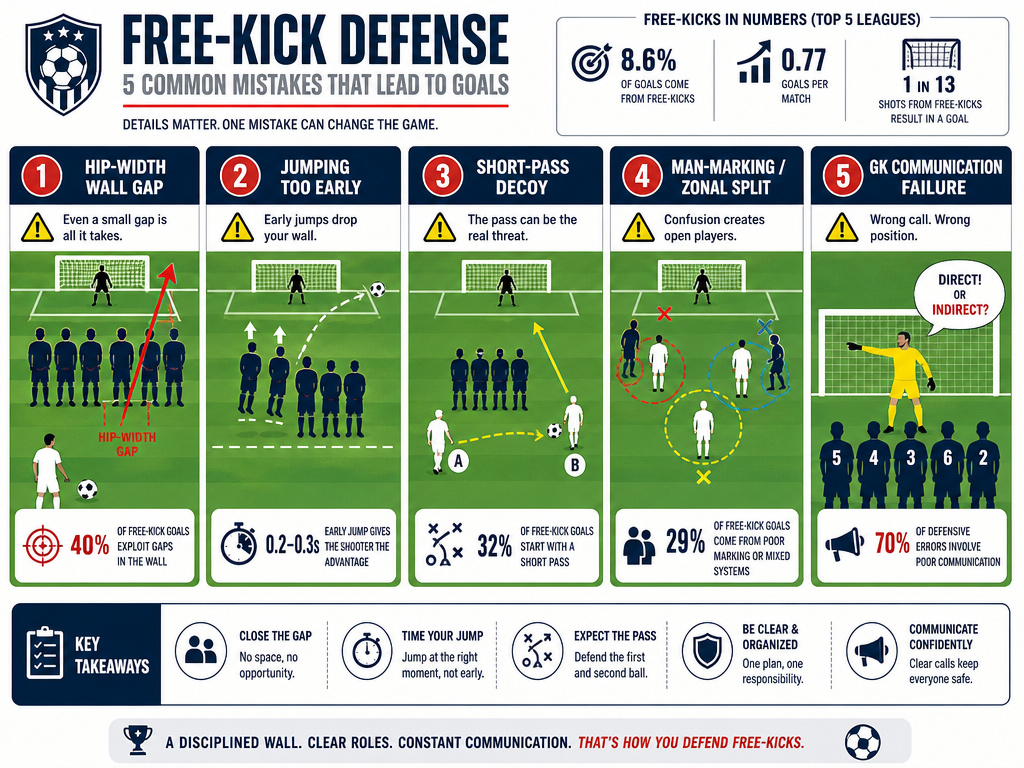
I once blamed a wall defender for a free-kick goal after watching it from the upper stand. The replay showed the keeper had drifted two metres off his line before the strike, opening the near post. The wall was fine. I rewatched before I said another word. That habit has saved me from a dozen wrong verdicts on muddy Saturday pitches.
Here are the errors that actually concede goals:
- The wall gaps. Two defenders standing shoulder-to-shoulder leave a hip-width channel. A driven shot finds it at 28m/s. Close the wall or add a fifth body.
- Jumping on the run-up, not the contact. Early jumpers land flat and cannot re-engage. The cue is the boot touching the ball.
- Ignoring the short option. If the taker has a teammate five metres away, the wall is a decoy. One defender must stay out of the wall to press the short pass. Study the free kick routines your opponent rehearsed in the previous two matches.
- Pure man-marking on a wide delivery. Track runners, and the zonal space behind the line opens. Pure zonal, and a physical attacker wins the header uncontested.
- Failing to communicate the direct/indirect call. The keeper must shout “direct” or “indirect” so the wall knows whether to jump or hold. A wall that jumps on an indirect kick has wasted its energy and left the ground channel open for a lay-off.
Easy to miss: A player on the ground behind a three-man wall counts as part of the wall under the “spirit” of Law 13. If all three defenders are positioned closely together to form a barrier, an attacker standing within 1m of that barrier (including the prone player) concedes an indirect free kick. Referees enforce this. Your wall must include the Crocodile in the measurement.
Rehearsing in the Notebook: Tools That Help
Stick with me on this. You do not need a Premier League analytics department. I sketch blocks in a TacticalPad session before every training night, drag six defenders into the wall, two zonal markers, and a rebound player, then show the squad where the gap opens if the taker goes short. The players see the geometry in ten seconds. Before that, I was shouting “close the gap” and nobody knew which gap.
For match-day prep, tag the opposition’s taker in Wyscout: footedness, preferred curve, average flight time from 25m. Load it into Hudl Sportscode alongside your own keeper’s positioning data. The goalkeeper communication in the box starts before the whistle, with the keeper already knowing whether to stay on his line or claim the space.
Frequently Asked Questions
How do you defend a free kick in football?
Build a wall of four or more players at 9.15m from the ball, align the outermost defender with the near post, assign zonal and man-marking defenders in the box, and let the goalkeeper choose between defending the goal line or the space based on distance and taker profile.
What are the 5 D’s of defending in football?
Why do players lie down to defend free kicks?
Prone defender behind the wall blocks low-driven shots that pass under a jumping wall.
How far do defenders need to be from a free kick?
Opponents must stand at least 9.15m (10 yards) from the ball until it is in play. Where three or more defenders form a wall, attackers must remain at least 1m from that wall. The referee enforces both distances.
Can you defend a free kick without a wall?
Yes. The PLOS ONE study found that the wall adds 1.5cm of hand error for skilled keepers and up to 4.5cm under short flight times.
What happens if an attacker is too close to the wall?
If an attacking player is within 1m of a wall formed by three or more defenders when the kick is taken, the referee awards an indirect free kick to the defending team from the offender’s position. If, when a free kick is taken, an attacking team player is less than 1 m from a ‘wall’ formed by three or more defending team players, an indirect free kick is awarded.
Before You Go
The wall is the visible part. The real defence starts in the keeper’s head two seconds before the taker strikes the ball, when he decides whether his priority is the goal or the space. Get that read wrong, and nine defenders in the box are furniture.
One concession: everything above assumes you know the taker’s profile. In grassroots football you often do not. In that case, default to a five-player wall, one Crocodile, two zonal markers in the six-yard area, and a man-marker on the biggest body in the opposition box. It is not a system. It is a survival shape until you can watch a clip and plan properly.
The best teams rehearse the movement, not the delivery. I saw a youth side at a wet Sunday tournament run the same wide free-kick block three times in ten minutes, and each time the shape shifted by one player because the opposition moved their runner. The coach had drawn it in a notebook before kick-off. That notebook beat a thousand shouty instructions from the touchline.
