
How the Defensive Wall Distance Works in Football
This post contains affiliate links. As an Amazon Associate, we earn from qualifying purchases.
Here’s how the defensive wall distance works in football under IFAB Law 13: every defender stands at least 9.15 m (10 yds) from the ball until the kick is taken, unless they’re on their own goal line between the posts. When three or more defenders form a wall, attackers must stay at least 1 m (1 yd) from it.
Viewers find the goal-line exception the most confusing clause, because a whole defence can stand far closer than 10 yards on an indirect free kick near goal. The bigger gap sits between the written Law and the pitch. Walls creep, referees spray lines, and the punishment on paper rarely matches what happens on a Saturday.
What follows: the exceptions, the sanctions (and where governing bodies disagree on them), what two Bundesliga studies found about creeping walls, and how high school and youth rules shift the numbers.
Key Takeaways
- A defender who intercepts a quick free kick from inside 9.15 m isn’t punished. Play goes on, because the kicker chose to take the risk.
- The attacker gap only applies to walls of three or more, so a two-man wall carries no 1 m rule at all.
- A study of 1,624 Bundesliga free kicks found no statistical advantage for defences whose wall stood too close.
- US high school soccer adds a twist: on a defending-team kick in its own box, opponents must be outside the penalty area and 10 yards away.
- Japanese U-12 8-a-side football uses 7 metres, not 9.15, according to the JFA.
Law 13 in Plain English: 10 Yards, 1 Metre, Two Kinds of Kick
The IFAB Law 13 free kick text sets the number at 9.15 m, and that odd decimal gives the game away. The original measure is 10 yards, and the metres are just the conversion.
Law 13 keeps every opponent at least 9.15 m (10 yds) from the ball at a free kick. The single exception is a defender standing on the defending team’s goal line between the goalposts. Where three or more defenders form a wall, attackers must stay at least 1 m (1 yd) from the wall until the ball is in play.
That one distance covers every free kick, direct or indirect, anywhere on the pitch. What changes is the job the wall is doing.
Direct vs indirect: does the wall care?
A direct free kick can go straight in. An indirect one needs a touch from another player first, and if it flies into the net untouched, IFAB’s answer is a goal kick to the defending team. The referee shows an indirect kick by holding an arm above the head.
For a direct kick near the box, the wall’s purpose is to block part of the goal so the keeper only has to cover the rest. For an indirect kick, the danger is the touch-and-shoot. The wall has to break the instant the ball rolls.
Honestly, I think the indirect free kick inside the box is the most chaotic restart in football. Ten bodies on one line. Pure theatre.
The 1 metre gap added in 2019/20
Attackers used to stand in or right beside the wall, and the shoving that followed ate up time. IFAB ended that for the 2019/20 season.
Now, once three or more defenders line up, every attacker must stay at least 1 m away until the ball is in play. Break it and the defending team gets an indirect free kick from where the attacker stood. The FA’s county guidance for referees spells out the same thing in almost identical terms.
The Scottish FA’s summary of the change was blunt. It said attackers near the wall cause management problems and waste time, and that there’s no legitimate tactical reason for them to be in it at all.
One detail trips up even seasoned viewers. The gap only matters until the ball is kicked and clearly moves, so an attacker who steps inside the metre after that has done nothing wrong. IFAB says the goal stands.
Who Is Allowed Closer Than 10 Yards?
Four kinds of player can stand inside the full distance without breaking Law 13:
- Defenders on their own goal line between the posts. This applies on an indirect free kick inside the box taken closer than 9.15 m from the goal line, where the whole defence can line up on the line.
- A defender lying or kneeling behind the wall. No offence. Play continues.
- Any defender who intercepts a quick free kick. If the kicker goes early and a defender inside 9.15 m cuts the ball out, IFAB lets play continue, since the kicker took a risk to gain an advantage.
- Attackers next to a two-man wall, since the 1 m rule only starts at three.
The lying defender (fans call it the crocodile) covers the gap under a jumping wall, where a low shot can skid through. It looks absurd from the stands: a grown professional face down in the grass behind his team-mates, studs pointing at the sky. It’s also completely legal.
Easy to miss: Two standing defenders plus one lying behind them count as a wall of three. IFAB treats the player on the ground as part of the wall in the spirit of the Law, so any attacker within a metre at the kick hands the defence an indirect free kick.
This is why I keep banging on about quick free kicks. Defenders still jogging back into shape are fair game, and the Law only shields the kicker if the kicker waits. That’s a fair trade.
What Happens When the Wall Creeps Forward?
The referee paces out the distance, turns to talk to the kicker, and by the time he looks back the wall has shuffled forward. Everyone in the ground saw it. So what does the rulebook actually say?
The answer depends on what the creeping defender does next, and on which text you read. (As a Sunday-league defender, I treated the referee’s back as an invitation. I’m not proud of it.)
| Situation | Decision | Source |
|---|---|---|
| Defender inside 9.15 m, ball still reaches a team-mate | Advantage, then caution or warning later | IFAB Law 13 |
| Defender inside 9.15 m intercepts a quick kick | Play continues | IFAB Law 13 |
| Defender closes in and interferes while kicker feints | Caution (yellow card) | IFAB Law 13 |
| Opponent stops a quick kick being taken | Caution for delaying the restart | IFAB Law 13 |
| Kicker goes before the whistle after being told to wait | Retake plus caution for the kicker | IFAB Law 13 |
| Any distance violation | Yellow card and retake | DFB laws, cited by Kolbinger & Link |
Look at the last row. Kolbinger and Link, writing about the Bundesliga, cite the German FA’s laws as saying a distance violation should get a yellow card and a retake. IFAB’s own Law 13 answers are more layered: advantage first, then a caution or just a warning, and no punishment at all for intercepting a quick kick.
Those two can’t both be the universal rule. IFAB writes the Laws that national bodies adapt, while the DFB reading, at least as the study reports it, is stricter. Which one your referee leans on depends on where you play.
If the kicker hasn’t asked for the full distance, a close wall is the kicker’s problem. Once the kicker waits for the whistle, it becomes the referee’s problem.
Note the feint ruling too. Feinting is allowed, so a kicker who dummies and draws a defender forward has done nothing wrong. The defender who charges in and interferes is the one who gets booked.
Building a wall is defending as a team at its most literal: several bodies, one shape, and a referee watching every inch of it.
The Vanishing Spray: A Line Built to Last About a Minute
I’ve had a rule for years: any football story with a suspiciously neat punchline gets checked twice. It started after I passed on a tale that was too perfect and later turned out to be dressed up. The vanishing spray has exactly that kind of origin story.
Here’s the tidy version. Pablo C. Silva, an Argentine journalist, had a free kick blocked by a wall that had closed to about three metres. The referee did nothing. He drove home angry and invented a foam.
His product, 9.15 Fair Play, mixes water, butane and a surfactant in an aerosol can. The name is the distance itself.
Now the checks. Core77, which ran Silva’s account, notes that other inventors floated the idea as early as the 1980s. Kolbinger and Link say South American competitions had used a spray since 2000, and that IFAB approved it at its 126th AGM in 2012.
So who invented it? I can’t give you a clean answer, and I’d distrust anyone who can. Core77 does agree on one milestone: 2014 was the first World Cup to use it.
How the spray fits into a set-piece matters more than the patent fight. Pieced together from IFAB’s Law 13 answers and the JFA’s account of the spray, a ceremonial free kick runs in this order:
- Spot the ball and keep it still. IFAB says a free kick can’t be taken while the ball is moving, so a kick taken on the roll gets stopped and retaken.
- Tell the attackers to wait for the whistle. Skip it and a kicker who goes early has taken a legal quick kick. Give the instruction, and a kicker who goes anyway faces a retake and a caution for unsporting behaviour.
- Mark the ball and the 9.15 m line. The JFA describes the spray marking both the ball’s spot and a line at the full distance. Before it, the JFA says, walls crept forward again after being told to retreat, and kickers nudged the ball when the referee looked away.
- Check the attackers last. With three or more in the wall, anyone inside 1 m at the kick gives the defence an indirect free kick.
- Blow. Dawdle and the line fades before the kick, which puts you back to judging the gap by eye.
The foam goes down as a bright white stripe across the grass. It’s gone within about a minute (the JFA says one minute; Silva’s account says less). That’s the point: it marks this kick and no other.
Referees didn’t reach for it every time, either. After the spray arrived in the Bundesliga, they used it on 308 of the 725 free kicks Kolbinger and Link examined.
How the Defensive Wall Distance Works in Football When Nobody Obeys It
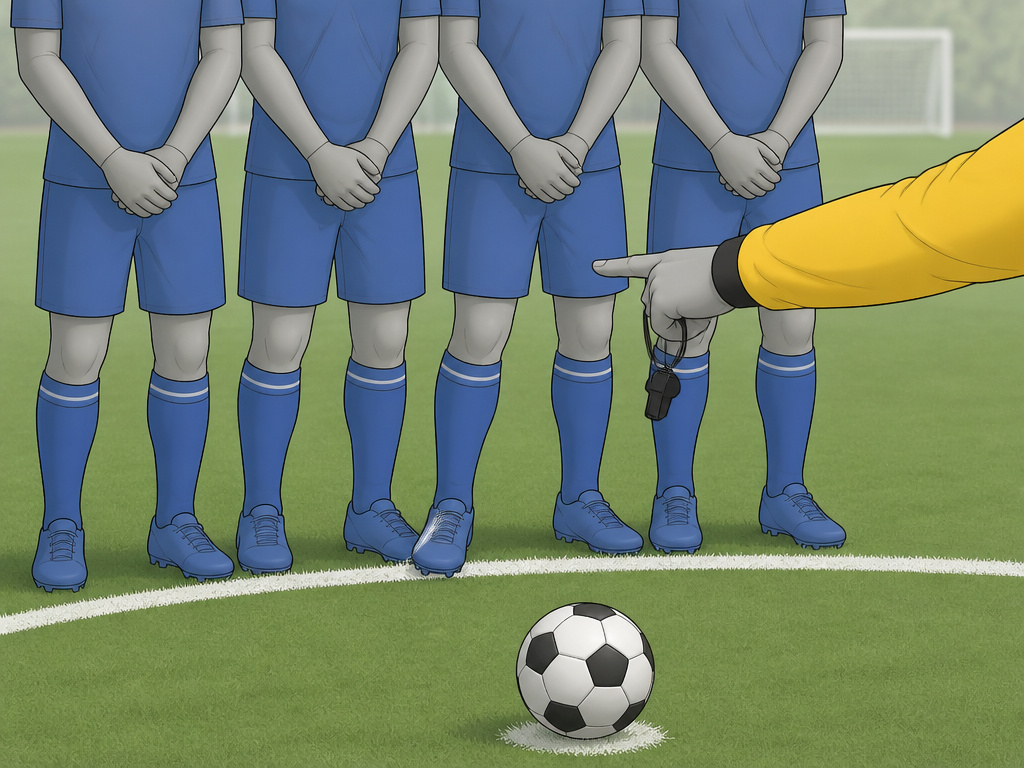
Across 1,624 Bundesliga free kicks taken less than 35 m from goal, Link and colleagues found no statistical advantage for the defence when the wall stood closer than 9.15 m. The result held even when the rule was clearly broken. That runs against everything the stands believe.
The JFA sees it differently. A column first printed in JFAnews in July 2024 calls the 10-yard rule perhaps the “least respected law in football.” It describes a “6-7 metre wall strategy” near goal, with defenders stalling until the referee orders them back.
Who’s right? Here’s my reading, and it’s only a reading. The JFA’s real complaint is stalling and killing quick restarts. Link’s team measured goals, and they also found that central, close kicks bring more rule violations and longer interruptions. The cost of a creeping wall shows up in time, not goals.
I’ll be honest about my limits here. I watch with my eyes and a notebook, not tracking data, and I’d have bet the creeping wall helps. One study of one league doesn’t close the case. It does make me less sure.
The peer-reviewed vanishing spray wall encroachment study adds a twist. Across 1,833 Bundesliga free kicks before and after the spray, the number of distance violations didn’t fall. How far walls encroached did drop significantly, and the authors note the violations weren’t punished appropriately.
The same study found no significant effect on how often shots or crosses succeeded. So the spray did its narrow job and nothing more.
My read: the spray made the cheating smaller, not rarer. A law that players break this openly, and referees punish this seldom, needs firmer enforcement more than it needs a better aerosol. On that, I’m with the JFA, which wants the rules changed so referees can act promptly against walls that are too close.
How Many Players Should Stand in the Wall?
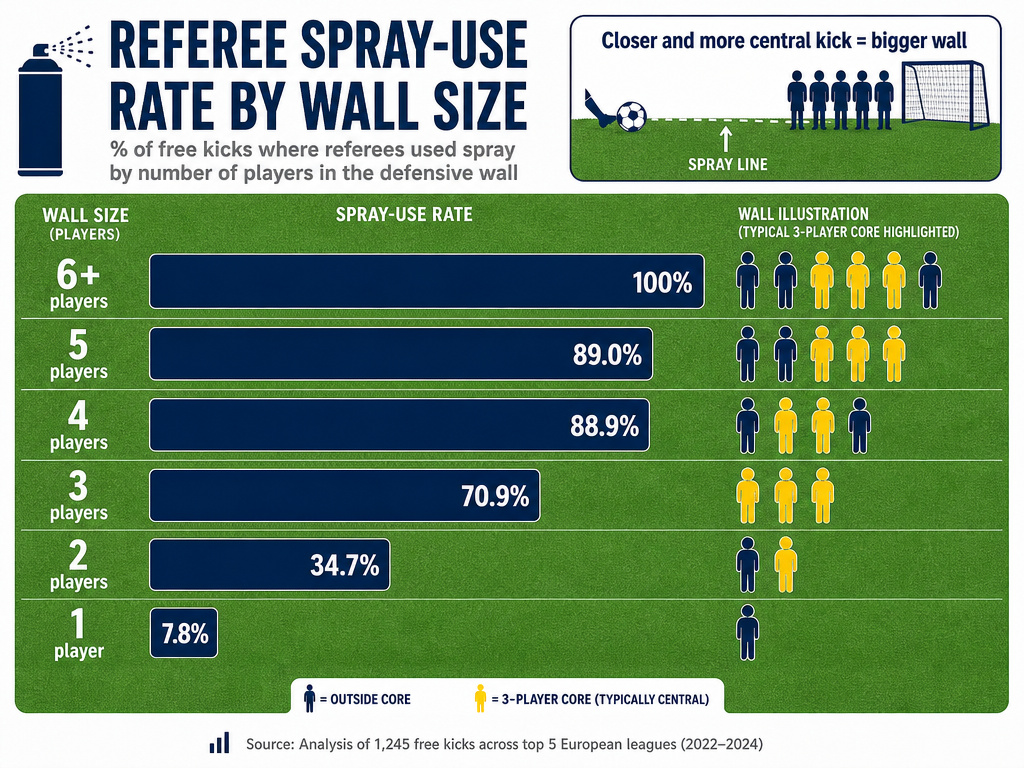
No Law sets the number. It’s a coach’s call, and the evidence points one way: the closer and more central the kick, the more bodies go in.
Link’s team found the share of free kicks scored rose from 5.9% central far to 10.9% central near. Their data also showed centrality and closeness to goal pushing up the number of players in the wall. Bigger threat, bigger wall.
Referees respond to the same pressure. Kolbinger and Link tracked how often the spray came out by wall size:
- Six or more in the wall: every time.
- Five: 89.0%. Four: 88.9%.
- Three: 70.9%, which is still most of the time.
- Two: 34.7%, and a lone defender drew the spray on just 7.8% of kicks, so the distance there mostly goes unmeasured.
Referees, in other words, police the distance harder as the wall grows. A two-man wall out by the touchline barely gets a glance.
A wall works like joinery. The strength comes from how the pieces fit, so players who leave gaps between their shoulders are weaker than fewer players who lock together. A pretty board with loose joints still wobbles.
If you coach, the detail of organizing the wall on free kicks (who lines it up, who jumps, who drops) matters as much as the count. I’d rather see a tight three than a ragged five.
10 Yards, 7 Metres, or Outside the Box: The Rules Change by Level
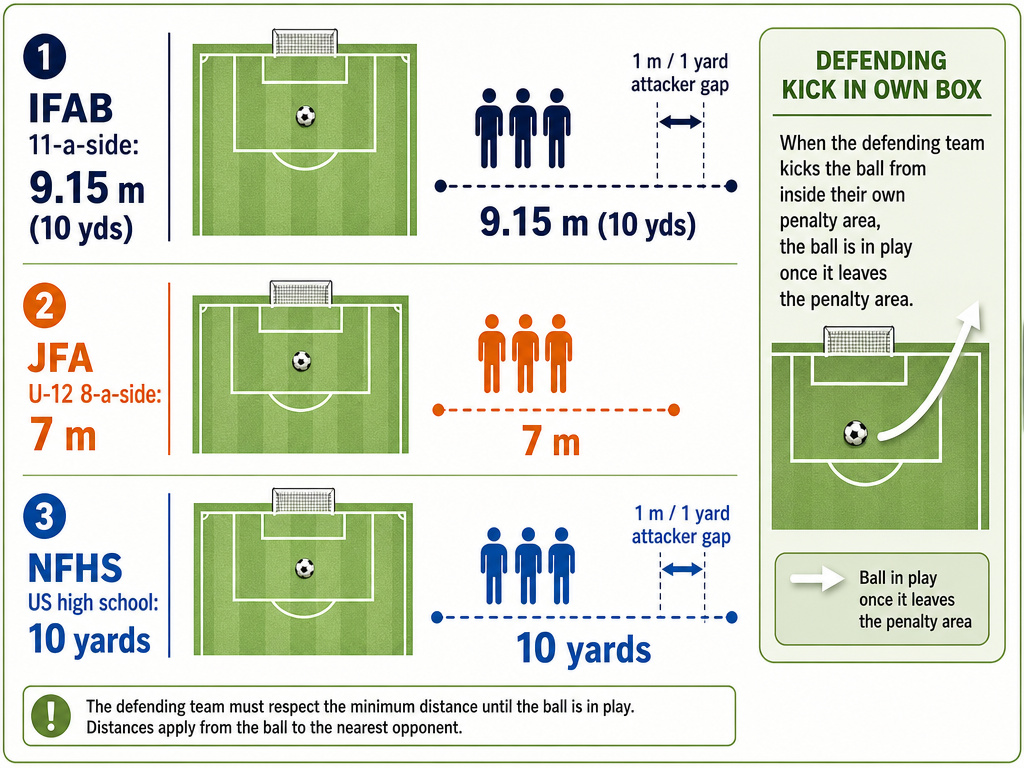
Ten yards is the full 11-a-side standard under IFAB, and the number shifts the moment you leave that game.
| Competition | Distance from ball | Attacker gap from wall | Defending kick in own box |
|---|---|---|---|
| IFAB 11-a-side | 9.15 m (10 yds) | 1 m from a wall of 3+ | Players staying in box can’t gain an advantage |
| JFA U-12 8-a-side | 7 m | Not stated in the JFA column | Not stated in the JFA column |
| NFHS US high school | 10 yards | 1 yard from a wall of 3+ | Opponents outside box and 10 yds away |
The NFHS soccer rules changes 2020-21 brought high school soccer in line on the 1-yard wall gap. Rule 13-3-1 also says that on a free kick to the defending team inside its own penalty area, opponents must be outside the area and at least 10 yards from the ball. The NFHS says the goal is faster restarts and fewer confrontations.
IFAB handles that situation differently. An opponent who deliberately stays in the box and intercepts a quick defending free kick has the goal disallowed and the kick retaken. Same intent, different wording: don’t profit from loitering.
State associations publish their own bulletins on top of the national book, such as the IAHSAA soccer rules document, so check yours before the season starts.
Skip this if: you only play or watch senior 11-a-side under IFAB Laws. For anyone in youth, school or small-sided football, the local handbook beats anything you saw on TV.
My own knowledge of youth rules outside Europe is thin. That’s exactly why I’d trust the JFA on its 7 m figure for U-12 8-a-side over any memory of mine.
Frequently Asked Questions
How far away should the wall be on a free kick?
At least 9.15 m (10 yds) from the ball in 11-a-side football under IFAB Law 13. The only defenders allowed closer are those standing on their own goal line between the posts. US high school soccer uses 10 yards under NFHS Rule 13-3-1.
What is the 10-yard rule in football?
It’s the minimum distance opponents must give the ball at a free kick until it’s in play. In metric terms it’s 9.15 m. A JFA column calls it perhaps the least respected law in the game, because walls creep forward so openly.
Can a defender lie down behind the wall?
Yes. IFAB says a defender lying or kneeling on the ground behind the wall commits no offence, and play continues. If two team-mates stand directly in front of that player, all three count as a wall, so attackers must stay 1 m away.
Do attackers have to stay away from a two-man wall?
No. The 1 m rule only applies when three or more defenders form the wall. The one catch is the lying defender, who can turn a two-player wall into a three-player wall in the spirit of the Law.
Is the distance different in youth football?
Yes, in some formats. The JFA says U-12 8-a-side football uses 7 metres, while 11-a-side always uses 9.15 metres. Your league’s own rules are the final word.
Before You Go
That’s how the defensive wall distance works in football on paper. In practice, I’d push kickers the other way from the crowd’s instinct. If the wall is still walking back and you’ve got a clean pass on, go. A close defender can intercept without punishment, but Link’s Bundesliga numbers suggest a creeping wall isn’t stopping goals anyway.
If you referee at grassroots level, try one change this week. Once three or more defenders line up, check the attackers’ metre before you turn your back on the wall. It’s the infraction that hands the defence a free kick, and it’s easy to forget while you’re busy pacing out ten yards.
The limit of all this: the best evidence comes from two seasons of one German league, and the sanctions differ depending on whose text your referee follows. Treat the data as a strong hint, not a verdict.
So here’s one to argue about: should referees be allowed to book a creeping wall on the spot, or is the spray enough?
