
How to Break Down a Low Block in Football: Step-by-Step
This post contains affiliate links. As an Amazon Associate, we earn from qualifying purchases.
To break down a low block in football, you must shift the entire defensive unit sideways using rapid switches of play before exploiting the created gaps with quick combinations, late runs, and cutbacks. Patience, width, and a deliberate change of tempo are essential, not just desirable.
That’s the textbook answer. The real work starts when you try to teach it. A coach can tell a team to “stretch the block” all day, but if the wingers stand flat or the central midfielders take four touches before looking up, the whole system seizes up. The difference between a frustrated 0-0 and a breakthrough isn’t a new tactical trick, it’s nailing the three or four actions that come before the final pass, which is the core challenge of how to break down a low block in football.
What follows is a walkthrough of the training-ground methods that work, pulled directly from published coaching sessions. We’ll look at the specific player movements that open lanes, the exact drills to practise them, and the common dead-ends that waste your possession. By the end, you’ll have a framework for your next session plan, not just a list of abstract principles.
Key Takeaways
- Stretch the block horizontally first. Force the defensive unit to shift from touchline to touchline with quick switches before attempting any central penetration.
- Target the half-space for cutbacks, not high crosses. A driven ball from the edge of the penalty area or the byline to a late runner beats a big defender more often than a hopeful lofted cross.
- Coach patience as a physical action, not an attitude. Use constrained possession drills that reward 5+ passes before a switch to build the required discipline.
- Your striker’s movement is your key. A centre-forward who drops into the ’10 space’ can pull a centre-back out of line, creating the vertical gap for a third-man run.
- Plan for the transition immediately. Every attacking drill should include a rule for what happens when the ball is lost, as low-block teams live on the counter.
The 4-Step Framework from FIFA’s Training Centre
The most structured blueprint comes from the FIFA Training Centre, via a session designed by former England U-21 coach Aidy Boothroyd. It follows a clear progression from individual skill to team application, built around four core drills.
A complete session to break down a low block progresses through 1v3 attacking scenarios (individual skills), 3v2 scenarios (combinations), 4v4 crossing/cutback drills, and finishes with an 11v11 game. This builds competence from isolated actions to integrated, game-realistic problem-solving.
The logic is sound. You can’t ask a team to execute a complex switch and cutback in a match if they haven’t first mastered the first-time pass and timed run in isolation. The 1v3 drill starts the process by forcing attackers to beat multiple defenders with dribbling or a sharp one-two, honing the solo skill needed when space is minimal.
The 3v2 phase is where combinations click. Here, the coach can introduce a critical rule from Boothroyd’s session: support players follow their passes into the area. This isn’t just about making a pass and stopping; it’s about continuing the movement to become an extra option, overloading the box unexpectedly. Players should consider how to create space for one-touch finishes for themselves and their team-mates.
Player Roles: What Each Position Must Do
Tactics are carried out by people. Generic instructions like “stay wide” or “make runs” aren’t enough. Here’s what each role in a typical 4-3-3 attacking shape needs to focus on against a deep 5-4-1 block.
The Centre-Forward: Your most important decoy. The striker must be willing to drop into midfield, between the opponent’s defensive and midfield lines. This pulls one of the three centre-backs out of position, disrupting their compact shape. The moment that centre-back steps up, the space opens behind for a winger or midfield runner. Their primary job is to create a dilemma, not just to score.
The Wingers/Inverted Wingers: Absolute width is their first duty. They must pin the opponent’s full-backs deep and wide, stretching the back five horizontally. Then, they must attack the half-space, the channel between the full-back and centre-back, with either the ball at their feet or via a run. According to the FIFA session, when receiving a switch of play, the pass should be into their movement path, allowing them to turn and attack without breaking stride.
The Number 8 / Attacking Midfielders: These players are the link between patience and penetration. They are responsible for the tempo. Their first look should always be to the far-side winger to facilitate a switch. They must also be the masters of the late, off-the-shoulder run into the box when the play goes wide, arriving for cutbacks rather than standing static on the edge.
The Full-Backs: In a 4-3-3, your full-backs provide the extra width that the wingers cannot. They must offer an overlapping option to create 2v1 situations, but their crossing should be deliberate: low and hard across the six-yard box or a cutback from the byline. A floated cross to a 5’9″ striker against three 6’2″ centre-backs is a wasted possession.
The Number 6 / Holding Midfielder (in a 4-3-3): This player is the security guard during the long periods of possession. Their role is to recycle the ball, switch the point of attack, and most critically, be the first line of rest defence to stop counter-attacks the moment the ball is turned over.
Practical Coaching Drills and Session Plans
Theory is one thing. Getting it onto the pitch is another. Here are three specific drills from different coaching resources, complete with their prescribed timings and constraints.
1. The “Switch & Overload” Rondo (Warm-Up)
This drill, from a UEFA Pro Coach on iCoachFootball, trains the speed of thought and pass required to shift a block. It uses two 15×15 yard squares separated by a 5-yard central zone. You have 9 players total: 6 Attackers vs. 3 Defenders.
Attackers start with 3v1 possession in one square. They must complete 5 passes to draw the sole defender in. The trigger: once the defender is compacted on that side, they must switch the ball hard and fast through the central zone to the other square, where two attackers sprint to create a new 5v2 overload. It teaches players to “bait the press” and then “punch the pass” to the weak side.
2. Breaking the Lines (Phase of Play)
This 8v6 drill from the same source forces players to find runs in behind. The defending team (a back four plus two midfielders) is not allowed to step past the 18-yard line, simulating a deep block. The attacking team must score, but a goal only counts if it comes from a “third-man run”, a pass from Player A to B, who sets the ball for Player C making a run from deep.
If the defenders win the ball, they have 10 seconds to score in two mini-goals on the halfway line, building in transition awareness. It stops attackers from taking lazy pot-shots from distance and mandates the precise, penetrating pass the low block is designed to stop.
3. A Full Session Plan: Switching Play (Sports Session Planner)
For a ready-made 75–80 minute session for 12 players, one plan outlines a clear progression:
- Directional Possession (15 mins): In a 40×30 area split into 3 zones, play 5v5 + 2 wide neutrals. The central zone is the “low block.” Teams must play through one side and switch play before scoring. RPE is 5-6, effort 70–80%.
- Wide Breakdown Scenario (15 mins): A scenario focusing on breaking down a wide area. RPE 6-7, effort 75–85%.
- Small-Sided Game (20-25 mins): A game where a goal from a switch → wide → goal sequence counts as 3 points. Central players have a 2–3 touch limit.
Where this goes sideways: Running these drills without the constraints. If you let players score without switching first, or let defenders step beyond their line, you’re not practising against a low block. You’re just playing football.
This structured approach, which moves from technical repetition to tactical recognition to game realism, is the answer to the how to break down a low block in football question.
Crossing and Cutbacks vs. Forced Central Play
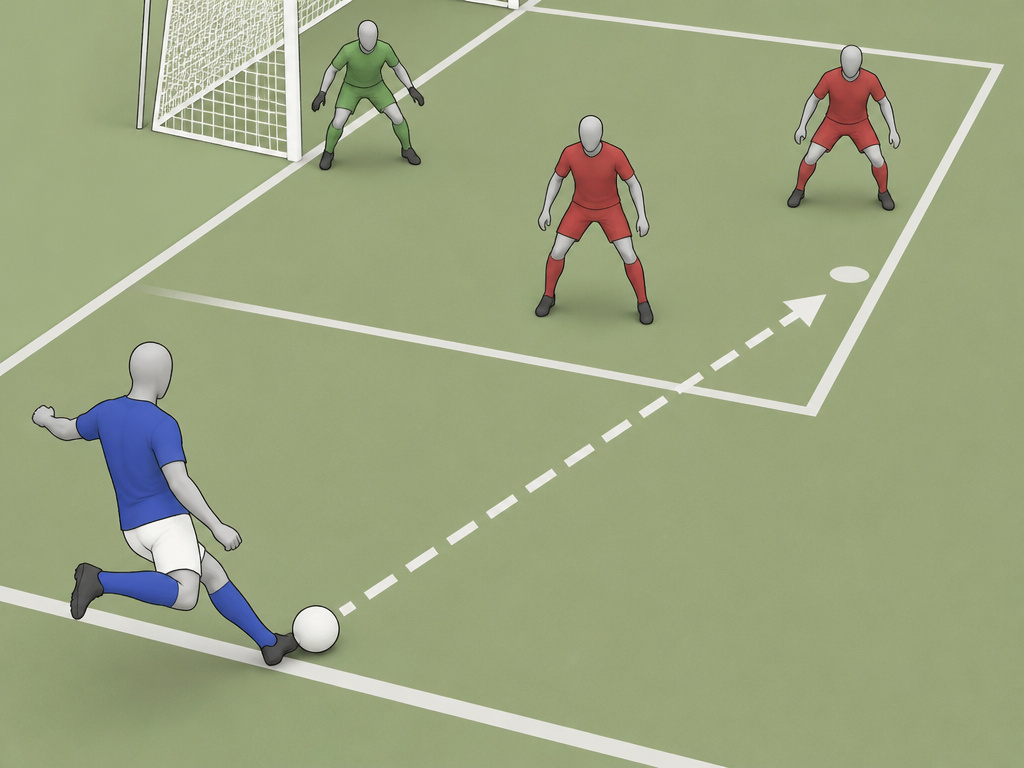
A major fault against a low block is the desperate, hopeful cross. The solution is to change the type and origin of the cross.
The FIFA session includes a dedicated 4v4 drill where wide players focus on crossing from the edge of the penalty area as well as working the ball to the byline for a cutback. The difference in outcome is stark. A cross from the byline, pulled back to the penalty spot, eliminates most of the towering centre-backs from the play. The ball is behind them, and it’s now a footrace.
A key variation in the drill states: wide players are only allowed to play first-time crosses or cutbacks. This eliminates the winger’s habit of taking two touches, allowing the defence to re-set. It forces the supporting runner to time their arrival into the box perfectly, a critical skill against compact defences. Mastering this is a core part of learning how to break down a low block in football effectively.
Common Mistakes and How to Avoid Them
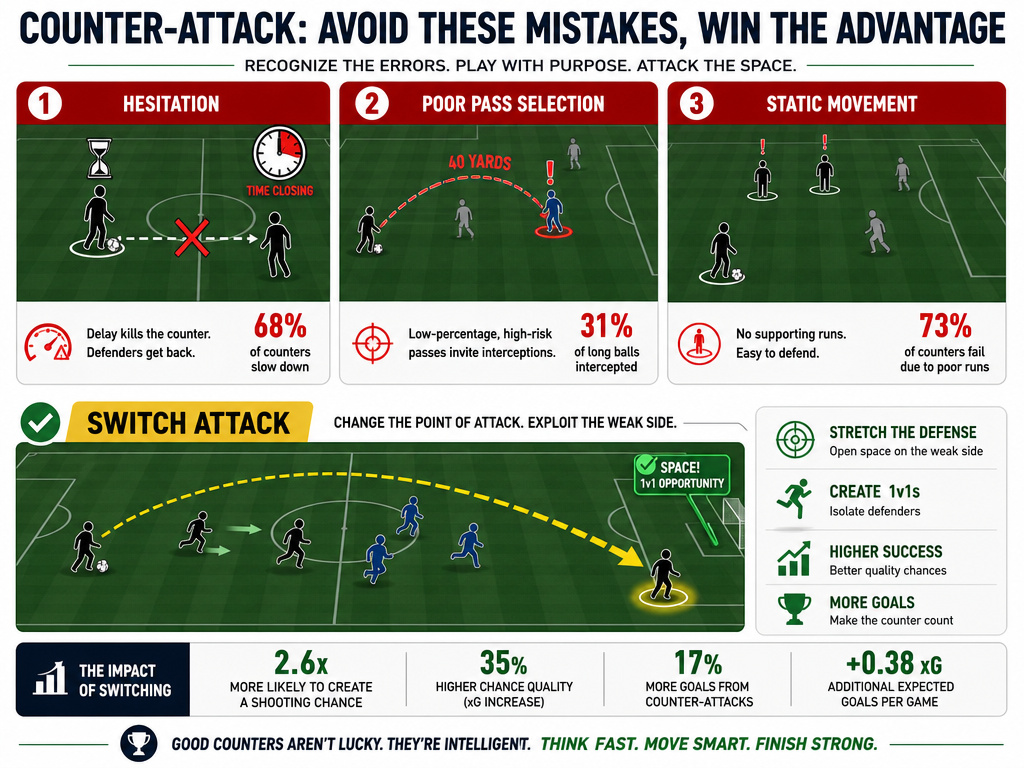
Even with the right plan, teams fall into predictable traps. Here are the quick fixes.
Mistake 1: All attackers gravitating toward the ball. This shrinks your own attacking space and makes the low block’s job easy. The weak-side winger might as well be wearing the same shirt as the opposition.
- Fix: Mandate maximum width. The weak-side winger should be on the touchline, forcing the last defender to cover a huge distance. This creates the space for a through ball into the channel when the switch finally comes.
Mistake 2: Playing at a single, slow tempo. Slow, side-to-side passing lets the defence shift comfortably. A single, constant speed is easy to defend.
- Fix: Introduce tempo changes. Use a slow, deliberate 5-pass sequence to lure the block to one side, then one-touch combinations or a rapid switch to break their rhythm. This is where third-man runs become lethal.
Mistake 3: Ignoring the defensive transition. You commit seven players to attack, lose the ball, and watch three opponents sprint into the acres of space you left.
- Fix: Every attacking drill needs a transition rule. In the “Breaking the Lines” drill, the reward for the defending team winning the ball is a 10-second counter to score. This builds the habit of immediate rest defence and recovery runs.
Mistake 4: Sticking rigidly to one formation. Sometimes the solution isn’t a better 4-3-3, but a different shape altogether.
- Fix: Be prepared to adapt. Boothroyd’s session includes a variation where the defending low block switches from a 4-4-2 to a 4-2-3-1. Your attacking team must then use different movements to find space. This is where understanding the differences between high press and low block systems helps, as each requires a unique tactical response.
Adapting Your Approach: Formation-Specific Solutions
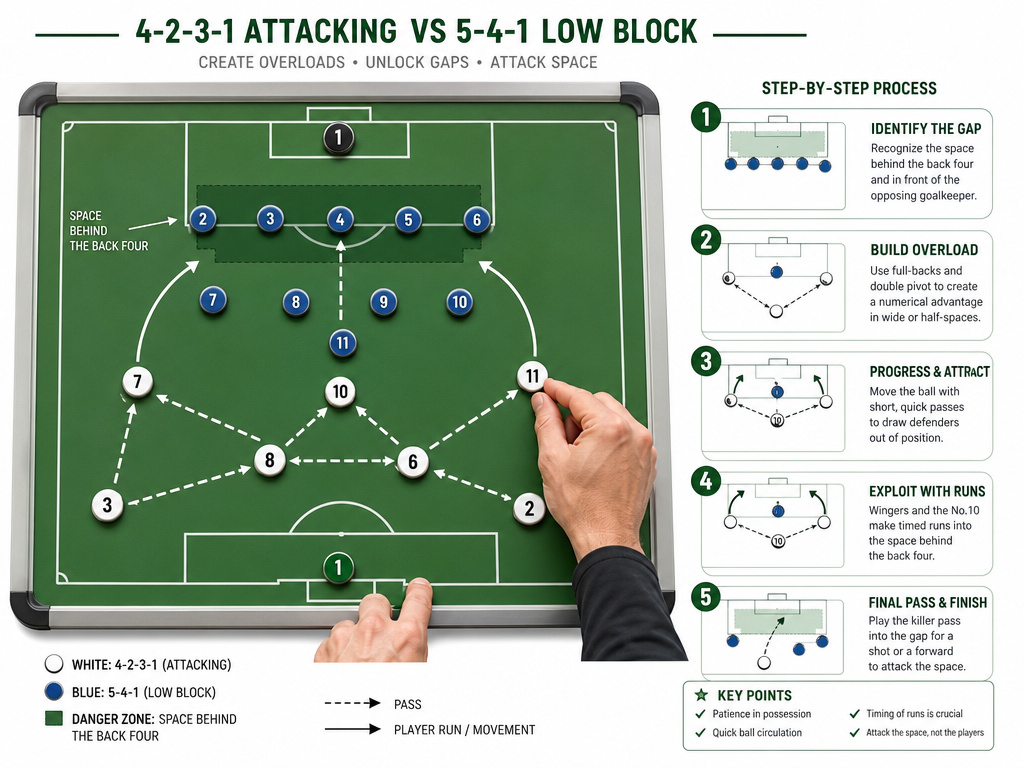
Not all low blocks are the same. A 5-4-1 presents different problems than a 4-5-1. Your attacking formation should offer specific solutions.
For instance, the Elite Soccer session by Fran Alonso is explicitly designed for breaking a medium-low block against a back four. His attacking team of 10 is set up in a 4-2-3-1 formation. The progression is different, too: 16 minutes of unopposed passing rotation, 30 minutes of a finishing drill breaking the back line, and a 30-minute 10v7 possession game. This reflects a different pedagogical approach from the FIFA model, focusing more on positional patterns against a back four. There’s no single right way, the best coaches pull from multiple resources.
The principle remains: you create overloads in specific areas to force a defender to make a choice, then exploit the space their choice leaves.
How to use individual skill against a low block
When a defence packs the penalty area, collective moves can stall. This is where individual skill becomes the key. Coaches design specific drills to hone the solo actions that can unbalance a deep block. One recommended session includes a 1v3 attacking scenario, forcing the isolated attacker to use feints, quick changes of direction, and explosive acceleration to beat their immediate opponents. The objective is to create a moment of superiority where one player’s skill can draw multiple defenders, disrupting the organised shape and creating space for a shot or a final pass. Practising these high-pressure scenarios builds the confidence and technique needed to break down the tightest defences.
Frequently Asked Questions
Can you block low in football?
Yes, a “low block” is a legitimate defensive strategy where a team defends deep in their own half with a compact, narrow shape, often with five or even six defenders in the final line. The aim is to deny space behind the defence and force the attacking team to play in front of them.
What is the 4-4-2 low block setup?
In a 4-4-2 low block, the two banks of four defend very deep, often just outside their own penalty area. The two strikers may drop to harass the opposition’s central defenders but rarely press high. It’s a classic, narrow shape that forces play wide, relying on the unit’s discipline and compactness to block central passes.
What is the weakest position in a football low block?
There is no universally “weakest” position, as a well-drilled low block is a system. However, the spaces between the units are typically targeted: the channel between the full-back and centre-back (the half-space) and the gap between the defensive and midfield lines. Exploiting these zones requires precise timing and passing.
How long does it take to coach a team to break a low block effectively? There’s no set timeline, as it depends on the players’ technical level and tactical understanding.
Before You Go
Breaking a low block isn’t solved by a magical formation or a superstar signing. It’s solved on the training ground, rep by rep, drill by drill. The most useful thing you can do this week is to pick just one of the gaps we’ve discussed, say, the quality of cutbacks, and design a 20-minute exercise around it. Use the constraint “first-time crosses only” and watch how it forces better movement.
Remember, the low block wins by making you impatient. Your best counter-tactic is a plan that rewards patience with a clear, coached pathway to a chance. Focus on the pass before the assist, the run that creates the space, and the switch that sets it all up. The goal is almost a byproduct.
And a final, self-deprecating note: I’ve watched my own amateur team try to pass through a parked bus for 89 minutes, only to win with a scrambled set-piece. Sometimes the beautiful solution is the ugly one. But you still need to have practised the beautiful patterns first. Otherwise, you’re just hoping.
