
How to Play a Through Ball in Football: The 5 Keys
This post contains affiliate links. As an Amazon Associate, we earn from qualifying purchases.
To play a through ball in football, you must identify a gap in the defense, time your pass as a teammate makes a run into the space, and deliver the ball with the correct weight and accuracy. The pass can be on the ground or in the air, but for young players, starting with a simple ground pass is easiest. The five keys are vision, speed, splitting defenders, leading the runner, and staying onside.
That’s the textbook definition. What the textbooks often skip is the quiet dance that happens two seconds before the pass. The passer isn’t just looking for a runner; they’re reading the defender’s shoulders, feeling the weight of the grass under their foot, and deciding in a blink whether to use their instep or the outside of their boot. This is the real essence of how to play a through ball in football. It’s a split-second calculation of risk and reward that turns a hopeful punt into a killer pass.
What follows is a breakdown of that calculation, which is the core of how to play a through ball in football. We’ll walk through the essential keys, the coach-vs-coach debate on the best technique, and the specific drills that build the instinct from a muddy youth pitch to a packed stadium.
Key Takeaways
- A through ball is defined by its destination into space, not just its distance. It must land where a teammate can run onto it, behind the defensive line.
- The timing between passer and runner is more critical than power. Release the ball before the runner is level with the last defender to avoid offside.
- Coaches disagree on the best starting technique: some advocate the inside-of-the-foot for control with beginners, others insist the instep is superior for accuracy and weight from the start.
- In a drill with defenders set approximately 30 yards apart, the runner should start from a position approximately 10 yards in front of the defenders.
- The decision to attempt a through ball hinges on one question: is the passer under little or no pressure? If they’re being closed down, the pass will likely be intercepted.
The 5 Keys to a Successful Through Ball
Forget about hitting a perfect 40-yard diagonal immediately. The through ball starts with five simple, sequential checks. Miss one, and the move breaks down.
First, the passer and the runner must both see the same opportunity. This shared vision is the foundation. Next, the move must happen fast, a quick turnover is the classic trigger. The third key is the pass itself: it must split the defenders with enough pace that they can’t intercept it. Fourth, the weight of the pass must lead the runner perfectly; they shouldn’t have to break stride or change direction. Finally, and most mechanically, the runner must be onside at the exact moment the ball is played.
A through pass is sent between two defenders, or through a gap in the defense, into open space behind them. The pass can be in the air or on the ground, but it is easier to introduce to young players by keeping the ball on the ground.
That last key, staying onside, is where countless promising attacks die. The runner’s timing is everything. They can’t go too early. According to a foundational coaching drill, the passer must release the ball before the receiver is even with the defenders. It’s a tiny window. Get it right, and your striker is through on goal. Get it wrong, and the flag goes up.
Vision, Timing, and Weight: The Holy Trinity
You can have the technique of Xavi, but without understanding how to play a through ball in football with these three elements, your through balls will be just hopeful punts.
Vision isn’t a mystical gift. It’s the habit of scanning the pitch before you receive the ball. Your head should be on a swivel, taking a mental snapshot of where the defenders are, where your teammates are, and, most importantly, where the space is. This spatial awareness is what lets you spot the gap before it even fully opens.
Timing is the silent agreement between you and the runner. It’s not about shouting “Go!”. It’s about reading their body shape. A teammate leaning forward, on their toes, is ready to explode. A lazy jog offers no signal. The pass should be released at the precise moment they commit to the run. This synchronicity turns a well-timed pass into an unstoppable one.
Weight is the most common failure point. An overhit pass races through to the keeper. An underhit pass is a gift to the nearest defender. The right weight sends the ball into the space just ahead of your teammate, so they can run onto it without slowing. Ground conditions dictate this, on a slow, wet pitch, you need more force. On a fast, dry one, a lighter touch will do.
The Great Technique Debate: Inside-of-the-Foot vs. Instep
Here’s where coaching philosophies clash. If you ask two experienced coaches how to teach a through ball, you might get two different answers. This isn’t a minor detail, it shapes how players learn the skill.
The reasoning is solid: it’s the first pass most players learn, it offers a large striking surface, and it promotes control and accuracy on short-to-medium ground passes. Once that’s mastered, players graduate to the instep for more power and variety.
The instep allows for a cleaner strike through the center of the ball, making it easier to judge weight over longer distances and to add a little lift if needed.
So who’s right? Honestly, it depends on the player’s age and coordination. For a nervous eight-year-old, the safe, familiar inside-of-the-foot pass builds confidence. For a developed teenager, learning the instep technique early might prevent bad habits. The key is to master one method for consistent, accurate passing before adding the other to your toolkit.
| Technique | Best For | Consideration |
|---|---|---|
| Inside-of-the-Foot | Beginners, short-ground passes, building confidence. | Can lack power for longer passes; body must open up. |
| Instep | Accuracy over distance, better weight control, option to lift. | Requires more practice to master clean contact. |
| Outside-of-the-Foot | Deceptive, quick releases, bending passes around defenders. | Unforgiving if technique is off; hard to judge weight. |
Choosing Your Passing Lane: Direct, Diagonal, or Over the Top?
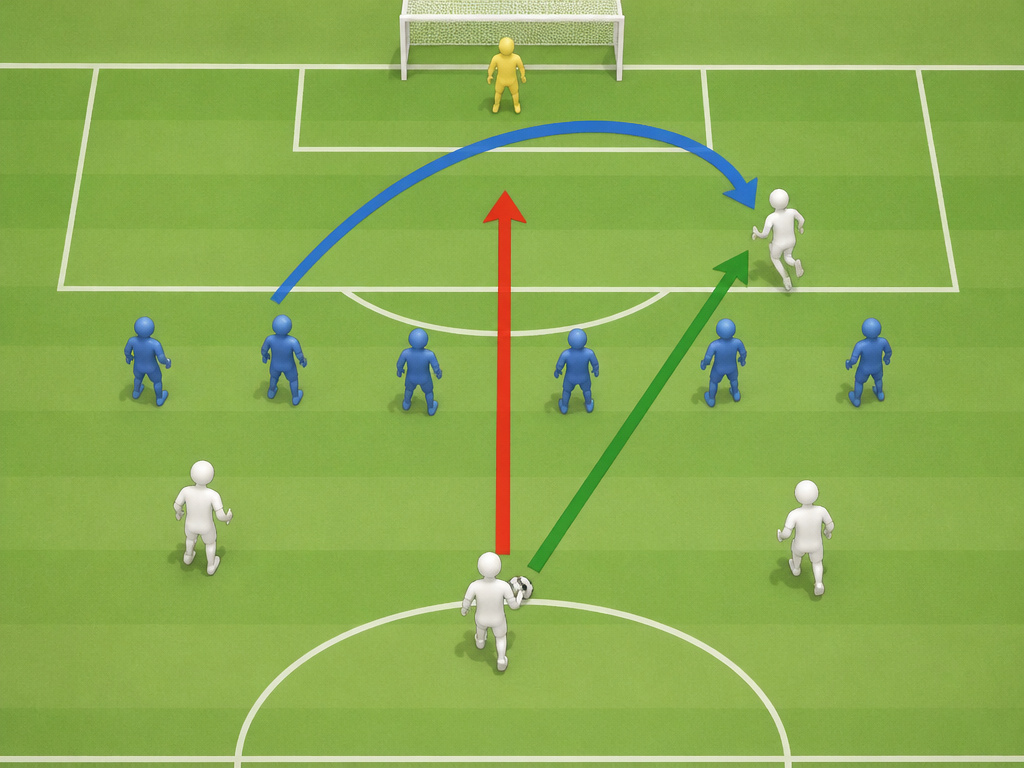
Not all space is created equal. The angle of your pass changes everything. A ball played straight up the middle on a direct route has less margin for error, it’s often heading straight toward the goalkeeper’s territory. Because of this, a direct pass needs to be passed with lighter weight so it doesn’t run through to the keeper.
The diagonal through ball is often the smarter choice. It has more space before going out of bounds, and it avoids the goalkeeper’s box entirely. It also stretches the defense horizontally, creating bigger gaps. Think of a pass from a central midfielder out to a winger bursting toward the corner flag.
Then there’s the aerial option. A through ball in the air could be a ball that’s about six feet high or lower. A ‘ball over the top’ is higher, lofted over the entire defensive line. When defenders are tight together, chipping or driving the ball to waist or chest height can be the only way through. This is where mastering a lofted pass becomes a lethal weapon.
Drills to Train the Instinct
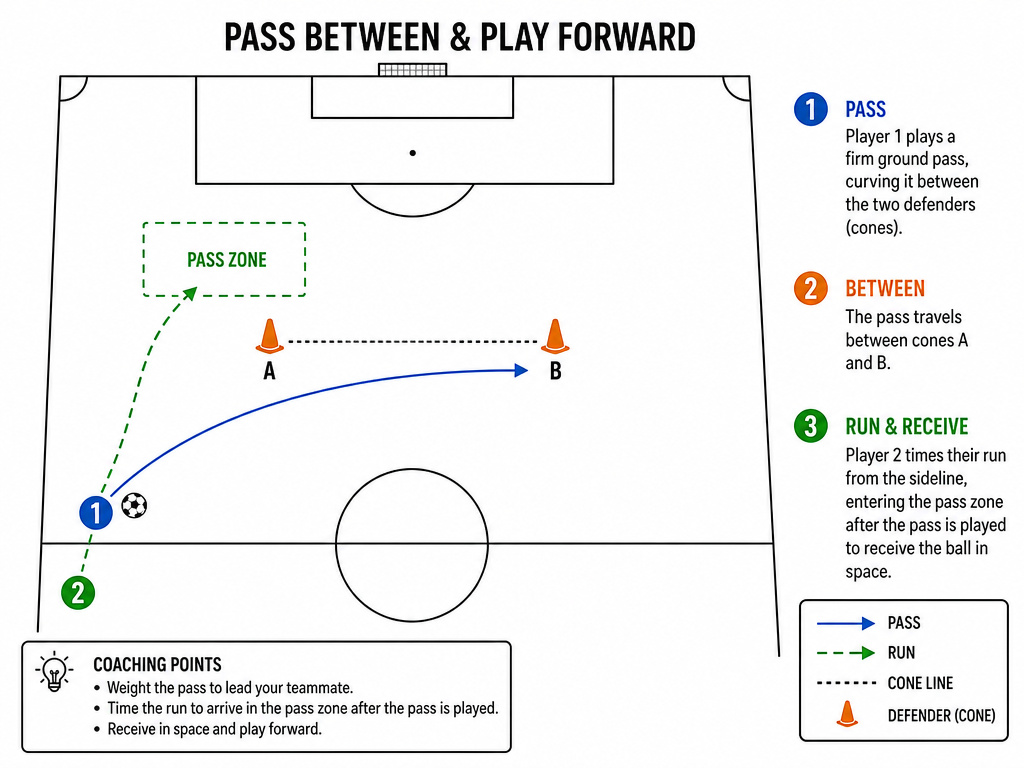
You can’t learn this from a video. You have to do it, over and over, until the decision becomes instinct. Here’s a proven progression, drawn directly from coaching manuals.
Start simple. Set up two stationary cones 30 yards apart to act as defenders. Have a runner start 10 yards in front of that line, near the sideline. As the passer, your job is to send a ground pass between the cones for the runner to collect. The only rule: you must pass the ball before the runner is level with the cones. This engrains the offside timing.
Common mistake: Passing when under heavy pressure. If a defender is on your back, the through ball is a low-percentage gamble. Keep possession and recycle the ball.
Once that’s comfortable, add live defenders. Then, add constraints to mimic real game pressure. A great way to do this is by implementing a minimum number of passes before a through ball can be played. This forces the attacking team to move the defense, create the gap, and earn the right to play the killer pass. It turns a technical drill into a tactical one.
Another excellent drill is the first-touch through ball, which is essentially the return pass in a one-two. Receive the ball, and if you see space, play the through ball immediately. If not, recycle. This sharpens decision-making at speed.
When to Attempt It: The In-Game Decision Flowchart
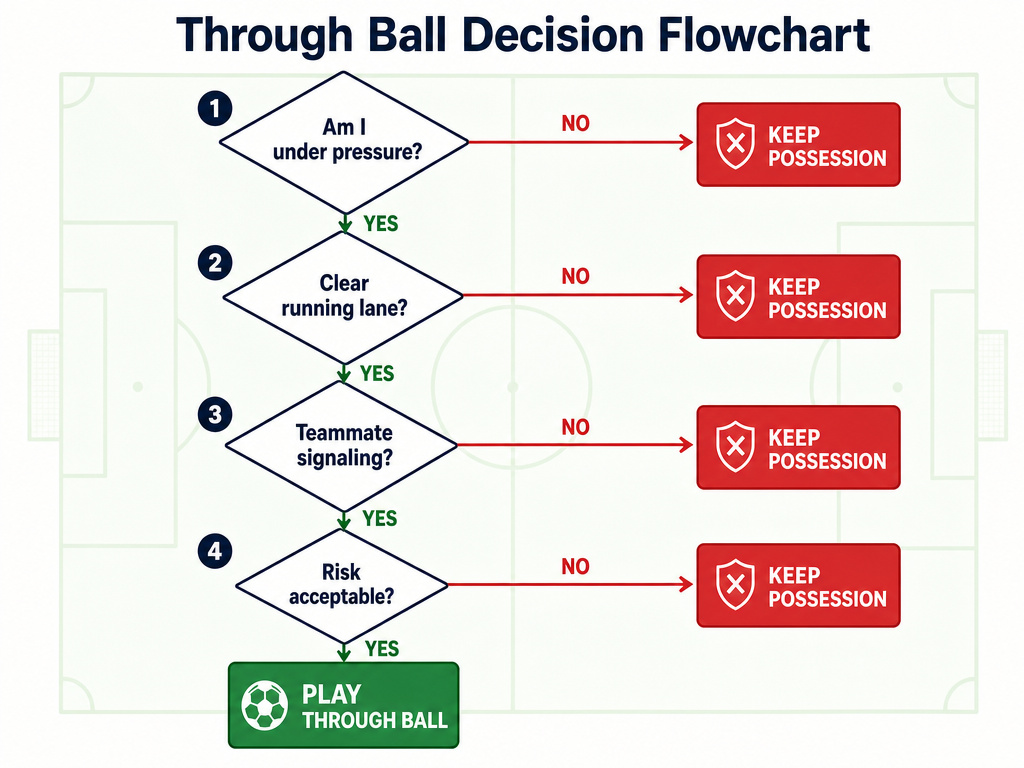
This is the part most guides gloss over. A through ball is a high-risk, high-reward pass. Attempt it at the wrong time, and you hand possession to the opponent in a dangerous area. So when do you pull the trigger?
Ask yourself these questions in this order:
- Am I under pressure? If a defender is within touching distance, don’t try it. The source material is clear: the passer should be under little or no pressure.
- Is there a clear running lane? Look at the defender’s hips. If they’re square and balanced, the lane is closed. If they’re turned or caught mid-stride, the gap might be there.
- Is my teammate signaling for it? A clear, committed sprint is the signal. A half-hearted jog is not.
- What’s the risk if I lose it? If you’re the last defender, a failed through ball is catastrophic. If you’re in the opponent’s final third, the risk is lower.
If you answer ‘no’ to any of the first three, the decision is simple: don’t force it. Keep possession, play a safer long pass to switch play, or recycle the ball. The through ball is a tool, not your only tool.
How to choose a through ball pass type
The choice between a ground pass and an aerial ball depends on the defenders. A ground pass is often the starting point, especially for learning the technique. If defenders are close together, chipping or driving the ball a little higher, around waist or chest level, can prevent them from intercepting it with their foot. A ball over the top is a pass above the players. According to England Football (The FA), to get height to pass over an opponent, players need to strike underneath the ball with their instep. According to England Football (The FA), to curl the ball around an opponent, players should plant their non-kicking foot to the side of the ball and wrap their kicking foot around the opposite side of the ball using their instep. According to England Football (The FA), the outside-of-the-foot pass is quicker and more deceptive, as players don’t have to open their body up.
Frequently Asked Questions
What is a through ball in football?
Through ball is a pass played into the space behind the opposition’s defensive line for a teammate to run onto. Its defining feature is that it’s played into space rather than directly to a player’s feet, aiming to beat defenders with timing and movement.
What’s the difference between a through ball and a long pass?
All through balls are forward passes, but not all long passes are through balls. A long pass can be aimed at a player’s head or feet to retain possession. A through ball is specifically designed to beat defenders by targeting the space behind them, regardless of its length. A 10-yard pass into a channel can be a through ball; a 50-yard punt to a striker’s chest is a long pass.
What is the hardest part of playing a through ball?
The timing. It requires an almost telepathic connection between the passer and the runner. The passer must release the ball at the exact moment the runner starts their sprint, before they go offside, and with the perfect weight so the ball arrives in stride. It’s a three-variable problem solved in under a second.
How can I practice through balls alone?
You can’t practice the timing alone, but you can drill the technique. Work on striking a stationary ball with the instep, aiming to hit a specific spot on a wall or fence from 20, 30, and 40 yards. Focus on clean contact and consistent weight. The partnership element requires a teammate, a few cones, and a lot of repetition.
The Bottom Line
The through ball is the ultimate test of a footballer’s football intelligence. It’s not about brute force or flashy skill; it’s about seeing the game one move ahead and having the technical clarity to execute the idea. Start by mastering the weight of your pass on the ground, then add the layers of timing and vision. And remember the one absolute rule from the training ground: if you’re under pressure, don’t even think about it. The best through balls look effortless because everything before the pass, the movement, the positioning, the scan, was done right.
