
How to Scan the Pitch in Football: The 0.4-Second Rule
This post contains affiliate links. As an Amazon Associate, we earn from qualifying purchases.
To scan the pitch in football, you make a quick, active head turn away from the ball to gather information before you receive it. Elite players’ scans average 0.4 seconds in duration, and they primarily look for colour, movement, and space. Central midfielders scan the most, forwards scan the least, and higher frequency is linked to better pass completion. The Frontiers in Psychology study defines scanning above 0.6 scans per second as the 75th percentile performance threshold.
It’s not about staring. The research shows only 2.3% of these glances are long enough to fixate on fine details. You’re taking snapshots. The skill is in knowing when to take them, what to look for, and how to turn that flash of information into your next move. A key part of this is learning how to scan the pitch in football. Get it right, and the game slows down.
What follows breaks down the science behind those head turns, the specific frequencies that separate good scanners from great ones, and the position-by-position habits that actually translate to the pitch. We’ll move from the “what” to the “how,” with drills grounded in the same studies used by Premier League clubs.
Key Takeaways
- A scan is an active head movement away from the ball, averaging 0.4 seconds, to gather information on space, teammates, and opponents.
- Aim for a scanning frequency above 0.6 per second — this is the 75th percentile performance threshold from elite match data.
- Central midfielders scan the most, forwards scan the least; tailor your practice to your position’s demands and the areas of the pitch where scanning drops off.
- Your last scan direction influences which foot you use for your first touch; scanning toward your dominant side makes you more likely to use that foot.
- Scanning frequency naturally drops under high opponent pressure; the best players maintain their composure and scanning habits when marked tightly.
What Does ‘Scanning’ Actually Mean?
Forget the idea of casually looking around. In football, a scan has a specific definition researchers use: an active head movement where a player’s face is temporarily directed away from the ball, with the assumed intention of gathering information.
The average scan lasts just 0.4 seconds, and only 2.3% of scans include a ‘fixation’ – a player looking at one spot for long enough to capture details. This tells us that players scan primarily for colour, movement and space. – Summary of Dr. Karl Marius Aksum’s research for the FIFA Training Centre.
You’re not reading a newspaper. You’re checking a radar screen. The glance is so fast that your brain is processing broad cues — the flash of a shirt colour, the sudden movement of a runner, a gap opening up — not fine details like a player’s sock tape. This is why improving your football vision is less about eagle eyes and more about training your brain to interpret these blips of information instantly, which is the core of how to scan the pitch in football.
The “assumed intention” part is key. A head turn because you’re distracted doesn’t count. A scan is purposeful. It’s the physical act of exploration that the ecological theory of perception is built on — you move to see. Mastering how to scan the pitch in football is what Xavi was doing when he famously checked his shoulder; he wasn’t just looking; he was downloading the coordinates of the entire midfield.
The 0.6 Scans-Per-Second Threshold
So how often should you be doing this? The landmark peer-reviewed scanning study in Frontiers in Psychology gives us hard numbers. Analysing over 9,500 possessions from 27 Premier League players, they found the average player performed 3.0 scans (±2.1) in the last 10 seconds before receiving the ball.
That translates to a mean frequency of 0.44 scans per second. But averages are for spectators. The players operating at the top end defined the benchmark.
Where this goes sideways: Assuming more scanning is always better. The data shows a point of diminishing returns, and frantic, unfocused scanning can be as bad as none at all.
The study identified the 75th percentile as the performance threshold. Players scanning above this level were doing more than most. That threshold is >0.6 scans per second.
| Performance Tier | Scans per Second | What It Means |
|---|---|---|
| Elite Benchmark | > 0.6 | 75th percentile; high-level awareness and preparation |
| Average | ~ 0.44 | Mean for studied Premier League players |
| Infrequent | < 0.3 | Below average; likely reacting more than anticipating |
Hitting that 0.6 mark isn’t about wild, constant head-swivelling. It’s about rhythm. It’s the difference between checking your mirror three times before changing lanes versus just once. That extra data point drastically reduces your chance of a collision.
Position, Pressure, and Pitch Location: The Context Rules
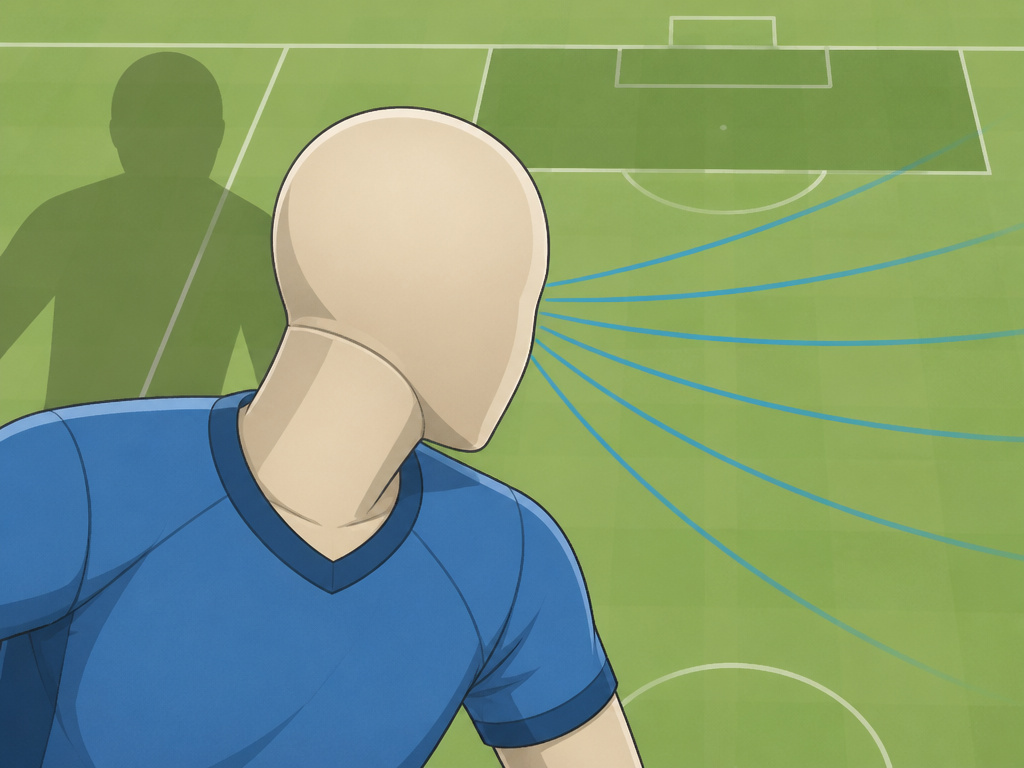
Your role on the team isn’t a suggestion; it’s a manual for how to scan. That same Premier League study found a “medium effect size” (d = 0.55) for positional differences. The order is clear, and it reframes how we think about game intelligence.
Central midfielders scan the most. Forwards scan the least.
It makes brutal sense when you think about the job. A midfielder is the hub. They need a 360-degree picture to know whether to turn, switch play, or recycle possession. A forward, especially a central one, is often playing on the last line, with most of the game in front of them. Their scans are more about timing runs onto through balls than surveying a vast landscape.
But context changes everything. Two other factors dramatically alter scanning frequency:
- Opponent Pressure: Scanning plummets when under tight opponent pressure. The effect size is small (d = 0.37), but the practical impact is huge. Under pressure, the instinct is to watch the ball onto your foot, not look away from it. The elite skill is maintaining your scanning tempo even when you feel a breath on your neck.
- Pitch Location: Players scan most frequently in a very specific zone: around their own 18-yard box, between the penalty spot and the top of the ‘D’. Why? It’s the most dangerous area to lose the ball. Scanning drops off in the attacking third, where decisions become more instinctive and defensive.
This isn’t academic. It’s a training guide. If you’re a midfielder, drill scanning under pressure in your own defensive third. If you’re a winger, practice scanning as you receive on the touchline, where your options are naturally limited.
The Link Between Your Scan and Your First Touch
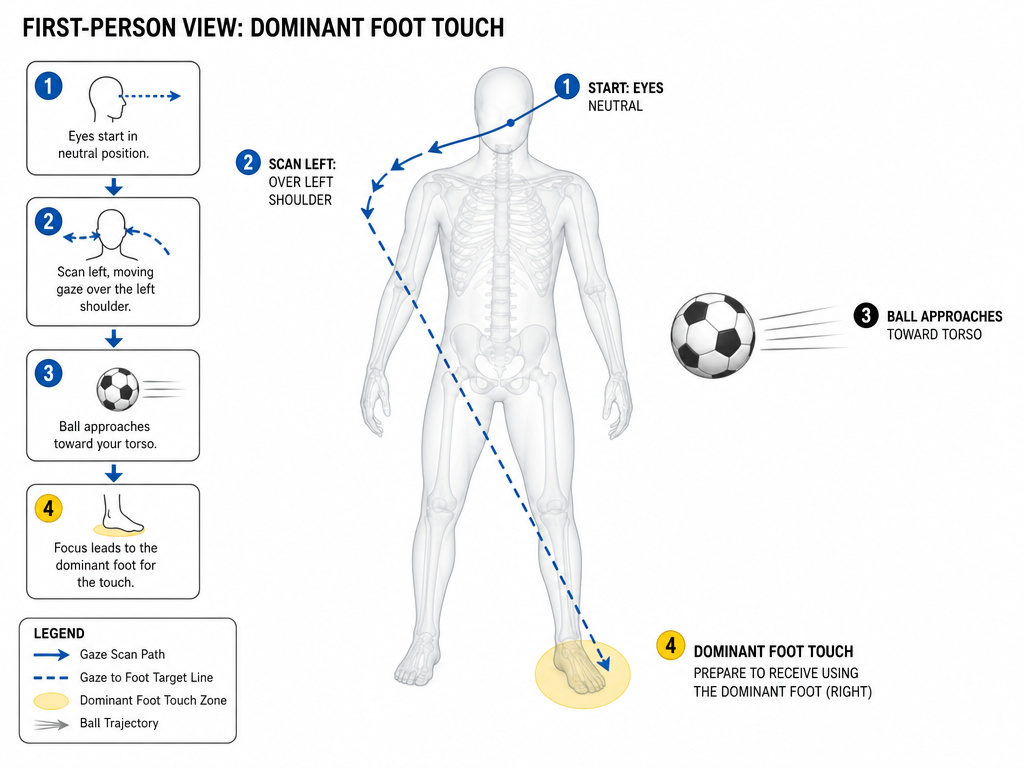
Here’s a nuance most guides miss: where you look influences what you do next. Research from the VU University Amsterdam on UEFA youth tournaments found a direct connection. The direction of your last scan before receiving the ball is related to the foot you use for the first contact.
Scanning to the side of your dominant foot increases the probability of using that foot. It’s a priming mechanism. Your brain sets up the receiving solution based on the last visual information it gathered. This relationship gets modified by opponent pressure, but the foundational link is there.
Think about receiving a ball on your right half-turn. If your last scan was over your left shoulder, you’re gathering info on what’s behind you. Your body might naturally open to use your right foot. But if that scan was over your right shoulder, you’ve already seen the space in front, making a controlled touch with your left foot into that space more likely. This is where scanning stops being a generic “good habit” and becomes a technical tool for better on-field communication with yourself.
Drills to Build the Scanning Habit
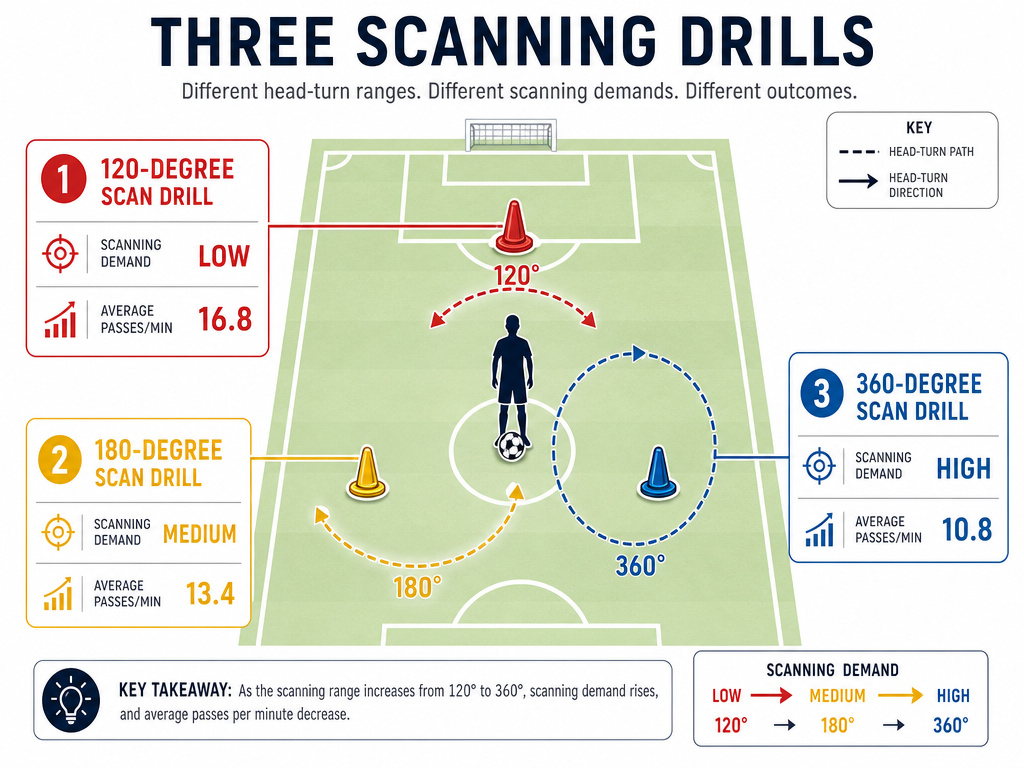
Theory is useless without practice. The good news is you can train this like any other skill. A 2024 study in the journal Sports validated a simple, reliable test that clubs use. It measures passing performance while enforcing different scanning demands.
| Drill Name | Scanning Demand | Average Passes/Min | Focus |
|---|---|---|---|
| 120-Degree Scan & Pass | Low | 30.11 ± 7.22 | Quick decision-making in a focused cone |
| 180-Degree Scan & Pass | Medium | 27.41 ± 6.14 | Expanding peripheral awareness |
| 360-Degree Scan & Pass | High | 25.55 ± 5.94 | Full-picture awareness under physical load |
How to run the 180-degree drill (the sweet spot):
- Set up two cones 10 yards apart. Stand in the middle, facing a server.
- The server plays a pass to you. You must turn your head to look at a specific coloured cone (left or right) before the ball arrives.
- Receive and pass back to the server’s hands, then immediately turn to scan the other cone.
- Repeat for 60 seconds. Count your completed passes. The goal is smooth technique, not frantic speed.
Common mistake: Scanning after you control the ball. The entire point is to gather information before it arrives. If you’re late, the drill fails.
Start with the 120-degree version (scanning only to one side) to build the muscle memory of turning your head. The 360-degree version, where you have to scan a cone behind you, is brutally tiring but fantastic for match realism. This kind of structured work builds the neural pathways faster than just playing small-sided games and hoping you remember to look.
Integrating Scanning into Match Play
Drills create the habit. The game tests it. The transition is the hardest part. You have to move from a controlled environment where scanning is the task to a chaotic one where it’s just a tool.
First, use triggers. Tie your scan to a specific event. “Every time my team’s centre-back gets the ball, I scan.” Or, “As the ball is travelling to my teammate, I check my shoulder.” This external cue stops you from having to remember an abstract concept in the heat of play.
Second, start with a limited focus. Don’t try to see everything. In your next match, pick one thing: “I will identify the position of the nearest opponent every time I receive.” That’s it. Once that becomes automatic, add a second layer: “…and I will note the location of my nearest supporting midfielder.”
This is where visualization off the pitch pays dividends. Spend five minutes before training or a match mentally rehearsing these triggers. See yourself checking your shoulder and seeing a clear picture. The analysis of elite players’ scanning in The Athletic often highlights this kind of premeditated, almost rhythmic preparation.
Finally, understand that your scanning directly informs your movement. A scan that shows a packed midfield tells you to drop deeper for space. A scan that shows your full-back overlapping demands you hold your width. It’s the first step in the chain of reading the game, not a separate skill.
Frequently Asked Questions
What’s the difference between looking and scanning in football?
Looking is passive. Scanning is an active, purposeful head movement away from the ball to gather specific information (space, players, movement) before you receive it. Scanning has intent; looking might just be watching the play.
Do I really need to scan if I’m a striker?
Yes, but your scanning priorities are different. As a forward, you’ll scan less frequently than a midfielder, but your scans are critical for timing runs, checking the defensive line, and spotting the keeper’s position. Your scans are more about precision and timing than constant surveillance.
How can I remember to scan during a fast game?
Use triggers. Don’t try to remember “scan more.” Instead, pick a specific, frequent game event (e.g., “when my defender receives the ball”) and make that your cue to turn your head. Start with one trigger until it becomes automatic.
Does scanning improve my passing?
The research suggests yes. The Premier League study using a Bayesian model found that, after controlling for pass difficulty and player skill, more scanning was associated with a higher probability of pass completion. It gives you more and better information with which to make your decision.
Are there any tools or technologies to help train scanning?
Some professional academies use virtual reality (VR) setups to train perception under pressure. However, for most players, the most effective tools are simple: structured passing drills with enforced scanning (like the cone drills above) and lots of small-sided games where awareness is constantly tested.
The Bottom Line
Scanning isn’t a magic trick. It’s a measurable, trainable skill with a clear performance threshold: aim for over 0.6 scans per second in the moments before you receive the ball. Ignore the generic advice. Your position dictates your rhythm, pressure will try to break it, and your final glance can dictate your first touch.
The best part? You can start tonight. In your next training session or kickabout, pick one scanning trigger and stick to it. It will feel forced and awkward for about twenty minutes. Then, for one play, you’ll scan, see the open man, and play the pass you used to only see on TV. That’s the moment the game changes. After that, you’ll never not scan.
