
Visualization Techniques for Football Players
This post contains affiliate links. As an Amazon Associate, we earn from qualifying purchases.
Football visualization techniques are the structured practice of mentally simulating game actions, decisions, and spatial scenarios to improve on-field performance. This goes far beyond simply “picturing success.” Effective methods combine spatial awareness drills, mental rehearsal of specific plays, and the use of video analysis to build a precise mental map of the pitch and your role within it.
The real value isn’t in vague positive thinking. It’s in wiring the brain to recognize patterns and execute decisions under pressure. The most advanced research in football analytics, like systems that analyze player positions at 25 frames per second, points to a truth we can borrow: high-resolution, specific mental practice beats fuzzy, general visualization every time. This is why effective visualization techniques for football players must be precise and data-informed.
What follows are the techniques that move from theory to the training ground. This section explains the sensory layer that makes mental practice stick, the argument for frame-by-frame mental review, how to build a personal mental highlight reel, and a simple way to know if your practice is working.
Key Takeaways
- The most effective visualization is identity-independent, like the shape-graph research that infers tactical positions from geometry alone, focus on the spatial relationships and movements, not just on seeing yourself as the star.
- Log-normalization is superior for measuring “dangerousness” in set plays according to University of Konstanz research; for your mental practice, this means quantifying your rehearsals (e.g., success rate in imagined scenarios) gives you better feedback than a simple “felt good/bad” rating.
- Combine video with mental rehearsal immediately after watching. The “Bring it to the Pitch” system integrates abstract visuals into match footage, showing how to layer tactical understanding directly onto what you see.
- Frame-by-frame mental review matters. Research in npj Complexity advocates for instantaneous analysis at the data’s native 25 fps to preserve context, while other approaches, like ForVizor, aggregate player positions over periods like 5-10 seconds to stabilize the signal. Mentally replay key moments in slow, precise detail, not as a blur.
- Define your mental pitch regions. Just as experts at clubs like FC Bayern München define semantically meaningful pitch partitions for analysis, you should have clear mental labels for zones (e.g., “half-space,” “channel”) to speed up decision-making.
The Sensory Layer: From Feeling to Seeing
Close your eyes and try to “see” a perfect first touch. If your mind’s eye is a blank screen, you’re not broken. This is where most generic advice fails. Visualization isn’t just a visual act.
For many players, especially younger ones or those who think kinesthetically, the feel of the game is the primary memory. The vibration of a clean strike traveling up your shin, the specific sound of the ball pinging off the post, the weight shift needed to turn a defender, these are the building blocks for visualization techniques for football players. Start there. Before you see the pass, remember the sensation of wrapping your foot around the ball. Before you see the tackle, recall the solid thud of a well-timed challenge.
Where this goes sideways: Trying to force a crystal-clear movie in your head. If you’re not a visual thinker, you’ll get frustrated and quit. The brain doesn’t care if the input is sight, sound, or feel; it’s building the neural pathway regardless.
A study from the University of Konstanz, developed with an FC Bayern München coach, calculated a dangerousness measure for set plays by combining factors like distance and shot power into a normalized score. They found log-normalization provided the most robust and interpretable results. For you, this means the “score” of your mental rehearsal shouldn’t be a vague feeling. Was the imagined pass weight perfect? Did the defensive movement feel timed to the striker’s plant foot? Rate it. Give your mental practice a 1-10 score based on concrete, sensory details. Over time, you’ll see the log-normalization effect: small improvements in your mental score lead to bigger confidence leaps on the pitch.
Why Instantaneous Frame-by-Frame Analysis Matters
Here’s a technical debate that changes how you should mentally review your game. In football analytics, one school of thought aggregates player positions over 5-10 second windows to “stabilize the signal” and see general formations. Another, championed in a 2025 npj Complexity paper, argues this smoothing loses the truth. They promote “shape graphs”, subgraphs of Delaunay triangulations, to infer tactical positions instantaneously, at the 25 frames-per-second resolution of the tracking data.
The lesson for your mental game is stark. Don’t just mentally replay “that good run” as a single clip. Freeze it. Break it down frame-by-frame. What was your body angle in the three steps before you received the ball? Where was the defender’s centre of gravity? This granular, instantaneous level of review, as used in shape graph analysis for tactical positions, is what builds true tactical understanding when using visualization techniques for football players.
A 2021 study in IEEE Transactions on Visualization introduced the “Sketchplan,” a system that lets coaches place magnets on a virtual tactic board to query massive datasets. Its genius is handling imprecise input, a rough magnet placement, by using query relaxation to find relevant situations. This isn’t about perfect recall; it’s about training your brain to connect rough patterns to specific outcomes.
| Mental Review Method | What It Focuses On | The Risk If You Skip It |
|---|---|---|
| Aggregated (5-10 sec clips) | General effort, overall positioning. | You miss the micro-decisions that actually caused the play to succeed or fail. |
| Instantaneous (frame-by-frame) | Specific body shape, opponent’s weight distribution, first-touch surface. | You practice in blurry generalities and won’t replicate the precision under match pressure. |
| Outcome-Only (just the goal/pass) | The end result, the celebration. | You reinforce luck, not the repeatable process that led to the moment. |
The art of scanning in football is the physical counterpart to this. Your head checks are the data collection; your brain’s instantaneous processing of that data is the analysis. Train both together.
Building Your Mental Highlight Reel (And Bloopers)
Your memory is an unreliable editor. It highlights the 30-yard screamer and buries the three simple passes you messed up right before. You need to take control of the footage.
This starts with actual footage. Video analysis is not passive watching. It’s active harvesting. After a match or training session, grab two clips: your best moment and your worst. Watch the best one three times. First for enjoyment. Second for the technical execution (foot placement, contact point). Third for the tactical setup, what did your teammates do to create the space? Now, close your laptop and mentally replay it from a first-person perspective, importing all those details.
Now for the blooper. This is harder but more valuable. Watch the mistake. Analyze it coldly: was it a technical error, a wrong decision, or a lack of spatial awareness? Then, mentally re-run the clip. But this time, edit it. In your mind, insert the correct technique or decision. See and feel yourself making the right play. This is called “mental editing,” and it’s how you overwrite the neural pathway associated with that failure.
I used to think reviewing mistakes was just punishment. Then I spent 45 minutes watching one midfielder off the ball in a professional match. His “highlights” were invisible, constant positioning to shut down passing lanes. My mental reel was all goals; his was all positioning. I started adding those invisible plays to my own mental library.
Systems like PassVizor use glyphs to encode a pass’s formation, player identity, and spatial region all at once. Your mental highlight reel should aim for similar density. Don’t just see the shot; know the formation shape (e.g., 4-3-3), your identity in that structure (inverted winger), and the exact pitch scanning sequence you used to find the space.
Position-Specific Mental Libraries
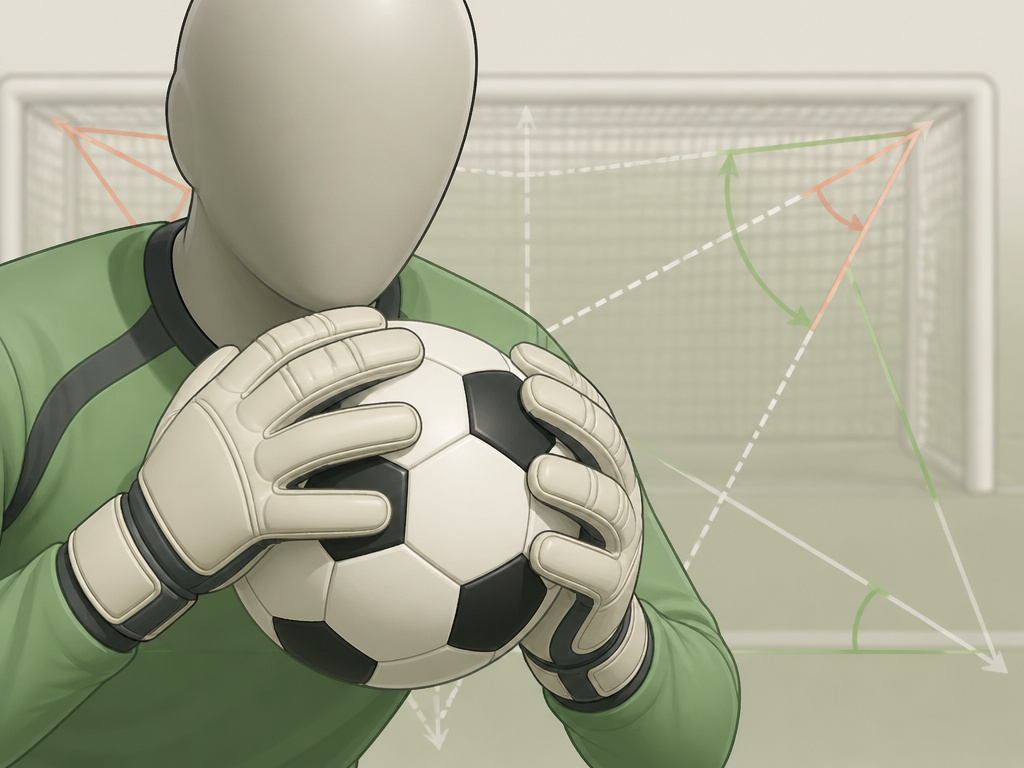
A goalkeeper’s mental preparation is fundamentally different from a striker’s. Generic “see yourself succeeding” drills are a waste of time. You need a customized mental toolkit for your role.
For Goalkeepers: Your library is about angles and sequences. Mentally rehearse not just the save, but the footwork pattern that gets you set. Visualize different types of crosses, driven, floated, and your decision command: catch, punch, or stay. Practice the mental reset routine after a goal conceded. This is pure managing nerves under fire.
For Defenders: Your focus is on partnerships and triggers. Mentally walk through zonal marking assignments, feeling the distance to your centre-back partner. Rehearse the trigger to step into the interception, what is the passer’s head angle? Visualize dealing with a physical striker, focusing on the sensation of balance and strength in the duel.
For Midfielders: Your library is the largest, built on patterns and transitions. Mentally drill switching the point of attack. Feel the body shape needed to receive under pressure and play one-touch. Rehearse the pressing trigger, when the opponent’s full-back receives with a back foot? See it, and feel your whole body move.
For Forwards: This is about ruthlessness in the box. Mentally practice your movement for different cross types. Near post run? Feel the explosive start. Far post drift? Sense the timing to hold your line. Rehearse one-touch finishes, emphasizing the sensation of contact, not just the ball hitting the net.
| Position | Core Mental Scenario | Key Sensory Focus |
|---|---|---|
| Goalkeeper | Dealing with a low, driven cross through a crowd. | The sound of the striker’s connection, the feel of wrapping the ball securely against the chest. |
| Centre-Back | Defending a 1v1 on the counter-attack. | The sight of the attacker’s dropping shoulder, the feeling of jockeying while staying on your toes. |
| Central Midfielder | Receiving a pass with a marker on your back. | The feel of the arm on your back, the body shape to spin away, the sound of your call for the ball. |
| Winger | Isolated 1v1 against a full-back. | The defender’s stance (open/closed), the feel of the ball under close control, the burst of acceleration. |
Building these libraries directly strengthens your football IQ. It moves your thinking from “what should I do?” to “this is what I do here.”
Measuring What Actually Works
How do you know your visualization practice isn’t just another box-ticking exercise? You measure it. Not with vague feelings, but with simple, observable links to performance.
The research is methodical. The ForVizor project involved 10 months of weekly expert collaboration to characterize formation analysis problems. The University of Konstanz dangerousness measure uses a weighted sum of parameters normalized to [0,1]. Your approach can be just as deliberate, if simpler.
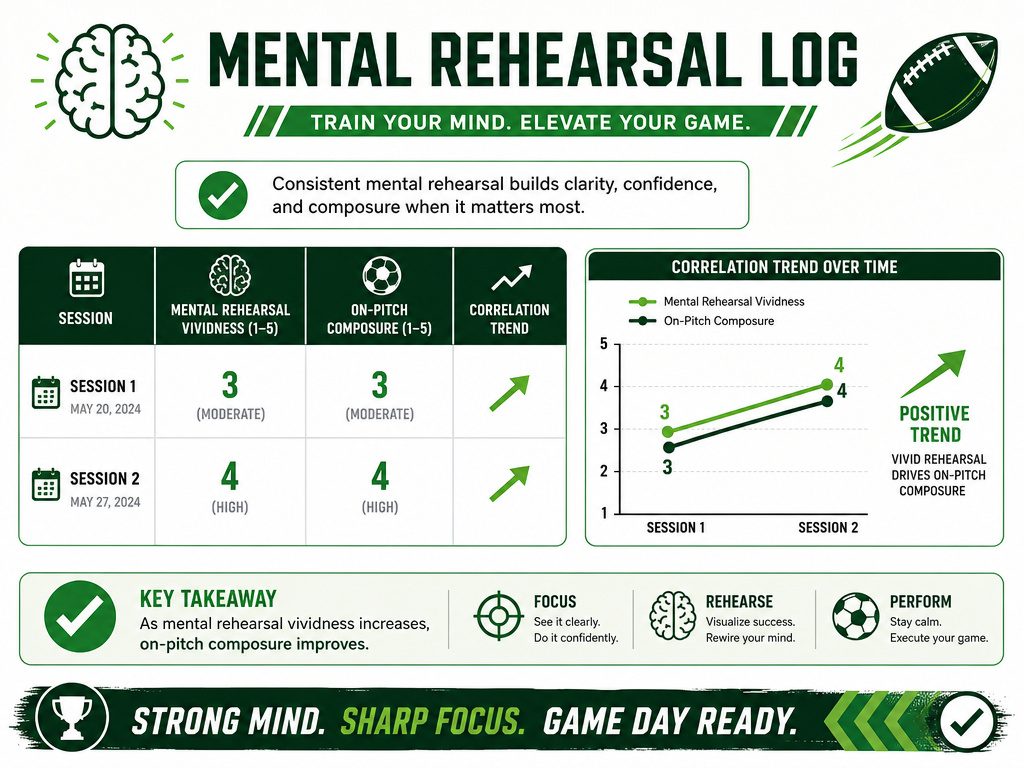
First, define a single, small target for your mental practice. For example: “Improve my calmness when receiving in midfield under pressure.” Then, create a 1-5 scale for a pre-performance routine. Before a training drill or match, you mentally rehearse the scenario for a short period.
- Did you complete the mental rehearsal without distraction? (Yes/No)
- How vivid was the sensory detail? (1= vague, 5= could feel the grass)
- After the drill, how did you perform? (1= flustered, 5= composed)
After several sessions, look for a correlation. Does a higher mental vividness score (question 2) often pair with a better composure score (question 3)? This is your personal log-normalization. It tells you if the mental work is translating.
Easy to miss: The timing of your practice. A 2018 study on the “Bring it to the Pitch” system notes that generating a clean panoramic view of the pitch for analysis usually takes the first 2 minutes of match footage. Your most effective mental rehearsal often isn’t the night before. It’s in the 60-90 seconds after you finish watching your video clips, or in the 2 minutes of focused quiet you create before stepping onto the pitch for training.
This data turns mental preparation techniques from a superstition into a skill. You stop wondering if it works and start knowing which specific technique works for you.
How do you use breathing with visualization?
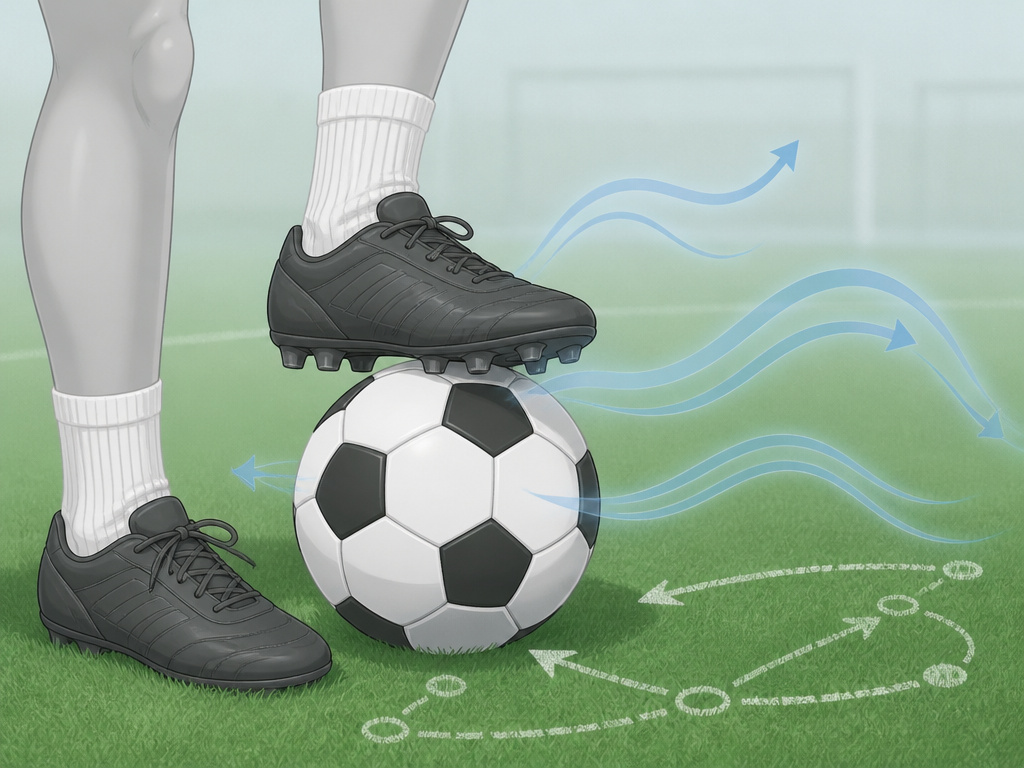
Controlled breathing is the anchor for effective mental rehearsal. Before you begin visualizing a play or a skill, take a moment to settle your breath. This calms the nervous system and focuses your attention inward, creating a clear mental space. Use your breath to pace the visualization, inhaling to initiate the action and exhaling to complete it, like breathing out as you strike the ball. This rhythm connects the mental image to your body’s natural cadence, making the imagined movement feel more integrated and ready for physical execution.
Frequently Asked Questions
What visualization techniques do professional athletes use?
Professionals use highly specific, often position-tailored mental rehearsal. This includes scenario-based visualization (e.g., a striker practicing penalty routines), sensory-rich recall of perfect technique, and guided imagery sessions with sports psychologists. Crucially, many integrate it with video analysis, using film to provide accurate visual fodder for their mental practice, a method supported by visual performance analysis in soccer research.
What is an example of a football-specific visualization technique?
Central midfielder might use “touch rehearsal.” Before training, they sit quietly and imagine receiving a pass on the half-turn. They don’t just see it; they feel the correct body shape, chest open, arm up for balance, and the sensation of the ball cushioning into the space between their feet. They mentally scan the options (full-back overlapping, striker checking in) before playing the pass. This drills the neuromuscular pattern and the decision tree simultaneously.
I can’t ‘see’ clear pictures in my head. Does visualization not work for me?
It absolutely works. This is a common block. Switch the modality. Focus on kinesthetic (feeling) or auditory (sound) recall. Instead of seeing the perfect cross, focus on remembering the feel of your leg swinging through, the sound of your foot connecting with the ball’s sweet spot, and the crowd’s reaction. The brain learns from the specific input, not the type of input. The key is vivid detail, not a photorealistic image.
How does visualization physically improve performance?
It primes the neural pathways. When you vividly imagine an action, the same motor cortex regions activate as when you physically perform it, just at a lower intensity. This strengthens the connections between neurons for that skill, making the actual execution more efficient and automatic. It’s a form of practice without physical fatigue, enhancing on-pitch concentration by pre-programming responses.
Can visualization help with confidence and nerves?
Yes, but indirectly. Visualization doesn’t magically inject confidence. It builds it by increasing familiarity and perceived competence. By mentally rehearsing challenging scenarios, like taking a penalty or facing a skilful winger, you reduce the novelty and associated anxiety. You’ve “been there” before in your mind. This is a core principle of sports psychology for managing performance anxiety.
How long and how often should I practice visualization?
Consistency beats duration. Aim for 5-10 minutes daily, rather than one 30-minute weekly session. The best times are right after video review (to cement learning) or as part of a pre-training/pre-match routine. Like any skill, regularity wires it into your habits. Research systems like ForVizor were built over 10 months of weekly iteration; your mental framework will solidify with steady, short practices.
The Bottom Line
The most effective visualization is the one you don’t notice happening during the game. It’s the automatic scan, the pre-planned movement, the calm first touch under pressure that feels rehearsed because, in your mind, it has been, dozens of times.
Start with the sensory detail you can already recall perfectly, even if it’s a sound or a feeling, not a picture. Use video as your truth-teller and your scriptwriter. Most importantly, track it. Note if a week of focused mental rehearsal on receiving under pressure actually leads to a calmer performance on Saturday. That feedback loop is what turns a well-intentioned trick into a genuine tool.
The tools exist, from techniques for building football confidence to advanced massive soccer dataset visualization research. Your job is to strip them down to the one or two practices that directly answer the question your last match asked of you. Then do the reps, in your head, with the same diligence you’d show on the training pitch.
