
How to Pass a Football Accurately: Step-by-Step
This post contains affiliate links. As an Amazon Associate, we earn from qualifying purchases.
How to pass a football accurately starts with the plant foot, body angle, and contact point. In a study of 15 student football players aged 15 to 18, the inside foot at 10 meters produced 91 +/- 7% accuracy. Set the plant foot close, keep weight stable, and strike the ball through its middle.
That 10-meter result shows how distance, foot surface, and stability interact. It gives a reference point for short passes. When those pieces line up, the receiver gets a controllable ball instead of a bouncing one.
What follows: plant-foot cues, body angle, drill progressions, and the two coaching ideas that disagree about where your eyes and foot should point.
Key Takeaways
- Inside foot at 10 meters scored 91 +/- 7% accuracy in a study of student football players aged 15 to 18.
- Plant foot close and pointing toward target; the Bench View Soccer guide says non-kicking foot placement controls direction.
- Body angle matters: the Journal of Educational Sciences study found 144.5 degrees gave a 78.11 cm foot distance and better stability.
- Practice 10 minutes against a wall 10 to 20 meters away, then add movement, pressure, and decision speed.
- Accuracy vs power: use the simplest pass that solves the next problem for your teammate.
What does accurate passing actually mean?
91 +/- 7% accuracy is the best result in the Atlantis study. I judge a pass by the weight and timing it gives the receiver. That is the test.
Accurate passing combines direction, weight, and timing so the receiver can control the ball without losing possession. The inside foot gives a broad contact surface for short passes, while body angle and plant-foot stability guide the ball toward the target. Distance changes the required force and the best foot surface.
Have you ever completed a pass that still lost possession? A clean pass skims the turf. A bad one thuds into shin pads.
The Atlantis Press biomechanics study measured 15 student football players aged 15 to 18. The inside foot at 10 meters produced 91 +/- 7% accuracy. That data supports accuracy over power for short passes.
Where does the plant foot go?
Plant-foot placement sets the line of the pass before your swinging leg moves. I still think plant-foot drift causes most wobble. If the plant foot lands with a scuff and a small hop, the ball leaves the foot late.
Where do your eyes go at the moment of contact? The sources disagree here. The Bench View Soccer guide says non-kicking foot placement controls direction, while the Journal of Educational Sciences study points to body angle as a key factor.
The Journal of Educational Sciences study points to body angle as a key factor. It found 144.5 degrees gave a 78.11 cm distance between the feet. A wider 168.3 degree angle gave 109.19 cm and hurt balance while moving.
| Source | Main cue | What it says | Best use |
|---|---|---|---|
| Bench View Soccer | Non-kicking foot placement | Controls direction | Short target passes |
| Journal of Educational Sciences | Body angle | 144.5 degrees gives 78.11 cm foot distance | Stability in inside-foot passing |
| Atlantis Press study | Foot and distance | Inside foot at 10 meters gave 91 +/- 7% accuracy | Accuracy testing, not match rule |
For a long pass, the same plant-foot logic applies. The body angle must stay open enough to let the swinging leg clear the ball.
The International Journal of Sports Physical Therapy kinematic study, a motion study, examined American football passing. Its phases were Stride, Cocking, Acceleration, Deceleration, and Follow through. It also noted stride knee flexion stayed relatively unchanged, while trunk movement shifted away from the throwing side and then converged toward near-neutral before release.
Common mistake: Reaching for the ball with a wide plant foot. It pushes the body angle toward 168.3 degrees, and the pass wobbles before it reaches the target.
Which foot surface should you use?
A fancy surface still needs clean contact. Which surface to use depends on distance, pressure, and what the receiver needs next.
I would rather see a simple pass that arrives at the teammate’s stronger foot than a flashy pass that lands behind them.
Inside-of-the-foot pass
Use the broad inside surface for short accuracy. Lock the ankle and strike through the ball’s middle. A clean contact feels like a firm thud. Skip it when a defender is too close to give you time. The driven pass is a better choice when the ball must arrive fast on the ground.
Outside-of-the-foot and curled passes
Outside-of-the-foot passes use the outer surface to bend the ball away from a closing defender. For an outside of the foot pass, keep the ankle firm and let the follow-through curve. Curled passes are a version of that bend. They are useful for switches and set pieces.
Driven, lofted, and chip passes
A low, firm pass is the basic driven option. For a lofted pass, lift the ball over a defender and aim for the receiver’s path. For an accurate chip pass, use less force and more height, then let the receiver’s touch finish the job. One-touch passing fits here too: the first player uses the ball’s momentum, and the receiver plays it quickly.
Do you have a ball that matches your surface? For a match ball, I would pick a Select ball. For durable training, I would use an adidas ball. On dry turf, a Nike ball gives a stable feel (my pick for a clean surface).
The ball changes touch, so test it before a game.
How to Pass a Football Accurately with Drills?

Three drill stages matter: contact, movement, pressure. I have learned that repeating a pass at walking pace is useless if the next step never adds pressure.
- Start with wall passing for 10 minutes. Use a wall 10 to 20 meters away. Focus on non-kicking foot placement and body orientation. If you skip this, your touch stays loose under movement.
- If you skip it, your plant foot never learns a repeatable line.
- If you skip it, you overhit the first pass that needs pace.
- If you skip it, your accuracy disappears when a defender closes the lane.
| Goal | Drill | Set-up |
|---|---|---|
| Build inside-foot mechanics | Wall passing | 10 min, wall 10 to 20m |
| Add movement and weight | Triangle passing rondo | 3v1, 8m triangle |
| Apply under pressure | Small-sided games | Weeks 7 to 8 progression |
Use wall drills for solo reps. Use passing drills when you have a partner. Add weak foot reps only after the dominant foot holds a steady line.
How do you pass accurately under pressure?

A defender closes the lane. Your body turns late. The pass wobbles. Have you ever passed accurately in training, then lost it in a match? The fix comes from a faster decision.
I have spent too many hours drawing pressing traps, only to lose a five-a-side game by overcomplicating a simple pass. That is my rule.
- Scan before the ball arrives. Use head up to see the defender’s angle and the teammate’s foot.
- Choose the receiver’s correct foot. A pass to the open foot protects the ball and signals the turn.
- Match pace to the lane. A tight lane needs a firmer pass; a one-touch return needs a softer touch.
- Use both feet in training. If you pass with one foot, defenders cut your preferred side.
Under pressure, you hear the defender’s studs before you see the lane. If you play a wide defensive role, your first job is a safe switch that lets the next player turn forward.
What mistakes ruin passing accuracy?
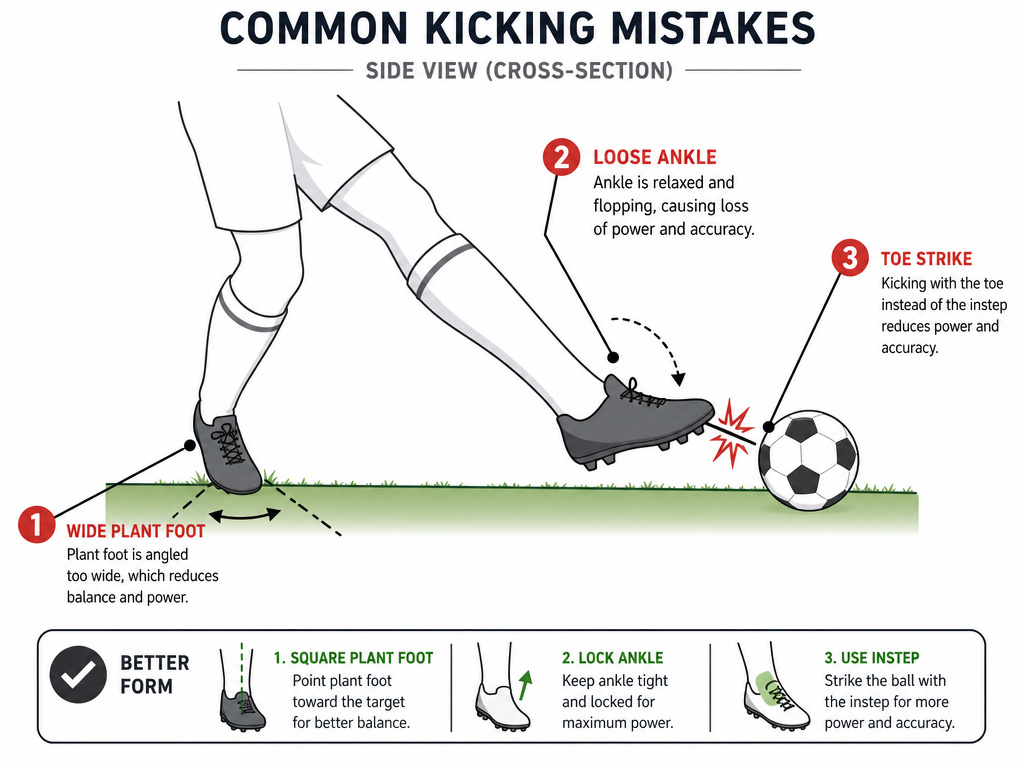
Bad passes leave evidence. Have you checked which one you repeat? A pass misses because the plant foot drifts, the ankle flops, or the eyes stay glued to the target.
- Plant foot too wide. It pushes the body angle toward 168.3 degrees and reduces balance while moving. Fix it by stepping close enough to reach the ball without stretching.
- Ankle too loose. Do not let the ankle flop. The ball pops up on the first bounce, and the receiver has to chase it. Lock the ankle and strike through the ball’s middle.
- Too much power. A hard pass beats the receiver’s touch. Use the simplest pass that solves the next problem.
- Eyes only on the ball. Some coaching cues, like The Bench View Soccer, tell players to track the ball onto the foot. Other sources imply focusing on the ball. The disagreement is real. For match play, I would glance at the target and keep the head steady enough to control the body angle.
What most people get wrong: Chasing distance before contact. If the ball hits the toe, the pass wobbles for the next two touches.
I still get annoyed when players overhit a simple pass. A pass that arrives too hard creates a second problem for the receiver.
How to do one-touch passing
One-touch passing is about preparation. Your body must be in the right shape before the ball arrives. The kinematic sequence for a pass still applies, but compressed into one fluid motion. As the ball comes to you, your trunk shifts away from the throwing side and then converges to a near-neutral position just before you release it. Point your non-kicking foot at your target the instant you receive the ball. Keep your body over the ball for ground passes and track the ball onto your foot. Practice this with a stationary wall passing drill before progressing to rondos under pressure.
Frequently Asked Questions
How to pass a football correctly?
Use a stable plant foot, a locked ankle, and a body angle that keeps you balanced. For short passes, the inside foot is the safest starting point. Strike through the ball so it glides instead of bouncing.
How to do a perfect pass in football?
Perfect pass is a pass the receiver can control without losing momentum. Aim for the teammate’s open foot and use the weight needed for the lane. A simple pass that solves the next problem beats a showy pass that creates a second touch.
What is the hardest skill in football?
There is no single answer, but passing under pressure is a strong candidate. It needs technique, speed, scanning, and timing at the same moment. A pass that looks clean in training fails when a defender closes the lane.
Who has the most accurate pass in football?
The sources here do not rank individual players. Pass completion percentage is also an incomplete measure. It says little about whether the pass arrived at the right foot, with the right weight, at the right time.
Does body angle really affect passing accuracy?
Yes, in the inside-foot passing study. The Journal of Educational Sciences found 144.5 degrees gave a 78.11 cm distance between the feet. A wider 168.3 degree angle gave 109.19 cm and hurt dynamic stability.
Before You Go
Start with one test this week to practice how to pass a football accurately. Pass against a wall for 10 minutes from 10 to 20 meters away. If the ball bounces before it reaches the wall, fix the plant foot before adding power.
The research does not settle every cue. Bench View Soccer leans on the non-kicking foot. The Journal of Educational Sciences leans on body angle. I would use both: point the plant foot, then keep the body balanced enough to swing cleanly.
For any player, the rule is simple. If the receiver has to adjust their body to control the ball, the pass was not accurate enough.
Which pass do you wish you could repeat every match?
