
How to Play an Outside of the Foot Pass: Step-by-Step
This post contains affiliate links. As an Amazon Associate, we earn from qualifying purchases.
To play an outside of the foot pass, you strike the ball with the area just outside your shoelaces, near your toes, while your plant foot points at a 45-degree angle from the target. It’s a quick, deceptive pass that doesn’t require you to open your body, making it perfect for disguising your intent in tight spaces or playing a give-and-go. The ankle must be locked, the foot turned inward, and the contact is a sharp, jabbing motion rather than a full swing.
That 45-degree plant foot is the whole game. Get it wrong, and your pass goes nowhere near your teammate; get it right, and the ball zips off your foot with a satisfying, crisp thwack that beats a defender’s reaction. It’s the sound of a pass that’s already done its job before the opponent even knows it’s happening. Mastering how to play an outside of the foot pass depends on this fundamental principle.
What follows is a breakdown of the exact contact point most people miss, the two main schools of thought on when to use this pass, and a step-by-step progression to take it from a static drill to a game-winning move.
Key Takeaways
- The contact surface is the area just outside your shoelaces, near your toes, not the literal outer edge of your boot.
- Use it for quick, deceptive passes in tight spaces where opening your body would telegraph your intent, as noted by England Football Learning.
- Lock your ankle and turn your foot inward from the hip, with your big toe pointing up, to create a solid striking platform.
- Your plant foot dictates direction; sources disagree on exact placement, with Coaching American Soccer advising to place it beside the ball approximately 10 inches away, pointed at a 45-degree angle from the target line for a straight pass, while Online Soccer Academy suggests placing it an inch or two behind the ball and to the side.
- Practice the motion without a ball first to ingrain the unnatural feeling of striking with the outside of your instep.
The Correct Contact Surface: Where Your Foot Hits the Ball
Most coaching guides get this wrong in the first sentence. They say “outside of the foot,” and beginners take it literally. I’ve watched kids on a muddy pitch swing their leg out to the side, sole parallel to the ground, trying to slap the ball with the outer edge of their boot. The ball squirts away weakly every time.
The real contact zone is more specific. According to Coaching American Soccer, it’s that portion of the foot just to the outside of the shoelaces, closer to the toes. Think of it as the “outside of the instep.”
The contact surface is not the literal outside edge of the shoe. It is the area just lateral to the laces, creating a firm, bony platform for striking the center of the ball.
This is the first and most important mental adjustment. You’re not slapping the ball. You’re striking through it with a precise part of your foot, using a motion that starts at your hip. Your foot needs to be turned inward from the hip joint, toes pointing down, heel raised, with the ankle joint locked hard. That locked ankle is essential; a floppy foot produces a weak, spinning mess.
Plant Foot Positioning: The 45-Degree Steering Wheel
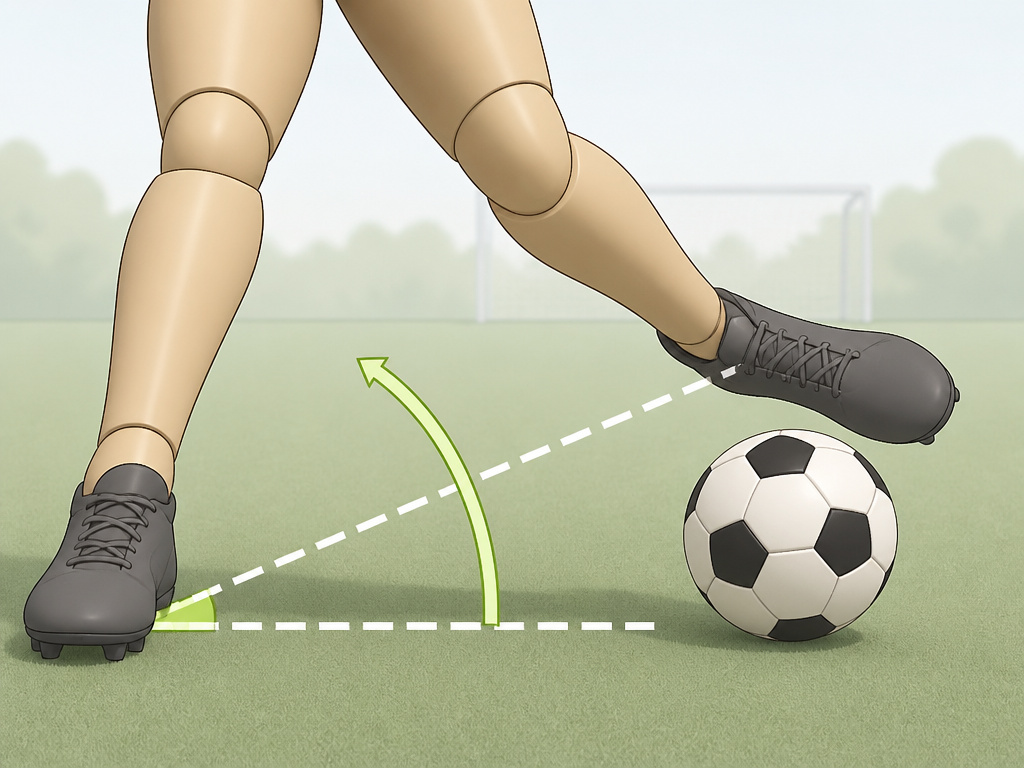
Your plant foot doesn’t just hold you up. It aims the pass. Get its placement and angle right, and the rest of the technique falls into place.
Sources disagree on the exact distance, but they agree on the principle. For a straight, ground pass, Coaching American Soccer specifies placing your plant foot beside the ball approximately 10 inches away, pointed at about a 45-degree angle from the path of the ball to the target. If you’re passing straight ahead to a teammate, your plant foot should point to the right of them (if you’re kicking with your right foot). This angle creates the biomechanical space for your kicking leg to swing through naturally and strike the ball squarely.
The Online Soccer Academy method, geared more toward bending the ball, suggests placing your plant foot an inch or two behind the ball and to the side. This slight rearward placement helps you lean back and strike under the ball to generate lift and curve.
| Pass Type | Plant Foot Position | Primary Goal |
|---|---|---|
| Straight, Deceptive Pass | Beside the ball, ~10 inches away, at a 45° angle to target. | Speed, accuracy, disguise. |
| Bending “Banana” Pass | 1-2 inches behind the ball, to the side. | Generating lift and lateral spin. |
The common fault, per Pacific Football Coaching, is placing the standing foot too close to the ball. This cramps your swing and prevents you from kicking across the face of the ball to generate spin. You need room for your leg to accelerate.
The Two Schools: Deceptive Jab vs. Bending “Banana”
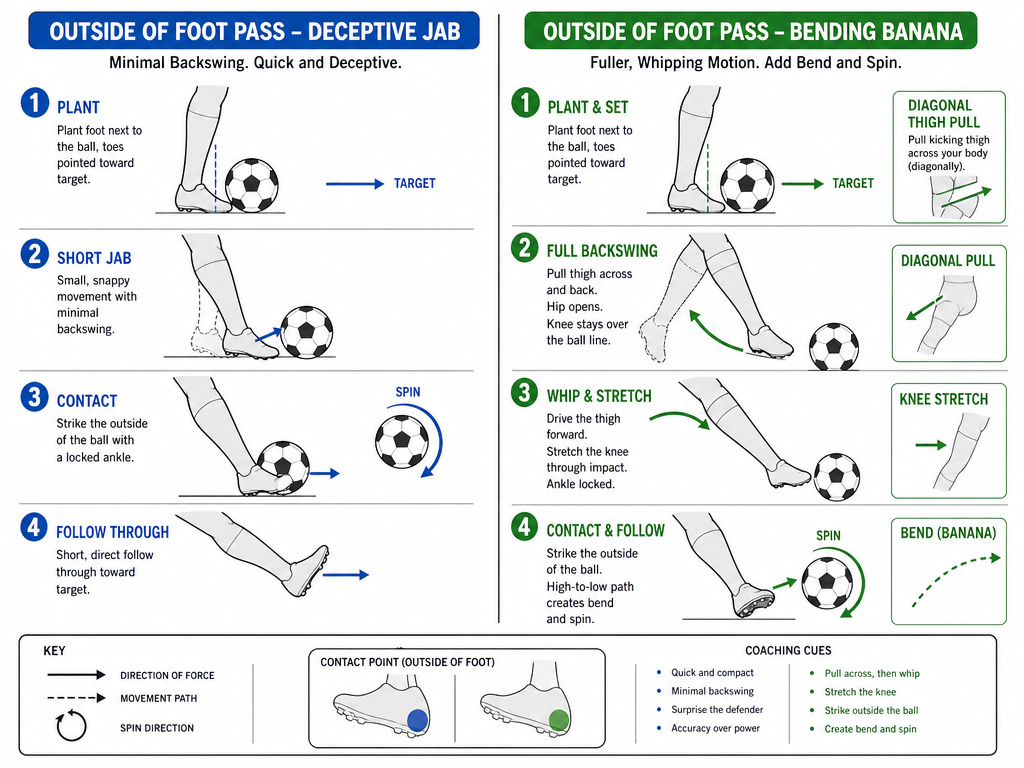
Here’s where the coaching manuals diverge, and understanding both makes you a more complete player. It’s not one technique, it’s a spectrum.
The English coaching perspective, from The FA’s resources, frames it as a tool for disguise and speed. It’s a short-range, quick jab of a pass. In contrast, resources like Pacific Football Coaching emphasize its use for powerful, long-range ‘banana’ passes and shots to bend the ball around opponents. You don’t open your body, so the defender can’t read your intention. It’s perfect for a give-and-go, playing a wall pass, or quickly switching the point of attack in a crowded midfield. The ball stays on the ground, and power comes from a sharp, hip-driven motion.
The biomechanics shift between these two. A recent SciTePress soccer biomechanics study on lower leg joint strategies identified four distinct movement patterns for the outside pass: pulling the thigh back diagonally, bending the knee, stopping the thigh’s acceleration, and suddenly stretching the knee. The quick jab likely uses a shorter, snappier combination, while the bending pass employs a fuller, more whipping motion to generate that lateral spin, which is a key part of how to play an outside of the foot pass.
Step-by-Step: Executing the Basic Deceptive Pass
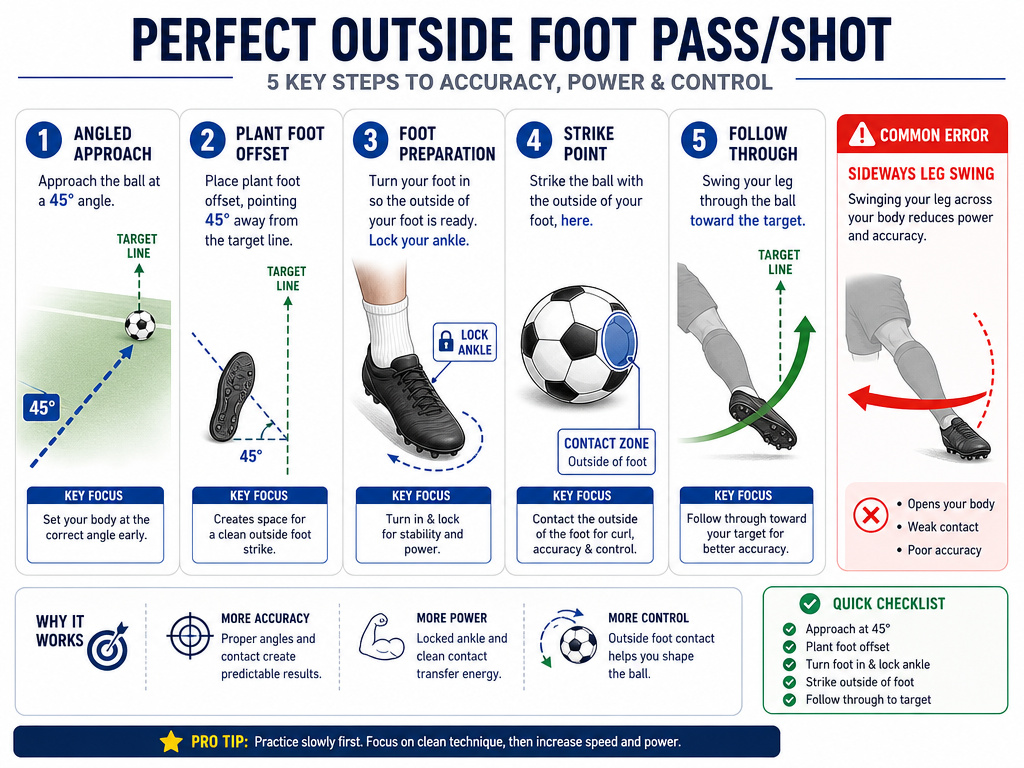
We’ll examine the straight-pass version first. This is the foundation.
- Approach the ball at a slight angle. Don’t run straight at it. Your run-up should mirror that 45-degree line your plant foot will take.
- Plant your foot firmly. As your plant foot lands beside the ball, point it where you want the pass to go, which is 45 degrees away from your actual target. This feels counterintuitive but is crucial.
- Prepare your kicking foot. Turn your foot inward from the hip. Lock your ankle. Your big toe should be pointing up toward the sky, exposing that sweet spot just outside the laces.
- Strike through the center of the ball. Use a short, sharp swing from the hip. Your leg isn’t swinging out to the side; it’s coming through almost like an instep drive, but with your foot turned in. Contact the ball with that defined area of your foot. The sound should be a clean thwack, not a slappy thud.
- Follow through toward your target. Your kicking foot should continue in the direction of the pass, not swing away to the side. A short, controlled follow-through maintains accuracy and pace.
Where this goes sideways: Swinging your lower leg out at a 90-degree angle from the knee. This is the classic beginner error from taking “outside of the foot” too literally. It kills all power and accuracy.
If your pass is consistently drifting to the side, check your plant foot angle. It’s almost certainly pointing too directly at your target, not offset from it. If the pass is weak and spinning wildly, your ankle isn’t locked.
Generating Power and Bend: The “Trivela” Technique
For the bending version, the steps adjust. The goal is to brush across the ball’s outside to impart spin.
The Online Soccer Academy sequence is great for this. Stand about 5 steps straight behind the ball. Place your plant foot an inch or two behind the ball and to the side. Lock your ankle and angle your foot so the outside is exposed. Now, instead of striking the dead center, you hit the lower outside part of the ball. Imagine kicking a slice off it.
The follow-through is dramatic and different. You follow through high, lean back, and curl your foot inward. This action puts that upward-and-downward dip on the ball, a crucial detail when learning how to play an outside of the foot pass. The power comes from the speed of your foot brushing across the ball, not from a massive backswing.
Pacific Football Coaching notes a key trade-off: hitting the ball further from its vertical axis creates more spin and swerve but less power. You have to find your own balance. They also warn against a common fault in this technique: following through directly to the target. For maximum bend, your foot should follow through away to the side, across your body.
Drills to Lock in the Muscle Memory
You can’t just think about this pass. You have to feel it, and that means repetition in a controlled setting before taking it into a game.
Start without a ball. Practice the foot positioning and the locking motion. Get used to the feeling of turning your foot in and presenting that bony striking surface.
Then, work with a wall or a partner from a short distance. Don’t worry about power. Focus entirely on clean contact and that crisp thwack sound. This is where you cement the fundamentals of passing. A great way to build consistency is through simple wall drills.
Next, introduce the give-and-go scenario. Set up a cone as a passive defender. For a demonstration drill based on Coaching American Soccer’s setup, start approximately 15 yards in front of a stationary defender (cone), and have a partner stand at least 10 yards away from the defender, perpendicular to your path. Then, sprint past the cone for the return. This drills the technique into a realistic movement pattern.
For the bending pass, set up a target 30 yards away, like a cone gate or a trash can. Practice curling the ball into the target from a dead ball. Spend 5-10 minutes on this, as Online Soccer Academy recommends. Then, make it dynamic: dribble a few steps and hit the pass, working on your awareness while passing to pick your moment.
Common Mistakes and How to Fix Them
Everyone makes the same errors. Here’s how to spot and correct yours.
- The Slap: The pass is weak and spins uncontrollably.
- Cause: Using the literal outer edge of the boot with a loose ankle.
- Fix: Re-drill the contact point. Lock your ankle hard, turn your foot in, and practice striking a stationary ball with just your foot, no leg swing.
- The Shank: The ball flies wildly off to the side.
- Cause: Your plant foot is pointing directly at your target, or you’re swinging your leg out to the side.
- Fix: Consciously point your plant foot 45 degrees away from your target. Film yourself to check.
- The Toe Poke: You’re accidentally using your toes.
- Cause: Your foot is not turned in enough, or you’re reaching for the ball.
- Fix: Focus on the “big toe to the sky” cue. Make sure your plant foot is close enough so you don’t have to over-stretch.
- No Disguise: The defender reads it easily.
- Cause: You’re telegraphing the pass by shaping your whole body first.
- Fix: Practice the pass from your natural dribbling posture. The move should be a quick jab from the hip, with minimal upper-body rotation.
A big, related mistake is using this pass on your strong foot to avoid using your weak foot altogether. It creates a predictable imbalance. Drill it on both sides.
When to Use It (And When Not To)
This pass solves specific problems. Use it when you need to play a pass quickly without adjusting your body shape, like when a defender is closing you down and you spot a runner. It’s perfect for a one-touch through ball in a crowded final third or a disguised pass in a wall drill sequence.
Use the bending version when you need to curve the ball around an opponent into a path, whether for a cross or a long diagonal switch. It’s also a clever way to take a shot that bends away from the keeper.
Don’t use it for every pass. It’s not a replacement for a firm, straight driven pass over distance or a lofted chip pass. Overusing it makes you predictable. And never force it if a simpler, more accurate pass with the inside of your foot is on. Good vision means picking the right tool for the job.
Frequently Asked Questions
Is the outside of the foot pass the same as a “Trivela”?
Mostly, yes. “Trivela” is the Portuguese term popularized by players like Ricardo Quaresma, and it typically refers specifically to the bending version of the outside-of-the-foot pass or shot. The basic straight pass is just an outside-of-the-foot pass.
Which part of the foot is best for passing?
There is no single “best” part, it depends on the pass. The inside of the foot is best for accuracy and reliability over short-to-medium distances. The laces (instep) are best for powerful, driven passes. The outside of the foot is best for disguise and bending the ball.
Can you shoot with the outside of the foot?
Absolutely. The technique is identical to the bending pass. It’s used to curl shots around defenders or the goalkeeper, often when the ball is on your “wrong” side and you want to get a shot off quickly without shifting your body.
Why is my outside of the foot pass so weak?
This almost always comes down to two things: a loose ankle or using the wrong contact surface. You are likely making contact with the soft, outer edge of your foot instead of the firm area just outside the laces. Lock that ankle and turn your foot in.
How long does it take to learn this pass?
Learning the basic mechanics requires practice. To use it reliably and effectively under pressure in a game takes consistent practice. Start with static drills, then add movement, then passive pressure, then active defenders.
The Bottom Line
The outside of the foot pass isn’t a fancy trick. It’s a functional tool that expands your passing vocabulary. Master the two versions, the quick, deceptive jab and the bending banana pass, and you gain new ways to break lines and surprise defenders.
The one rule I’d add to the manuals: if you can’t hear that clean, crisp thwack on contact, you’re not doing it right. Go back to the contact point. Everything, the disguise, the bend, the speed, starts with your foot hitting that exact spot on the ball. Get that right first, and the rest is just repetition.
