
How to Cross a Football: The 4-Step Method That Delivers
This post contains affiliate links. As an Amazon Associate, we earn from qualifying purchases.
To cross a football effectively, match four things: your body position, foot placement, point of contact, and follow-through. The goal is to deliver the ball with pace and accuracy into a dangerous area, giving your attacker the best chance to score. The technique changes slightly for an inswinger, outswinger, or driven cross, but the core mechanics remain the same.
Most guides tell you to “use your instep” and “look up.” That’s true, but it’s like a recipe that says “cook until done”, it misses the timing and the weight. The difference between a hopeful punt and a chance-creating cross is what happens in the half-second before your foot meets the ball. Your plant foot decides the height, your ankle decides the direction, and your head decides the target. A key part of this is knowing how to cross a football.
What follows is the four-step method for how to cross a football, the five types of crosses you need, the common errors that turn deliveries into turnovers, and the one adjustment that changes everything when the pitch is wet.
Key Takeaways
- Plant your non-kicking foot beside the ball, pointing toward your target. This simple step controls the cross’s trajectory more than anything else.
- Strike the ball with the inside of your foot, just below its center. Contacting the ball low sends it upward; hitting it dead center keeps it driven.
- Look up before you receive the ball, not as you’re about to kick it. Your final glance should confirm runner movement, not discover it.
- Aim for the space between the penalty spot and the six-yard box. This “corridor of uncertainty” forces defenders and the goalkeeper to make a decision.
- On a wet pitch, lean back slightly and strike the ball with less force. A heavier, slick ball will travel farther and faster with the same effort.
The 4-Step Crossing Technique (Body Position to Follow-Through)
Let me walk you through it. I spent years hitting crosses that either ballooned over the bar or scudded harmlessly along the byline. The breakthrough came from a youth coach who filmed me from behind the goal. My plant foot was always a foot behind the ball, not beside it. That one detail meant I was leaning back on every cross, scooping it into the sky.
The crossing sequence is a chain of four linked actions: the approach and plant, the backswing and lean, the contact point on the ball, and the follow-through toward the target. Break one link, and the delivery lacks either power, accuracy, or both.
Step 1: The Approach and Plant Foot
Take your last stride into the cross. Your non-kicking foot, your plant foot, must land beside the ball, not behind it. Point your toes in the general direction you want the ball to go. If your foot is behind the ball, you’ll lean back and lift it over the bar. If it’s too far in front, you’ll lean forward and drive it into the ground. This step sets your body’s angle and dictates the cross’s height.
Step 2: The Backswing and Body Lean
As you plant your foot, swing your kicking leg back. Your arms come out for balance. Here’s the critical lean: your shoulders and chest should be over the ball at the moment of contact. Not leaning back, not lunging forward. This keeps the cross low and driven. For a lofted cross, you allow a slight backward lean, but it’s controlled, you’re not falling away.
Step 3: Striking the Ball
This is the moment. Lock your ankle, point your toes down, and strike the center or just below the center of the ball with the inside of your foot. Your instep is the sweet spot. For an inswinger, approach the ball at a slight angle and strike the right side (if you’re right-footed). For an outswinger, strike the left side. The follow-through comes from the hip and knee, not a wild swing of the leg.
Step 4: The Follow-Through
Your kicking leg should follow through toward your target area. Don’t chop the motion short. A complete follow-through ensures you’ve transferred your momentum into the ball, giving it pace and spin. Your plant foot might pivot or even leave the ground slightly. That’s fine. The action should feel smooth, not jerky.
| Cross Type | Plant Foot Position | Point of Contact | Best For |
|---|---|---|---|
| Driven/Low Cross | Beside the ball, shoulders forward | Direct center of the ball | Cutting through a crowded box |
| Inswinging Cross | At a slight angle, pointing near-post | Right side of ball (right foot) | Catching a keeper on their line |
| Outswinging Cross | At a slight angle, pointing far-post | Left side of ball (right foot) | Pulling defenders away from goal |
| Lofted/Chipped Cross | Slightly behind the ball, controlled lean | Under the center of the ball | Switching play or beating a tall back line |
The 5 Crosses You Actually Need (And When to Use Them)
You don’t need ten variations. You need five, and the intelligence to know which one the moment demands. The worst cross is the right cross at the wrong time.
The Inswinger
This cross curves toward the goal. From the right flank with your right foot, you whip it so it bends in. It’s dangerous because it’s moving toward the goal, making it tough for a keeper to decide whether to come or stay. The risk? It can also curve right into the keeper’s gloves if you don’t get enough pace or bend. Use it when you have a runner attacking the near post or when the keeper is rooted to their line.
The Outswinger
This one bends away from the goal, from the right flank with your right foot. It’s excellent for pulling defenders out of position and inviting a late runner to attack the space at the back post. It feels less immediately threatening, which is why defenders sometimes switch off. The key is pace, a slow outswinger is a gift to any center-back.
The Driven (or Low) Cross
This is hit hard and low, across the face of the goal. The driven pass technique is key here. It’s the most difficult cross to defend because it’s a blur. Defenders hate turning and facing their own goal with a ball zipping past them. It requires impeccable timing from the attacker, but when it connects, it’s often a tap-in. Use it when you’ve beaten your fullback and the defense is back-pedaling.
The Lofted or Chipped Cross
Sometimes you need to get the ball over a crowd. That’s when you lean back a touch and get under the ball, using a lofted pass motion. The aim is height and hang-time, giving your big striker a chance to attack it. The downside is it gives defenders and the keeper time to adjust. Use it as a last resort from deep, or when targeting a specific aerial threat.
The Cut-Back
This is a pass back from the byline into the space at the edge of the penalty area. You’ve drawn the defense toward their own goal, leaving a gap for a midfielder arriving late. It requires vision and composure, you have to look up and pick the runner. It’s one of the most effective chances in football because the shooter often has time and space.
Crossing for Wingers vs. Fullbacks: The Responsibility Shift
The job is different depending on your shirt number.
A winger is usually crossing against a retreating defense. They’ve often taken on and beaten a fullback, creating a moment of disorganization. Their cross is about speed and surprise. They might have less time to look up, so their decision, driven near post, curled far post, has to be instinctive, often pre-planned with their striker.
A fullback, especially in modern systems, is crossing against a set defense. They receive the ball from midfield with time, but also with ten defenders in front of them. Their cross is about precision and variety. They need to be able to hit both an early, curling outswinger and a late, drilled cut-back. For a fullback, improving passing accuracy is essential. Their success is measured less by beating a man and more by picking the right delivery.
Common mistake: A winger trying to place a delicate cross like a fullback, or a fullback trying to whip in a first-time cross like a winger. Play to the context of the chance you’ve created.
The Non-Negotiables: Timing, Vision, and the “Corridor”
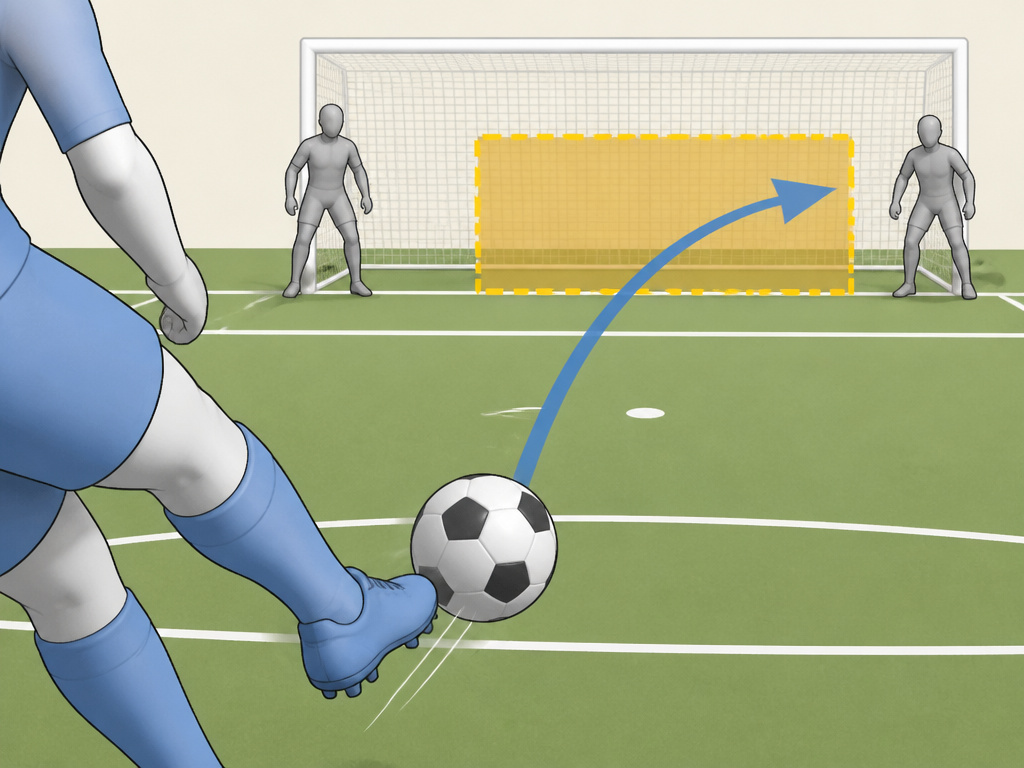
Technique is useless without the right decision. Three things separate a cross from a great one.
Timing and Vision
You must look up before the ball arrives at your feet. Your final glance should be a confirmation, not a discovery. Are your runners charging the near post, hanging back, or making a late run? That glance tells you whether to drill it low or float it to the back stick. Crossing with your head down is just kicking the ball into a crowded area and hoping.
Aiming for the “Corridor of Uncertainty”
This is the space between the penalty spot and the six-yard box. A cross delivered here forces a defender to decide: do I head it? Do I leave it for the keeper? The keeper has to decide: do I come and claim it, or stay on my line? That split-second of doubt is where goals come from. Avoid the easy cross, the one that sails harmlessly beyond the far post or floats directly into the keeper’s hands.
Movement in the Box
Your cross is only as good as the movement it meets. Strikers should be making curved, angled runs, not just standing still. A near-post run drags a defender, potentially opening space for a late runner at the far post. As a crosser, you’re not just kicking it. You’re part of a coordinated attack. A well-timed run for winning headers can turn a cross into a goal.
How to Defend Against a Cross (The Other Side of the Coin)
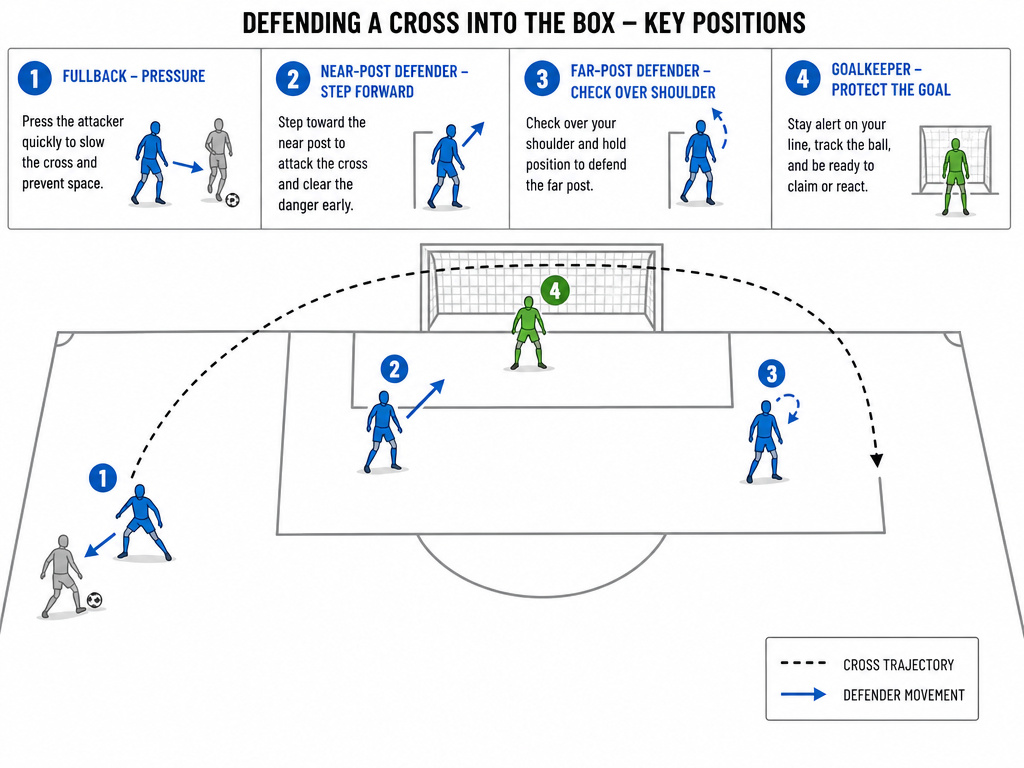
Knowing how to cross makes you better at stopping them. The principles are simple, but they require discipline.
For the Defender Marking the Striker
Your first job is to get goal-side. Position your body between the attacker and your own goal. As the cross comes in, watch the ball and the man. Anticipate the flight. Are you dealing with a lofted ball for an aerial duel, or a driven cross you need to intercept? The moment you lose sight of your man is the moment he gains a yard.
For the Fullback Pressuring the Crosser
Your goal is not always to block the cross, that’s often impossible. Your goal is to make the crosser uncomfortable. Show them onto their weaker foot. Force them to check back inside, buying time for your defense to organize. If you can’t stop the cross, make it a predictable, loopy one that your keeper or center-back can deal with easily.
| Defensive Position | Primary Duty | Key Physical Cue |
|---|---|---|
| Pressuring Fullback | Force cross onto weaker foot / delay delivery | Body shape, showing crosser inside or outside |
| Near-Post Defender | Attack any ball in the front third of the box | Aggressive step forward to intercept or clear |
| Far-Post Defender | Mark space and track late runners | Constant shoulder checks, positioning goal-side |
| Goalkeeper | Command the six-yard box and communicate | Loud call of “Keeper!” or “Away!” |
Common Crossing Mistakes (And How to Fix Them Right Now)

We all make these errors. The trick is knowing what you’re doing wrong so you can stop.
Over-hitting the Cross
This sends the ball sailing over everyone and out for a goal kick. Cause: You’re leaning back too much and/or following through too high. Fix: Focus on keeping your chest over the ball at the point of contact. Practice crosses with a teammate standing at the far post; your goal is to hit them in the hands, not ten yards behind them.
Poor Contact (Toeing or Slicing the Ball)
The cross spins wildly or lacks power. Cause: You’re not locking your ankle and using your instep. You’re kicking with your toes or the outside of your foot. Fix: Slow down. Practice stationary crosses against a wall, focusing solely on making clean contact with the inside of your foot. The sound should be a firm ‘thud’, not a slappy ‘tap’.
Crossing Before Looking Up
You deliver a perfect cross to an empty box. Cause: Panic or habit. You get the ball in a position and fire it in without checking. Fix: Develop a one-glance routine. As the ball is traveling to you, take that snapshot of the box. It takes a fraction of a second and changes everything.
Choosing the Wrong Type of Cross
You drill a low cross when your striker is waiting for a lofted ball at the back post. Cause: Lack of awareness or a pre-determined decision. Fix: This ties back to vision. Link the type of cross directly to the movement you see. No near-post run? Don’t hit the driven cross.
Drills to Build Crossing Consistency
You can’t learn this in a match. You build the muscle memory on the training ground.
The Cone Gate Drill
Set up two cones about three yards apart, ten yards from the byline. Dribble at pace, beat a mannequin (or a patient friend), and then cross the ball through the cone gate before it goes out of play. This forces you to get your cross away under pressure and with precision. Start with no runners, then add moving targets in the box.
Cross-and-Finish with a Partner
Have a partner feed you balls from various angles, some ahead of you, some to your feet. Your job is to take one touch to set yourself and then deliver a specific cross (e.g., “far-post outswinger”). Your partner then becomes the attacker, trying to finish. This builds realism into your practice.
Crossing Under Fatigue
The 85th-minute cross is often the worst one. Set up a drill where you have to sprint the length of the pitch, receive a ball, and then deliver a cross before your heart rate settles. It teaches you to maintain technique when you’re exhausted, which is when most crosses fail in a game.
How to Hit an Early Cross
An early cross is delivered before reaching the byline, often while the ball is still rolling. The key is to strike while your momentum is moving forward and the defense is unsettled. Your body shape is different from a deep cross. You don’t have time to take the ball to the line, so you must adjust your approach. Open your hips early and aim to make contact with the side of your foot. The goal is to whip the ball across the face of goal with pace, giving defenders little time to react and attackers a clear run at the ball. Practice hitting these while running at speed, focusing on a clean connection.
Frequently Asked Questions
What’s the difference between a cross and a long pass?
Cross is specifically a delivery from a wide area into the penalty area, with the intent of creating a direct scoring chance. A long pass can be from anywhere to anywhere, often to switch play or bypass midfield. The technique can be similar, but the intention and target zone are different.
How do I get more curve (swerve) on my cross?
To get the ball to bend, you need to apply side-spin. Strike the ball on its side with the inside of your foot, and follow through across your body. Our full guide on curving the ball breaks down the exact foot angle and run-up needed for consistent swerve.
Does a corner kick count as a cross?
Absolutely. A corner is a cross from a stationary position. All the same principles apply, choosing between an inswinger, outswinger, or driven delivery, but you have more time and less pressure, so accuracy is even more critical.
What’s the best way to practice crossing alone?
Wall is your best friend. Mark a target (a square with tape) at different heights to simulate near-post and far-post crosses. Practice delivering the ball to that spot consistently with both pace and accuracy. You can also work on your chip pass technique against a wall for lofted deliveries.
Before You Go
Crossing is a skill built on a repeatable technique, sharpened by decision-making, and completed by a teammate’s run. Forget trying to score the perfect “assist of the season” highlight. Focus on the weight of the pass. A cross that arrives with pace, in the right space, does the work for the attacker.
The one adjustment I make every winter: on a wet, heavy pitch, I take a slightly shorter backswing. I let the slickness of the ball do some of the work, focusing on clean contact over pure power. The ball will skid and travel anyway. That small concession to conditions has kept more crosses in play than any grand technical change.
So, which cross are you working on first? The driven ball across the six-yard box, or the curling outswinger to the back post? Pick one, find a wall, and hit fifty of them. The repetition is the only shortcut.
