
Corner Kick Rules in Football: Procedure and Penalties
This post contains affiliate links. As an Amazon Associate, we earn from qualifying purchases.
Corner kick rules in football give the attacking team a restart from the corner area when a defender last touches the ball over the goal line. Opponents must stay 9.15 m back, and there’s no offside from the kick itself. Since 2025, a goalkeeper holding the ball for more than eight seconds also concedes one.
That eight-second clause only joined the Laws for 2025/26. A second time-wasting route to a corner arrived at the 140th IFAB annual meeting on 28 February 2026, when a delayed goal kick was added to the list. A corner used to be a reward for a deflection. Now it also works as a penalty for stalling.
What follows: the four ways a corner is awarded, the step-by-step procedure, a table of offences and sanctions, the offside question, and the places where IFAB, high school and college rulebooks disagree.
Key Takeaways
- Opponents stay 9.15 m from the arc, measured from the corner area and not from the ball, until the ball is in play.
- The ball is in play once it is kicked and clearly moves. It doesn’t need to leave the corner area.
- A goal kick delayed past a five-second countdown now gives the opponents a corner kick. A delayed throw-in just changes hands.
- At the 2022 World Cup only 2.6% of 570 corners ended in a goal, so the real value of a corner is rarely the goal itself.
Corner Kick Rules in Football: The Four Ways One Gets Awarded
Law 17 gives referees four routes to a corner, and only the first one existed for most of the sport’s history.
A corner kick restarts play from the corner area nearest where the ball crossed the goal line. The ball sits inside the quarter circle of 1 m radius, the flagpost stays in place, and opponents remain 9.15 m from the arc. Play resumes once the ball is kicked and clearly moves, with no requirement to leave the corner area.
Here are the four triggers:
- Defender’s last touch. The ball crosses the goal line, on the ground or in the air, after a defender touched it last, and no goal is scored.
- Goalkeeper holds too long. More than eight seconds in the hands or arms.
- Delayed goal kick. The ball isn’t in play when the five-second countdown ends.
- A kick straight into the kicker’s own goal. The opponents get the corner.
The 2025 change replaced the old six-second rule, where the sanction was an indirect free kick. IFAB approved the new version at its 139th annual meeting on 1 March 2025.
Which corner gets used
The ball goes in the corner area nearest where it crossed the goal line. That catches out viewers who expect it always to follow the ball.
Corner, goal kick or throw-in?
Three restarts get mixed up constantly, so here’s the quick decision guide.
- A corner kick follows a defender’s last touch over the goal line.
- A goal kick is the matching restart when an attacker touched it last. That split goes back to 1873, when Great Marlow FC proposed giving the corner to the attackers and the goal kick to the defenders.
- A throw-in covers the touchlines.
- A delayed goal kick gives the opponents a corner; a delayed throw-in goes to the opponents as a throw-in.
Five Steps to a Legal Corner (and What Each Mistake Costs)
Picture a ball sitting with half of itself hanging over the painted arc. Is that legal? Yes. IFAB’s own Law 17 FAQ says a position is valid as long as part of the ball overhangs the arc, so nobody needs to nudge it back inside.
The full sequence runs like this:
- Place the ball in the correct corner area. Put it in the wrong one and the kick is retaken, because any other offence at a corner means a retake.
- Leave the flagpost upright. The flag must not be removed or moved for the kick, and an altered corner is another retake.
- Wait for the 9.15 m gap. Opponents must stay 9.15 m (10 yds) from the corner arc until the ball is in play. A defender who ignores it and interferes costs his side a retake and a yellow card.
- Kick a stationary ball. It is in play when kicked and clearly moves. A touch that doesn’t move it leaves it out of play.
- Don’t touch it twice. The kicker can’t play it again until another player has. Do that and the opponents get an indirect free kick.
Worth knowing before you start: The 9.15 m is measured from the corner arc, not from the ball. A defender standing closer than that who interferes with the kicker forces a retake and picks up a yellow card, unless the referee plays advantage.
I like a quick corner as much as any coach. The law still gives you no shortcut on placement, and a rushed kick with the ball in the wrong spot simply comes back.
What Happens When Someone Breaks the Rules at a Corner?
The ball being out of play changes everything. A foul or push before the kick can’t become a free kick or a penalty, because those need the ball in play.
IFAB’s Law 17 FAQ gives two clean examples. If a defender pushes the kicker’s team-mate before the kick, the defender can be warned, cautioned or sent off, and the original corner is retaken with no penalty. If an attacker makes a reckless tackle after the ball has already gone out for a corner, he’s cautioned, and play restarts with the corner.
| Offence | Outcome |
|---|---|
| Kicker touches the ball twice | Indirect free kick |
| Kicker handles after it’s in play | Direct free kick |
| Same handball inside own penalty area | Penalty (indirect free kick if keeper) |
| Defender within 9.15 m interferes | Retake and yellow card |
| Kick goes straight into own goal | Corner for the opponents |
| Any other offence | Kick retaken |
One more detail from Law 17: deliberately kicking the ball at an opponent to play it again is allowed. It becomes a direct free kick only if it’s careless, reckless or uses excessive force.
If the ball is out of play, nothing that happens before the kick can create a free kick or a penalty. The worst case is a card and the same corner again.
Can You Be Offside From a Corner Kick?
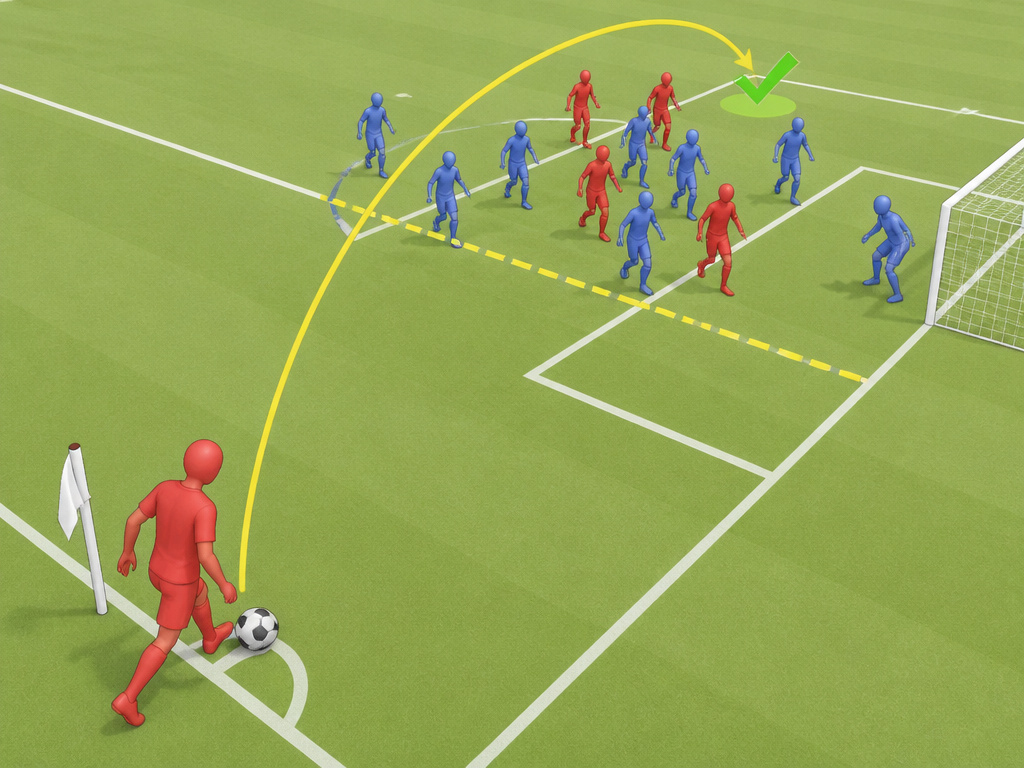
No. Nobody can be penalised for offside from a corner kick when receiving the ball directly from the kick. The exemption applies to the first touch only.
Stay with me on the catch. If the ball is played onward or a short corner brings the kicker back into the move, the second phase of play can create an offside offence again. That is where most arguments start.
When readers ask me to skip the basics and jump to advanced systems, I tell them the same thing. Without a solid grasp of offside and positioning, the advanced ideas don’t stick. Corners are the cleanest proof: the exemption only makes sense once you know what the line normally does.
Eight Seconds and Five-Second Countdowns: The Time-Wasting Corner
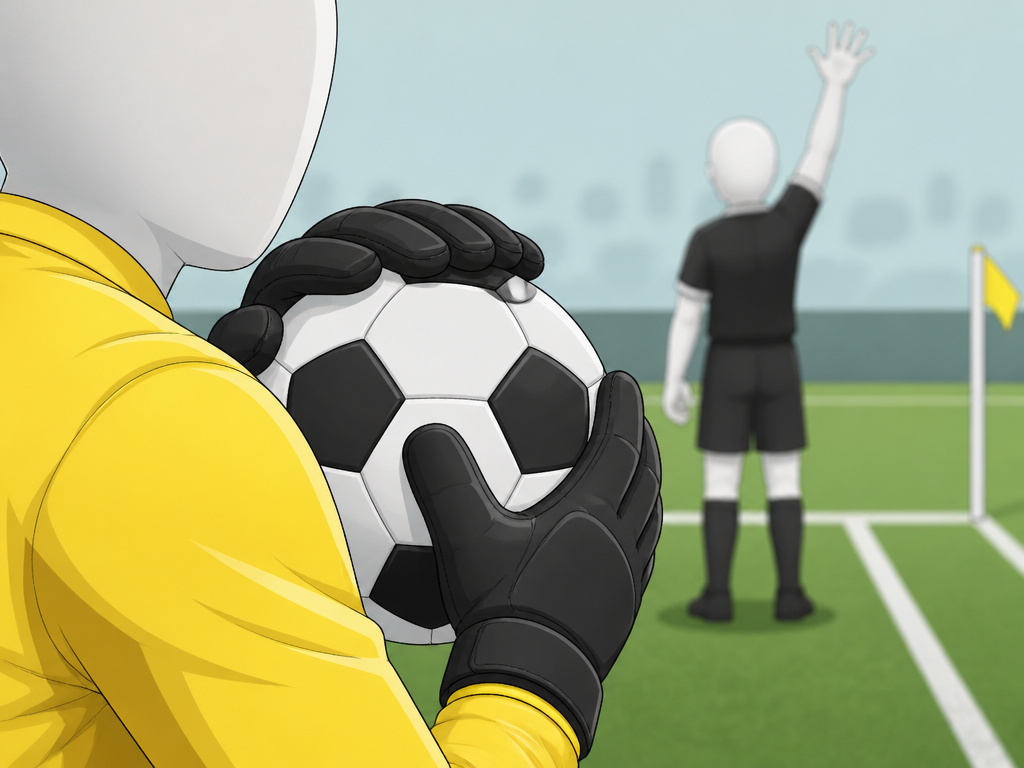
Eight seconds is the new limit for a goalkeeper holding the ball in hands or arms. The referee uses a visual five-second countdown, and if it runs out the opponents get a corner.
Watch for it on the pitch. A keeper stands with the ball cradled to his chest, looking for a runner, while the referee’s countdown runs. That’s the moment the new rule bites.
The timeline matters, because the rule keeps growing:
- 1 March 2025: goalkeeper rule approved at the 139th annual meeting as an amendment to Law 12.2 for 2025/26.
- 14 June 2025: in force at the FIFA Club World Cup, since competitions starting before 1 July 2025 could adopt it early.
- 28 February 2026: the 140th annual meeting extended the five-second countdown to throw-ins and goal kicks.
- 1 July 2026: the next edition of the Laws takes effect, with earlier adoption allowed.
The 2026 meeting added a refereeing wrinkle too. Competitions may let VAR review a clearly incorrectly awarded corner, but only if the review can be completed immediately without delaying the restart. It’s a competition option, so the same mistake can be reviewable in one tournament and not in another.
I’d say the quick-restart camp should welcome all of this. Anything that stops a team slowing a goal kick helps the side that wants to play fast.
Where IFAB, High School and College Rules Part Ways
IFAB’s Law 1 sets the physical details: a corner area of 1 m (1 yd) radius, drawn inside the field of play from each corner flagpost, and a flagpost at least 1.5 m (5 ft) high with a non-pointed top. Marks may be made off the field at 9.15 m (10 yds) from the corner arc.
Other bodies don’t always match IFAB. The table shows what the sources say.
| Topic | IFAB | Other body |
|---|---|---|
| Off-field marks near the corner | Optional; 9.15 m (10 yds) from arc | NCAA 2014-15: 11 yards from flag, mandatory |
| Missing flag or marks | Missing flag: play on with team agreement, report | NCAA 2014-15: marks missing, game played, report filed |
| 8-second keeper rule start | 2025/26 Laws; Club World Cup from 14 June 2025 | NFHS: starting next school year |
The NCAA row comes from an old (2014) referee-association summary, so check current rulebooks before relying on it.
High school (NFHS)
The NFHS high school soccer rule changes moved goalkeepers from six to eight seconds. A corner kick replaces the indirect free kick. It was one of 13 proposals from the rules committee’s February meeting in Indianapolis.
College (NCAA)
The old NCAA summary says missing hash marks no longer stop a game. Before that change, the same item said a game could not be played.
Youth and small-sided football
I can’t give you sourced figures for youth leagues, smaller pitches or small-sided formats. Competitions set their own variations, so ask the organiser. That’s an honest gap, not a hedge.
Why Only 2.6% of Corners Score (and Why Teams Still Drill Them)
A 2.6% conversion rate sounds like a waste of everyone’s time. It isn’t. The FIFA World Cup 2022 corner kick analysis from Solent University examined 570 corners and found that corners influenced match status in 73.3% of cases. A Sloan Sports Analytics Conference paper puts the average conversion rate at around 2% in most elite leagues.
The Solent study found that direct out-swinging corners showed the best efficacy for goal-scoring opportunities, and that the delivery and first-contact zone it labels PA 1/2 was the most effective. On defending, a mixed zonal dominance approach limited goals conceded best. A separate analysis of corner kick success in LaLiga looked at the 2019/20 season; I haven’t reproduced its figures here.
I’m an eyes-and-notebook person, not a data analyst, so treat my reading of tracking-style papers with care. If you want the tactical side, the footballbits guides on corner kick routines and defending corners go deeper. For the delivery question, see near post versus far post corners, and for the age-old argument, zonal or man marking.
From Corner Throw to Quarter Circle: How the Law Evolved
In 1865-66 the United Mechanics FC rulebook in Sheffield had a corner throw from the flag, and it had to travel at least 6 yards. By March 1867 a letter in the Sheffield Daily Telegraph complained that defenders were letting the ball cross the goal line to stop attacks.
Sheffield Norfolk FC’s proposal for a corner kick was adopted by the Sheffield FA in October 1868. The Sheffield FA persuaded the London FA to adopt it in 1872, and in 1873 Great Marlow FC proposed the modern split: a corner for the attackers, a goal kick for the defenders. The Sheffield and London codes amalgamated in 1877.
The sources disagree on the origin date. Sheffield Home of Football dates the corner kick to 1868. FA-centred accounts often cite 1872, when London adopted it. They also disagree on the early kick type: one law-history archive lists the corner as an indirect free kick from 1868 to 1871 and a direct free kick from 1871 to 1877.
The quarter circle of 1 yd radius around the flag was added and marked on the field from 1877.
What happens if the ball goes out straight after a corner kick?
Once the corner is kicked and the ball moves, it is in play, so the next restart depends on where it leaves the field and who touched it last. If it crosses the goal line after a defender made the last touch, the attacking team gets another corner. If the last touch came from the attacking team, the defenders take a goal kick. If it crosses the touchline, the opponents of the last player to touch it take a throw-in.
That means a corner that flies straight over the end line with no touch from a defender usually ends in a goal kick. A kick that goes directly into the kicker’s own goal gives the opponents a corner kick. Referees watch closely for deflections here, because a faint touch from a defender changes the restart from a goal kick to another corner. The kicker also cannot play the ball a second time before another player has touched it. If that happens, the opponents get an indirect free kick.
Frequently Asked Questions
What is the new rule for corner kicks in football?
Goalkeeper who holds the ball for more than eight seconds now concedes a corner, replacing the old six-second indirect free kick. From the 2026 meeting, a delayed goal kick also gives the opponents a corner after a five-second visual countdown. The next edition of the Laws takes effect on 1 July 2026.
Can you score on a corner kick if no one touches it?
Yes. A goal can be scored directly from a corner kick, but only against the opponents. A kick straight into the kicker’s own goal gives the opponents a corner instead.
Do you have to give 10 yards on a corner kick?
Opponents must stay 9.15 m (10 yds) from the corner arc until the ball is in play. The distance is measured from the arc, not the ball. A defender who interferes closer than that forces a retake and a yellow card.
Can you be offside from a corner kick?
Not directly from the kick. A player receiving the ball straight from the corner can’t be penalised for offside. Later phases of play can still produce offside offences.
What happens if the corner flag is missing?
IFAB’s Law 1 guidance says the referee can allow the match to go ahead with the teams’ agreement and submit a report.
The Bottom Line
If you referee, coach or play, here’s one first step this week: read Law 17 on the IFAB site and the corner-related items in your competition rules. Whether VAR may review a corner, and when the eight-second rule applies, depends on the competition, so check yours.
Corner kick rules in football are simple on paper and slippery at the edges. The ball being out of play limits what a foul can cost. The offside exemption covers only the direct receiver. And a corner is now as likely to come from a stalling keeper as from a deflection.
My contrarian take: at youth level I’d rather see a team take a corner quickly and correctly than spend a minute arguing over the arc. If the rules really are the same for everyone, who should own the stopwatch?
