
Zonal vs Man Marking on Corners: Which Is Right for You?
This post contains affiliate links. As an Amazon Associate, we earn from qualifying purchases.
Zonal vs man marking on corners is defined by numbers: four or more zone defenders makes it zonal, three or fewer makes it player-to-player. Zonal setups can win first contact, while man marking can cut corner attempts. The best choice depends on squad, opponent, and scoreline.
Those thresholds come from FIFA Training Centre analysis of the 2022 World Cup. They matter because a corner setup changes what defenders watch: space, runner, or both. A plan that ignores the delivery angle can leave a zone empty before anyone jumps.
What follows: the rules, the evidence, the failure modes, and a practical way to pick a system for your team.
Key Takeaways
- Four or more zone defenders is the FIFA Training Centre threshold for a zonal setup.
- Three or fewer zone defenders marks a player-to-player setup, with most defenders tracking runners.
- USA won 84% of first contacts with 5 zonal markers, while Germany won 75% with 6.
- Uruguay, Spain, and England were among teams conceding fewest corner attempts using player-for-player-based setups.
- The most popular World Cup approach was hybrid, mixing zones, man markers, and edge players.
How to Tell If a Corner Is Defended Man-to-Man or Zonally
I watch the first movement after the ball is placed. That’s where the system shows its hand. You can hear it. A keeper barks “man on”. Then the box goes quiet for a beat.
A corner setup is called zonal when four or more defenders have zone duties. Player-to-player setups use three or fewer zone defenders. The difference is visible after the ball is placed. Zone defenders hold spots in the six-yard box. Man markers move with attackers and hand off only if the rules allow such movement.
Three signs separate the systems:
- Zone defenders stand still before the kick. They hold spots in the six-yard box.
- Man markers shuffle with runners. They take a step when the attacker takes a step.
- Edge players face the corner. They are ready to press a short delivery or chase a second ball.
The basic split in zonal marking and man marking is space versus opponent. That split gets messy when a short corner drags a zone marker out, or when a runner slips behind a man marker.
The Field of Play Sets the Corners
The pitch gives the corner its shape. IFAB Law 1 sets the sizes that every marking plan must fit.
- The corner arc has a 1 m radius.
- The penalty area is 16.5 m deep from the goal line.
- The penalty area is 40.32 m wide.
- The goal area is 5.5 m deep and 18.32 m wide.
- Opponents must stay at least 9.15 m from the corner arc until the ball is in play.
Those measurements create the real battlefield. The six-yard box is small enough to control, but the penalty area is wide enough for runs and blindside movements. IFAB Law 11 also removes one worry: there is no offside offence from directly receiving a corner.
If you want a broader base before picking a setup, defending corners is the simpler place to start.
Zonal Marking: Strengths, Gaps, and Failure Modes
The four-or-more rule is the clearest zonal marker. It also explains why some teams win the first ball and still get punished by a second run.
| System | Best fit | Main weakness | | Zonal | Four or more zone defenders; first-contact wins | Static defenders lose to runs | | Player-to-player | Three or fewer zone defenders; stopping key threats | Defenders get dragged around the box | | Hybrid | Most popular World Cup setup | Still leaves mismatches and free runners |
USA used 5 zonal markers and had an 84% first-contact rate, according to FIFA Training Centre. Germany used 6 zonal markers and won 75% of first balls. Those are strong first-ball numbers. Coaches’ Voice says ball-focused defenders get run on from the blindside, and attackers overload one zone. It also says a ball or runner on a zone border can create confusion.
The two-line zonal shape
Coaches’ Voice describes a common zonal shape with a higher line and a deeper unit.
I’ve watched enough muddy youth corners to know a zone plan can look tidy on paper. It can still freeze when the ball drops between two defenders. A delivery between zones looks like a freeze: both defenders glance, neither commits.
Easy to miss: A ball dropped between two zones can create a great chance. If defenders watch the ball instead of the runner, the first contact is lost before anyone jumps.
Man Marking: Accountability, Drag, and Lead Protection
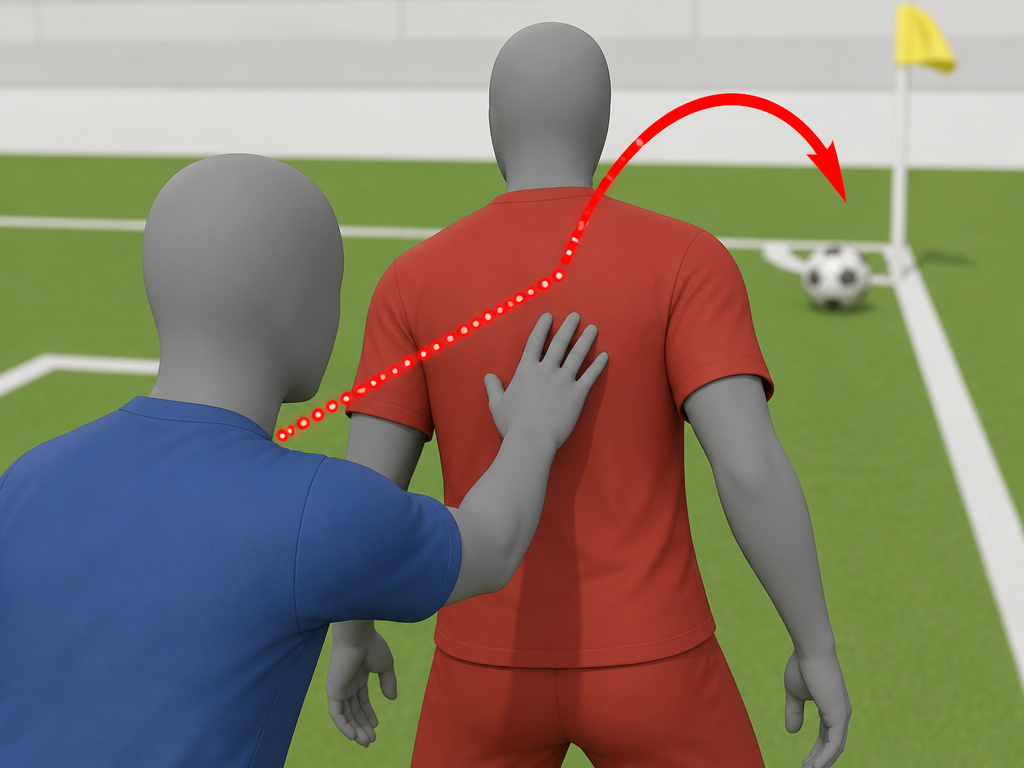
This one puts blame on a body. That’s its strength and its risk. A defender who tracks a runner well gets credit. A defender who loses a runner gets shouted at.
I like man markers only for two or three threats. A plan that marks every runner turns the box into a chase.
SoccerCoachLab says player-to-player marking fits best when the goal is stopping a specific dangerous opponent. Coach-OS adds two narrow uses: tracking a dangerous playmaker and protecting a lead in the closing stage.
Attackers test the difference between near post corners and deeper deliveries by using short options. A man marker who follows a short pass can leave the runner free in the box.
Lead protection and dangerous threats
If the opponent has a tall target, put a marker on him. Keep the rest in zones. That’s a simple rule, and it matches the World Cup evidence. Uruguay, Spain, and England were among teams conceding the fewest attempts from corners with player-for-player-based setups.
Where do the weakest players go? Not in the six-yard box. Coach-OS says corners need your best headers. A small midfielder in the danger zone is a hole waiting to be found.
Hybrid Marking: The Most Common Pro Setup
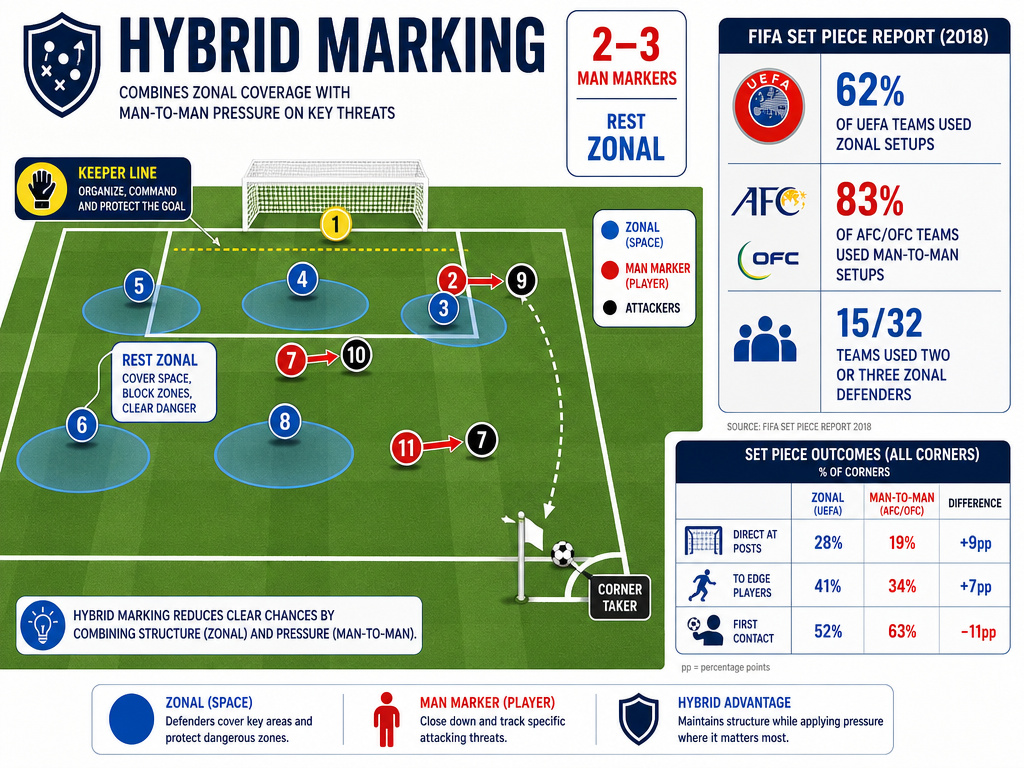
FIFA Training Centre says the most popular setup at the 2022 World Cup was a hybrid. It mixed zonal defenders, player-to-player markers, and edge players.
FIFA also saw fewer teams stationing players on the posts. More teams defended corners with all ten outfielders back in the defensive third. FIFA says teams stick to a setup and change one role for a nuance.
FIFA says 15 of 32 teams used two or three zonal defenders.
| FIFA data point | Number | What it suggests | | UEFA zonal setups | 62% | Zones were common among European teams | | AFC/OFC man-to-man | 83% | Tracking players was common there | | USA first contact | 84% | Five zonal markers won first balls | | Germany first contact | 75% | Six zonal markers won first balls | | Fewest corner attempts | Uruguay, Spain, England | Player-based setups limit shots |
What does a hybrid look like in practice? A keeper line, a deeper zone, and two or three markers on the biggest aerial threats. Coach-OS recommends 2 to 3 man markers and the rest zonal at set pieces.
I prefer a tidy hybrid with two or three man markers to a pure zone plan that nobody talks through.
The disagreement is real. FIFA Training Centre says the numbers do not prove one system is better by itself. ESPN argues that man-marking leads to individual blame for conceded goals, while zonal marking leads to system blame, which may influence a manager’s choice. FIFA Training Centre counters that setup choice depends on coach preference, squad qualities, and the scoreline. The ESPN zonal marking article is worth reading for that angle.
Coach-OS calls zonal marking the more modern, robust system, while FIFA Training Centre presents zonal and player-to-player as equally effective depending on context and team composition, without declaring one more modern or robust. I side with FIFA on the evidence. I side with Coach-OS on the habit: zones need talking, hand-offs need drilling.
Modern corner routines use runs and short options to pull markers out of position. Good compactness keeps the zones tight and reduces the gaps between lines. Without cover and balance, a defender who jumps into a zone can leave the edge exposed.
Zonal vs Man Marking on Corners: Which Is Right for You?
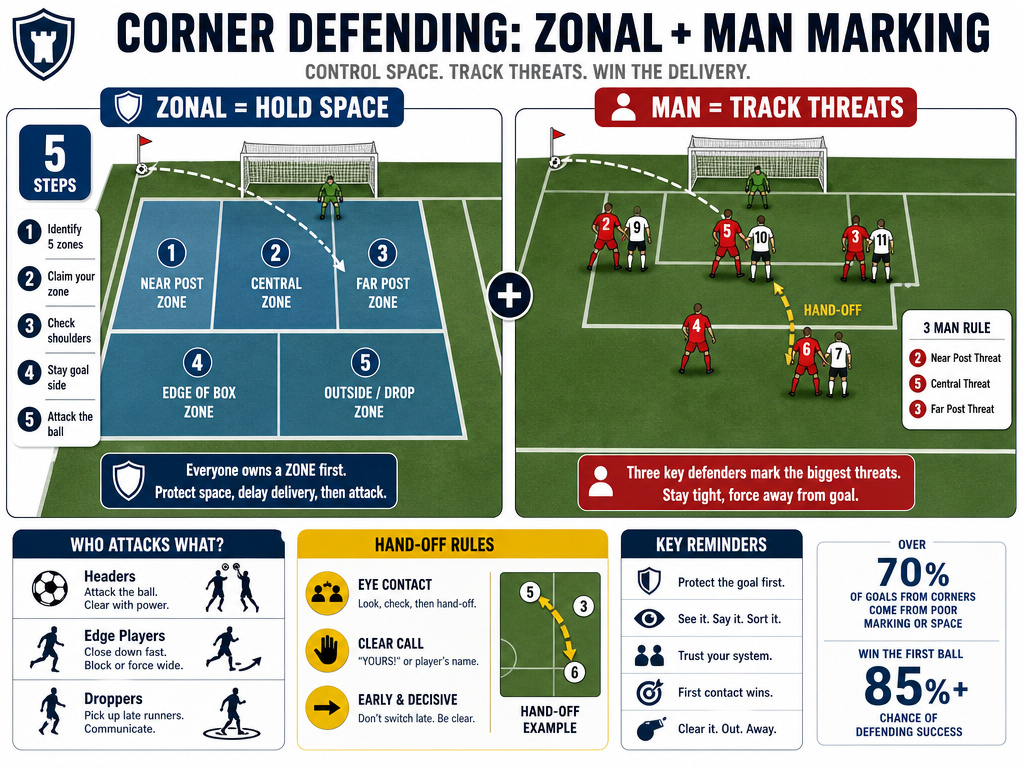
Which system suits a Sunday-league back line? Start with your players, not your pride. A plan that needs four or more zone defenders and a brave keeper won’t survive a thin Tuesday night squad.
Follow these steps: 1. Count your best headers. Coach-OS says defending corners requires your best headers of the ball.
- Pick two or three dangerous attackers to mark. If you mark everyone, you’ll drag defenders out of position and lose the box.
- Place the rest in zones. Keep the deepest zone for your strongest header. A weak zone marker creates freeze, and freeze costs the first contact.
- Assign edge players. If nobody faces the corner, a short delivery turns your plan into a scramble.
- Write the hand-off rule. If zones aren’t named before the kick, defenders will guess. Guessing causes defenders to chase the same ball.
For youth sides, Coach-OS says introduce zonal marking as a concept from U13/U14, with systematic application from U15 upwards. It says zonal work is more demanding but delivers greater value in the long term.
If you switch systems, change one role at a time. Keep your zones, add two man markers, then test the hand-off rule.
A keeper who’s strong at dealing with crosses can rescue a passive zone. But don’t build a plan around heroics. Build it around clear jobs.
Three drills to train the call
IFAB Law 12 draws the line. If marking contact becomes holding, pushing, or impeding, the referee awards a direct free kick. That’s why hand-off drills matter.
How to set up a zonal marking system
A zonal setup is defined by having four or more players assigned to cover specific areas rather than specific opponents. At the 2022 World Cup, teams like the USA used five zonal markers, while Germany used six. The most popular setup overall was a hybrid approach, mixing zonal and player-to-player principles. To implement a zonal core, assign your best headers of the ball to key zones, typically covering the space from the goal line out through the penalty area. The rest of the team can be positioned to cover edge spaces, block runs, or mark specific threats, creating a layered defence.
Common criticisms of zonal and man marking
Each system has distinct vulnerabilities. Zonal defenders compete from static positions, which can reduce their jumping power. Accurate deliveries into the gaps between zones can create chances, and attackers running onto the ball can exploit a defender’s blindside. Confusion can also occur when a ball or opponent is on the border of two zones. For man-marking, the primary risk is defenders being dragged out of position by clever opponent movement, which can open up dangerous spaces in the penalty area. Aggressive marking contact can also cross into foul territory as defined by Law 12.
Player roles in zonal vs man marking
In a pure zonal system, players are responsible for a zone of space. They must attack any ball entering their area, often from a static starting position. In a player-to-player system, a defender’s primary duty is to track and challenge a specific opponent, typically staying goal-side. A hybrid approach, common at the top level, often uses zonal marking as the core principle. For example, a coach might assign two or three players to man-mark the most dangerous aerial threats, while the rest form a zonal structure to cover key spaces in front of the goal.
Frequently Asked Questions
How do you tell if a corner is defended zonally or man-to-man?
Watch the first movement after the ball is placed. Zone defenders hold set spots. Man markers move with runners. A hybrid shows both. Some bodies freeze. Some follow. One or two players face the edge.
What is zonal marking on a corner kick?
Zonal marking assigns defenders to areas instead of opponents. FIFA Training Centre uses four or more zonal defenders as the threshold for a zonal setup. The job is to win the first ball in dangerous space.
Can you mix zone and man marking on corners?
Yes. The most popular World Cup setup was hybrid, mixing zones, man markers, and edge players. Coach-OS suggests 2 to 3 man markers for dangerous aerial threats, with the rest in zones.
Where should the weakest players go?
Keep them out of the deepest six-yard box zones. Coach-OS says corners need your best headers. Weaker players fit edge roles, short-corner pressure, or marking a less dangerous runner.
Is zonal marking better than man marking?
The numbers do not prove one system is better by itself, according to FIFA Training Centre. ESPN argues that zonal systems can reduce individual blame. The better system is the one your squad can execute.
The Bottom Line
If your squad has fewer than four defenders who can hold a zone, skip a pure four-zone plan. Put your best header in the deepest zone, assign two man markers to the biggest runners, and leave the rest at the edge. That’s a workable version of zonal vs man marking on corners.
Do one thing before your next match. Tag corner deliveries. Note which defenders freeze, which follow, and which get caught by a blindside run. The tape will tell you whether your current plan is a system or a habit.
Back to the pitch. The notebook still helps.
