
How to Deal With Crosses as a Goalkeeper: Step-by-Step
This post contains affiliate links. As an Amazon Associate, we earn from qualifying purchases.
To deal with a cross, a goalkeeper must master three things: a starting position that covers the goal while allowing for an explosive forward move, the timing to judge the ball’s flight and commit only when sure, and the technical choice to either catch securely at the highest point or punch decisively clear. A key part of training is learning how to deal with crosses as a goalkeeper. The correct decision hinges on traffic, pressure, and the game’s context.
That starting position is the bedrock, and coaches argue over it. The Goalkeepers’ View advocates starting deeper to protect the line, while NZGKU argues for a more advanced position to intercept. The FIFA data from the last two U-17 World Cups shows a clear shift: keepers are now claiming and punching more, with aerial control success under pressure jumping from 57.1% to 70.5%. They’re getting more aggressive, and it’s working. This guide unpacks that aggression, how to find your spot, when to go, and what to do with your hands when you get there, which is the core of how to deal with crosses as a goalkeeper.
We’ll walk through the debated starting positions, break down the catch-versus-punch decision with a simple flowchart, and lay out specific drills for the cross types that break young keepers, covering every aspect of how to deal with crosses as a goalkeeper. By the end, you’ll have a plan for the next corner that comes your way.
Key Takeaways
- Your starting position is negotiable, but your timing is not: commit too early and you’ll get caught underneath the ball, a terrible place to be.
- Claim (catch) when you’re clean, punch when you’re crowded, the FIFA data shows a +5.5% increase in claiming at the top level, but punching also rose by +7.1% as keepers got more assertive in traffic.
- Shout “Keeper!” or “Away!” the moment you decide, clear communication tells your defenders whether to challenge or clear, and it establishes your authority in the box.
- Train for failure recovery: a missed cross doesn’t end the play; your next two steps back to the line are what prevent the tap-in.
- The scoreline and time change the calculus, trailing late, a risky claim might be worth it; protecting a lead, a safe punch is smarter.
The Great Starting Position Debate
Where do you stand for a corner? Ask three coaches, get three answers. The NZGKU academy says start 2–3 yards off your line, forward enough to intercept, but not so far you’re exposed to a lob. The blog The Goalkeepers’ View prefers to start two-thirds of the way back in the goal, using the logic that it’s easier to sprint forward than backpedal. FIFA Goalkeeping Coach Dean Santangelo warns against stepping out too early before the cross is played, advocating for patience.
So who’s right? They all are, for different situations. Here’s how to pick your spot:
Where this goes sideways: Picking one universal starting position and sticking to it. A driven, near-post cross demands a more advanced starting position than a lofted, far-post ball. Your position must be a reaction to the crosser’s body shape and the ball’s likely trajectory.
If the cross is an in-swinger (curving towards your goal), hug your line a little tighter. The ball is coming back toward your net, so starting deeper gives you a fraction more time to judge its dip. For an out-swinger (curving away), you can afford to creep out a couple of steps, the ball’s flight is taking it away from goal, giving you a clearer path to attack it.
The sweet spot is on the balls of your feet, weight forward, ready to explode in any direction. That’s not a yard measurement; it’s a posture.
Reading the Cross and Timing Your Move
The cross is in the air. Now what? Most young keepers ruin the next three seconds by committing too soon. You see the ball leave the winger’s foot and you go. That’s how you end up stranded, watching it sail over your head.
FIFA Goalkeeping Coach Dean Santangelo advises to wait, read, then commit, while the FIFA Training Centre also recommends approaching attackers aggressively to close space quickly. Watch the crosser’s body. A loopy, hanging delivery buys you time. A whipped, driven cross demands an immediate decision. Your eyes track the ball’s arc, and your brain calculates one thing: can I get there at its highest point? The answer isn’t yes or no, it’s how.
The mistake is guessing. You don’t guess. You watch for the first half of its flight, then you go.
Short, open steps help goalkeepers change angle and approach more efficiently than jumps.
FIFA Training Centre
That’s the footwork secret. Don’t hop or bounce. Use quick, short, choppy steps to adjust your angle as the ball moves. This keeps you balanced and ready to spring forward, sideways, or back. The big, dramatic leap comes after the adjustment, not during it.
The Catch vs. Punch Decision Tree
You’re in position, you’ve timed your move, and you’re arriving at the point of contact. Do you catch or punch? This isn’t a question of bravery. It’s a checklist.
| Catch (Claim) When… | Punch (Box) When… | Why This Rule |
|---|---|---|
| You have a clear jump and clean hands. | The ball is in a crowd of players. | A clean catch ends the threat. A punch through traffic is a safer, definitive clearance. |
| The delivery is high and catchable. | The cross is low and driven. | High balls are easier to secure. Low balls are harder to gather without spilling. |
| You are under little direct pressure. | You are under heavy aerial pressure. | Pressure causes spills. A firm punch is less likely to be affected by a nudge. |
| You are protecting a lead late. | You are chasing a game and need tempo. | A catch kills time and momentum. A punch can start a rapid counter-attack. |
This decision matrix isn’t just theory. The stats back it up. At the 2024 FIFA U-17 World Cup, goalkeepers increased their punching by +7.1% and their claiming by +5.5% compared to 2022. They were choosing the right tool for the job more often. At the same time, tipping the ball (a last-resort, reactive move) dropped by 12.6%. That’s a keeper taking control, not just reacting.
FIFA TSG member Pascal Zuberbühler adds the crucial game-context layer: “The time of the game and scoreline can also influence the decision a goalkeeper makes.” Needing a goal? Maybe you take a risk and claim a crowded ball to start a quick throw. Protecting a 1-0 lead in the 88th minute? A powerful, distant punch into the stands is a perfectly professional choice.
The technique for each is fixed and must be followed.
- To catch: Attack the ball at its highest point, with your hands forming a ‘W’ behind the ball. Bring it into your chest, elbows tight, the moment you make contact. Your knee should come up to protect your midsection from incoming challengers.
- To punch: Use one or two fists, with your knuckles making contact with the bottom half of the ball. The motion is explosive and through the ball, not just at it. Aim for distance and height, preferably toward the sidelines.
Your communication seals the decision. A loud, early “KEEPERS!” tells your defenders you own it. A sharp “AWAY!” tells them you’re not coming and they must deal with it. This isn’t politeness. It’s vital tactical information that prevents collisions and organizes your defense.
Technique Deep Dive: Catching, Punching, and Diving
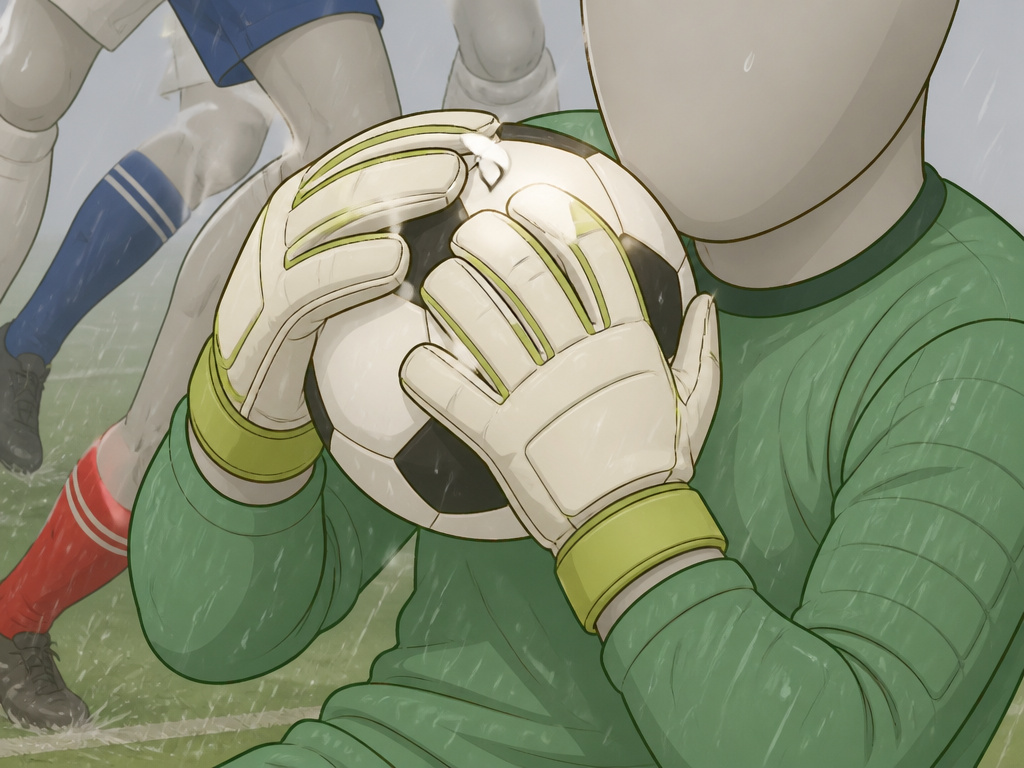
We’ll start with the practical details. The techniques look simple on TV. From inside the six-yard box, with rain and elbows flying, they feel anything but.
Catching a Cross
The goal is to make a difficult skill look routine. It starts with your eyes. Watch the ball all the way into your hands. As you jump, your hands rise to meet the ball, palms open and fingers spread wide. The catch happens at the apex of your jump, that’s the highest point where only you can reach.
Catch the ball at its highest point. Due to the high number of players around you… it’s important to catch the ball above head height.
The Goalkeepers’ View
The moment you make contact, you pull the ball into your chest, tucking your elbows in like a cocoon.
Punching Clear
Punching is not a failure. It’s a calculated clearance. For a standard two-fisted punch, bring your fists together, knuckles aligned. Strike the bottom third of the ball with a short, sharp extension of your arms. The power comes from your core and shoulders, not a wild swing.
The key is to make contact with the solid part of your fist, not your fingers.
Diving for Low Crosses
Some crosses never get high enough to catch or punch. They skid across the wet six-yard box. This is a dive situation. FIFA’s instruction is direct: “Dive onto the ball with arms open when dealing with low crosses to remain in control of the ball and space.”
You’re not diving at the ball; you’re diving onto it. Lead with your hands, palms open and together, and smother the ball into the ground. Your body follows, covering the ball completely. It’s a brutal, physical move that leaves no doubt.
Drills for Different Cross Types
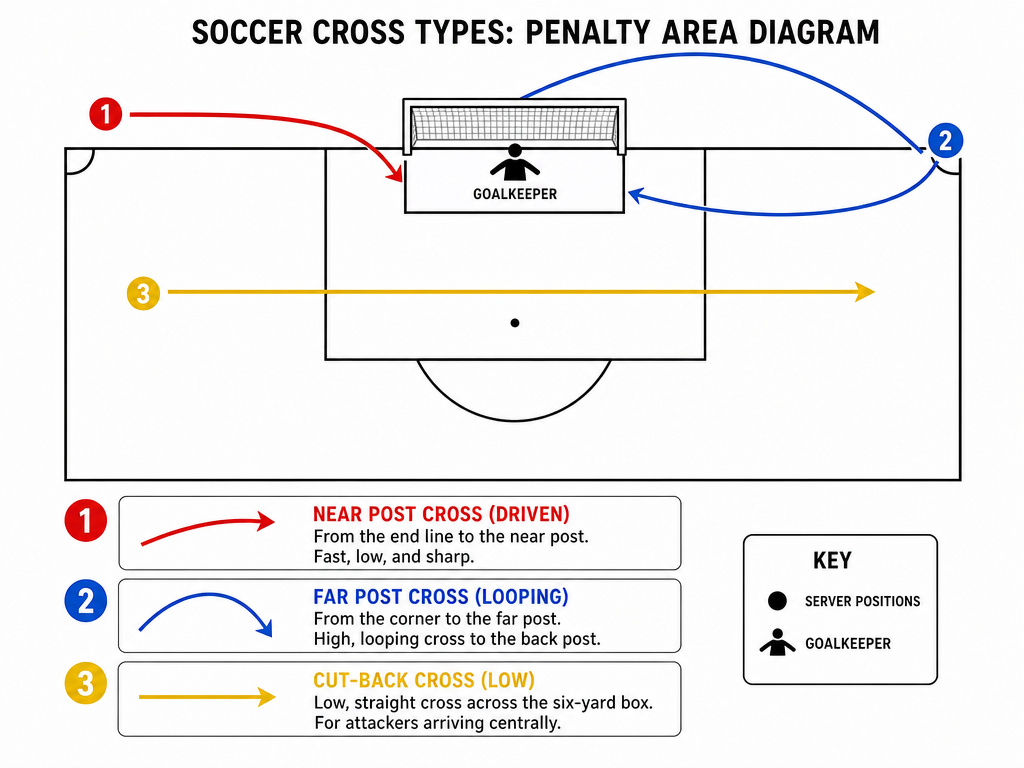
You can’t just talk about it. You have to train it. And generic crossing drills don’t cut it. You need exercises that isolate the specific problems.
Near-Post Drill
- Setup: Place a server on the end line, 5-10 yards from the near post. You start on your goal line, centered.
- Execution: The server throws or kicks driven, curling balls to the space between the near post and the penalty spot.
- Focus: Explosive first step, decisive decision (catch vs. Punch), and dealing with the tight angle. Do you catch it or parry it around the post?
- Common mistake: Taking an extra shuffle step. The near-post cross is about immediate reaction. The first step is the only step.
Far-Post / Back-Post Drill
- Setup: A server stands wide, near the corner flag. You start in a traditional position.
- Execution: The server delivers high, looping crosses aimed at the far post and beyond.
- Focus: Backpedaling while tracking the ball, timing your jump to meet it at the highest point, and catching with confidence despite drifting toward your own net.
- Sensory cue: The ball will look like it’s hanging forever. The temptation is to go early. Wait until it starts its descent.
Driven Low-Cross Drill
- Setup: Two servers, one on each side of the penalty area, about 18 yards out.
- Execution: They take turns firing low, hard balls across the face of the goal, aiming for the six-yard box.
- Focus: Reading the pace, choosing to either gather (if you can get your body behind it) or dive to smother. Footwork is everything, side-shuffling to get in line.
- Progression: Add a passive attacker making a near-post run to simulate game pressure.
These drills build the specific goalkeeper footwork and reaction drills you need. Mix them into your weekly training. The variety itself is the teacher.
How to Recover When It Goes Wrong
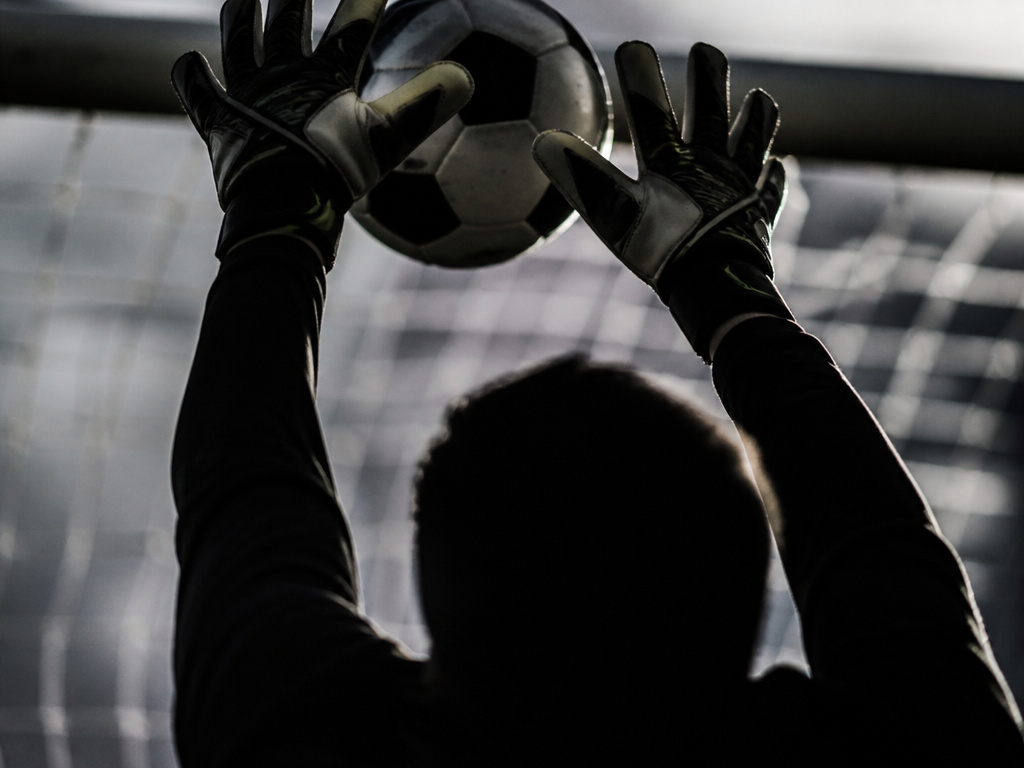
You will miss one. The ball will slip through your hands, or your punch will be weak, or you’ll misjudge the flight completely. What happens next defines you.
The immediate priority is to get back on your line. Not to the spot where you missed the ball, to your goal line. Your eyes must find the ball again the instant you’ve missed it. Where did it go? Who is following it in?
The play has collapsed into a chaotic, close-range shooting chance. Your positioning is your last defense.
When the ball is falling behind the goalkeeper, he can catch it behind his head with his fingertips. There is always a risk of the ball slipping from his grasp… so it is preferable to catch or deflect the ball with a backwards dive.
Soccer Laval Goalkeeping Guide
This is the edge case nobody practices. The cross that goes over your head. The guide says a backwards dive is safer than an awkward, over-the-shoulder catch attempt. It’s a last-ditch maneuver, but knowing it exists keeps you from trying the impossible and failing completely.
Train this. Have a coach whip crosses just over your reach. Practice the turn, the sprint back, and the low set position. It feels awful. It looks worse. But conceding from a missed cross feels infinitely worse.
Communicating Under Pressure
Your voice is a tool. In the noise of a packed penalty area, it’s your most important one. You’re not just calling for the ball; you’re running the defensive operation.
The two commands are simple, but their timing is everything.
- “Keeper!” – This is a declaration of ownership. You shout it the moment you decide to come, and you shout it loud. It tells your defenders to stop competing, to maybe even block for you, and it tells the attacker you’re coming through.
- “Away!” or “Out!” – This is an abdication of responsibility. It means the cross is too far away, too high, or too dangerous for you to claim. It’s the signal for your defenders to attack the ball with their heads and clear their lines.
The mistake is being late or quiet. A late “Keeper!” call causes a collision with your own defender. A quiet “Away!” leaves your center-back unsure, and he hesitates. That hesitation is a goal.
Your communication starts before the cross. You are the conductor. The cross is the crescendo.
How to protect yourself when coming for a cross
When you attack the ball in a crowded area, you must protect your space and yourself. Approach aggressively to close down space, but keep your upper torso upright with your arms slightly out and ready. This posture makes you a bigger, more stable presence. As you jump to catch or punch, lead with your knee slightly raised. This creates a barrier between you and oncoming attackers, giving you a safer window to make contact with the ball. Your focus stays on the ball, but this physical assertion helps prevent collisions and deters opponents from challenging you recklessly.
Frequently Asked Questions
Is goalkeeper the hardest position?
At what age do goalkeepers peak?
The position relies heavily on experience, decision-making, and positioning, qualities that improve with time. Shot-stopping reflexes might dull slightly, but the mental game more than compensates.
What are goalkeepers not allowed to do?
They can’t handle a deliberate back-pass from a teammate’s foot (though chest or head is legal). They can’t pick up a ball that has been thrown directly to them from a throw-in. And of course, they can’t handle the ball outside their penalty area.
What is the best tactic for a goalkeeper dealing with crosses?
There is no single “best” tactic. The best approach is a flexible one based on the principles here: an adaptable starting position, patient timing, a clear decision matrix for catching vs. Punching based on traffic and game state, and relentless, clear communication. The tactic is to be the most prepared, most decisive person in the box.
The Bottom Line
Dealing with crosses isn’t about being the biggest or jumping the highest. It’s about being the smartest. It’s a chess match played in three seconds of chaos. The keepers rising to the top now are the ones who study the patterns, who know that FIFA’s numbers show a move toward aggressive claiming and punching, not one or the other.
Your single most important takeaway is this: your job isn’t done when you catch or punch. Your job is to control the outcome. A clean catch controls possession. A powerful punch controls space. A missed cross demands you control the next five seconds with a frantic, intelligent recovery. Master that cycle, read, decide, act, recover, and the six-yard box starts to feel a lot bigger.
