
Goalkeeper Positioning Explained
This post contains affiliate links. As an Amazon Associate, we earn from qualifying purchases.
Goalkeeper positioning is the art of being in the right place before the shot is taken. It starts with the basic line from the center of your goal to the ball, but modern keepers play 13.1 meters off their line on average—1.3 meters higher than in 2018—to defend space, support their defense, and act as the first attacker. The best positioning prevents the danger, turning a potential dive into a simple catch or clearance.
That shift from 11.8 meters in 2018 to 13.1 meters in 2022, documented by FIFA’s Football Analysis and Insights Team, is the story of the position. It’s not just about standing further out. It’s about a complete change in the goalkeeper’s role, where your starting spot is dictated by your team’s tactics, the game’s score, and the phase of play. A key principle is goalkeeper positioning explained by these tactical demands. Position wrong, and you’re chasing the game. Position right, and the game comes to you.
What follows is a breakdown of the principles, from the foundational angle rule to the advanced data on high lines in a complete goalkeeper positioning explained guide. This guide explains where to stand during open play, the essential rule for transitions, and how the very best make it look easy.
Key Takeaways
- The core principle is the line from goal center to ball; this dictates your side-to-side positioning to cover both posts equally.
- Modern professional keepers now operate with an average line height of 13.1 meters, a significant increase driven by the need to defend space behind high defensive lines.
- In transition, you must instantly choose to pressure or retreat; hesitation leaves you in ‘no man’s land’, the most vulnerable spot on the pitch.
- Your positioning is not static; FIFA data shows the distance between the goalkeeper and the defensive line decreased by 1.5 meters when a team was winning in 2022 compared to 2018.
- Game experience is irreplaceable; the UEFA coaching manual states a keeper’s decisions are mostly automatic, built from thousands of trained repetitions and match scenarios.
The Golden Rule: The Line from Goal to Ball
Forget the spectacular dives for a second. The foundation of all goalkeeping is a simple geometric line. You must position yourself on an imaginary line that runs from the center of your goal to the ball.
This is basic geometry, not advanced tactics. This line determines your side-to-side positioning. If you’re on it, you are equally far from each post. The shooter’s angle is at its most narrow. Any shot they take has to beat you directly, because you’ve taken away the corners. It makes you look bigger.
A goalkeeper on the correct line turns a top-corner screamer into a desperate hope. A keeper off that line turns a tame roll into an open-net goal.
The second part of the equation is how far along that line you come. This depends on the ball’s location and your own physical reach. The closer the ball is to the goal and the more central it is, the more you can afford to stay closer to your line to protect against the chip. As the ball moves wider, you must come out further to cut down the angle at the near post. A quick check from the coaching blog JB Goalkeeping: if you’re square to the ball and point your arms straight out sideways, the arm nearest the goal should be pointing outside the near post. If it’s pointing into the net, take another step out.
This principle is your constant, a core part of any goalkeeper positioning explained session. During any attacking phase, your feet are always shuffling, your eyes always checking your posts, keeping you on that line as the ball moves. It’s the bread and butter of the position. Get this wrong, and nothing else matters.
Where the Ball is on the Pitch: The Three Zones
The line-from-goal rule works when the ball is in a shooting position. But what about when play is building 70 meters away? You can’t stand on your six-yard line all game. This is where zonal positioning comes in, a practical framework for the vast majority of the match.
Coaching resources like the Elite GK Academy break the pitch into three vertical zones to simplify this decision:
| Ball Location | Goalkeeper’s Zone | The Why |
|---|---|---|
| Attacking Third (Opposition Half) | Beyond the penalty spot to edge of box | Your team is pressed high. You are a sweeping option and must be ready to intercept long balls over the top. |
| Middle Third | Between 6-yard box and penalty spot | Balanced position. You can support build-up, but are deep enough to react to a sudden switch and through-ball. |
| Defensive Third (Your Half) | Between goal line and 6-yard box | Danger is imminent. Your priority is shot-stopping and commanding your immediate area. |
These are guidelines, not locked coordinates. A strong wind at your back might pull you a few yards deeper. If your center-backs are lightning fast, you might feel comfortable stepping a yard higher. But these zones answer the basic, nagging question every young keeper has on a full-size pitch: “Where should I be?” Start here. The nuance comes later.
The Modern High Line and the Data
Now, consider why the classic image of a goalkeeper glued to the line is extinct. The game has changed, and the numbers from the highest level prove it.
According to the FIFA Football Analysis and Insights Team, the average goalkeeper line height—that’s the distance from the goal line—was 11.8 meters at the 2018 World Cup. By the 2022 World Cup, that number jumped to 13.1 meters. That’s a 1.3-meter shift across the entire tournament. Even more telling, at the 2022 World Cup the average distance between the keeper and the defensive line was 20.4m, compared to 21.4m in 2018. Keepers are higher and closer to their defense.
This isn’t a preference; it’s a tactical requirement for teams that play with a high defensive line.
Why? The rise of the high press and the offside trap. If your defensive line is on the halfway line, standing on your 6-yard box creates a cavernous, indefensible space behind them. You become a sweeper-keeper. Your job is to patrol that space, ready to sprint off your line to clear through balls before an attacker can reach them. As FIFA TSG expert Pascal Zuberbühler puts it, the keeper must “defend the space behind the defensive line by being positioned higher and close.”
This role requires insane confidence and perfect communication. Your defenders must trust you to be there, and you must trust them to hold the line. It’s rehearsed on the training ground until it’s instinct. When it works, you snuff out attacks before they become shots. When it fails, you see a keeper stranded in open grass as the ball sails over them. The modern game asks for the former, and punishes the latter.
The Transition Decision: Pressure or Retreat
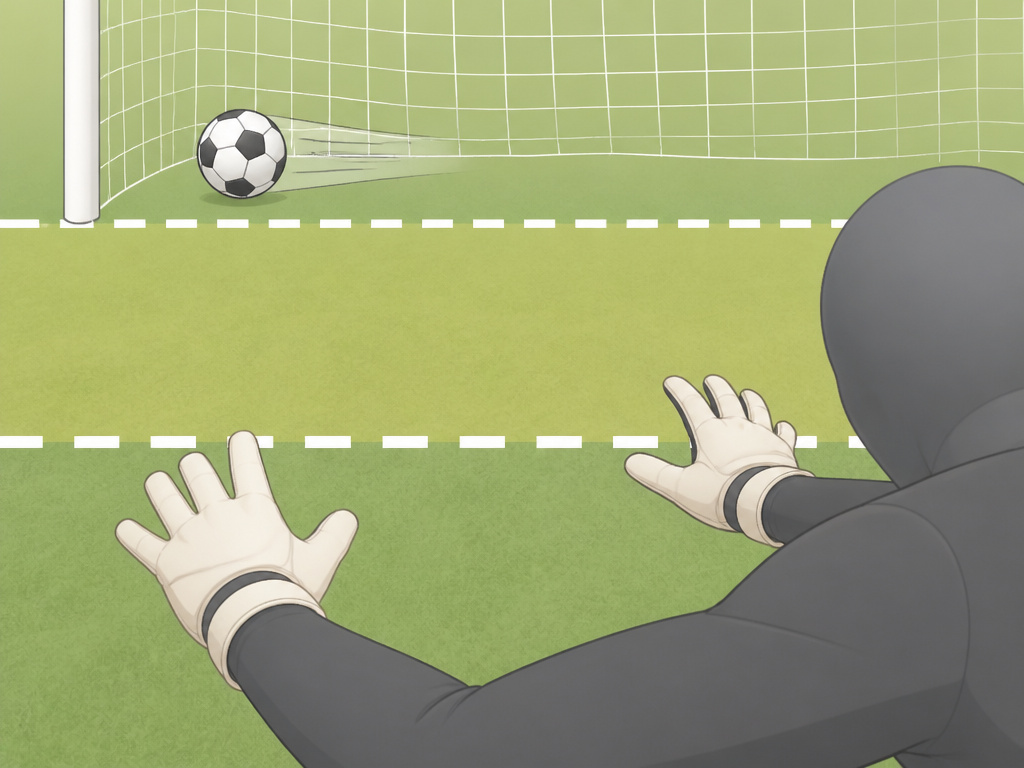
This is the moment that separates good keepers from great ones. Your team loses the ball while attacking. The opponent looks up and sees space behind your defense. What do you do?
The UEFA Goalkeeper Coaching Manual is brutally clear on this. You have one instant to decide: apply immediate pressure or retreat to your goal. You must “at all costs avoid finding yourself in ‘no man’s land’.”
No man’s land is the worst place on the pitch. It’s far enough off your line that you can’t make a quick reaction save, but not far enough out to challenge the attacker or intercept the ball. You’re a spectator. The decision hinges on where the ball is lost and the positioning of your defenders.
| Scenario | Recommended Action | Risk of the Opposite |
|---|---|---|
| Ball lost in opponent’s final third, your defense is set | Hold a high starting position. Sweep up through-balls. | Staying deep cedes huge space, inviting pressure. |
| Ball lost in central areas, defender is isolated 1v1 | Instantly decide. If you go, go fully and fast to narrow the angle. If you stay, drop and set for a shot. | Hesitating. A “stop-and-go” leaves you flat-footed and beaten. |
| Ball lost in your own half, defense is scrambling | Prioritize guarding the goal. Get set on your line. | Rushing out when your defense can recover, leaving an open net. |
The first step is crucial. FIFA’s analysis of Esteban Andrada highlighted that if the ball is approaching on the right, your first step must be with your right foot. That small technical detail buys you a vital half-second of momentum in the right direction.
I learned this the hard way playing Sunday league. A misplaced pass in midfield, I took two hesitant steps out, saw my defender might get there, stumbled, and ended up in that awful crouch halfway out as their striker rolled it past me. It’s a sickening feeling. Now I coach my nephew’s team one simple mantra: see the trigger, pick your path, and commit.
How Game State Changes Your Position
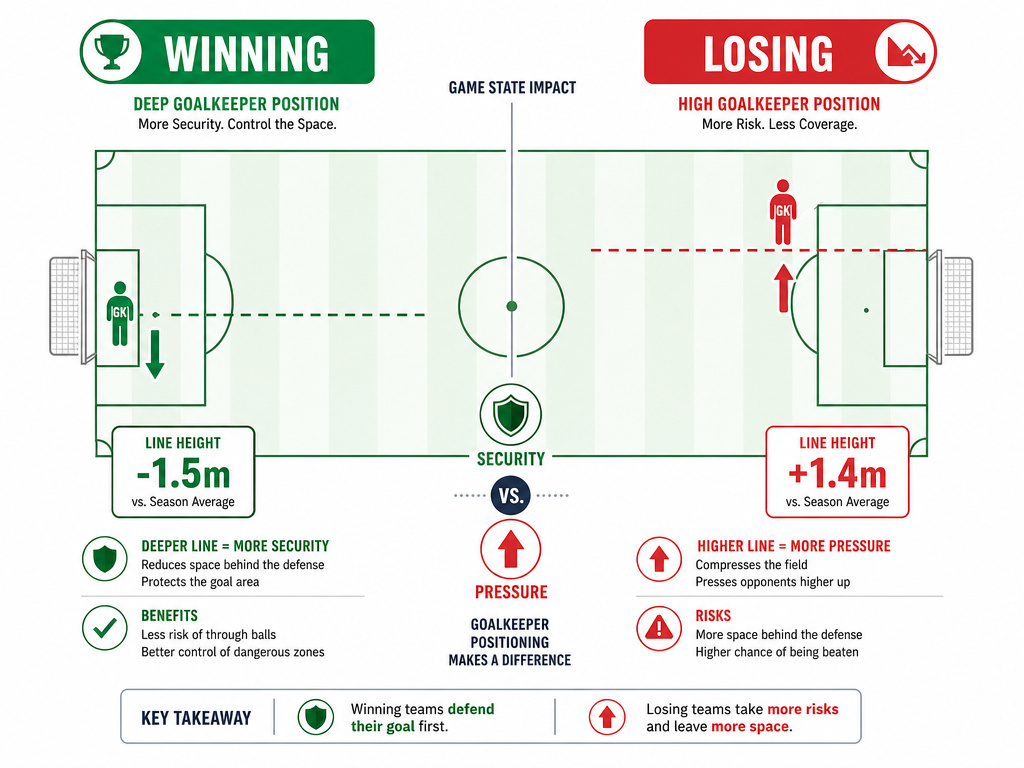
Your positioning depends on both the ball’s location and the scoreboard. Are you winning, losing, or drawing? The data shows keepers adjust subconsciously.
That same FIFA analysis found that when a team is winning, the average distance between the goalkeeper and the defensive line decreased by 1.5 meters in 2022 compared to 2018. You naturally sit a bit closer to your goal, protecting your lead, making your goal a smaller target. The game becomes about security.
When a team is losing, the opposite happens. FIFA data shows the average goalkeeper line height was 14.2 meters versus 12.8 meters in 2018. You push higher, acting as an extra outfielder to support possession and pressure, trying to force an equalizer. The risk of a lob increases, but the need for a goal outweighs it.
Think of it like a boxer. When you’re ahead on points, you cover up, move away, and avoid big swings. When you’re behind, you lead with your chin, throw more punches, and accept you might get hit. A goalkeeper’s positioning follows the same strategic rhythm. It’s not cowardice or bravery; it’s game management.
Positioning for Set Pieces: A Different Game
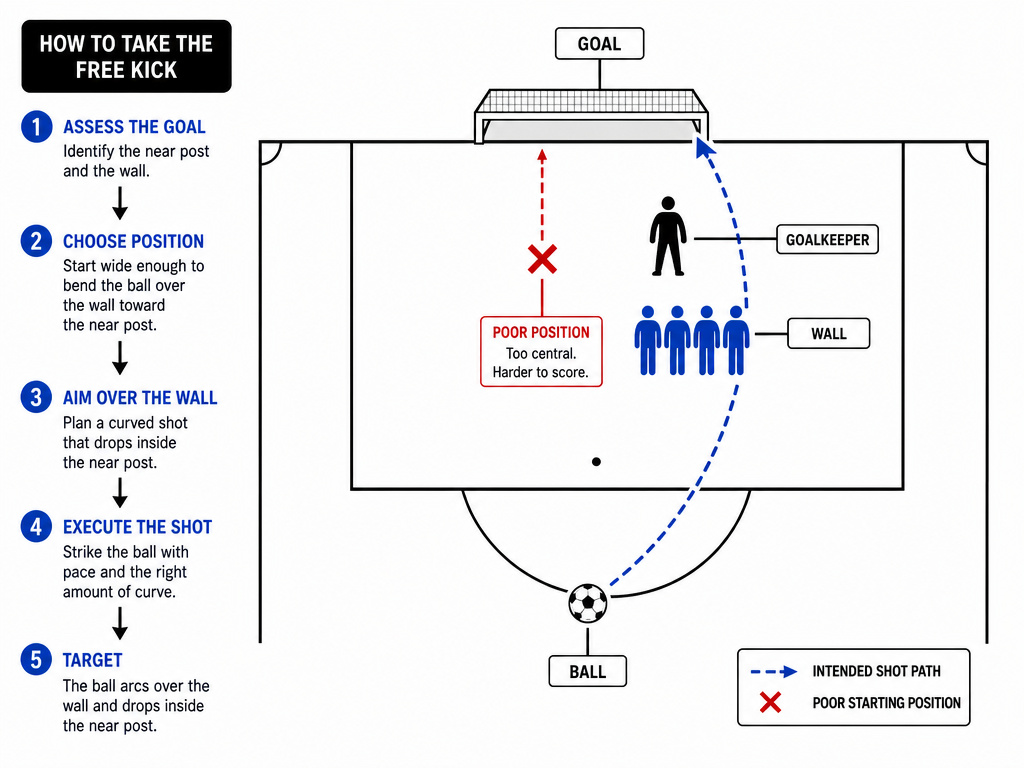
Open-play rules shift when the ball is dead. For free-kicks and corners, positioning becomes more premeditated and technical.
For a direct free-kick on the edge of the box, you have two main concerns: seeing the ball and guarding your near post. The standard practice is to position a wall to cover one side of the goal (usually the side the shooter can curl the ball over) and then position yourself just past the last player in the wall. This gives you a clear sightline. A common trick is to place the first player in the wall just outside the front post, physically blocking that vulnerable short-side shot.
Where this goes sideways: Starting too close to the center of your goal for a wide free-kick. It’s easier to move forward to meet a chipped ball than to backpedal and dive. Start a step toward your back post.
For corners, your starting position depends on your command. If you’re coming to claim, start a yard or two off your line, giving yourself room to move forward and attack the ball at its highest point. If you’re staying on your line, plant yourself in the center, ready to move laterally. The key is a loud, early call of “Keeper’s!” or “Away!” so your defenders know the plan. Indecision here leads to collisions and easy goals.
Training Your Positioning Instincts
You can’t just understand this stuff. You have to feel it. The UEFA manual states that during a match, a goalkeeper’s actions are “mostly automatic or instinctive.” That automation comes from one place: repetitive, game-realistic training.
Drills are great, but they must be opposed and variable. Don’t just have a coach roll balls at you from the same spot. Incorporate servers playing passes behind a dummy defensive line for you to sweep up. Practice transition scenarios where a teammate suddenly turns and shoots as you’re moving. Use small-sided games where you’re constantly adjusting to live, unpredictable attacks.
The most valuable thing, honestly, is miles on the clock. There is no substitute for match experience. Every cross, every through ball, every 1v1 feeds your mental library. You start recognizing patterns—the way a striker shapes their body, the angle of a midfielder’s head before a through ball. That’s why an older keeper with slower reflexes can often out-position a younger, more athletic one. They’ve seen the movie before.
How should a goalkeeper stand ready?
Your body position is the platform for everything you do. When the ball is in play, you must be in a set stance: knees bent, weight on the balls of your feet, and hands in a relaxed, ready position at your sides. This athletic posture allows for explosive movement in any direction. Your first step is crucial; if the ball is moving to your right, your first step should be with your right foot, and vice versa. This technique ensures you push off correctly to cover ground quickly and efficiently, turning your stance into dynamic action.
What are good goalkeeper positioning drills?
Effective positioning must be trained repeatedly so it becomes automatic. Drills should focus on the relationship and triggers between you and your defensive line, as this distance is extremely important. Work on scenarios that simulate different stages of the game, such as when your team is in possession in the final third or during a sudden transition to defense. The team requires discipline and communication to manage these distances, so involve defenders in these exercises. The goal is to feed your memory with a huge variety of cues and responses you can apply spontaneously during a match.
Where should a goalkeeper stand in a 1v1?
In a one-on-one situation, your priority is to reduce the attacker’s shooting angle. Position yourself on the line from the center of the goal to the ball, coming out far enough to make the target smaller. You must instantly decide whether to apply immediate pressure or retreat to your goal, and avoid finding yourself in ‘no man’s land’ where you can’t do either. Your actions here are mostly instinctive, built from accumulated game experience. Stay on your feet as long as possible, be big, and force the attacker to make the first move.
Frequently Asked Questions
What is the single most important positioning rule?
The line from the center of your goal to the ball. It is the essential starting point for all other positioning decisions. If you are not on this line, you are giving the shooter an unnecessary advantage.
How far out should a goalkeeper come?
It depends on the ball’s location and your ability. For pure angle coverage against a shot, an academic geometric study suggests an optimal maximum distance off the line is between 1.68m and 1.83m. This differs from average open-play positioning, where FIFA data shows modern pros average 13.1 meters off their line to defend space. For youth keepers, be far enough out that you can cover the near post with a strong step and dive.
Why is positioning more important than reflexes?
Good positioning reduces the need for spectacular reflex saves. It turns a potential top-corner shot into a comfortable save at your chest, or better yet, allows you to intercept the ball before a shot is even taken. Reflexes save the occasional wonder-strike; positioning prevents the other nine shots from being dangerous in the first place.
How do I know when to come out for a through ball?
This is the hardest decision. Key triggers: the weight of the through pass (is it overhit?), the speed and body position of your defender versus the attacker, and your own starting position. If you are in doubt, you must instantly choose between applying immediate pressure or retreating to the goal, and avoid ‘no man’s land’. But once you decide, commit fully.
Does positioning differ for women’s football?
The principles are identical, but the average tactical positions can differ. Data from different tournaments shows variation: at the 2024 Olympics, goalkeepers when their team was in possession in the final third had an average line height of 28 meters, while at the 2023 Women’s World Cup it was 24.2 meters.
Before You Go
Positioning is a practiced, conscious habit that becomes unconscious. Start with the line, understand the zones, and then layer on the modern demands of defending space. Watch a top-level game this weekend, but ignore the ball for a few minutes. Just watch the goalkeeper. See how they are never still, how their starting spot shifts with the flow of the game, how they are always adjusting to be in the right place before the right place is needed.
That’s the art. It’s not about the saves you make. It’s about the saves you never have to make because you were already there. Now get out on the pitch and start building that instinct. Your goal will thank you.
