
Goalkeeper Reaction Drills: Key Training Methods Explained
This post contains affiliate links. As an Amazon Associate, we earn from qualifying purchases.
Goalkeeper reaction drills require more than fast feet, they need you to link your eyes to your hands under unpredictable pressure. The foundation is a standard 8×6 yard reaction wall drill, where a ball is fired into a board placed two yards from the keeper, and you work for thirty seconds followed by thirty seconds of rest across six rounds.
That two-yard gap between you and the wall is where the real lesson lives. Most keepers stand too far back, buying themselves an extra half-second their brain doesn’t need. The drill trains your hands to move before your conscious mind registers the ball’s new angle, a hollow thunk as the ball hits the board, a quick shuffle of the feet, and a firm save that feels almost automatic. Get that distance wrong, and every save becomes a frantic lunge instead of a controlled reaction.
What follows is a breakdown of what the research actually says works, from that basic wall drill to tennis balls, virtual reality, and a crucial disagreement between what expert coaches do and what the studies recommend. The guide explains the setups, the mistakes that waste your time, and how to know if you’re getting faster.
Key Takeaways
- Run the standard 8×6 yard wall drill for ten minutes, using a 30-second work, 30-second rest structure across six rounds to maximize neural adaptation without fatigue.
- For pure reaction speed, a 2024 study found tennis ball training demonstrated a higher level of effectiveness than wall-rebound drills with a football.
- A 2023 study on futsal keepers showed that training requiring unpredictable stimuli, like a server calling direction at the last second, beats predictable routines for reaction gains.
- The Rezzil Player® VR application, used in a 2025 study for 12 sessions over six weeks, produced a statistically significant improvement in goalkeeper reaction times versus a control group.
- Watch for flinch reactions and static feet; the most common mistake is turning away from the ball or planting your feet so nothing is reachable on the second bounce.
The Standard Wall Drill: Setup and Execution
The most replicable reaction drill uses a rebound board or a solid wall. The specifics from the coaching handbook are exact for a reason.
The standard goalkeeper reaction wall drill uses an 8 x 6 yard area, lasts 10 minutes, and is suitable for 1–4 players. The rebound board or wall should be placed two yards from the keeper, with a work-to-rest ratio of thirty seconds of work then thirty seconds rest, for six rounds.
That thirty-second work window is key. Shorter intervals let you repeat the high-intensity effort more often, which is how you build the neural pathways for speed in any goalkeeper reaction drills. Go longer, and you’re just training endurance, a different quality altogether.
Start in your set position, knees slightly bent, weight on the balls of your feet. The server, standing behind you with a few balls, strikes one into the board. Your job is to react to the unpredictable bounce and make the save, catch it if you can, parry it safely if you must. The ball should stay in play; the server should hit the board with enough pace to challenge you but not so much that it rockets into the next postcode. After thirty seconds, you get thirty to reset, talk through the last sequence, and go again. Six rounds of that completes the standard drill.
Common mistake: Flinching and turning away from the ball. You see the ball kick up awkwardly and your first instinct is to protect your face. It’s natural. The fix is to start with softer serves or even throws from the server, and consciously keep your eyes open and your body square through the entire motion. The goal isn’t just to stop the ball; it’s to train your brain that it’s okay to face it.
Why Unpredictability Beats Repetition
Most training sessions get this backwards. Drilling the same reactive move from the same spot builds muscle memory for that specific scenario. A match never gives you that.
A study published in Competitor Journal put this to the test with 45 futsal goalkeepers. They split them into three groups: one did predictable training, one did unpredictable training, and one was a control. The unpredictable training group worked for 4 weeks across 12 sessions, reacting to stimuli that changed without a set pattern. The result? That group showed a higher increase in reaction speed compared to both the predictable and control groups. The researchers didn’t hesitate: they recommend the integration of unpredictable training into routines.
This aligns with a study from Jurnal Pendidikan Jasmani, where 4 goalkeepers trained with varied reaction exercises for 6 weeks, 3 times a week. They also found a significant effect on increasing reaction speed. Variation wasn’t just helpful; it was the engine.
So what does “unpredictable” look like? It means changing the server’s strike point on the wall, low, high, left, right. It means the server sometimes calling “left!” or “right!” a split-second before they strike, forcing you to override a pre-planned move. It can even mean using different balls. Which leads us to a piece of equipment you probably already own.
The Unexpected Winner: Tennis Ball Drills
You’d assume training with a football is always best. It’s sport-specific. But a study in KNOWLEDGE: Jurnal Inovasi Hasil Penelitian dan Pengembangan compared two methods for young goalkeepers: wall-rebound drills with a football versus training with tennis balls. Both groups improved, but the tennis ball group demonstrated a higher level of effectiveness.
Think about the physics. A tennis ball is smaller, lighter, and bounces more erratically than a football. Your margin for error shrinks. Your hands have to be softer and more precise. Catching it cleanly requires sharper visual tracking. That overload for your nervous system seems to translate into greater gains when you switch back to the bigger ball.
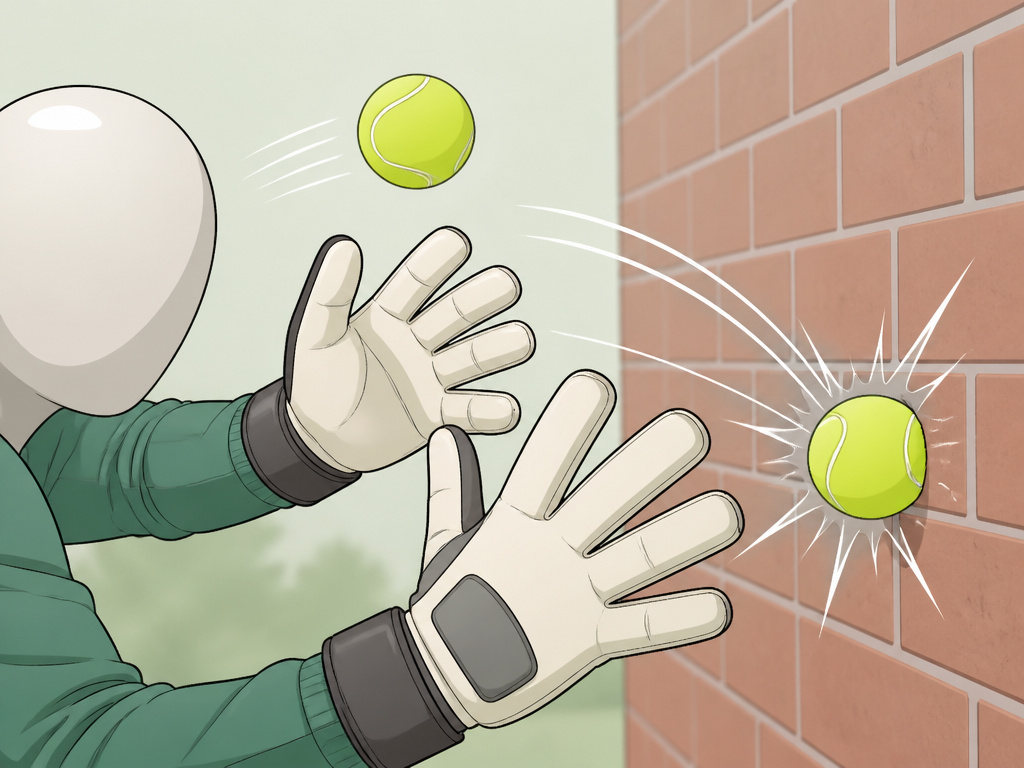
You don’t need a wall for this. A simple partner drill works: stand close together, maybe three yards apart. Your partner throws the tennis ball at your feet, your chest, just to your left or right, anywhere they want, as fast as they can. Your job is to catch it with two hands. Start slow to get the hand-eye coordination down. That sound is your instant feedback.
Advanced Tools: From Ball Launchers to Virtual Reality
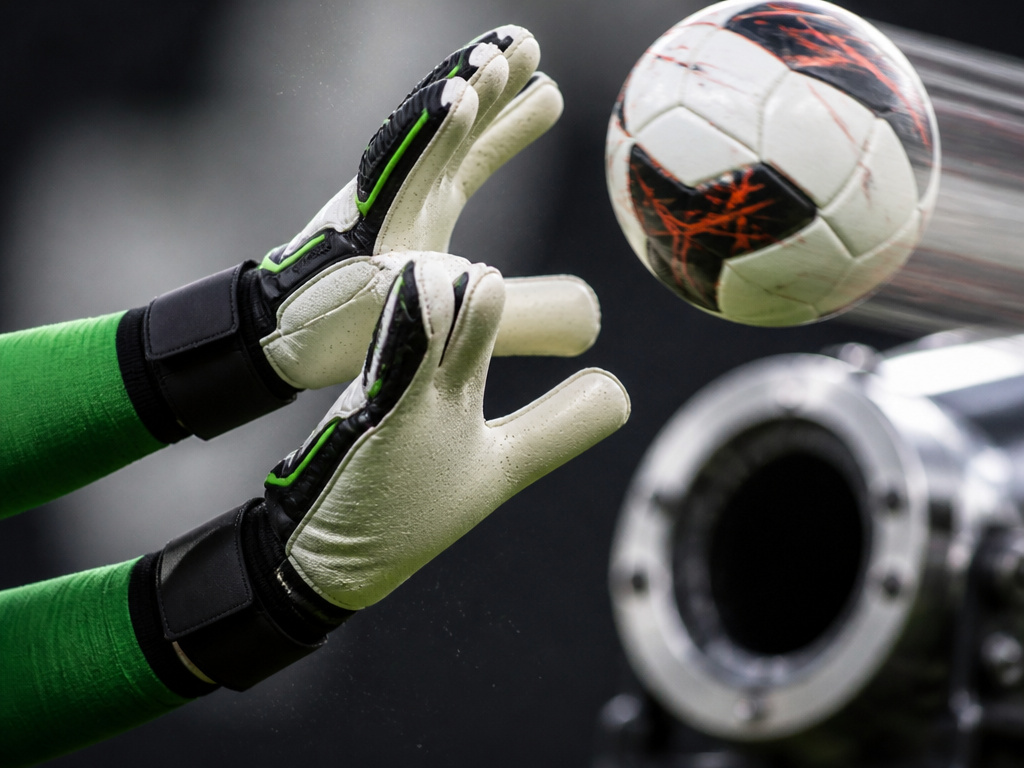
Once you’ve exhausted the possibilities of a wall, a partner, and a bag of tennis balls, the pro-level tools offer a different kind of stimulus. They remove the human variable entirely, providing consistent, measurable pressure.
A study in the Journal Sport Area used a ball launcher with 20 university student goalkeepers. They trained with it and were measured using the Nelson Foot Reaction test. The result was a significant effect on reaction speed. A machine doesn’t tire, doesn’t telegraph its shots, and can fire at a relentless, programmable pace. It’s the ultimate test of pure reaction, stripping away any anticipation of a server’s body shape.
Then there’s virtual reality. A study in the Turkish Journal of Sport and Exercise took 12 male goalkeepers licensed by the Turkish Football Federation (TFF). Six did regular training, while the other six used the Rezzil Player® VR application for 12 training sessions over 6 weeks (2 days a week). They used a Go/No-Go test before and after. The VR group showed a statistically significant positive difference in reaction times. The control group did not.
VR and ball launchers are about measuring and isolating variables. They tell you exactly how fast you’re reacting to a specific cue, which is invaluable for diagnosing plateaus. But they’re supplements, not replacements.
The Research Gap: What Coaches Do vs. What Studies Say
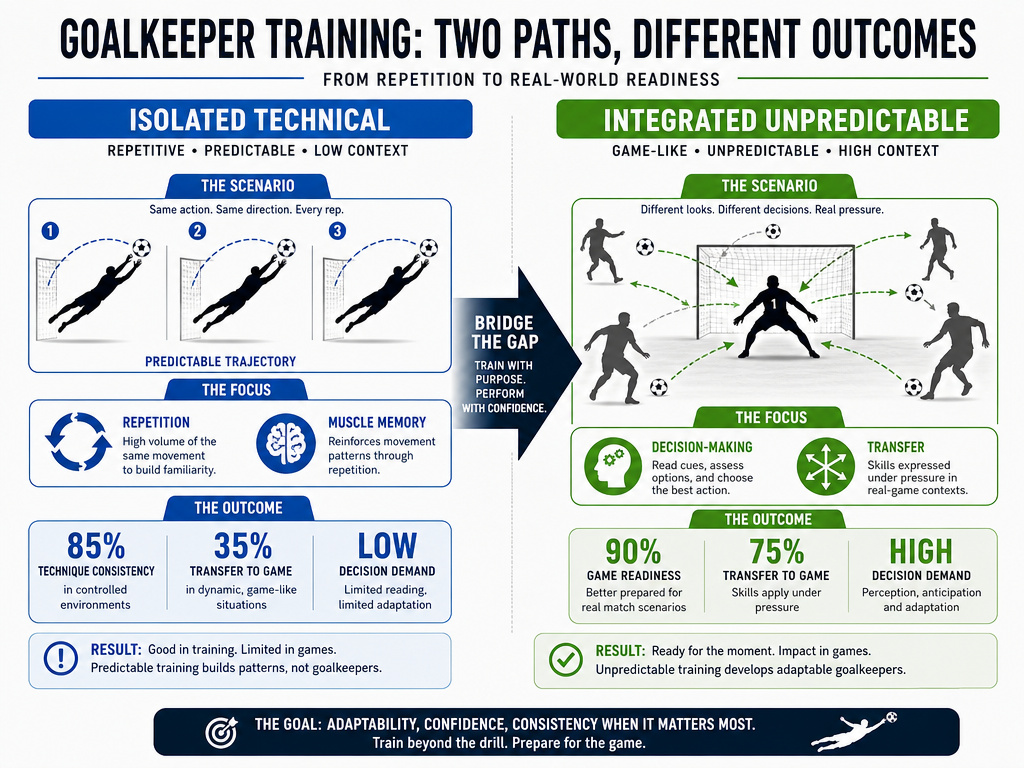
There’s a fascinating tension in the research. On one hand, multiple studies advocate for integrated, unpredictable, perceptual-cognitive training. A study by Murgia et al. Tested a perceptual home-training protocol over eight weeks on skilled goalkeepers, hypothesizing it would improve predictions. The 2023 futsal study recommends integrating unpredictable training. The evidence points toward holistic methods.
On the other hand, a cross-cultural study of 15 expert goalkeeper coaches found that while they name decision-making as a critical skill, their typical session structure “prioritises isolated technical training over a holistic training approach.” This contrasts with studies that recommend integrating unpredictable, holistic training. The coaches know what’s important, but their default practice leans toward repetition of isolated saves and catches.
| Training Approach | Advocated By | Typical Focus | Best For |
|---|---|---|---|
| Isolated Technical | Expert Coach Practice | Repetition of specific saves, handling, footwork patterns | Building foundational muscle memory and technique |
| Integrated Unpredictable | Recent Studies (e.g., Competitor Journal 2023) | Reaction to varied, game-like stimuli within tactical contexts | Transferring training gains to actual match decision-making |
This isn’t about one being right and the other wrong. It’s about sequence. You need the isolated repetition to own the basic movement, the collapse dive, the high catch, the side-step. But if you stop there, you’ve built a fast engine with no steering. The studies are a reminder to always bridge that gap. Spend the last third of your session in a more chaotic, unpredictable drill that forces you to choose, not just react.
Building Your Weekly Reaction Plan
You can’t train reaction at maximum intensity every day. Your nervous system needs time to adapt, and fatigue will slow you down, teaching your body the wrong speed. Here’s a simple framework.
In each, after a warm-up that includes dynamic stretches and light footwork, pick one or two focus drills. Use the standard wall drill as your benchmark. Time it, count how many saves you make cleanly in each thirty-second burst. That’s your number to beat next week.
On another day, focus on unpredictable partner drills. Use tennis balls. Work on having the server call out direction as they throw. Record the point where you stop guessing and start reacting correctly. It takes a couple of weeks for your brain to stop trying to outthink the drill.
Let the ball come to the hands.
One session can be more technologically oriented if you have access. Try a VR setup if available. The key is to measure something, time, score, success rate. What gets measured gets improved.
In your other training sessions, integrate reaction elements subtly. During handling work, have servers vary the pace and height unexpectedly. This constant seasoning with the unexpected is what makes the gains stick.
How to train for close-range and low saves
A standard reaction wall drill is a foundational tool for this scenario. Set up a rebound board or wall a short distance from the keeper. The keeper serves the ball hard against the wall and must react to the unpredictable return, focusing on quick footwork and getting the body behind the ball. Work in short, high-intensity intervals, such as thirty seconds of maximum effort followed by thirty seconds of rest, repeated for several rounds. This structure targets pure reaction speed and recovery. Research also shows that using a smaller ball, like a tennis ball, in similar drills can be highly effective for improving reaction speed due to its increased difficulty.
How to train for deflections and second saves
Training for second saves requires drills that create unpredictable rebound scenarios. The standard wall drill naturally develops this, as the ball can come back at any angle or height, forcing the keeper to make an initial save and immediately recover for a potential second touch. To specifically target deflections, a coach or partner can intentionally strike shots to create parried rebounds, or use equipment like a ball launcher set to fire sequences. The key is unpredictability; studies confirm that training requiring adaptation to unpredictable situations is more effective for increasing reaction speed than predictable, repetitive drills. This builds the decision-making and technical skills needed in crowded goalmouths.
Frequently Asked Questions
What are the best solo goalkeeper reaction drills?
The most effective solo drill is the standard wall rebound. You just need a solid wall and a ball. Mark a spot two yards out, set a timer for thirty-second intervals, and strike the ball against the wall from various angles, reacting to the return. Both rely on creating unpredictable rebounds you must respond to.
How long does it take to improve goalkeeper reaction time?
Measurable improvement can appear within a focused training block of 4–6 weeks, according to several studies. The futsal unpredictable training study saw gains in 4 weeks. The VR study protocol was 6 weeks. The key is consistent, focused sessions 2–3 times per week with clear rest days in between. Neural adaptation happens during recovery, not during the drill itself.
Can reaction time be trained, or is it genetic?
Reaction time is absolutely trainable. While baseline neural speed has a genetic component, the skills that make a goalkeeper quick, anticipation, efficient movement patterns, decision-making under pressure, are highly coachable. Studies on ball launchers, VR, and unpredictable training all show significant improvements in tested reaction speed after targeted interventions. It’s a skill, not just a fixed trait.
How do I measure my reaction time improvement?
Use simple, repeatable benchmarks. For the wall drill, count the number of successful saves (clean catches or safe parries) you make in a standard thirty-second work period. For a more clinical measure, use validated tests like the Nelson Foot Reaction test.
Before You Go
One rule most guides skip: if you’re only training reaction time with a football, you’re leaving gains on the table. The 2024 study showing tennis balls were more effective is a signal that varying the stimulus, making it smaller and faster, forces a different kind of neurological adaption. That overload translates back to the bigger ball.
So here’s your first step this week. Grab a tennis ball. Find a partner. Have them throw it at you, hard and randomly, for thirty seconds. Try to catch everything two-handed. The first few sessions will feel chaotic. Your hands will sting. You’ll miss more than you catch. That’s the point. Around the third session, you’ll notice your hands starting to move just that bit earlier, your eyes tracking the smaller object a little more smoothly. That’s the adaptation happening.
The speed you gain will make those close-range reaction saves feel less like luck and more like a skill you own. That’s the story behind the story.
