
Football Referee Hand Signals Explained
This post contains affiliate links. As an Amazon Associate, we earn from qualifying purchases.
Football referee hand signals explained in one line: each gesture tells fans, broadcasters and both teams what the official just ruled. American football now uses more than 35 official signals, from both arms straight up for a touchdown to a hand gripping the opposite wrist for holding. Soccer referees use a smaller, separate set.
That broadcaster detail is older than television. The first recorded signals came at a 1929 college game between Syracuse and Cornell, when radio announcers asked the referee to show them what he was calling. Every gesture since has kept the same job: getting a ruling out of one official’s head and into a crowd that can’t hear him.
What follows: the scoring and clock signals, the penalty calls grouped by type, the head taps that confuse everyone, how high school, college and NFL charts differ, and the soccer signals for anyone who meant the other football.
Key Takeaways
- Both arms straight up covers a touchdown, a successful field goal and a successful extra point. Palms pressed together overhead means a safety.
- Learn the horizontal arm wave early. It means incomplete pass, penalty declined, no play or no score, and the play before it tells you which.
- Signal numbers don’t travel between the NFL, NCAA and NFHS charts. State-association summaries of the 2024 NFHS changes show high school holding and illegal use of hands split across two numbers.
- A player’s signal only works once the referee acknowledges it, which is the lesson the NFL drew from John Urschel’s 2015 report.
- In soccer, a referee who forgets the raised arm on an indirect free kick has the kick retaken if the ball goes straight in, per IFAB Law 13.
Both Arms Up Covers Three Kinds of Points
Both arms shot straight above the head is the touchdown signal, and it’s the gesture most new fans pick up before they can name a single position.
In American football, the scoring signals are made by the referee or the covering official immediately after the play. Both arms extended straight overhead mark a touchdown, a successful field goal or a good extra point. Palms pressed together above the head mark a safety. A first down is shown by one arm pointed toward the defending team’s goal.
The same raised arms close out a successful kick. So the gesture really means points on the board, whatever kind they are. A missed kick gets the horizontal wave instead, which I’ll come to in the next section.
Watch the two officials under the posts on a field goal. Two pairs of striped sleeves rise in unison beneath the crossbar, and from a high seat you’ll read the result off their arms before the scoreboard changes.
History backs up the simplicity here. According to American Football International’s account of the NFL’s signal history, the touchdown and safety signals are more or less the same as decades ago. When a gesture survives that long, it’s doing its job.
I’d tell any new fan to learn the safety first. It’s rare. Palms together overhead, a bit like a diver about to go in, and plenty of the crowd will spend the next play wondering why the defense is celebrating.
The first down rounds out this group. One arm pointed downfield toward the defending team’s goal means the offense has a fresh set of downs. The chain crew watches for it before moving the sticks.
What Do the Clock and Game-Flow Signals Tell You?
Ever noticed an official whirling one arm in a full circle after a stoppage? That’s the start-clock signal, a wind-up motion telling the clock operator to get time running again.
Clock signals matter more than fans give them credit for, because someone in the press box acts on every one of them. These are the ones worth knowing:
- Timeout: hands crisscrossed above the head.
- Referee’s timeout: the same crisscross, then one hand placed on top of the cap. The stoppage belongs to the officials rather than either team.
- Start the clock: one arm swung in a full circle, like winding an old clock.
- Incomplete pass, penalty declined, no play or no score: both hands swept back and forth horizontally in front of the body.
- Play clock reset: one arm pumping straight up resets the shorter play clock, and both arms pumping resets the longer one. I’ve left the exact second counts out because I couldn’t confirm them for every level, so check the rulebook for the games you watch.
Easy to miss: The horizontal wave carries several meanings at once. A ball bouncing on the turf means incomplete, a flag already down means a declined penalty, and a kick sailing wide means no score. Read the two seconds before it.
I think of the wave as the officiating version of a firm shrug. It says nothing counts on this play.
The play right before it tells you why.
Football Referee Hand Signals Explained: The Penalty Calls
Penalties are where a signal chart earns its keep. The yellow flag tells you something happened, and the arm motion afterwards tells you what. A thrown flag lands with a dull thud, its weighted knot dragging the yellow cloth flat on the grass, and every eye in the stadium swings to the referee.
The descriptions below follow the NFL-style charts. College and high school charts share most of these motions, but check your own level’s chart before you teach them to anyone.
Before the Snap: Starts, Shifts and Offside
Pre-snap fouls have the most distinctive signals on the chart, which helps, because they happen fast.
- False start or illegal formation: forearms rolled over each other in front of the body.
- Illegal shift: a horizontal arc traced with both hands.
- Illegal motion at the snap: one flat hand raised and swung forward.
- Offside or encroachment: hands on hips. Impatient, which suits the foul.
- Delay of game: arms folded across the chest.
- Illegal substitution or too many players: both hands on top of the head.
Folded arms have a past life. American Football International notes the folded-arms declined-penalty signal was modified as newer signals arrived. On today’s NFL-style charts, folded arms mean delay of game, and the horizontal wave handles a declined penalty.
Contact Fouls: Holding, Hands, Face Masks and Personal Fouls
From a high seat, holding and illegal use of hands look almost identical. I watch the free hand. A clenched fist means holding, while an open palm pushed forward means illegal use of hands.
| Foul | The motion | What to watch for |
|---|---|---|
| Holding | One hand grips the other wrist, fist clenched | Fist stays closed at chest height |
| Illegal use of hands | Grips the wrist, free hand open and forward | Open palm facing the field |
| Face mask | One hand grabs an imaginary face mask and pulls down | Pulling motion at chin level |
| Personal foul | One wrist strikes the other above the head | The chop happens above the cap |
| Roughing the kicker | Personal foul signal, then a swinging leg | The kick mime comes second |
| Roughing the passer | Personal foul signal, then a throwing motion | The throw mime follows the chop |
Personal fouls used a very different signal once. Until 1955, officials used a military-type salute for unnecessary roughness, and the reason it changed is one of my favourite stories in the game. It’s coming up in the history section.
College football layers targeting calls on top of the personal foul signal. I haven’t checked the exact college follow-up gesture against the rulebook, so I won’t describe it from memory. The NCAA chart is the place to look.
Passing and Conduct Fouls
Passing fouls are where fan charts disagree the most, so this list sticks to the NFL-style motions.
- Pass interference: both hands open and pushed forward from the shoulders, as if shoving someone.
- Intentional grounding: parallel arms waved in a diagonal plane across the body.
- Ineligible receiver downfield: a hand placed on top of the cap.
- Unsportsmanlike conduct: arms held straight out to the sides, palms down, making a T.
- Disqualification: a follow-up gesture after the foul signal, showing the player is out of the game. Confirm that follow-up on your level’s chart before teaching it.
Where this goes sideways: Learning pass interference from a random signal page. At least one university housing page describes crossed arms, while NFL-style charts use the two-handed push. Teach the wrong one to a youth team in preseason and you’ll spend the whole season unlearning it.
How Does a Penalty Call Unfold, Start to Finish?
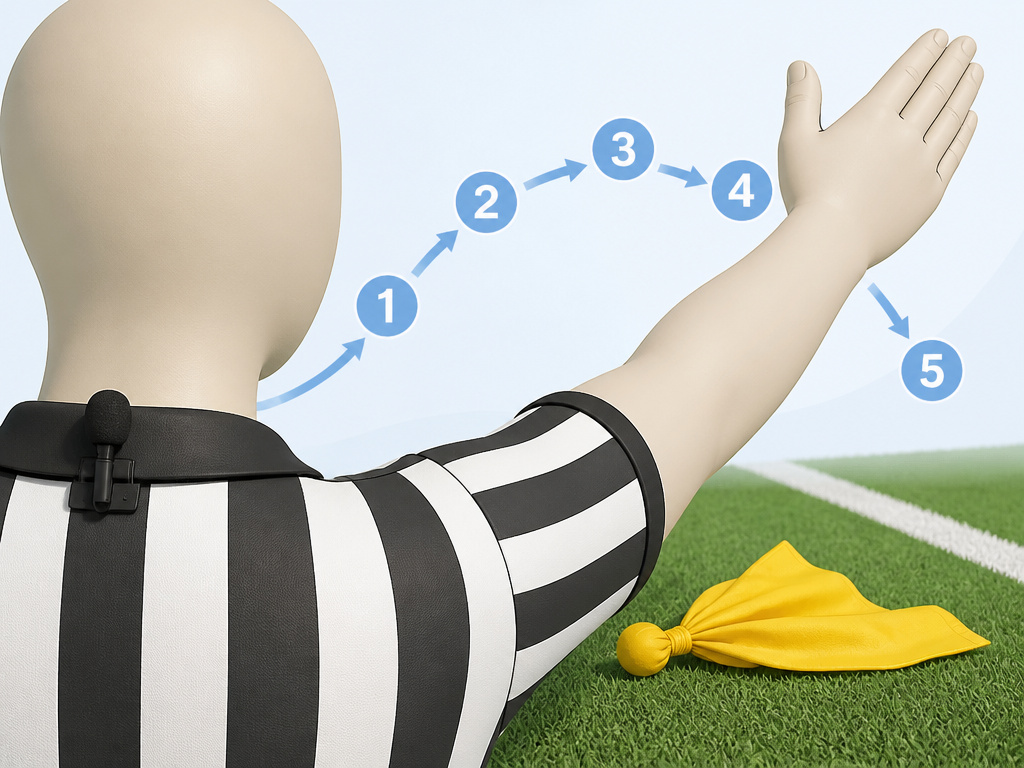
October 26, 2015. Ravens lineman John Urschel, wearing No. 64, ran his hands up and down his jersey number to report as an eligible receiver. Referee Ronald Torbert missed it. He was correcting a number from a foul on the previous play.
NFL vice president of officiating Dean Blandino owned the mistake. “We didn’t recognize that he reported, and that’s why the penalty was called,” he said, and the league issued a public mea culpa, according to Fox News.
Blandino’s other line is the one I’d frame. “It’s important that the referee recognizes that, it’s important that the player gets a visual signal.” He also indicated the Ravens should have waited for confirmation from the referee before running the play.
So a signal is a two-way exchange. The sender’s gesture is half the job, and the acknowledgement is the other half.
Officiating mechanics work like good joinery. A dovetail holds because each piece is cut to meet the next one, and a call holds because each signal meets an answer. Cut one piece badly and the whole drawer rattles.
Here’s how the pieces fit on a penalty:
- The flag goes down at the spot of the foul. Skip it and the crew loses the spot, so the enforcement starts from a guess.
- A preliminary signal goes up so the press box and broadcast booth know what’s coming. Without it, announcers fill dead air with speculation.
- The referee gathers the facts from the officials who saw the foul, confirming the player and the options. The Urschel play shows what happens when one detail never reaches the referee.
- The captain chooses when a penalty can be accepted or declined. Rush this step and a team can decline yardage it actually wanted.
- The final signal and announcement close the loop.
That last step has a sound to it. You hear the faint pop of the referee’s microphone going live before he speaks, and the stadium goes quiet for a second. The NFL gave referees microphones in 1975 so they could explain calls to teams, to broadcasters and to fans in the stadium and at home.
A signal only counts once someone has seen it and answered it. Until then, it’s a man in stripes waving his arms.
Why Does the Ref Tap His Head?

Three separate calls end up on top of an official’s head.
One hand on the cap after the timeout crisscross means a referee’s timeout. A hand on the cap after a passing play signals an ineligible receiver downfield. Both hands on top of the head means illegal substitution or too many players.
Every match leaves a clue, and with head taps the clue is whatever happened two seconds earlier. A stoppage with no flag points to the timeout version. A flag on a passing play points to the ineligible receiver.
Players have body signals of their own, too. Urschel’s hands running down his number were a player reporting eligible, aimed squarely at the referee.
1929, Four Signals and a Radio Booth
I keep one rule for football history: if a story has a suspiciously neat punchline, check it twice. I picked that rule up the hard way, after passing along a tidy tale that turned out to be dressed up.
The salute story set off that alarm straight away. Until 1955, officials signalled unnecessary roughness with a military-type salute. The American Legion asked the NFL to change it because children were confusing the football signal with the salute to the nation’s flag.
Then comes the punchline. When Legion officials quizzed schoolchildren about the salute, one child reportedly answered: “That means unnecessary roughness.”
Too perfect? Maybe. I could trace it to American Football International’s account, which restates the NFL’s own history, and no further. So I’m keeping it, with that label attached.
I’d rather print a good story with its source pinned to it than a great one I can’t trace. Football history is full of punchlines that grew a little with every retelling.
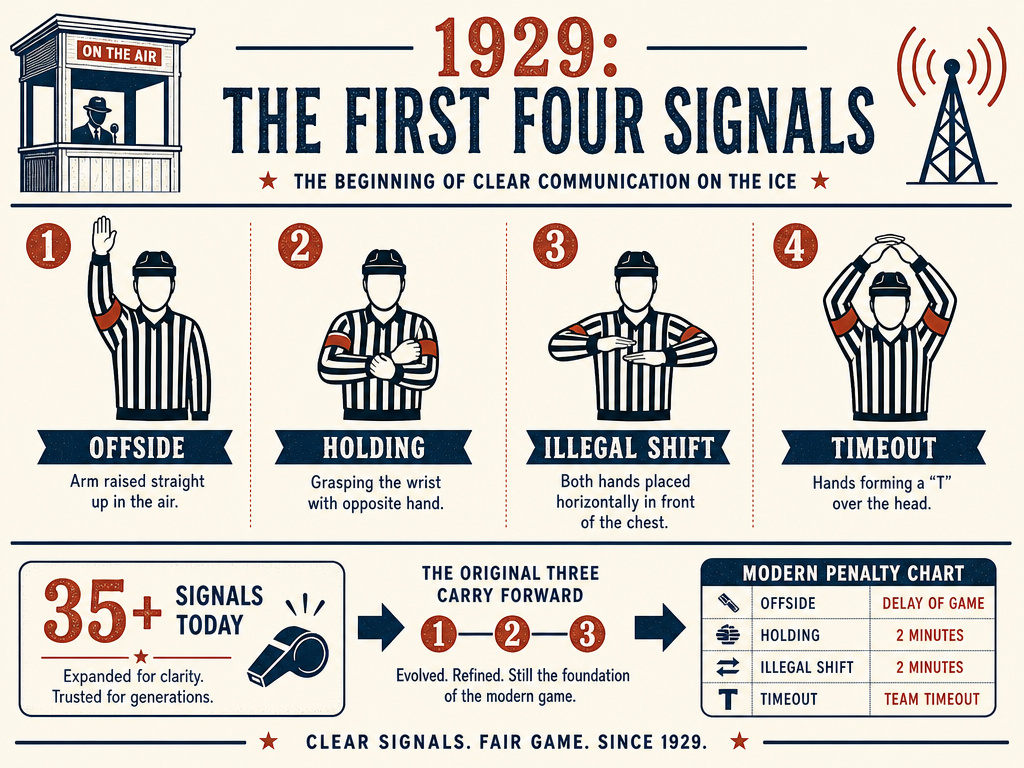
Rewind a second, to where the whole thing started. Before kickoff at the 1929 Syracuse-Cornell game, radio announcers asked referee Elwood Geiges to signal which penalties he was calling and why he’d stopped play. He came up with four: offside, holding, illegal shift and timeout.
When Geiges stopped the action, he looked up at the broadcast booth and flashed the sign. Before that, officials simply shouted their calls. Spectators who couldn’t hear them were left confused, according to the same account.
College football used the signals first, and the NFL adopted them later. The chart has since grown to more than 35 signals. (On the muddy pitches I grew up on, the referee’s full signal vocabulary was a whistle and a long sigh.)
Notice that three of Geiges’s four originals, offside, holding and illegal shift, still sit on today’s penalty chart. The game kept the categories it started with.
Signal 43 Means Nothing Outside Its Own Rulebook
The number printed beside a gesture on a signal chart is the least reliable thing on it. The NFL, the NCAA and the NFHS (the National Federation of State High School Associations, which writes high school rules in the US) each publish their own charts. Their numbers don’t line up.
Some of the disagreement is documented, and some lives only on officiating forums. Here’s where things stand, with how solid each claim is:
| Claim | Where it comes from | How solid |
|---|---|---|
| NFHS signal 42 now covers holding only | 2024 NFHS editorial changes, via ASAA summary | Search snippet; full PDF unread |
| NFHS signal 43 covers illegal use of hands and illegal block | Same 2024 change list | Search snippet only |
| S18 means encroachment in NFHS, defensive offside in NCAA | Officiating forum thread | Unverified |
| S17 (uncatchable pass) exists only in NCAA | Same forum thread | Unverified |
| S16 covers NFHS “first touching” and NCAA “illegal touching” | Same forum thread | Unverified |
Charts from before 2024 put illegal use of hands under 42, and plenty of fan pages still copy that old mapping. If you officiate high school games, check every gesture against the NFHS 2024 football rules book instead of a screenshot. College officials should do the same with the NCAA 2025 football rules book.
The part nobody mentions: A pre-2024 high school chart still sitting in a coaching folder sends you to the wrong number for illegal use of hands. Swap it out before the first preseason scrimmage, or your film notes won’t match the officials’ reports all year.
The word “signals” causes its own muddle at high school level. The NFHS 2025 football rules changes allowed fixed electronic signs showing play signals and other non-audio methods, while still banning in-helmet communication. Those are coaches’ signals to players. They have nothing to do with officials’ gestures.
The 2026 changes, reproduced in the NJSIAA summary of NFHS 2026 rules changes, let players wear play cards on the belt as well as the forearm or wrist. They also add Rule 9-4-7, which bars a player from using the hands to slap an opponent’s head.
The same document lists “NFHS Official Football Signals” among its 2026 editorial changes. What changed inside it, I honestly can’t tell you. The summary doesn’t say.
My stance: don’t bother memorising signal numbers at all. Learn the motion, and look the number up when a rulebook argument demands it.
Soccer Referee Signals: The Other Football
IFAB, the body that writes soccer’s Laws of the Game, publishes its referee signals as drawings rather than written descriptions. If you searched this thinking of the round-ball game, this section is yours. It’s also my home turf, so forgive me for lingering.
The Raised Arm on a Free Kick
An arm held straight above the head marks an indirect free kick, one where the ball has to touch another player before a goal counts. From the stands it’s unmistakable: a single straight line above the wall. The arm stays up until the ball touches another player, goes out of play, or it’s clear no goal can come directly.
Forget that arm and the referee pays for it. Under IFAB Law 13 on free kicks, if the referee never raises it and the ball goes straight into the goal, the kick is retaken by the same team.
The goalkeeper version is fairer still. If the keeper touched the shot on its way in, the referee disallows the goal and orders a retake, because “a team should not suffer because of a referee’s mistake.”
Defenders must stand at least 9.15 m (10 yds) from the ball. When three or more form a wall, attackers have to stay at least 1 m (1 yd) from it until the ball is in play.
Take the kick before the referee’s signal after being told to wait, and Law 13 orders a retake plus a caution for unsporting behaviour.
Both arms swept forward is the advantage signal. The referee saw the foul and is letting play run, because stopping it would hurt the team that was fouled.
Cards, the Spot and the Flag
Yellow and red cards are the signals every fan knows, but the timing surprises plenty of them. Law 5 gives the referee power to show cards from the moment they enter the field and during the half-time interval. A caution handed out between the coin toss and kick-off carries into the match.
An arm pointed straight at the penalty mark is pointing to the spot, the gesture that awards a penalty.
The referee has help. The assistant referee flag signals handle offside and throw-ins from the touchline, and they’re one part of how referees communicate across a whole crew.
The VAR Rectangle
Two index fingers tracing a rectangle in the air is the TV signal. It tells the crowd the video assistant referee has been involved.
For a VAR-only review, Law 5 says one TV signal is enough, made immediately before the final decision. For an on-field review, the referee shows the TV signal and walks to the referee review area to watch the footage. In both cases the referee makes the final decision, sending-offs included, and the VAR only advises.
My view: VAR earns its keep on factual calls. IFAB itself names the location of a foul, inside or outside the penalty area, as a decision suited to a VAR-only review. Ask the system to settle matters of interpretation and you get long minutes of everyone staring at a screen.
And judge a review by the protocol. The one replay angle a broadcaster chose to show you is a poor guide.
Frequently Asked Questions
What are the hand signals used by referees in football?
In American football, officials use more than 35 signals covering scoring, the clock and penalties. They range from both arms raised for a touchdown to one wrist striking the other above the head for a personal foul. Soccer referees use a smaller set, including the raised arm for an indirect free kick, the cards and the VAR TV signal.
Which three signals should a new fan learn first?
Start with both arms straight up for a touchdown, field goal or extra point. Add the horizontal wave for incomplete, declined or no score, and the arm pointed downfield for a first down. Those three tell you whether a drive is alive.
Why do NFL refs wave their hands?
The side-to-side wave in front of the body signals an incomplete pass, a declined penalty, no play or no score. It’s one gesture with several meanings, so read it alongside what just happened on the field.
What does it mean when a football ref taps his head?
One hand on the cap after the timeout signal marks a referee’s timeout. A hand on the cap on a passing play signals an ineligible receiver downfield, and both hands on top of the head mean illegal substitution or too many players.
Do high school referees use the same signals as the NFL?
The core motions overlap, but the NFL, NCAA and NFHS each publish their own charts with their own numbering. The NFHS also listed its official signals among its 2026 editorial changes, so high school officials should work from the current NFHS chart.
Before You Go
Having football referee hand signals explained on a page is the easy half. The habit comes from watching.
Here’s a job for this week. Learn five signals: both arms up, the horizontal wave, the first-down point, the wrist grab for holding and the start-clock circle. Then call each one out loud at your next game before the announcer does.
One concession. Everything above follows NFL-style descriptions, and if you coach or officiate at high school or college level, your rulebook’s chart wins every argument, including any with me. Keep Urschel’s lesson close too: as far as the crew is concerned, a signal nobody acknowledged never happened.
So which is harder to read from the stands, a holding call or a soccer referee’s advantage sweep?
