
Yellow Card vs Red Card in Football: Key Differences
This post contains affiliate links. As an Amazon Associate, we earn from qualifying purchases.
A yellow card vs red card in football is a caution versus a sending-off. A yellow warns the player, who stays on the pitch. A red ends that player’s match and leaves the team a player short. A second caution in the same match also produces a red.
That last line hides a wrinkle. A red can arrive as the answer to one ugly act or as the sum of two ordinary ones, and the player walks either way. What separates the routes is the offence behind each card, and Law 12 of the Laws of the Game lists them.
Below: the exact offences behind each card, how a second yellow turns red, what happens to the player and team afterwards, and the odd cases where the same foul earns either colour. The origin story and the rumoured blue card get their turn too.
Key Takeaways
- The referee’s disciplinary power starts at the pre-match inspection and runs until after any penalty shoot-out, so a card can land before kick-off.
- Inside the penalty area, the same goal-denying foul is a yellow if the defender was trying to play the ball, and a red if it was holding, pulling or pushing.
- Yellow-card bans are counted per competition, while dismissals carry across all competitive matches (Premier League, per Fantasy Football Scout in 2021).
- At the 2026 World Cup, single yellows were wiped twice: after the group stage and after the quarter-finals.
- Team officials climb a ladder of warning, caution, sending-off, and the senior coach takes the sanction if nobody can say who offended.
Yellow Card vs Red Card in Football: What Changes the Moment It Comes Out
IFAB’s Law 12 settles the basic question in one line: the yellow card communicates a caution, and the red card communicates a sending-off. The rest of the rules below follow from that line.
Under Law 12, a yellow card communicates a caution and a red card communicates a sending-off. A cautioned player stays in the match. A sent-off player, substitute or substituted player must leave the vicinity of the field of play and the technical area. Only players, substitutes, substituted players and team officials may be shown either card.
Picture a restaurant kitchen. A yellow is the head chef telling you to fix your timing, and you keep working the line. A red is being sent out the back door mid-service, and the line runs one cook short.
You can read it from the stands. The referee’s hand goes to a shirt pocket, the card rises above the head, and the colour tells the story before anyone explains it.
| Question | Yellow card | Red card |
|---|---|---|
| Meaning | Caution | Sending-off |
| The player’s match | Carries on | Over; leaves field and technical area |
| The team | Same numbers on the pitch | Plays a player short |
| Suspension reach | Counted per competition | Covers all competitive matches |
The last row comes from Fantasy Football Scout’s 2021 Premier League guide. It says yellow-card accumulation punishments are competition-specific, while suspensions for dismissals cover all competitive matches. Hold that thought for the bans section.
The referee’s reach is longer than open play. Disciplinary authority starts when the referee walks onto the field for the pre-match inspection. It ends after the referee leaves the field post-match, penalty shoot-out included. A player or official who commits a sending-off offence before kick-off can be stopped from taking part.
I find that pre-match window the most underrated bit of Law 12. A card can land before anyone has kicked a ball.
Eight Ways to Earn a Yellow Card (and Why “Persistent” Has No Number)
Law 12 lists eight cautionable offences for players, and the fouls that result in a yellow card sit inside just one of them. Most of the list has nothing to do with tackling.
- Delaying the restart of play.
- Dissent by word or action.
- Entering, re-entering or deliberately leaving the field without the referee’s permission.
- Not respecting the required distance at a dropped ball, corner kick, free kick or throw-in.
- Persistent offences, with no specific number or pattern set by the Law.
- Unsporting behaviour, the catch-all covered below.
- Entering the referee review area, the zone around the pitchside TV screen.
- Excessively using the “review” signal, the TV-screen gesture.
Take the persistent line. Law 12 sets no number, so the referee judges when a pattern has formed. Two players with the same foul count can get different treatment, and the rulebook is fine with that.
Unsporting behaviour is the catch-all
Unsporting behaviour covers more ground than any other item on the list. Law 12 names simulation (feigning injury or pretending to be fouled), reckless direct free-kick offences, handball to stop a promising attack, handball in an attempt to score, lack of respect for the game, verbally distracting an opponent, and the deliberate trick to pass back to the goalkeeper.
A foul that stops a promising attack lands here too. That is why a cynical shirt-tug on the break earns a yellow. Celebrations get the same treatment: take the shirt off or cover the head with it and the caution comes, even if the goal is disallowed. Climbing a perimeter fence, provocative celebrations and wearing a mask count as well.
Dissent, substitutes and team officials
A yellow card for dissent is the easiest booking to avoid. One survey cited by the Japan Football Association says a quarter of all yellow cards are for dissent. The survey goes unnamed, so treat the figure as a rough guide.
My own view: the protest costs more than the card. While the argument runs, the other side takes the restart and resets its shape.
Substitutes and substituted players get a shorter list of six offences. Persistent offences and the restart-distance offence drop off. Team officials get a ladder of warning, caution and sending-off, and the first rung covers things like minor disagreement with a decision. Sarcastic clapping at a match official is cautionable dissent. If nobody can identify the offender in the technical area, the senior coach present takes the sanction.
Why Does a Second Yellow Turn Into a Red?
Because Law 12 lists a second caution in the same match as a sending-off offence in its own right. That one line is the whole second yellow card rule, and it leaves the referee no extra decision to make.
Two separate cautionable offences earn two cautions, even in close proximity. Law 12’s own example pairs entering the field without permission with a reckless tackle. Advantage works differently here. A referee should not play it for a second cautionable offence unless a clear scoring chance exists, and the red comes when the ball is next out of play.
Does an earlier yellow protect anyone from a straight red? No. Law 12 ties none of the other sending-off offences to a previous caution.
On ban length, I can’t hand you a clean answer. Searchers keep asking whether a second-yellow red carries a lighter ban than a straight red. Law 12 doesn’t say, and nothing in my sources sets a rule that applies everywhere. Check the competition’s own regulations.
The cleanest proof that this system needs a referee who counts is Croatia v Australia on 22 June 2006. According to Wikipedia’s list of 2006 World Cup controversies, the sequence ran like this:
- 61st minute: Graham Poll books Josip Simunic for a foul on Harry Kewell.
- 90th minute: Poll books Simunic again for another foul but doesn’t follow it with the mandatory red.
- 93rd minute: After the final whistle, Simunic angrily pushes Poll. Poll shows a third yellow and then the red.
Australia had been through something similar before. In 1974, Ray Richards took a second yellow in the 83rd minute against Chile and played on for four minutes. Reserve official Clive Thomas then told a linesman that referee Jafar Namdar had forgotten the red.
Four minutes. That’s a long time to play a man who isn’t allowed to be there.
Nine Offences That End a Match on the Spot (Plus Three Options)
Four families cover the red list: denying a goal, brutal play, abuse and process offences. Law 12 puts nine specific things under those headings, and a player who commits any of them is sent off with a red card.
- DOGSO by deliberate handball, anywhere, except a goalkeeper inside their own penalty area.
- DOGSO by non-deliberate handball outside the offender’s own penalty area.
- DOGSO by a free-kick offence against an opponent whose overall movement is towards goal.
- Serious foul play.
- Biting or spitting at someone.
- Violent conduct.
- Offensive, insulting or abusive language or action.
- A second caution in the same match.
- Entering the video operation room (VOR), where the video match officials work.
Three of the nine are versions of denying an obvious goal-scoring opportunity, shortened to DOGSO. The referee weighs four things: the distance between the offence and the goal, the general direction of play, the likelihood of keeping or gaining control of the ball, and the location and number of defenders and attackers.
Serious foul play vs violent conduct
The difference between violent conduct and serious foul play is whether the player was challenging for the ball. Serious foul play is a tackle or challenge that endangers an opponent’s safety or uses excessive force or brutality. A lunge from the front, side or behind, with one or both legs and excessive force, counts.
Violent conduct is excessive force or brutality when not challenging for the ball. It can target anyone, and contact isn’t needed. A deliberate strike to an opponent’s head or face with the hand or arm is violent conduct unless the force was negligible.
The three options a competition can switch on
Law 12 also lists three sending-off offences marked as competition options: covering the mouth when communicating with an opponent in a provocative, derisory or inflammatory way, leaving the field in protest at a referee’s decision, and instructing or encouraging others to leave in protest. Whether your league uses them is the organiser’s call.
Reds can stack up fast. Referee Valentin Ivanov ran the 2006 World Cup record card match between Portugal and the Netherlands. He set a World Cup single-match record of four red cards and tied the yellow-card record at 16. Italy v USA at the same tournament had three reds.
Same Foul, Different Colour: How the Penalty Area Flips the Card
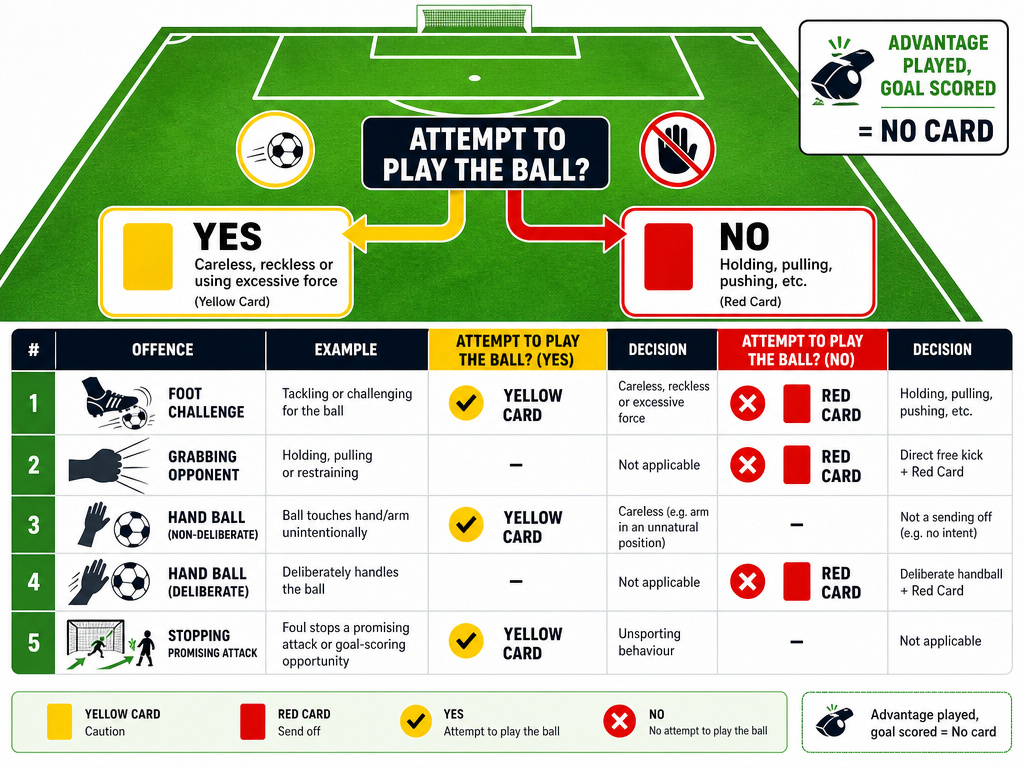
A defender catches an attacker’s heel just inside his own area, with the attacker clear through on goal. Penalty. So which card? The answer hangs on one question: was the defender trying to play the ball?
| Situation | Card | Why |
|---|---|---|
| Foul in own area, penalty, attempt on the ball | Yellow | Attempt to play or challenge for the ball |
| Holding, pulling or pushing in own area, penalty | Red | No genuine challenge for the ball |
| Non-deliberate handball denies a goal, penalty | Yellow | Law 12 sanction for non-deliberate handball |
| Deliberate handball denies a goal | Red | Except a goalkeeper in their own area |
| Foul only stops a promising attack | Yellow | Unsporting behaviour, not DOGSO |
The logic follows intent. The first defender went for the ball, however clumsily. The second just stopped the player. Law 12 says the offender is cautioned in the first case and sent off “in all other circumstances” in the second.
The part nobody mentions: Play advantage after a goal-denying foul and the non-offending team scores, and there’s no card at all. If no goal comes, the player is cautioned for unsporting behaviour when the ball is next out of play.
A professional foul that only stops a promising attack gets a yellow. The same foul on an opponent whose overall movement is towards goal, denying a clear scoring chance, gets a red. That gap is where defenders do their sums.
I think the tactical foul is a real skill, and referees should punish it the same way every time. When the sanction is a coin flip, players gamble on it.
Referee judgement cuts both ways. In 2006, Luis Figo got only a yellow for head-butting Mark van Bommel. Wikipedia’s list calls that usually a red-card offence, and Figo stayed eligible for the next match. Van Bommel said it “was a clear red card.”
What Happens to the Team and the Player After Each Card?
A yellow changes nothing on the pitch. A red changes everything. The sent-off player must leave the vicinity of the field and the technical area, and the team plays a player short for the rest of the match.
I’ve watched ten-man sides defend with extra focus after an early red, more than once. The extra focus is now the first thing I look for.
Red card suspensions
Dismissals carry across all competitive matches, according to Fantasy Football Scout. Its November 2021 piece shows the spread.
Law 12 covers when a card is shown, not how long the ban lasts. Ban lengths sit in each competition’s rules, so a universal number would be a guess.
Easy to miss: A yellow-card count belongs to its competition. Fantasy Football Scout puts it plainly: accumulation punishments are competition-specific, whereas dismissals cover all competitive matches. Assuming otherwise gets a fantasy manager’s team sheet wrong by next weekend.
Yellow card accumulation
Yellow card accumulation works differently in every competition. In the Premier League, per that 2021 source, the ban threshold is five yellows until after a team’s 19th league fixture, then it moves up to ten. The source is dated, so check the current handbook before quoting it.
World Cups handle it by wiping the slate. At the previous World Cup, a one-game ban followed yellow cards in two different games, and single yellows were cancelled only after the quarter-finals. FIFA’s Council changed that for 2026 because the 48-team tournament adds a round-of-32 knockout stage.
| Tournament | Single yellows cancelled | Source |
|---|---|---|
| Previous World Cup | After the quarter-finals | Al Jazeera/AP |
| 2026 World Cup | After group stage, and after quarter-finals | FIFA Council, via Al Jazeera |
| Premier League | No wipe; threshold rises from five to ten after a team’s 19th fixture | Fantasy Football Scout, 2021 |
The second 2026 amnesty has a condition. It covers only players with one yellow from the three previous knockout rounds whose teams reached the semi-finals. The tournament ran from 11 June to 19 July in the United States, Canada and Mexico.
The First World Cup Red Came in 1974, Not 1970
The red card debuted at the 1970 World Cup, and nobody was shown one there. The first World Cup red went to Chile’s Carlos Caszely against Germany in 1974.
The idea began with a mess on 23 July 1966. In England v Argentina, German referee Rudolf Kreitlein ordered Argentine captain Antonio Rattin off in the 35th minute. History.com reports that Kreitlein probably read Rattin’s passionate Spanish as aggressive, a language he didn’t speak. Rattin didn’t grasp he’d been sent off and stayed on the pitch for somewhere between 7 and 10 minutes.
Meanwhile, Bobby and Jack Charlton couldn’t tell whether the referee had written their names down. Nobody could clarify, because the referee spoke no English. England manager Alf Ramsey contacted FIFA afterwards. Before cards, referees warned players verbally and wrote names in a notebook, and managers learned of cautions after the game. Single referees had been officiating since 1891.
Ken Aston, head of referees at that World Cup, found his answer on the drive home. In History.com’s telling, he stopped at the traffic lights on Kensington High Street and thought of colours: “He saw red as naughty, yellow as quite naughty,” as author Richard Foster puts it. You can read more in the Ken Aston referee biography on Wikipedia, and in History.com’s 1966 World Cup card history.
(Knowing that 1974 detail would have won me a pub quiz.) A rule born from a communication failure, then. Fitting.
Is There a Green Card, Black Card or Blue Card in Football?
Ever heard a pundit ask for a blue card? Law 12 names two cards: the yellow for a caution and the red for a sending-off. Nothing in the text I read mentions a green or black card. I haven’t verified which other sports use them, so I’ll leave that to their own rulebooks.
The nearest thing football has is the sin bin, a temporary dismissal. It was approved for testing at the 2017 IFAB annual general meeting. The Japan Football Association describes it as something like an “orange card” between yellow and red.
The English FA’s version gave a 10-minute dismissal for a yellow card for dissent (8 minutes in an 80-minute match), in weekend competitions for men and women of all ages. The FA trial produced a 38 per cent reduction in dissent yellow cards in the competitions involved.
The blue-card idea grew from there, and the sources disagree on how it would work:
- Sky Sports (before the protocol was published): two blue cards, or a blue and a yellow, would mean dismissal for the rest of the match.
- Japan Football Association: because of the temporary dismissal, a player isn’t sent off even if they get another yellow later in the match.
Sky wrote before IFAB’s protocol came out, so I’d check IFAB’s own guidance before quoting either. FIFA called blue cards at elite level “premature” and said any trials should stay at lower levels. UEFA president Aleksander Ceferin opposed them, saying “It’s not football anymore.” Sin bins weren’t used at Euro 2024 or in the following season’s Champions League. Former Premier League referee Mike Dean and pundit Paul Merson both objected loudly, though that’s opinion, not evidence.
Sky’s example of a blue-card moment: Giorgio Chiellini’s shirt pull on Bukayo Saka in the Euro 2020 final, which earned only a yellow. FA chief executive Mark Bullingham said the starting point was dissent, with tactical fouls a possible extension.
The Bottom Line
The colour tells you the sanction, and the offence behind it tells you the story. So the next match you watch, note why each card came out: ball or no ball, own area or not, one act or two cautions. That habit makes the yellow card vs red card in football split obvious within a few games.
Here’s a threshold worth carrying. Before anyone says “one more yellow and he’s banned”, check the competition. A yellow count belongs to its competition, and at the 2026 World Cup it was wiped twice. In the Premier League sources I read, a dismissal covers all competitive matches.
My contrarian bit: total yellow-card counts are an overrated way to judge how dirty a team is. A side that fouls high up the pitch to stop counters is picking up cards for a reason. Where the fouls happen tells you more. That’s my view, not a finding from these sources.
And if you run or play in a local league, ask the secretary for the ban lengths in writing. The Laws set the colours. The league sets the sentence.
Why does the referee write down a booking in a notebook?
The notebook is older than the cards. Before the colour system arrived, referees warned players out loud and wrote their names in a notebook, and managers often learned of a caution only after the game. The cards fixed the visible part of that problem, since everyone can now see a caution or a sending-off as it happens. The written record still matters, because a card on its own does not say who received it or when.
The 1966 World Cup showed the gap clearly. The Charlton brothers were unsure whether either of them had been booked in the same match, and England manager Alf Ramsey had to contact FIFA for clarification. The 2006 World Cup showed it again. Graham Poll showed Josip Šimunić yellow cards in the 61st and 90th minutes without sending him off, and a third yellow and a red followed after the final whistle. Keeping a written note of each caution gives the referee a way to check the count before acting on it.
Frequently Asked Questions
What are the differences between yellow and red cards in football?
Yellow card is a caution, and the player stays in the match. A red card is a sending-off, and the player must leave the field and technical area while the team plays a player short. Two cautions in one match also produce a red.
Can you get a straight red card after a yellow?
Yes. Law 12 lists the red-card offences, such as serious foul play and violent conduct, without tying them to an earlier caution. A player on a yellow can be sent off for any of them, and a second caution in the same match is a sending-off offence too.
What is a green card in football?
Law 12 names only the yellow and red as cards, so a green card isn’t part of the rules I checked. I haven’t verified where else it is used, so I won’t guess. Football’s in-between sanction is the temporary dismissal, or sin bin.
What is a black card in football?
The same answer applies: Law 12 doesn’t mention a black card. If you saw one in a match, it came from a local or non-football rule, and the competition’s own regulations are the place to check.
Can a coach or substitute be shown a card?
Yes. Under Law 12, referees can show cards to players, substitutes, substituted players and team officials. Officials usually get a warning for minor offences, a caution for clear or persistent ones, and a sending-off for serious ones.
Can a card be shown after the final whistle?
Yes. The referee’s disciplinary authority lasts until they leave the field after the match, penalty shoot-out included. Josip Simunic’s third yellow and red in 2006 came in the 93rd minute, after the final whistle.
