
Dissent in Football Rules Explained
This post contains affiliate links. As an Amazon Associate, we earn from qualifying purchases.
Dissent in football rules explained in short: under Law 12, dissent by word or action is a yellow card for players, while offensive, insulting or abusive language is a sending-off offence. Team officials usually get a warning first for minor disagreement. Repeated or blatant offences move up the ladder.
That ladder has more rungs than most explainers show. The warning rung sits in the team officials part of Law 12, and the player list has no written equivalent. A coach and a player can say the same thing and face different first steps.
Below: the exact wording at each step, the line between dissent and abuse, the sin bin used in English grassroots football, the captain-only protocol, and the places where the sources disagree.
Key Takeaways
- Team officials get a warning first for minor disagreement; repeats and blatant cases move up to a caution or sending-off.
- Deliberately leaving the technical area to remonstrate with a match official is a sending-off offence.
- At Step 5 and below in English grassroots football, a dissent caution means a sin bin, and adult sin bins run 10 minutes.
- A second caution ends the match for the offender, so a “cheap” dissent yellow carries real risk.
- The mouth-covering sending-off is optional for competitions, so check what your league adopted.
Dissent in Football Rules Explained: The Three-Step Ladder
Law 12 lists dissent by word or action as a cautionable offence for players, substitutes and substituted players. The wording is broad. What you say counts, and so does what you do.
Under Law 12, team officials follow a three-step ladder for disagreement with match officials. Minor, low-level disagreement should usually draw a warning. Dissent by word or action, including throwing or kicking drinks bottles and sarcastic clapping, draws a caution. Deliberately leaving the technical area to remonstrate, or using offensive, insulting or abusive language, draws a sending-off.
The passages of Law 12 I read give concrete examples for team officials. They don’t give a word list for players. Throwing or kicking drinks bottles is a caution example.
Sarcastic clapping is another. The law treats it as an action showing a clear lack of respect for the match officials. Slow claps from a technical area carry across a quiet ground, and the referee hears every one.
| Behaviour | Who | Law 12 level |
|---|---|---|
| Minor, low-level disagreement | Team official | Warning |
| Dissent by word or action | Player, substitute | Caution (yellow card) |
| Throwing or kicking a drinks bottle | Team official | Caution |
| Leaving the technical area to remonstrate | Team official | Sending-off |
| Offensive, insulting or abusive language | Player or official | Sending-off |
Read the table like joinery. Each level is a separate cut, and the referee picks the one that fits. Players sit on the middle and top rungs, and team officials get the extra rung at the bottom.
Law 12 is the part of the Laws of the Game that covers fouls and misconduct, and the full text sits on IFAB’s Law 12 page. I’d call “dissent by word or action” the most elastic phrase in the book. Every player booked for dissent is also one caution from an early shower, because a second caution in the same match is a sending-off offence.
Elastic wording, firm consequences.
Where Does Dissent End and Abusive Language Begin?
A midfielder mutters at the referee after a free kick goes the other way. Was that a caution, or something worse?
Law 12 draws the line at the words. Dissent by word or action is a caution. Using offensive, insulting or abusive language and/or action(s) is a sending-off offence, which means a red card for a player, substitute or substituted player. Team officials face the same sending-off for the same conduct.
Law 12 treats three nearby behaviours differently:
- Dissent: a caution for players, substitutes and substituted players.
- Abusive language or action: a sending-off, with no caution step in between.
- Verbally distracting an opponent during play or at a restart is a caution under unsporting behaviour, which is a separate offence from dissent.
One video I watched claims Law 12 bans abusive language but referees only show yellow in practice. Another clip says Lewis Dunk got a straight red from Anthony Taylor in November 2023 for dissent, the first in 15 years in the Premier League. I couldn’t confirm either against an official record, so treat them as stories, not facts. (I repeated a too-tidy football tale once, it turned out to be embellished, and I now check those punchlines twice.)
My view: dissent and abuse should never share a mental box. Dissent is an argument with the decision. Abuse is an attack on the person. Blur the two and you’ll talk yourself into a red.
The Mouth-Covering Offence Added for 2026/27
IFAB approved additional Law 12 changes on 28 April 2026. A player, substitute or substituted player who covers their mouth when communicating with an opponent in a provocative, derisory or inflammatory manner is sent off, but only where the competition opts in. IFAB’s 2026/27 changes document says the aim is to combat racism and discrimination, and it names the hand, arm or shirt as ways of covering the mouth.
Concacaf confirmed its version took effect on 1 July 2026 and applies to its sanctioned competitions from 20 July 2026. The offence concerns what is said to an opponent, so it sits beside dissent rather than inside it.
The Warning Rung: Why Coaches Get a Word Before a Card
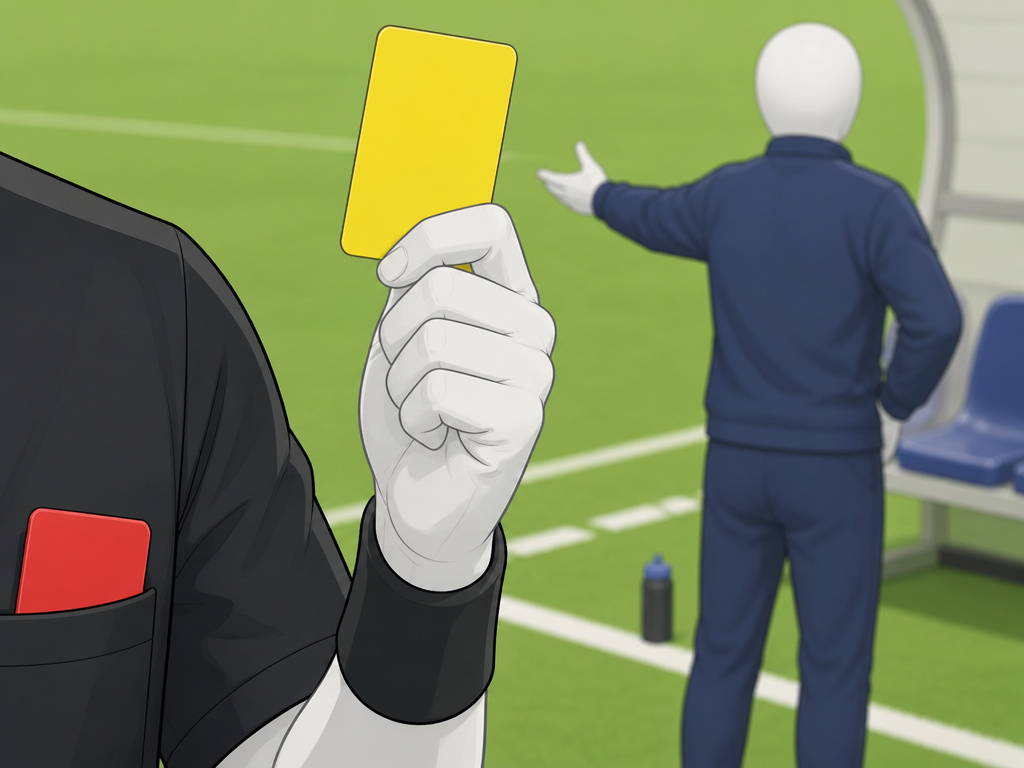
Coaches get a head start. Players don’t.
Here’s the bit people skip. Law 12 lists a warning tier for team officials, and the bottom rung also covers occasionally leaving the confines of the technical area without another offence, and failing to cooperate with a match official. Do you know which rung your own bench is standing on?
The escalation runs in order:
- Warning for minor, low-level disagreement by word or action. Ignore it and the next outburst counts as repeated, which moves it up.
- Caution for dissent by word or action, such as kicking a drinks bottle or sarcastic clapping. A second caution in the same match is a sending-off offence.
- Sending-off for deliberately leaving the technical area to show dissent or remonstrate with a match official, or for abusive language. Nothing sits above this rung, so the match carries on without that official.
Where this goes sideways: The whole dugout shouts at once and nobody owns the outburst. When the offender can’t be identified, the senior team coach present in the technical area takes the sanction.
Excessively or persistently gesturing for a red or yellow card is also a caution offence for officials. So is excessively showing the “TV signal” for a VAR review.
Easy to miss: The referee’s disciplinary authority starts at the pre-match inspection and runs until the referee leaves the field after the match. Entering the field to confront a match official, including at half-time and full-time, is a sending-off offence for team officials.
Nothing in the passages I read says how patient a referee must be. For players, Law 12 says no specific number or pattern of offences constitutes “persistent”. That leaves judgment with the referee.
My own habit is to note what gets waved through in the opening spell, because that sets the budget for everyone else. It’s opinion, not law. I rate reading a referee’s tolerance far above counting card tallies.
Sin Bins for Dissent Start at Step 5 and Below
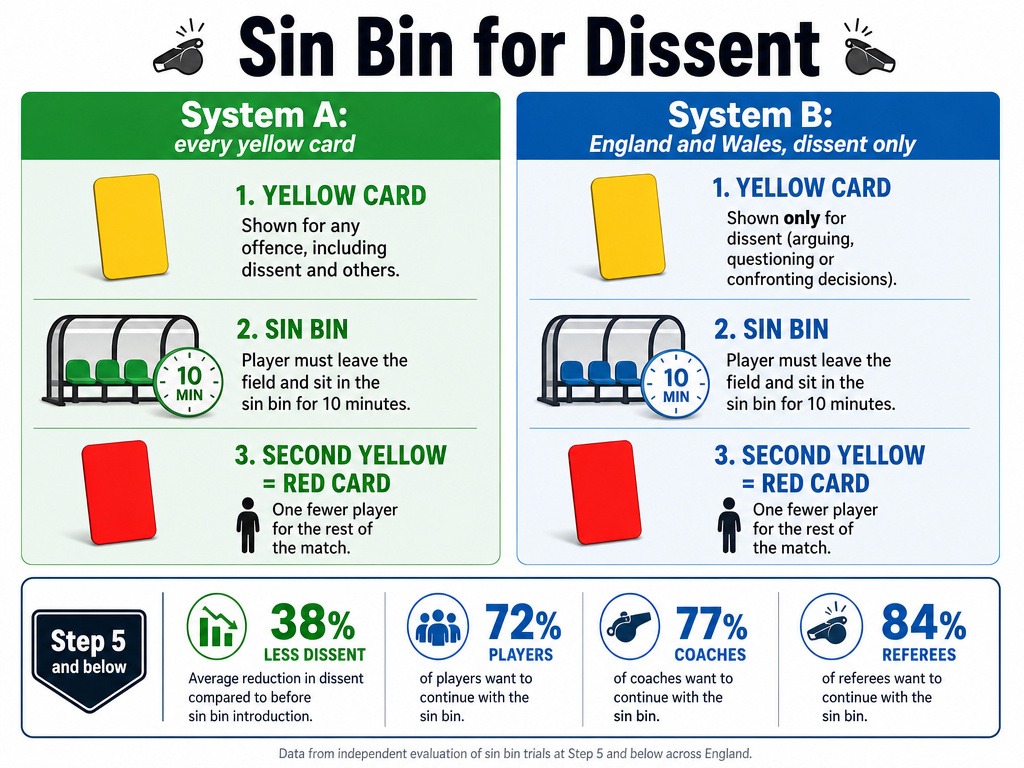
West Riding FA says FA sin bins apply at Step 5 and below, and at Women’s Tier 3 and below, including cup competitions in those leagues. IFAB approved a discretionary system of temporary dismissals in March 2017.
The FA chose to use sin bins for dissent only. They became mandatory across grassroots football from the start of 2019/20. Adult sin bins run 10 minutes, and youth football uses shorter ones.
Two Systems, One Offence
RefSix describes two ways a competition can run a sin bin. England and Wales follow the second.
| Feature | System A | System B (England and Wales) |
|---|---|---|
| Who gets sin-binned | Every yellow card | Dissent by word or action |
| Other offences | Sin bin | Normal yellow card |
| Who sets the offences | Fixed: all cautions | The FA or league |
| Further yellow | Cannot return, can be substituted | Dismissed, team plays one fewer |
The last row mixes two sources. RefSix describes System A, and West Riding FA describes what England does after a second yellow. Check your league’s rules before assuming either.
How a Sin Bin Plays Out
- The referee shows a yellow card and points to the touchline.
- The player goes straight to the designated sin bin area.
- Warm-ups are allowed if competition rules permit. Ten minutes on a cold touchline stiffens the legs, so it helps.
- A dissent caution that is the player’s second yellow ends in dismissal, and the team plays one fewer for the rest of the game.
Since 1 July 2024, Somerset FA says any sin bin counts as a standard caution and carries an administration fee on top of the minutes lost. Two yellows for dissent or other offences mean dismissal, a suspension and a larger fine.
Who Can Be Sin-Binned?
The answer depends on the setting. West Riding FA says a substitute who shows dissent gets a yellow card, reported as a C2 caution, and isn’t sin-binned.
Reporting by PA is different. It says IFAB trial protocols allowed any player on the pitch, including goalkeepers, to be sin-binned for dissent or a tactical foul, but not substitutes, substituted players or team officials. No sin-binned player could be substituted until the dismissal ended.
Publication of those protocols was delayed indefinitely pending the IFAB AGM on 2 March 2024. FIFA said any trials should stay at “lower levels”. Pierluigi Collina said in November 2023 that the trials would “very probably” involve professional football. The sources I have don’t say what the March meeting decided.
Do Sin Bins Work?
The FA’s own figures say yes. Its trial showed a 38% total reduction in dissent across participating leagues. Afterwards 72% of players, 77% of managers and coaches, and 84% of referees wanted to continue. The page gives no method for the 38%, so read it as the FA’s claim.
One Somerset FA referee says dissent dropped sharply and he never had to sin bin more than one player. That’s one voice.
Only the Captain Protocol Becomes Compulsory in July 2027
The FA says “Only the captain” guidelines become a compulsory protocol for all competitions from 1 July 2027, under Law 3. The name says the idea: the captain speaks to the referee, and the squad stays back. The FA’s summary of the 2026/27 law changes gives the date.
The Premier League says its “Captains Only” approach belongs to a refreshed Participant Behaviour charter introduced in 2023. In its 2025/26 season preview it says mass confrontations and surrounding of match officials were reduced last season compared with 2022/23. It gives no figures.
Online explainers describe different sanctions for a non-captain who approaches the referee. I couldn’t find a fixed one in the primary text I read, and I won’t invent one.
Grassroots officials face referee abuse that wears down volunteers. Fewer players crowding the official is part of that.
Cards for Dissent Went Up After the Crackdown, Not Down
Opta says the harsher line failed. The Premier League says it worked. Both claims can stand, because they count different things: cards on one side, mass confrontations on the other. That reading is mine, not either source’s.
Opta’s data, reported by The Analyst, covers 2023-24 at the time of writing:
- A record number of yellow cards for dissent and time-wasting at the time of writing.
- Cards per game more than 20% higher than the year before, the highest average in top-flight history.
- 43 dismissals with about 60% of the season played, with “cheap” yellows for dissent or time-wasting feeding the rise.
- Chelsea led on dissent with 22 players carded (12 the previous season). Nicolas Jackson had seven dissent yellows and Enzo Fernandez five. Luton Town had only three players carded.
Opta’s own verdict, in its analysis of the card records, is that the stricter threshold “doesn’t seem to have worked”. Data isn’t my strong suit. I work from notebooks and eyes, so I lean on Opta here.
The Premier League says the 2023 charter “has led to much improved behaviour”. Both can be true. A cheap yellow looks like a bargain until it becomes the first half of a red.
What Happens After a Second Dissent Caution, and Can VAR Touch It?
Three things follow a second caution:
- Sending-off. A second caution in the same match is a sending-off offence. The second yellow card rule covers the mechanics.
- Grassroots penalty. From 1 July 2024, Somerset FA says the player is dismissed, not permitted to return, and faces a suspension and an increased fine.
- VAR check. Under IFAB’s 2026/27 protocol, VAR can review a second caution that is clearly incorrect when it results in a red card.
A plain dissent yellow isn’t on the review list. A clearly incorrect second caution that produces a red is. “Using offensive, insulting or abusive action(s)” also remains a reviewable red-card category.
The Football Association also lists mistaken identity as reviewable. That covers a player wrongly shown a red or yellow card when someone else committed the offence. For the difference between yellow and red cards, the second caution is the bridge.
A dissent yellow is never just one yellow. It’s the first half of a red, and the referee is counting.
How many matches a red-card ban lasts depends on each competition’s rules. I haven’t sourced those tariffs here.
What happens when play is stopped for dissent?
The card and the restart are two separate decisions, and mixing them up causes plenty of confusion on the touchline. When a player’s words or actions stop play, the referee gives the sanction the offence deserves and restarts the game.
If play is already dead when the dissent happens, there is nothing to stop. The referee deals with the player, then the game restarts the way it was always going to. The same goes for dissent from a technical area, where the referee often waits for the next natural pause before acting. The restart never replaces the card. It sits on top of it.
How do referees handle dissent without showing a card?
The cards are the last tool in the bag, and good referees reach for them late. Body language comes first: a raised palm, a firm stare, a step toward the player. Often that is enough to end it. Next comes the quiet word, a calm private message that the tone needs to change. Players tend to respond better when they aren’t being embarrassed in front of a crowd.
A public warning works when the problem is spreading. Calling the captain over makes it a team matter, and it fits the Premier League’s Captains Only approach, where the captain is the voice to the referee. For team officials, the law itself points to a warning for minor, low-level disagreement and saves cautions for repeated or blatant offences.
The biggest tool is setting standards early. The first sharp comment, handled firmly and fairly, tells everyone how the match will go.
Does the context change how dissent is punished?
The law gives one offence, but referees read the moment around it. Timing matters. A flash of frustration just after a bad decision is different from a player who keeps muttering all afternoon, and late in a tight match a single caution can change the whole result. Game temperature matters too. In a heated fixture, one careless remark can set off a chain reaction, so a firm early response often calms things down.
Repeat offences are the clearest factor. A player who has already been warned has used up the benefit of the doubt, and a second caution in the same match means a sending-off. Team officials follow the same pattern, with repeat or blatant offences moving from a warning toward a caution or worse.
The type of call also counts. Complaints after a foul decision tend to be about contact and fairness, while complaints about throw-ins, corners and goal kicks are often lazy habits that deserve a quick, firm reset.
Frequently Asked Questions
What are the rules for dissent in football?
Law 12 makes dissent by word or action a caution for players, substitutes and substituted players. Team officials get a warning for minor disagreement, a caution for dissent, and a sending-off for leaving the technical area to remonstrate. Offensive, insulting or abusive language is a sending-off for everyone.
Is dissent always a yellow card?
No. Players are cautioned for dissent, but team officials can get a warning first. Abusive language jumps straight to a sending-off. One video claims dissent is always a yellow and the free kick is taken where the dissent happened, but that skips the warning tier and the red-card cases.
Can a coach be sent off for dissent?
Yes. Deliberately leaving the technical area to show dissent towards, or remonstrate with, a match official is a sending-off offence. Entering the field of play to confront a match official, including at half-time and full-time, is too.
Can a substitute be sin-binned for dissent?
Not in English grassroots football. West Riding FA says a substitute who shows dissent receives a yellow card, reported as a C2 caution. PA also reported that IFAB’s trial protocols excluded substitutes, substituted players and team officials.
Do referees get punished for bad calls?
Law 12 covers discipline for players and team officials. Nothing in the sources I checked covers punishing a referee for a bad call. VAR exists to correct clear errors on goals, penalties, direct red cards and mistaken identity.
The Bottom Line
The practical threshold is level, not tone. If you play or coach at Step 5 or below in England, dissent costs 10 minutes in a sin bin before it costs a card in the book. This week, check which sin bin rules your league uses and whether it adopted the optional mouth-covering offence.
The concession: sources disagree on what happens in practice. Anecdotes claim referees go easy on abuse, Opta counted record dissent yellows, and the Premier League counts fewer confrontations. The Law 12 text itself is clear, and I’d quote that over any clip.
Dissent in football rules explained comes down to the ladder. Warn, caution, send off, and the referee decides how fast you climb it.
So where’s your line between honest frustration and a card?
