
The 17 Laws of the Game in Football Explained
This post contains affiliate links. As an Amazon Associate, we earn from qualifying purchases.
The 17 laws of the game in football explained simply: Laws 1 to 4 set the pitch, ball, players and kit, Laws 5 and 6 cover the officials, Laws 7 to 10 run the match, Laws 11 and 12 handle offside and fouls, and Laws 13 to 17 are the restarts.
That grouping is the lens for everything below. Each cluster answers a different question: where do we play, who decides, how does the match run, what’s illegal, and how does play resume? Learn the clusters and the individual Laws hang on them like pans on a kitchen rail.
What follows walks through each cluster in order. Then it covers the 2026/27 changes now in force and the two places where official sources disagree with each other.
Key Takeaways
- IFAB writes the Laws, and the 2026/27 edition took effect on 1 July 2026.
- Standing in an offside position is not an offence. Getting involved in play from there is.
- A substituted player now has ten seconds to leave once the board goes up.
- Slow throw-ins and goal kicks face a five-second visual countdown, and the sanction is lost possession or a corner.
- Lines belong to the areas they bound, so a foul on the penalty area line is a penalty.
The 17 Laws of the Game in Football Explained on One Page
IFAB writes the Laws, and the 2026/27 edition is the one in force right now. FIFA is one of the bodies in the room, not the only one.
The International Football Association Board, known as IFAB, publishes the Laws of the Game. The annual general meeting, attended by FIFA and the four home associations, approves each new edition. The 2026/27 edition took effect on 1 July 2026, and competitions starting before that date, such as the FIFA World Cup 2026, could adopt the changes early.
That explains why “the 17 Laws according to FIFA” has an odd answer. FIFA’s refereeing site carries the news, but the official text sits on IFAB’s own pages. The 140th meeting that approved the current package took place in Hensol, Wales, on 28 February 2026.
For the long view, read Wikipedia’s history of football’s seventeen laws. A mate once asked me whether he could skip the older history and learn only the modern game. I told him no, because plenty of modern ideas are old ideas in new clothes.
Fans like to joke about an unofficial “Law 18”, meaning common sense. The joke has a real basis in the text. The joke has a real basis in the text, because the Laws leave room for referee judgement.
A brand-new fan should start with football rules for beginners and use this page for the law-by-law detail. I’d go further. Don’t memorise any of it before you’ve watched a match. The flow comes first.
Here’s the whole structure in five groups. Screenshot it.
| Group | Laws | Question it answers |
|---|---|---|
| Setup | 1 to 4 | What’s on the pitch and in the kit? |
| Officials | 5 and 6 | Who decides, and who checks? |
| Match flow | 7 to 10 | How does it start, stop and end? |
| Offside and fouls | 11 and 12 | What’s illegal? |
| Restarts | 13 to 17 | How does play resume? |
Laws 1 to 4: What’s on the Pitch Before Kick-Off
Picture a lower-league ground with one corner flag missing and the goalposts painted grey instead of white. Does the referee call it off? Not necessarily.
I won’t pretend the substitution paperwork is thrilling. Learn the seven-player minimum and the ten-second exit rule below, and let the rest wait until it shows up in a match you’re watching.
Law 1 and Law 2: The Pitch and the Ball
Law 1 covers the pitch size, markings, goals and areas. In that grey-post scenario, IFAB’s Practical Guidelines recommend letting the match go ahead with the teams’ agreement and sending a report to the authorities. They add that lower levels often can’t apply Law 1 strictly.
A broken crossbar is different. If it can’t be repaired or replaced, the match must be abandoned.
Artificial turf has its own gate. In matches between national teams affiliated to FIFA, and in international club competitions, the surface must meet the FIFA Quality Programme for Football Turf unless IFAB grants a dispensation. Goals in FIFA or confederation competitions are recommended to meet the matching goals programme.
Law 2 sets the ball’s size, weight and pressure, and the Law text has the exact figures. In FIFA and confederation competitions, every ball must meet the FIFA Quality Programme for Footballs and carry one of its marks.
Law 3: Players and Substitutions
Eleven players a side is the headline. The details that trip people up are smaller, and the substitution rules hold most of them.
- Seven is the floor. A team can’t resume play after the ball goes out with fewer than seven players.
- A named player who arrives late can join during a stoppage with the referee’s permission, and counts as a player, not a substitute.
- Return substitutions exist only in youth, veterans, disability and grassroots football, subject to national association, confederation or FIFA agreement.
- Swapping places with the goalkeeper without telling the referee: play continues, and both players are cautioned when the ball is next out.
- A named substitute who is sent off can’t be replaced, but the team’s permitted number of substitutions stays the same.
Law 4: Equipment
Law 4 covers the compulsory kit: shirt, shorts, socks, shin guards and boots. The 2026/27 edition adds a loosening. Non-dangerous items are now permitted if they’re safely and securely covered.
Who Decides, and Who Checks? Laws 5 and 6
Law 5 makes the referee the final word on the pitch, and Law 6 lists the helpers: assistant referees, the fourth official and the video match officials.
The advantage rule is the referee’s most useful tool. For 2026/27, IFAB clarified that advantage can be applied when a restart is incorrectly taken and the ball is in play. Competitions can also now choose to let referees wear chest- or head-mounted body cameras. The competition supplies the cameras and controls the footage, and communication with the VAR can’t be broadcast.
VAR assists only for a “clear and obvious error” or a “serious missed incident”. IFAB’s amended protocol lifts the reviewable categories from four to five. A clearly wrong second yellow card can now be reviewed, and so can a case of mistaken identity, where the wrong player of the offending team is cautioned or sent off.
Where this goes sideways: A coach or player stepping into the referee review area while the referee watches a replay. The coach or player is cautioned on the spot. A substitute who enters the video operation room is sent off and can’t be replaced.
Laws 7 to 10: How a Match Starts, Stops and Ends
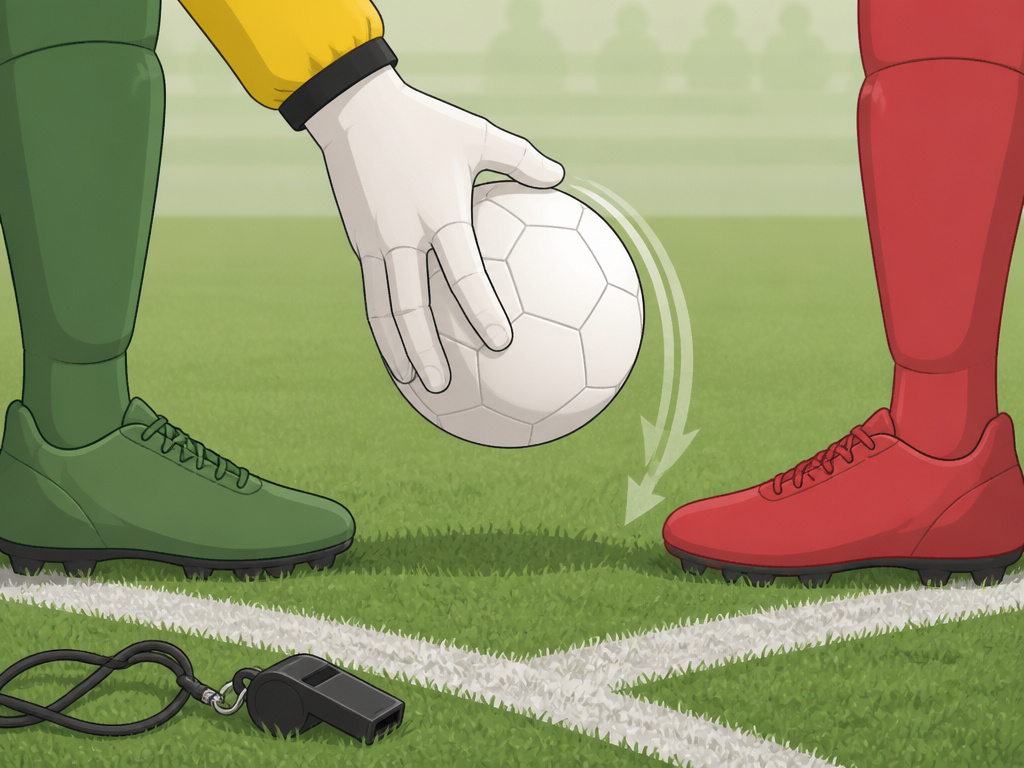
A ball heading for a throw-in is caught by an eager ball boy while it’s still on the field. What now? The referee stops play, sends the ball boy off, and drops the ball for the team that would have taken the throw-in.
That scene touches three Laws at once. Law 7 governs the length of the match, half-time and added time. Law 8 covers the kick-off and the dropped ball, and the 2026/27 text clarifies that a dropped ball goes to the team that would have had or kept possession. Law 9 decides when the ball is in or out of play.
Law 10 settles the result: goals, the winner, then extra time and penalty shoot-outs. The 2026/27 edition writes Circular 31 (June 2025) into Laws 10 and 14, covering an accidental double touch by the penalty taker.
Only players on the field at the final whistle, or temporarily off it, can take part in a shoot-out. A substitution requested before the whistle but not completed by then doesn’t count. The one exception is a replacement for a goalkeeper who can’t continue.
Is It an Offence to Be in an Offside Position?
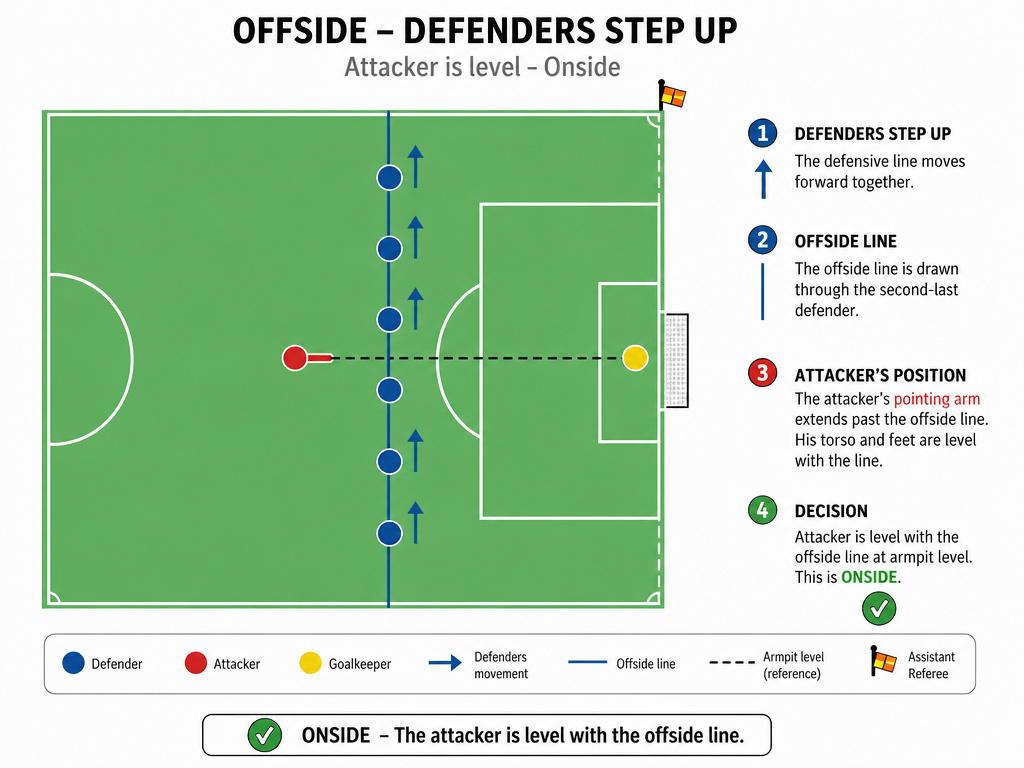
No. Law 11 says so in its first line. The offence comes when a player in that position becomes involved in active play.
Offside is where I used to lose readers. I once explained a pressing system with so much jargon that a reader told me they were lost, so I rewrote it around one simple image. Now I ask whether a casual fan could follow every paragraph. For offside, the image is a defensive line stepping up together, with the second-last opponent setting the line.
Watch an attacker’s arm next time the flag goes up. The line is drawn at the bottom of the armpit, so a pointing arm stretched ahead of the body counts for nothing. The official Law 11 text spells it out.
- A player level with the second-last opponent, or with the last two, is onside.
- Hands and arms are ignored, for goalkeepers too.
- The first point of contact of the pass or touch is used. When the goalkeeper throws the ball, the last point of contact is used.
- There’s no offside offence when receiving the ball directly from a goal kick, throw-in or corner kick.
- The punishment is an indirect free kick where the offence occurred, even in the offender’s own half.
Easy to miss: The goalkeeper’s throw flips the contact rule. Judge position from the last touch, not the first, or you’ll flag a player who was onside at the moment of release.
Law 12: Where Fouls, Cards and Arguments Live
Law 12 causes more shouting than any other Law, and I mean that as a supporter. It sorts offences into those punished with a free kick or penalty and those that also earn a yellow or red card.
Three situations show how the pieces fit:
- A reckless foul with the contact point on the penalty area line is a penalty and a yellow card.
- A goalkeeper who fouls an attacker outside the area to deny an obvious goalscoring opportunity gets a red card, and the attackers a direct free kick.
- When the referee plays advantage after such an offence and a goal is scored, 2026/27 says no caution follows.
Two yellows make a red. A player who re-enters the field without permission and then stops a promising attack collects one for each offence.
Handball gets its own treatment in the handball rule, and it’s the offence fans argue about most.
On goalkeepers holding the ball, FIFA’s release refers to last year’s change to stop them holding it too long. Press reports describe it as an eight-second limit with a corner kick as the sanction, replacing the older six-second rule. Check Law 12’s own text before quoting the exact figure.
Laws 13 to 17: Five Restarts, Five Ways Play Resumes
Direct and indirect free kicks cover most fouls, and offside always earns the indirect kind. A penalty kick follows a foul inside the area, and lines count as inside.
Then come the three restarts where the ball leaves the pitch. Throw-ins and the goal kick both carry the new five-second countdown, and a corner kick is what a delayed goal kick turns into. All three share one more feature: no one can be offside receiving the ball directly from them.
Listen for the whistle.
A restart that goes wrong doesn’t always stop the game. If a restart is taken incorrectly and the ball is in play, the referee can apply advantage.
What Are the Key Changes to the Laws in 2026/27?
Nine headline changes are now in force. The Referees’ Association IFAB changes 2026/27 summary confirms the 1 July start, and the full IFAB list of changes has the wording.
- Law 3: a ten-second exit limit for substituted players, and larger squads for senior ‘A’ international friendlies.
- Law 4: non-dangerous accessories allowed if safely covered.
- Law 5: referee body cameras as a competition option, and advantage after an incorrectly taken restart.
- Law 8: the dropped ball goes to the team that would have had or kept possession.
- Laws 10 and 14: Circular 31 on an accidental double touch by the penalty taker.
- Law 12: no caution when advantage is played after an obvious goalscoring opportunity is denied and a goal follows.
- VAR: second yellow cards and mistaken identity can be reviewed.
- Delays: a five-second countdown on slow throw-ins and goal kicks.
- Injuries: a player treated on the field, or whose injury stops play, stays off for one minute after the restart, with some exceptions.
Here’s how the new substitution timer plays out:
- The board goes up. Skip the ten-second exit and the substituted player is late, and the clock now has consequences.
- The player leaves at the nearest point on the boundary line. A slow walk from the far touchline eats most of the ten seconds on its own.
- If the player is late, the substitute must wait until the first stoppage after one minute has elapsed following the restart. Your team plays with ten for that stretch.
The part nobody mentions: “Only the captain” guidelines, which limit who approaches the referee, become compulsory for all competitions from 1 July 2027. Coaches planning a season ahead need to start drilling it now.
Two details differ by source. The table shows who says what.
| Question | FIFA / IFAB release | Concacaf |
|---|---|---|
| Previous friendly cap | No figure given | Six |
| New friendly cap | Eight, up to eleven by agreement | Eight, up to 11 by agreement |
| Start date | 1 July 2026 | In effect 1 July 2026; its competitions apply it from 20 July 2026 |
The difference on the start date is about scope. Concacaf’s own competitions began applying the changes from 20 July 2026.
Youth, Grassroots and US High School: Where the Laws Bend
Return substitutions are the clearest bend. They’re allowed only in youth, veterans, disability and grassroots football, subject to the relevant association’s agreement. That’s why you see a tired teenager come back on at an under-12 game and never see it at a top-flight ground.
I’m an English-game man, and my knowledge of other systems is thinner. US high school soccer follows NFHS rules, which modify several Laws, so check the NFHS 2024-25 soccer guide if you coach or play there. The same goes for any league that publishes its own rulebook.
Frequently Asked Questions
What are the 17 basic rules of football?
They’re the 17 Laws: the field of play, the ball, the players, equipment, the referee, other match officials, duration, start and restart of play, ball in and out of play, determining the outcome, offside, fouls and misconduct, free kicks, penalty kick, throw-in, goal kick and corner kick.
What are the 17 Laws of football according to FIFA?
IFAB maintains the Laws, and FIFA is one of the bodies that attends its annual meeting. FIFA’s refereeing site publishes the news, but the official text sits on IFAB’s pages.
What are the key changes to the Laws of the Game in the 2026/27 season?
Substituted players have ten seconds to leave, slow throw-ins and goal kicks face a five-second countdown, and injured players stay off for a minute after play restarts. VAR can now review a clearly wrong second yellow card and mistaken identity.
What is the stupidest rule in football?
There’s no official ranking, so this is opinion. Offside draws the most arguments, mainly because arms and hands are ignored and the line sits at the armpit. Handball runs a close second.
Do youth and US high school matches follow the same Laws?
Mostly, but competitions can modify them. Return substitutions are permitted in youth, veterans, disability and grassroots football, and NFHS rules adjust several Laws for US high school soccer. Check your own league’s rulebook.
Can you be offside from a throw-in?
No. There’s no offside offence when receiving the ball directly from a goal kick, throw-in or corner kick.
Before You Go
Once you’ve got the 17 laws of the game in football explained like this, the next step is to watch, not read. For ten minutes of your next match, ignore the ball and track the last line of defenders. If you can call level versus offside before the flag goes up three times in a row, you’re ready for the restarts.
One caveat. Everything here follows IFAB’s text. If you coach or play youth or US high school football, your competition can bend things, so read your own rulebook first and this page second.
It always comes back to the basics. A full-pitch view will teach you more than any list of Laws.
Next match, watch the back line step up together and wait for the flag.
