
Denying an Obvious Goal-Scoring Opportunity Explained
This post contains affiliate links. As an Amazon Associate, we earn from qualifying purchases.
Denying an obvious goal-scoring opportunity explained in short: a player fouls or handles the ball to stop a clear scoring chance. Outside the penalty area, that is a red card. Inside it, a penalty is given and the card is yellow if the defender tried to play the ball, red for holding, pulling, pushing or no attempt.
The word “obvious” hides a four-part test, and the same foul can earn a red card in one match and a yellow in the next. Referees judge that test live, at full speed, with the attacker still running. Former referees and pundits disagree on borderline cases regularly.
What follows: the four tests, the card for each zone of the pitch, real Premier League and Champions League incidents, and the places where different rule books give different answers.
Key Takeaways
- The four tests are judged at the moment of the foul, so a heavy touch or a covering defender can flip the call.
- A non-deliberate handball that denies a chance and brings a penalty is only a yellow card, per the Law and the Premier League’s 2024/25 guidance.
- Stopping a promising attack is yellow, not red when one of the four tests fails. Tuta’s challenge on Son is the worked example.
- If the referee plays advantage, IFAB says caution when the ball is next out of play (or no sanction if the non-offending team scores). ESPN adds that a referee shouldn’t actively play advantage on a red-card offence.
- College and high school rules differ from IFAB on outside-the-area offences and on goals scored after the foul.
What Counts as an Obvious Goal-Scoring Opportunity?
Four named tests decide it. IFAB Law 12 calls them considerations, and the Premier League’s 2024/25 guidance lists the same four.
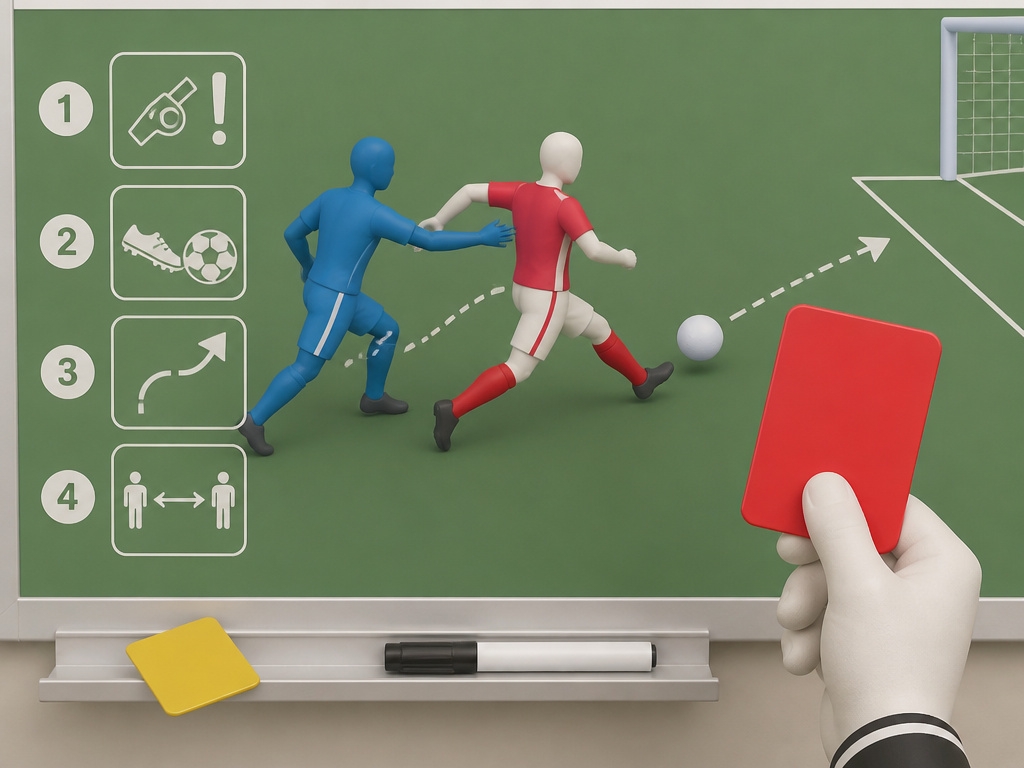
Referees weigh four considerations when judging an obvious goal-scoring opportunity under IFAB Law 12: distance between the offence and the goal, general direction of the play, likelihood of keeping or gaining control of the ball, and location and number of defenders. All four apply at the moment of the offence, and the final factor counts attackers too.
Here’s each test in plain terms:
- Distance to goal: how far from the goal the offence happens.
- Direction of play: whether the attacker’s overall movement is toward the offender’s goal. The sending-off wording in Law 12 requires exactly that.
- Control of the ball: does the attacker have it, or is he about to gain it?
- Defenders and attackers: where they stand and how many. A covering defender can turn a red into a yellow.
Direction of play carries a clause worth knowing. IFAB Circular 7 says the opportunity still exists if, in the final stage of an attack, the attacker moves diagonally to go past a goalkeeper or defender, provided the overall movement is toward goal. A run round a keeper bends, so without that clause a defender could argue the run had drifted wide.
I’d argue the fourth test is the one fans forget. The camera shows every defender, but the referee on the pitch sees a slice of them.
Watch the attacker’s first touch instead. A ball that sits at his feet points to control. A heavy touch that squirts wide, as in the Robertson case below, plants doubt.
Is Denying a Goal-Scoring Opportunity Always a Red Card?
Zone decides the card, and the Law is blunt about it. This table sums up the main cases under IFAB Law 12.
| Situation | Restart | Card |
|---|---|---|
| Foul outside the penalty area | Free kick | Red |
| Foul inside the area, attempt to play the ball | Penalty | Yellow |
| Foul inside the area: holding, pulling, pushing, no chance to play ball | Penalty | Red |
| Deliberate handball (keeper in own area excepted) | Free kick or penalty | Red |
| Non-deliberate handball, penalty awarded | Penalty | Yellow |
| Non-deliberate handball outside own area | Free kick | Red |
Outside the penalty area: red, no discount
The sending-off wording covers denying a goal or obvious chance to an opponent moving toward the offender’s goal “by an offence punishable by a free kick”. The Premier League’s 2024/25 guidance puts it in one line: an offence outside the area that denies a goal or obvious opportunity is a red card. MLS reporting on the 2016 rule change confirmed the outside-the-box rule stayed the same.
One quirk matters. If a defender starts holding an attacker outside the area and keeps holding inside it, the referee must award a penalty kick.
Inside the penalty area: the attempt-to-play test
When a referee awarded a penalty kick for a DOGSO offence, the card turns on one question. Was the offence an attempt to play the ball or a challenge for the ball? If yes, the offender is cautioned. In all other circumstances, such as holding, pulling, pushing or no possibility to play the ball, the offender is sent off.
What most people get wrong: Expecting a red card every time a penalty stops a goal chance. If the defender made a genuine attempt to play the ball, the Law says caution, so the defender stays on the pitch.
Handball: the same logic with its own twist
A deliberate handball that denies a goal or obvious chance is a sending-off wherever it happens. The only exception is a goalkeeper inside their own penalty area.
A non-deliberate handball splits by location. Inside the offender’s area, with a penalty awarded, it’s a caution. Outside their own area, it’s a sending-off.
The keeper’s exception stops at the area line. Step outside it and the same deliberate handball is a red card, which is why the goalkeeper rules and the question of handling outside the area matter so much for sweeper-keepers.
2016: When Penalty-Plus-Red Got Softer
The change landed at the Copa America Centenario in 2016. MLS reported that IFAB removed the automatic red card for a penalty-area DOGSO foul, unless it involved holding, pulling or pushing, no attempt to play the ball, or an offence that would be a red anywhere (violent conduct, for example).
IFAB Circular 7 lists DOGSO in Law 12 among the experiments its annual business meeting received updates on. The Premier League’s 2024/25 guidance then added the handball tweak: a non-deliberate handball that brings a penalty is a caution.
I read the 2016 change as an incentive nudge. A defender who lunges for the ball now risks a yellow. A defender who grabs and drags risks a red. Fair enough, I’d say, because the Law now rewards the better footballing instinct.
Five Incidents, One Process: Applying the Tests to Real Matches
Sixteenth minute at Fulham. Harry Wilson takes a heavy touch, and Andrew Robertson fouls him. The ball runs to Raul Jimenez, who scoops a shot over Alisson. Virgil van Dijk clears it before it crosses the line.
Only then did referee Tony Harrington stop play for the free kick and the red card. No whistle, a few strides, a shot, a clearance. That’s the sequence ESPN describes.
Denying an obvious goal-scoring opportunity explained through match footage works best, so here are five incidents side by side.
| Incident | On-field call | Commentator view |
|---|---|---|
| Konsa v West Ham (Bowen, about 18 yards out) | Red | Gallagher: correct |
| Laporte v Zaha | Red | Gallagher: correct |
| Evans v Arsenal (Aubameyang) | Yellow | Gallagher: wrong, should be red |
| Robertson v Fulham, 16th minute | Red, VAR kept it | ESPN: harsh |
| Tuta on Son | Yellow (promising attack) | CBS: defender-location test failed |
ESPN’s Andrew Robertson red card analysis says only distance to goal was definitely met. Wilson’s touch went out to the left and Van Dijk was closing in, which left doubt about control. The on-field referee and the VAR, Stuart Attwell, stayed with the red anyway. Here the sources disagree: ESPN calls it harsh, the officials called it DOGSO.
In a Dermot Gallagher DOGSO incident analysis for Sky Sports, the former Premier League referee works through a checklist. This is the order he effectively follows:
- Is it a foul? Skip this and you end up debating a card for a challenge that may not have been a foul at all, which is CBS’s argument about Tomori’s 17th-minute red against Chelsea.
- Is the attacker in control, or about to be? Gallagher judged that Bowen was, and said the ball ran away only because he’d been fouled.
- Is there a clear path to goal? For Laporte and Zaha, Gallagher said Zaha had no obstacles at all.
- Could a defender catch him? Skip this and every foul from behind looks like a red.
I keep coming back to the Evans case. Gallagher blamed the referee’s starting position for misjudging the distance to the ball. The law wasn’t the problem; the angle was. Referees get that wrong.
DOGSO or Promising Attack? Why Some Last-Man Fouls Stay Yellow
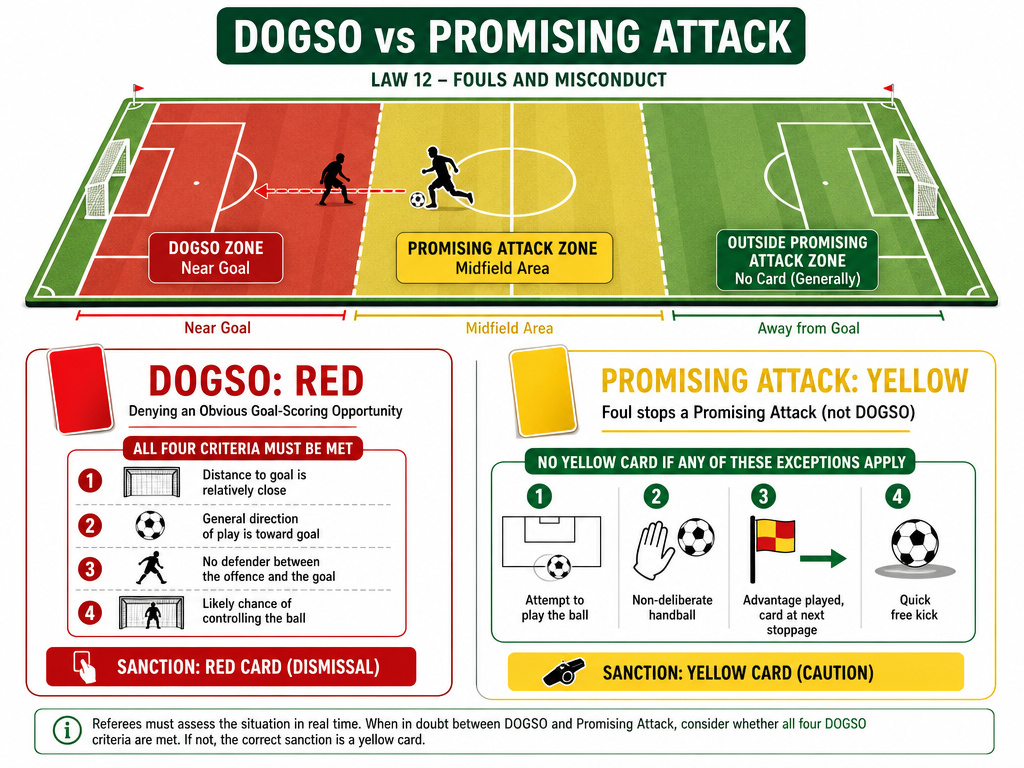
Every foul that stops a break looks like a red from the stand. The Law disagrees when a test fails. A foul that interferes with or stops a promising attack is cautioned for unsporting behaviour, except where a penalty is awarded for an attempt to play the ball.
CBS explained Tuta’s challenge on Son this way. It felt like Tuta was the last defender, but the location-and-number-of-defenders test wasn’t met. Because the foul was outside the area, it could only be red if it was DOGSO, so the referee gave a yellow for stopping a promising attack.
Yellow cards also survive in these cases:
- A penalty for an attempt to play the ball.
- A non-deliberate handball that brings a penalty.
- Advantage played, with the caution coming when the ball is next out of play.
- A quick free kick taken with a clear chance, where the sanction waits until the next stoppage and the player is cautioned if the offence was DOGSO.
In my book, this gap is where the tactical foul lives. A yellow for stopping an attack in midfield is the price. The red arrives when the attacker is already through. A well-timed foul is a skill; a late one is a sending-off.
Advantage, VAR and the Slow Whistle
IFAB’s Law 12 wording allows the advantage rule on a DOGSO offence. The player is cautioned for unsporting behaviour when the ball is next out of play, unless the non-offending team scores as a result, in which case there’s no disciplinary sanction. The Law also says advantage shouldn’t be applied to serious foul play, violent conduct or a second cautionable offence unless there’s a clear chance to score.
ESPN, reviewing Robertson’s red card, says a referee shouldn’t actively play advantage on a red-card offence but can pause briefly if there’s an immediate scoring chance. ESPN draws its own line between a pause and a signalled advantage. When two sources split like this, I go back to the Law text before I write anything.
The part nobody mentions: If a defender starts holding outside the area and keeps holding inside it, the referee must award a penalty kick. The foul that began as a free-kick offence becomes a penalty the moment it continues across the line.
VAR interventions on DOGSO are rare because the call is so subjective. ESPN said William Saliba’s red card at Bournemouth was the first VAR involvement in a DOGSO decision since November 2022. That was when Brighton goalkeeper Robert Sanchez was sent off for fouling Callum Wilson outside the area. It added that the failure to recommend a red for Ian Maatsen’s foul on Ismaila Sarr was the only logged DOGSO error that season at the time of writing.
CBS made the same point about Tomori: VAR shouldn’t overturn a borderline call, only a clear and obvious error.
One last edge case. IFAB Circular 7 says any player, substitute or team official who enters the field without permission and prevents a goal or denies an obvious chance must be sent off, even if no other offence is committed.
Three Rule Books, Three Answers
IFAB, the NCAA and the NFHS handle DOGSO differently. My knowledge of American college and high school football is thinner than my knowledge of the European game, so treat this as a pointer, not a ruling.
- IFAB: a sending-off for denying a goal or obvious chance by an offence punishable by a free kick, with no sanction if advantage is played and the non-offending team scores.
- NCAA: rule 12.5.6 covers denying an obvious goal-scoring opportunity outside the area only by an offence punishable by a direct free kick.
- NFHS (via NISOA’s 2013 explanation): three criteria, namely a foul, the fouled player moving toward his offensive goal, and an obvious opportunity, which normally means control of the ball and past all defenders except the goalkeeper. The player is disqualified if the goal isn’t scored, cautioned if it is, and disqualified even then if the force was disproportionate.
That NFHS description dates to 2013, so check the current rule book before relying on it. If you play or referee grassroots or school football, ask your league which book applies. The cards can change.
Do indirect free kick offences and goalkeeper offences count as DOGSO?
Yes to both. The Law 12 sending-off wording covers denying a goal or obvious chance to an opponent moving toward the offender’s goal “by an offence punishable by a free kick”. It says free kick, not direct free kick, so an indirect free kick offence can qualify. Some rule sets are narrower. NCAA rule 12.5.6 applies only to an offense punishable by a direct free kick, so check which code you are working under.
Goalkeepers are not exempt. ESPN noted that Brighton goalkeeper Robert Sánchez was sent off in November 2022 for fouling Callum Wilson outside the area. The one carve-out is handball. A deliberate handball that denies a goal or obvious chance is a sending-off wherever it happens, except for a goalkeeper inside their own penalty area. Outside that area, a keeper who handles the ball is treated like any other player.
Frequently Asked Questions
What is denying an obvious goal-scoring opportunity?
It’s an offence where a player stops a goal or clear scoring chance with a foul or handball. IFAB Law 12 judges it with four considerations: distance to goal, direction of play, control of the ball, and the location and number of defenders.
Is denying a goalscoring opportunity a red card?
Outside the penalty area, yes. Inside it, the card is yellow if the offence was an attempt to play the ball and red for holding, pulling, pushing or no possibility to play the ball. Deliberate handball is red wherever it happens, except for a goalkeeper in their own area.
When a player deliberately handles the ball to deny a goal, what happens?
The player is sent off, except a goalkeeper within their own penalty area. The restart is a penalty kick if it happened in the offender’s area and a free kick if it happened outside.
Which factors decide whether an obvious chance was denied?
Distance between the offence and the goal, general direction of the play, likelihood of keeping or gaining control of the ball, and location and number of defenders. The referee assesses all four at the moment of the foul.
How long is the suspension after a DOGSO red card?
No single figure applies everywhere. CBS describes a red card and one-game suspension as the result of a foul, penalty and red in the Tomori case. Appeals and longer bans depend on the competition’s own rules.
The Bottom Line
Before you call anything DOGSO next weekend, ask which of the four tests fails first. If distance or defender position fails, expect a yellow for stopping a promising attack. Denying an obvious goal-scoring opportunity explained fully means accepting that experts split on borderline cases.
Your first step this week: rewatch the Robertson incident and tick the four boxes yourself. Then compare your answer with ESPN’s. The concession: the Law gives a framework, but a referee still decides at full speed from one angle.
My view stays the same. A cynical foul in the middle third is a yellow-card risk. The same foul with the attacker clear through is the one that costs a team its eleven.
So where does the tactical foul end and the sending-off begin, in your view?
