
Goalkeeper Rules in Football Explained: The 8-Second Shift
This post contains affiliate links. As an Amazon Associate, we earn from qualifying purchases.
Goalkeeper rules in football explained simply: a keeper can handle the ball only inside their own penalty area, can’t handle a deliberate kick or a throw-in from a teammate, and since 1 July 2025 concedes a corner for holding the ball more than eight seconds. Outside the box, they’re treated like any other player.
That 1 July 2025 date is where the trouble starts if you watch more than one competition. The change reached the Laws that summer, but US high-school and college keepers stayed on six seconds and an indirect free kick through 2025-26. They only switch to eight seconds and a corner for 2026-27.
What follows: the handling laws, the back-pass detail fans get wrong, how the eight-second count works, penalties, restarts, kit and youth formats, plus one table showing where the rulebooks still disagree.
Key Takeaways
- Hold the ball past eight seconds and IFAB Law 12 gives the opponents a corner, taken from the corner area nearest where the keeper stood.
- A keeper can pick up a headed or chested back pass, but setting up a deliberate trick to dodge the law earns a caution.
- US school and college soccer used six seconds and an indirect free kick in 2025-26, and both move to eight seconds and a corner for 2026-27.
- At a penalty, part of one foot has to touch, sit in line with, or stay behind the goal line until the ball is kicked.
- Inside their own box, a keeper is exempt from the handball red card for denying a goal. Step outside and the exemption is gone.
Where Can a Goalkeeper Use Their Hands?
IFAB Law 12 draws the line at the edge of the penalty area. Inside their own box, the keeper can catch, parry, punch and hold the ball. One step outside, they handle under the same limits as any outfield player.
IFAB Law 12 treats a goalkeeper as in control when the ball is held between the hands or against a surface, rests on an open hand, or is being bounced or thrown up. Control starts the eight-second count. An opponent who blocks the release concedes an indirect free kick, or a direct free kick if contact is made.
That bounce clause matters more than it looks. A keeper who bounces the ball while strolling to the edge of the box is still in control, so the clock keeps running. The bounce-and-walk was a classic way to kill time. It buys nothing now.
Handball Outside the Box: Free Kick, Yellow or Red?
The keeper handling outside the penalty area is just a defender with gloves on. The sanction depends on what the handball stopped:
- Direct free kick for the handball itself, from where it happened.
- A caution if the handball interferes with or stops a promising attack.
- A red card if a deliberate handball denies a goal or an obvious goal-scoring opportunity (referees shorten that to DOGSO, which simply means the attacker was clearly about to score).
Inside the area, the picture flips. The DOGSO handball red applies to every player “except a goalkeeper within their penalty area.” The keeper is allowed to handle there, so stopping a goal with the hands is simply doing the job.
I’d call this the least understood corner of goalkeeping law. Fans see a keeper sprint out, block a shot with an arm and expect a debate about intent. Outside the box, a deliberate handball that denies a goal or obvious chance is a red card.
The Back-Pass Rule: Feet Yes, Hands No, and the Knee Trick That Earns a Booking
Ask a room full of fans whether a keeper can ever pick up a pass from a teammate and you’ll hear a confident no. They’re wrong.
The back-pass rule is narrower than its reputation. It stops the keeper handling a ball that a teammate has deliberately kicked to them. It also bans handling a throw-in taken straight to them by a teammate. Break either and the opponents get an indirect free kick.
So what can a keeper pick up?
- A header back from a centre half. Legal.
- A pass cushioned on the chest or thigh.
- A miskick or a deflection off a teammate’s boot, because nobody deliberately kicked it to them. This one causes more touchline shouting than any other.
- Their own released ball, but only after another player has touched it. Drop it, then grab it again with nobody else touching it, and that’s an indirect free kick too.
Then there’s the trick clause. Law 12 cautions any player who “initiates a deliberate trick” to get the ball to the keeper with the head, chest or knee to get around the law. The booking stands whether or not the keeper touches it with the hands. If the keeper set the trick up, the keeper gets the yellow.
Common mistake: Screaming for a free kick when a keeper catches a headed back pass. It’s legal. The only offence is a deliberate flick-up designed to beat the law, and that brings a caution for whoever started it.
I’d argue this law changed football more than almost any other, and the tactical effect still gets underrated. Once the keeper couldn’t scoop up every nervous back pass, defenders had to fit together like a well-cut dovetail joint, each passing angle shaped to the next. A back four that can’t take the easy way out learns to move as one unit. That’s the part I love watching.
From Six Seconds to Eight: How the Corner-Kick Count Actually Works
The first time I read that Burnley’s Martin Dubravka was the first Premier League keeper penalised under the new rule, against Tottenham in August 2025, I wanted it to be true. It’s a tidy line. Tidy lines are exactly the ones I check twice, ever since I repeated a too-perfect football story that turned out to be embellished. The Dubravka claim comes from secondary media, so hold the word “first” loosely.
Rewind a second. The old six-second rule punished a slow keeper with an indirect free kick. Inside World Football described it as “mostly unenforced.” Patrick Nelson, Irish FA chief executive and an IFAB director, said it had “been a bane of many people’s lives for quite some time.”
My own reading of why referees ducked it (and it’s only a reading) is that an indirect free kick in the box felt out of proportion to a few seconds of dawdling. A corner is a cleaner, more familiar punishment. Referees give corners every match.
IFAB approved the change at its 139th AGM in Belfast. It ran at the Club World Cup from 14 June 2025 and entered the Laws on 1 July 2025. The Fox Sports goalkeeper eight-second rule report covers Yassine Bounou conceding one for Al Hilal against Real Madrid at that tournament, in June 2025.
Here’s how a referee applies it, in order:
- The keeper takes control under one of the three definitions above. Bouncing counts, so a keeper who thinks dribbling it on the turf pauses the count gets a nasty surprise.
- The referee raises a hand for the last five seconds, an open palm held high with fingers dropping as the count runs out. Ignore that signal and the keeper is choosing to gamble.
- The count passes eight seconds and the whistle goes. The opponents get a corner, not a free kick, so the defence has to deal with a dead-ball delivery into its own box.
- The corner is taken from the corner area nearest where the keeper was when penalised. A keeper drifting to one side of the box has picked which flag the attackers use.
Release it before the hand goes up and you never have to think about the count again.
The trial numbers tell their own story. IFAB’s trial covered more than 400 games in 3 competitions, and only 4 corners were awarded. I read that as the threat doing the work: keepers simply let go sooner. Strip the threat away and you’d expect the dawdling to come back.
Now, the ball-in-play figures. The Premier League averaged 54:57 in 2022/23, 58:10 in 2023/24 and 56:58 in 2024/25. All three seasons came before the rule. I’m no data analyst, and I won’t pretend those numbers prove anything about eight seconds yet.
Goalkeeper Rules in Football Explained Across Rulebooks: Who Disagrees on What
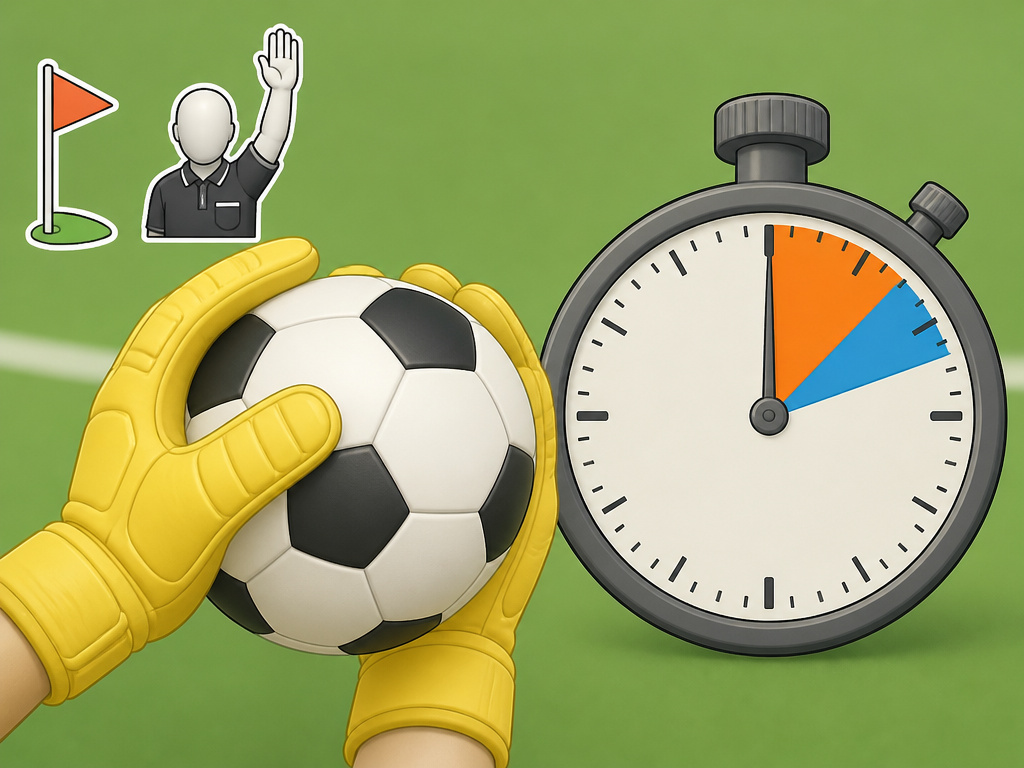
Two time limits ran side by side in 2025-26. IFAB used eight seconds and a corner. US college and high-school soccer kept six seconds and an indirect free kick for that season.
The NFHS high school soccer rules changes raise the limit from six to eight seconds for 2026-27, with a corner as the penalty. The NCAA adopted eight seconds plus a five-second visual signal, with a corner replacing the indirect free kick. Its release says the change “aligns the NCAA with international rules.”
That leaves an odd edge case. A US keeper playing club football and school or college football in 2025-26 faced two different rules in the same year. Same gloves, same hands, different count.
The smaller details split too. The IHSAA 2026-27 soccer rules changes document says a goalkeeper violation stands even if the referee fails to give the visual signal. No IFAB text in the sources behind this article says the same.
| Issue | Position A (who holds it) | Position B (who holds it) |
|---|---|---|
| Holding limit, 2025-26 | 8 seconds, corner (IFAB) | 6 seconds, indirect free kick (NFHS, NCAA) |
| Referee misses the signal | Violation still stands (NFHS-based IHSAA material) | No matching IFAB text found |
| Repeat holding offences | Corner, warning, then yellow (Premier League summary, unverified) | Corner only (IFAB Law 12) |
| First penalty line offence | Warning (IFAB) | Warning only from 2026-27 (NFHS) |
| Kicker and keeper offend together | Kicker cautioned, IFK to defence (IFAB) | Kicker penalised, caution unconfirmed (NFHS) |
| Who watches the keeper’s line | VAR alone (Premier League) | Assistant referee (matches without VAR) |
Treat that repeat-offence row with care. The corner-warning-yellow ladder comes from an unverified summary of a Premier League page. It may be a competition principle, or it may be an error in the summary. The IFAB Law 12 text lists only the corner.
Easy to miss: Assuming a keeper escapes punishment because the referee never raised a hand. Under NFHS-based state rules the violation stands anyway, and nobody has shown IFAB says otherwise, so don’t build an appeal on it.
Two NFHS rules are worth knowing on their own. Rule 12-1-2c says that outside the penalty area “the goalkeeper has no more privileges than any other player.” Rule 14-1-3 keeps at least one foot on or in line with the goal line at a penalty, with the keeper free to move sideways or forward.
Penalty Kicks: One Foot on the Line, and the Saves That Still Stand
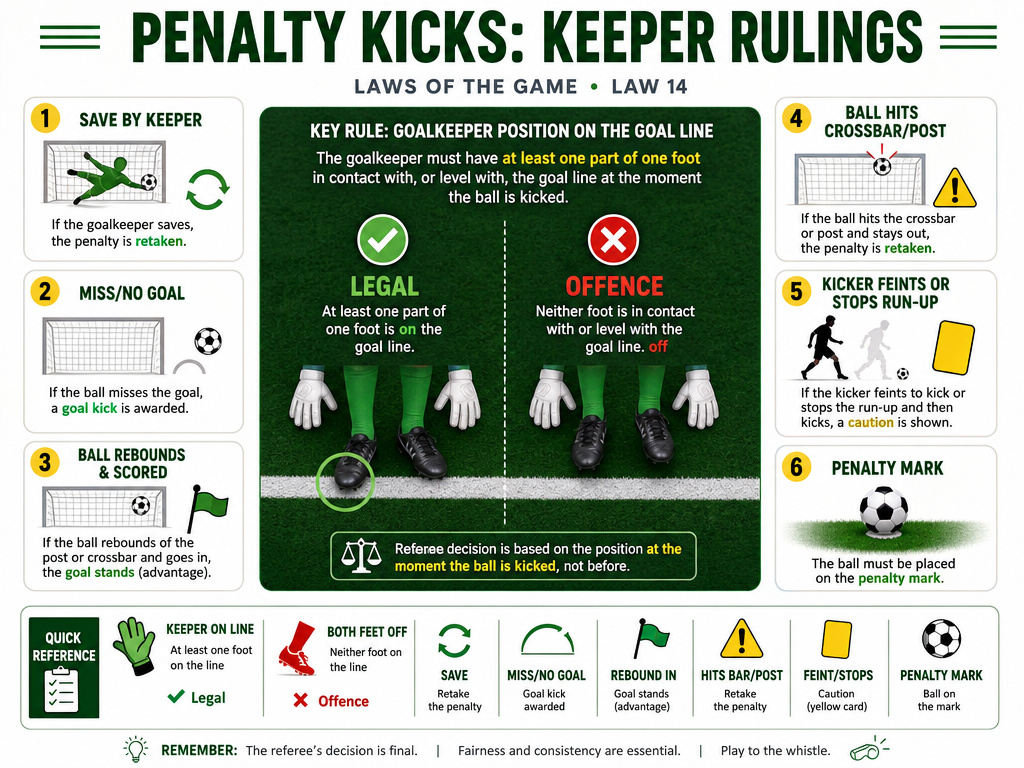
Penalty line arguments get far more airtime than they deserve. They decide few matches. Still, the law has more nuance than the shouting suggests.
IFAB Law 14 asks for at least part of one foot touching, in line with, or behind the goal line until the ball is kicked. One foot in front and one behind is fine. The goalkeeper foot on the line test fails only when both feet are off it.
Even then, the goalkeeper encroachment only costs the keeper when it matters. The IFAB Law 14 penalty kick text orders a retake only if the offence clearly impacted the kicker, unless the keeper actually saved it.
| Situation at the kick | Ruling | Keeper sanction |
|---|---|---|
| Both feet off the line, keeper saves | Kick retaken | Warning first, then yellow |
| Both feet off, shot misses, no impact on kicker | Goal kick or play on | None |
| Both feet off, save rebounds to a scorer | Goal awarded on advantage | None |
| One foot on the line, one in front, save | Play continues | None |
| Keeper rattles the crossbar, kicker misses | Kick retaken | Warning for a first offence |
| Kicker feints while keeper is off the line | IFK to the defence | None, kicker is cautioned |
That third row is my favourite. The keeper cheats, saves it, and the ball pops out to an attacker who scores. The referee plays advantage, gives the goal, and the keeper walks away without even a warning.
What the Keeper Can Do Before the Kick
Quite a lot, actually. A keeper can move the arms, jump, and move along the goal line, provided the referee doesn’t judge it disrespectful or unfair. Touching the crossbar so it moves and distracts the kicker crosses that line: the kick is retaken if missed and the keeper is warned for a first offence.
Walking out to the kicker is worse. A keeper who approaches and unfairly distracts or delays the kick is cautioned.
I’d rather see a keeper spend the build-up studying the kicker’s run than dancing on the line. The Laws allow the jumping and the waving, but a saved penalty with both feet off the line gets wiped out and retaken anyway.
When the Kicker Is the One Who Cheats
An illegal feint is treated as more serious than encroachment. If the kicker feints while the keeper has both feet off the line, the kicker is cautioned and the defence gets an indirect free kick. The same applies if a defender encroaches during an illegal feint: no retake.
Two more details round it off. The ball must touch or overhang the centre of the penalty mark. If a retake is ordered for a keeper offence after a save, the attacking team can switch to a new kicker, provided that player is clearly identified.
Can a Goalkeeper Score With a Throw?
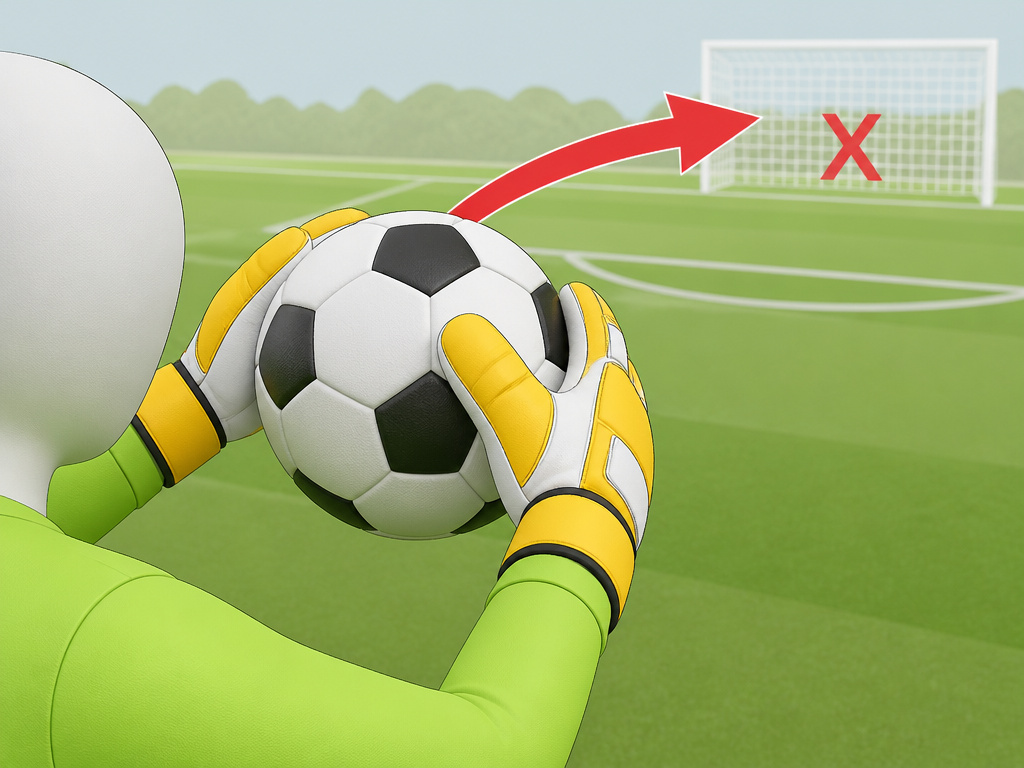
No. A keeper who throws the ball straight into the opponents’ net doesn’t score; play restarts with a goal kick to the other side. Throw it into their own net and the opponents get a corner.
Kicking is a different matter. A goal kick can go in directly against the opposition, which is why the occasional wind-assisted punt from a keeper ends up as a goal.
The goal kick rules are simple once you see them laid out:
- The ball is stationary and kicked from anywhere in the goal area by a defending player.
- Opponents must stay outside the penalty area until the ball is in play, which happens once it’s kicked and clearly moves.
- If an opponent rushes in early and gets fouled, the attacker is the one who broke the law.
Two newer details catch people out. Under Law 11 for 2025/26, when a keeper throws the ball, offside is judged from the last point of contact. Every match leaves a clue about where a throw was released, and that release point is now what the assistant referee lines up against.
The Premier League added its own wrinkle for 2025/26. If play stops with the ball in the penalty area, the restart is a dropped ball to the keeper. Quiet change. Big effect on stoppages.
Kit, Captaincy and Who Goes in Goal When the Keeper Is Sent Off
Goalkeeper shirts from the 1990s are where designers clearly worked without supervision. Clashing neon, zigzags, patterns that look like an old screensaver. I’ve always thought they tell you more about the era than the outfield shirt ever does.
The goalkeeper kit rules only ask for one thing: colours that set the keeper apart from every other player and the officials. Within that, clubs have room to play. I see second-choice kits doing the same job. The away shirt is where a club can nod to a local industry or an old crest, while the home shirt has to play it safe.
Swapping who wears the gloves is where the law bites. A player who changes places with the goalkeeper during play, or without the referee’s permission, is cautioned for unsporting behaviour. The goalkeeper substitution rules exist so the referee always knows who can handle the ball.
That matters most after a red card. Every team needs a goalkeeper, so if the keeper is sent off, an outfield player or a substitute has to take over in a properly distinct shirt. Watching a centre forward pull on a borrowed jersey two sizes too big is one of football’s small comedies.
Captaincy has its own quirk. Under captains-only arrangements, if the captain is the goalkeeper, the referee must be told before the coin toss which outfield player will approach the referee instead.
Where this goes sideways: Letting a defender swap into goal mid-play without telling the referee. The swap itself earns a caution, and any handling before the referee knows about it turns a sensible change into a mess.
Youth Formats and the Rules That Protect the Keeper
Three things protect a keeper in possession: a retreating line in some youth formats, a ban on blocking the release, and limits on how keepers themselves can challenge. Each one shapes the game differently.
New Zealand’s Mainland Football uses a retreating line only in 7v7 and 9v9. It sits at 30% of pitch length from each goal and applies when the keeper has the ball in hand. Opponents drop back, so the keeper gets time to play out.
Fair enough, but my grasp of youth formats outside Europe is thinner than I’d like. The New Zealand example is one of the few I can cite cleanly, and other countries run their own versions I can’t vouch for.
The adult protections hold at every level:
- An opponent who prevents the keeper releasing the ball concedes an indirect free kick.
- Touch the keeper while doing it and it becomes a direct free kick.
- Keepers don’t get a free pass either. One who recklessly bumps an attacker while jumping to punch a free kick concedes a penalty and a yellow, or a red if the challenge endangers the attacker’s safety.
One more case from Law 14’s examples. A keeper who leaves the area and carelessly fouls an attacker, denying an obvious chance, is cautioned rather than sent off if the referee plays advantage and the chance is restored.
My blunt view on youth football: coaches who chase wins at under-10 level do real damage. A young keeper told to hoof every ball clear never learns to read a retreat line or pick a pass. The rules give them time. Use it.
Frequently Asked Questions
What are goalkeepers not allowed to do?
Keepers can’t handle the ball outside their own penalty area, handle a ball deliberately kicked to them by a teammate, or handle a throw-in taken straight to them by a teammate. They also can’t hold the ball for more than eight seconds under IFAB rules, or handle it again after releasing it before another player touches it.
When can a goalkeeper not handle the ball?
Outside their own penalty area, a keeper has no handling privileges at all. Inside it, the back-pass and throw-in restrictions apply, along with the second-touch rule. A headed or chested pass from a teammate can be picked up, unless it’s a deliberate trick to get around the law.
Can a goalkeeper throw the ball and score?
No. A throw that goes directly into the opponents’ goal results in a goal kick to the other team, and a throw into their own goal gives the opponents a corner. A kicked ball from a goal kick can score directly against the opposition.
Can a goalkeeper come off his line for a penalty?
The keeper can move along the line, jump and wave the arms, but at least part of one foot has to stay touching, in line with, or behind the goal line until the ball is kicked. If both feet are off and the keeper saves, the kick is retaken, with a warning for a first offence and a yellow for any later one.
Does the eight-second rule apply in US high school soccer?
From 2026-27, yes. NFHS raised the limit from six to eight seconds with a corner as the penalty, and the NCAA made the same move with a five-second visual signal. In 2025-26, both stayed on six seconds and an indirect free kick.
Before You Go
Goalkeeper rules in football explained in one sentence would miss the real trap: which rulebook your match runs on. If you coach or referee in the US, check before kickoff whether you’re under IFAB, NFHS or NCAA wording. The missed-signal question alone can decide an argument on the touchline.
One concession. Several details here rest on sources that disagree or remain unconfirmed, especially the Premier League repeat-offence ladder and whether NFHS cautions a feinting kicker. I’d rather show you the gap than paper over it.
And one stance I’ll defend: the eight-second corner matters far more to the game than any penalty-line debate, because it touches every match where a keeper catches the ball.
So which changed football more, the back-pass rule or the eight-second corner?
