
Goalkeeper Kit Color Rules in Football: Who Changes First?
This post contains affiliate links. As an Amazon Associate, we earn from qualifying purchases.
Goalkeeper kit color rules in football start with IFAB Law 4: each keeper must wear colors distinguishable from the other players and the match officials. Competitions then pile on stricter terms. UEFA requires at least two contrasting goalkeeper kits, and its priority list makes the referee team change first. US high school rules leave officials out entirely.
That missing referee changes how a clash gets sorted. The NFHS goalkeeper rule says nothing about the referee’s shirt, while IFAB and UEFA write officials straight into the text. And when nothing contrasts in a UEFA match, the person who has to change isn’t the one fans expect.
What follows: the IFAB text line by line, a side-by-side of where the rulebooks split, the US high school sock and shorts clauses, a century of keeper colors, four real clashes, and a matchday packing list for grassroots sides.
Key Takeaways
- Under IFAB, two keepers in the same color don’t stop a match if neither has another shirt. The referee allows the match to start.
- UEFA competitions demand at least two goalkeeper kits that contrast with each other and with both outfield kits.
- In a UEFA clash with no contrasting option, the referee team changes first, because it sits last on the priority list.
- NFHS and OHSAA rules include goalkeeper socks, which must differ in color from the opposing field players.
What Does IFAB Law 4 Actually Ask of a Keeper’s Kit?
IFAB’s Law 4.3 sets one test for a goalkeeper’s colors. The full line reads: “Each goalkeeper must wear colours that are distinguishable from the other players and the match officials.”
Under IFAB Law 4.3, a goalkeeper’s colors must be distinguishable from the other players and the match officials. If both goalkeepers’ shirts are the same color and neither has another shirt, the referee allows the match to be played. Gloves are optional for all players under Law 4, so a keeper without gloves breaks no rule.
Read that same-color clause twice.
The lawmakers’ version is more relaxed than the one most fans carry around. I’d have bet a pint that matching keepers meant someone had to change. The current text says otherwise, as long as neither keeper has a spare. You can check the wording yourself in the IFAB Laws of the Game text on players’ equipment.
The IFAB FAQ adds the emergency case. If a keeper is seriously injured and the team has no substitutions left, an outfield player takes over in goal. That player changes into a distinguishing shirt, one that clearly separates them from the other players and the match officials. Pulling on gloves over the team shirt doesn’t cut it.
Gloves, funnily enough, are the one item the law shrugs at. The same FAQ says the referee takes no action when a keeper plays without them, because Law 4 lists gloves as optional for everyone. Every keeper I’ve ever watched still treats choosing between the best goalkeeper gloves as a bigger decision than any clause in the law.
Kit color is the gentle end of the goalkeeper rules. The handling restrictions and the time-wasting limits decide far more matches. Honestly, they deserve more of the airtime that kit clashes get.
Where Goalkeeper Kit Color Rules in Football Split Apart
Four questions split the rulebooks: who the keeper must stand out from, whether socks count, whether two keepers can match, and whether the referee appears at all. Here’s how the three main sets of rules answer them.
| Question | IFAB Law 4 | UEFA regulations | NFHS / OHSAA |
|---|---|---|---|
| Keeper must stand out from | Other players and match officials | Own outfield kits and other keeper kit | Teammates and opposing field players |
| Socks covered? | No separate keeper sock rule | Socks can be mixed across approved kits | Yes, differ from opposing field players |
| Both keepers same color | Match goes ahead if no spare | Two contrasting keeper kits required | Not covered in the rule text |
| Referee in the rule? | Yes | Yes, referee team is last priority | No |
Socks are the messiest row. The NFHS added goalkeeper socks to rule 4-1-1(h)3 in 2015-16 with a short reason: “To differentiate opponents.” You can read the change in the NFHS goalkeeper uniform rule changes summary.
The old Premier League text from 2008-09 covered the keeper’s “shirt and stockings” too. That comes from an archived secondary copy, and I couldn’t confirm the current handbook keeps the wording. Treat it as history.
IFAB’s Law 4 has no separate keeper sock clause. Its only sock color line says any tape has to match the part of the sock it covers. UEFA sits in between: under Article 9.04, a team can be asked to combine shirt, shorts or socks from more than one approved kit to create contrast.
The two-keepers row shows the widest gap. IFAB allows matching keepers to play on. UEFA’s Article 9.03 makes that situation far rarer, because every team must bring “at least two goalkeeper attires which clearly contrast with each other and with the first-choice and second-choice outfield player attires.” Same game. Very different paperwork.
I’d copy the NFHS sock clause into every grassroots league. When a keeper goes down at a forward’s feet, the referee sees a tangle of legs, and the socks are what tell you whose legs they are.
Who Changes First When the Keeper Clashes With the Referee?
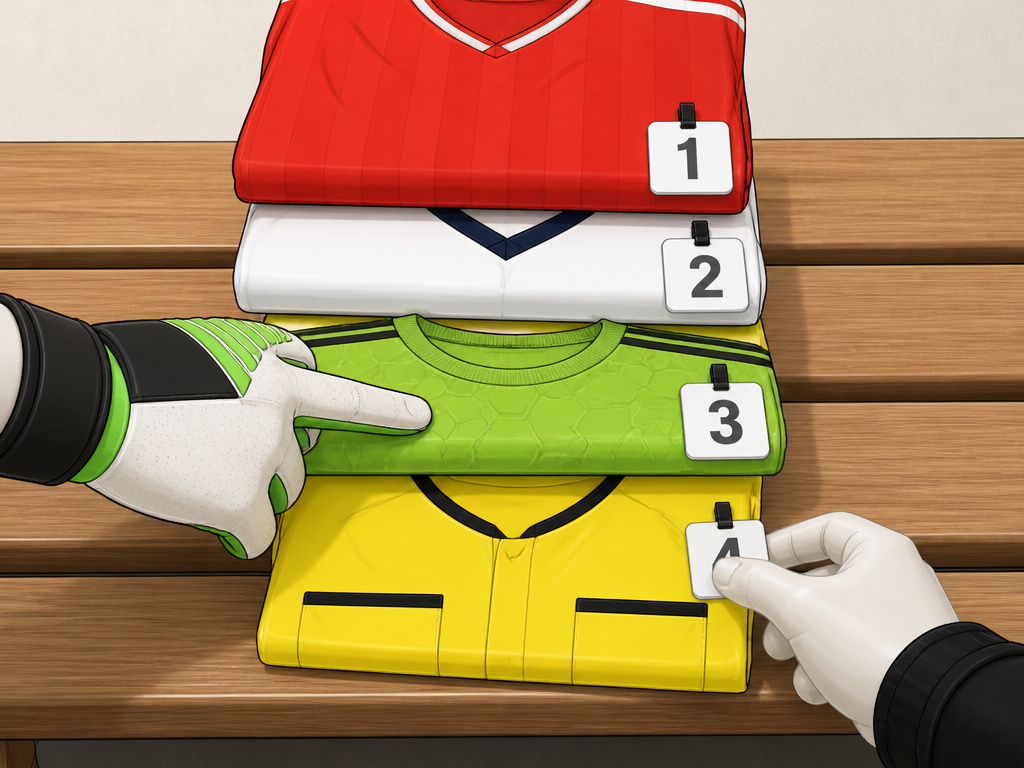
The referee does, under UEFA’s rules. Article 9.05 sets a priority order for avoiding clashes, and the officials sit at the bottom:
- Home outfield kit gets first claim on its colors.
- Away outfield kit comes next.
- Home goalkeeper kit, which has to work around both outfield kits.
- Away goalkeeper kit. It gets its own slot, which is why UEFA keepers can’t count on the IFAB same-color allowance.
- Referee team, last. If nothing contrasts, the others change in reverse order, so the referee team swaps shirts before any player does.
A priority list like that is good joinery. Every piece has its slot cut before matchday, so nobody hammers a solution together in the tunnel.
Rewind a second. In 1992 the Premier League decided its referees would wear green, and keepers whose color was green had to pick an alternative. Home and away strips still took precedence over the referee’s shirt, according to the history site goalkeepersaredifferent.com. But the keeper gave way to the official, which is the opposite of UEFA’s order.
I prefer UEFA’s version. Swapping the referee team’s shirts is a dressing-room job. Forcing clubs to redesign their keeper kits, as the 1992 call did, is a whole-season job.
Whatever the list says, UEFA’s Article 5.03 gives the referee the final decision on what each team’s outfield players and goalkeepers wear. If a team arrives without approved kit, Article 5.04 allows UEFA’s administration to order a neutral or alternative kit that it provides or approves. The full text sits in the UEFA Equipment Regulations.
The Premier League adds a line no other rulebook I found includes. Rule M.22 asks for strips that differ visibly so that viewers “including those with colour vision deficiency” can tell the teams apart. That’s why Newcastle wore their dark blue third kit at Sunderland: red-and-white stripes against black-and-white stripes were judged too similar.
The part nobody mentions: The 2008-09 Premier League rules, in an archived copy, contained no definition of a kit clash at all.
So don’t bother hunting a rulebook for a color chart. The call happens by eye, on the day.
The NFHS Sock Rule and Ohio’s 70% Shading Test
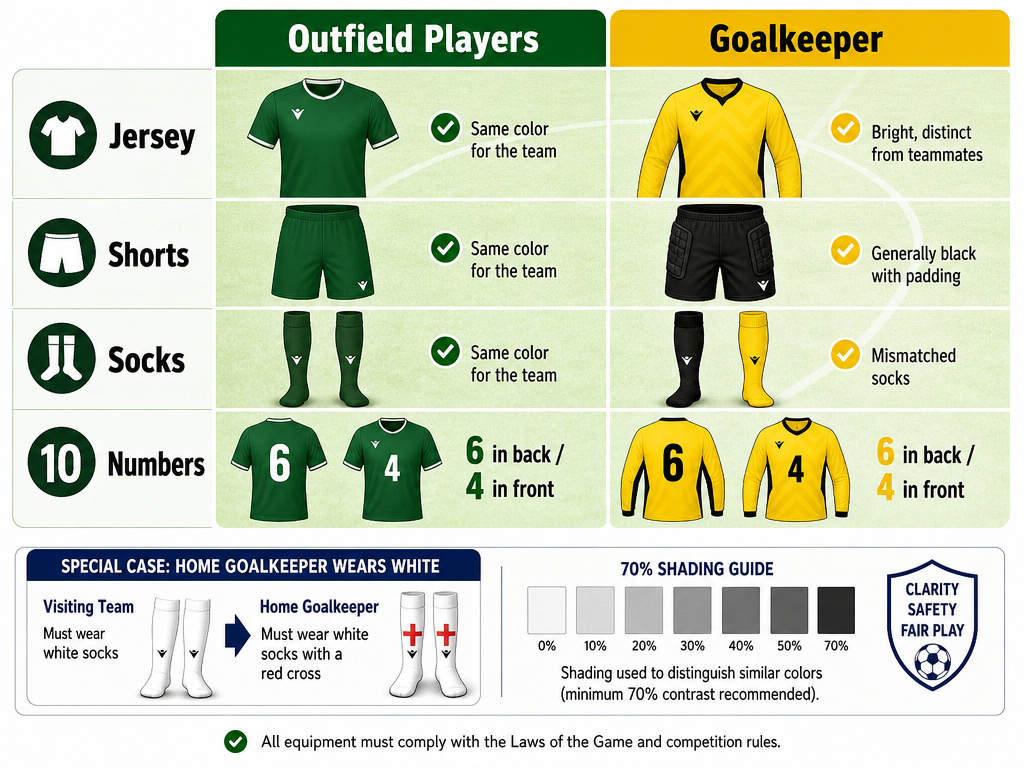
OHSAA wants a back number at least 6 inches high on every jersey, the goalkeeper’s included, plus a front number at least 4 inches high on the jersey or shorts. Both must be a solid contrasting color. That part treats the keeper like everyone else.
The rest of the Ohio rules carve out space. The keeper is exempt from team uniformity, the clause requiring teammates’ jerseys, shorts and socks to share color, design and pattern. The full text is in the OHSAA goalkeeper jersey color regulations.
| Item | Outfield players | Goalkeeper |
|---|---|---|
| Jersey | Similar color, design and pattern to teammates | Distinctly differs from teammates and opposing field players |
| Shorts or pants | Similar to teammates | Need not match; numbering rule still applies |
| Socks | Visitors solid white; home a single dominant color | Need not match; must differ from opposing field players |
| Numbers | 6-inch back, 4-inch front | Same 6-inch and 4-inch minimums |
That shorts clause matters more than it looks. A keeper in goalkeeper padded shorts or full-length pants in a different color from the outfield shorts is legal in Ohio, provided the numbering rule is met.
Now add the home-and-away rule. Visiting teams wear solid white jerseys and socks, and home teams wear dark. A gray or light home jersey has to meet 70% shading of its main color to contrast with white.
Follow that through and the sock clause bites.
Easy to miss: A home keeper in white socks fails the sock clause against any visiting side, because the visitors’ field players are required to wear solid white socks. The jersey can be perfect and the keeper still gets sent to change before kick-off.
US high school soccer sits outside my usual patch, so I’ve stuck closely to the two documents rather than guessing at other states. Other state associations follow the NFHS too, but I haven’t read their versions line by line.
How Keeper Colors Went From Four Options to 1990s Neon
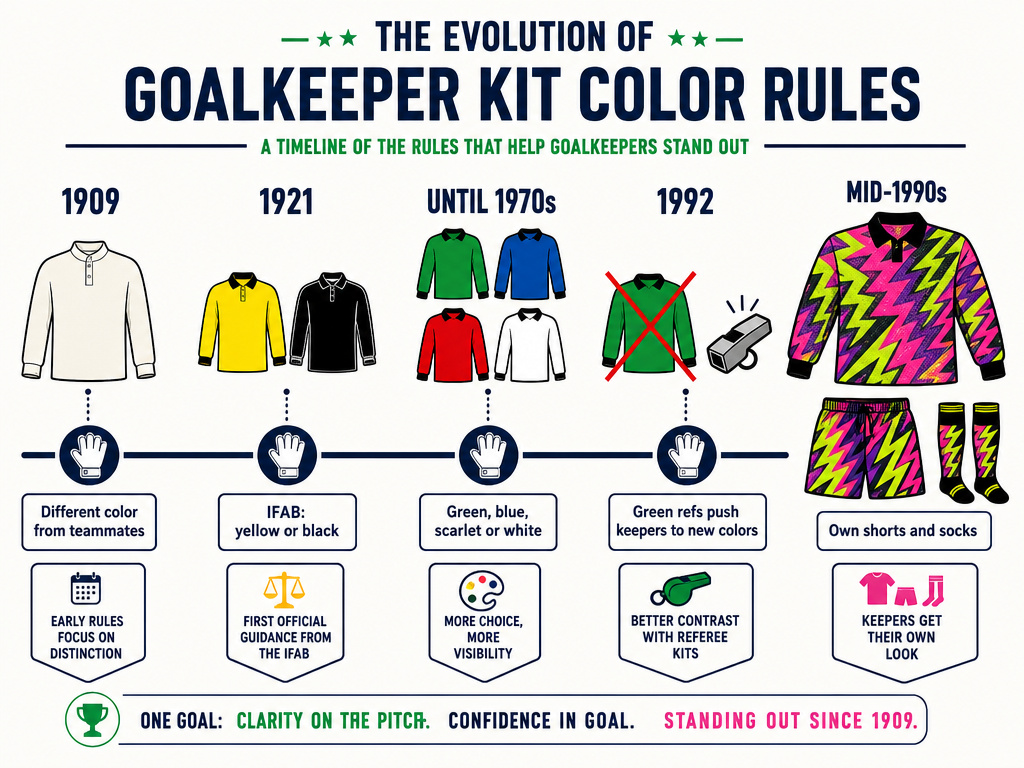
Put a 1990s goalkeeper shirt next to the outfield shirt from the same season. The outfield one looks signed off by a committee. The keeper’s looks like a computer screensaver someone printed onto polyester, all clashing neon and zigzags.
I’ve always thought those shirts tell you more about the era than the outfield kit does. Nobody was supervising the keeper’s wardrobe. It wasn’t always that way:
- 1909: Scottish goalkeepers were told to wear a jersey of a different color from their teammates.
- 1921: IFAB set yellow or black as the goalkeeper color for international matches.
- Until the 1970s: club keepers were limited to green, blue, scarlet and white tops.
- 1992: the Premier League’s green referees pushed green keepers into other colors.
- Until the mid-1990s: keepers wore the same shorts and socks as their teammates.
Color also changed how keepers played, or so the stories go.
The second-choice shirts carry their own clues. For me, the away kit is where a club nods to a local industry or an old crest, while the home shirt plays it safe.
A keeper’s shirt has one job written into law: be seen. Everything else on it is the club having fun inside that one rule.
Four Clashes That Show How the Rules Bend on the Day
How does a referee actually fix a clash minutes before kick-off? With whatever is in the kit bag. These four cases show the gap between the rulebook and the tunnel.
Dundalk v Shelbourne, September 2007
Referee Anthony Buttimer took issue with the colors of the goalkeepers’ jerseys. The fix: the Dundalk keeper wore a t-shirt with a strip of white tape on the back, and the Shelbourne keeper wore a training top.
That sits awkwardly next to IFAB’s same-color allowance, and I can’t tell you the exact clash. The account comes from Wikipedia citing an Irish newspaper, which is thin ground. Still, it shows a referee using the final say rather than waving matching keepers through.
Chelsea v Arsenal, 15 March 2024
This one involved outfield socks, not keepers. The WSL kick-off started 30 minutes late because the teams’ socks matched. Arsenal bought black Chelsea socks and taped over the logos.
The lesson for keepers is plain. A sock clash alone was enough to hold up a WSL game.
Staines Town, December 2020
Goalkeeper Jack Turner wanted to wear an all-pink kit. He was banned because pink wasn’t the club’s official colors.
This case bothers me more than the others. Law 4 only asks for contrast, so the block came from club-color rules, not from the referee’s need to see the keeper.
FIFA Futsal Law 4, September 2020
FIFA’s 2020/21 futsal rules required a goalkeeper’s knee and elbow protectors to match the kit color. Keepers campaigned against the requirement. The retraction was announced on 12 September 2020.
Where this goes sideways: Copying a color rule onto protective gear. FIFA retracted the futsal pad clause in September 2020 after a campaign.
What Should a Grassroots Team Pack for Its Keeper?
The spare keeper shirt matters more than the first-choice one. The first shirt gets planned. The spare is what the referee asks for when something clashes, and grassroots clubs forget it more than anything else in the goalkeeper kit.
Here’s what goes in my bag-check list for any youth or Sunday side:
- A second keeper shirt in a color that appears nowhere in your home or change outfield kits.
- A plain spare top for the outfield player who ends up in goal. The IFAB FAQ says that player has to change into a shirt that stands out from everyone else, and a bib over the team shirt is a gamble with the referee’s patience.
- Tape in the sock color.
- Keeper socks that differ from the opposing field players, if you play under NFHS-style rules.
Common mistake: Packing one keeper shirt and trusting the IFAB same-color clause. That allowance covers two matching keepers with no spares. A keeper who clashes with the outfield players still has to change before kick-off, and everyone waits while it happens.
Look after that spare, too. I wash every shirt cold and inside out, with no fabric softener. Softener clogs the moisture-wicking finish; one of mine was holding sweat like a wet sponge by about the third wash.
And never tumble dry. I turned a replica sponsor logo into a wavy mess in a single cycle (my Sunday league mates have never let me forget it).
If you want one answer for a youth or Sunday side, here it is. Carry two keeper shirts in colors absent from both your outfield kits, plus one plain spare top for the emergency keeper. That covers nearly every clash a grassroots referee will raise.
Frequently Asked Questions
Can both goalkeepers wear the same color?
Under IFAB Law 4, yes, as long as neither keeper has another shirt. The referee allows the match to start. UEFA competitions are stricter in practice, because each team must bring at least two contrasting goalkeeper kits.
Do goalkeeper socks have to be a different color?
In US high school soccer, yes. Since 2015-16 the NFHS rule says the keeper’s socks must differ in color from the opposing field players. IFAB has no separate keeper sock clause, only a rule that sock tape matches the sock.
What happens if an outfield player has to go in goal?
The IFAB FAQ says the player changes into a shirt that clearly separates them from the other players and the match officials. This comes up when the keeper is injured and the team has no substitutions left. A plain spare top in the kit bag solves it.
Does the goalkeeper have to wear number 1?
UEFA’s regulations reserve number 1 for goalkeepers and ban any number above 99. Outfield players are the ones barred from wearing 1. A keeper is free to take a different number.
Can a goalkeeper wear any bright color for charity?
Law 4 only demands contrast, but clubs and leagues add their own color rules. Staines Town keeper Jack Turner was stopped from wearing all pink in December 2020 because it wasn’t the club’s official colors.
Before You Go
Here’s one job for this week. Lay your keeper’s shirt and socks next to your home kit, your change kit and the referee colors your league uses. If any two look alike under a gray winter sky, buy the second keeper shirt now, not on matchday.
One honest limit on all this: goalkeeper kit color rules in football change with the competition. Ohio’s sock and shading clauses, UEFA’s referee-last list and the Premier League’s color-vision wording all sit on top of IFAB’s short line. Your league’s handbook beats anything here.
And remember the 1992 green referees. A rule that feels permanent today was written by someone who thought a different order made sense.
So here’s one to argue over at the bar: should IFAB still let two keepers play in the same color?
