
Goalkeeper Padded Shorts Pros and Cons: How to Choose
This post contains affiliate links. As an Amazon Associate, we earn from qualifying purchases.
Goalkeeper padded shorts are compression base layers with foam or EVA padding over the hips and thighs. The pros are increased comfort on hard surfaces and reduced abrasion from artificial turf. The cons are added heat, potential bulk that can restrict movement, and a peer-reviewed study finding they did not reduce injury risk compared to wearing no padding. (Note: Sources disagree on injury risk reduction; the study found no difference, while other sources highlight comfort and abrasion resistance.) The gear is legal under IFAB Law 4 if the padding is soft and the colour matches your team shorts.
Right, here is the thing. That study changes the entire conversation. We are not talking about a guarantee against a broken hip. We are talking about managing soreness and skin irritation so you can train again tomorrow. This guide walks through the lab data, the real-world trade-offs keepers make, including a look at goalkeeper padded shorts pros and cons, and the specifics that separate a useful pair from a sweaty, shifting burden.
What follows: the exact injury-prevention data most brands do not cite, a breakdown of padding materials and thickness from 7mm to 16mm, and the situations where this gear genuinely earns its place in your bag.
Key Takeaways
- A peer-reviewed study (Schmitt et al.) found no difference in injury risk between keepers who wore padded shorts and those who did not, but noted shorts with visco-elastic foam performed best in impact tests.
- Use the thinnest comfortable padding that stays centred over your hip’s landing point; thicker foam often just adds heat and bulk without better protection.
- Replace shorts when the foam stays flattened, cracks, separates from the fabric, or loses its shape, compromised padding does nothing.
- These shorts are most useful for high-volume training on firm ground or abrasive turf; on soft grass or hot days, the cons often outweigh the pros.
- Cleaning instructions vary: brands like Reusch explicitly state ‘Do not machine wash’, while a user review of Slazenger ROBO pants notes the official method is hand-washing but admits many keepers machine wash anyway.
The Core Trade-Off: Protection vs. Everything Else
Padded shorts do not make you invincible. They manage impact and friction. The protection they offer is a direct trade with mobility, temperature, and sometimes even durability. Think of them like seasoning, a little in the right place improves the dish, but too much ruins it.
The primary job is to sit between your hip bone and the ground. On synthetic turf, that means less of the infamous “turf burn” rash. On hard, dry grass, it turns a sharp smack into a dull thud. The padding absorbs and spreads the force you would otherwise feel directly on the greater trochanter, that bony knob on the side of your hip, which is a key part of the goalkeeper padded shorts pros and cons discussion.
Where this goes sideways: Padding that rotates away from the landing point. If the shorts shift during your dive or recovery step, the pad ends up over your thigh or buttock when your hip hits the turf. You get all the bulk and heat with none of the benefit. A proper compression fit is non-negotiable.
The trade-off is real. Every square inch of closed-cell foam or EVA traps body heat. In a ninety-minute match on a hot day, that extra layer can feel like a sauna strapped to your legs. Bulk is the other side. A poorly designed short with stiff, thick panels can limit your full range of motion, making a quick recovery step or a powerful kick feel slightly restricted.
Do Padded Shorts Actually Prevent Injury? The Study Says…
We should go back a moment. Everyone assumes more padding equals less chance of injury. The marketing implies it. The logic feels sound. But a 2022 study published in a sports medicine journal tested that assumption with artificial hip models and surveys of professional and amateur keepers.
The researchers, Schmitt et al., impact-tested commercially available goalkeeper shorts and found only those made of visco-elastic foam fulfilled the basic requirements requested for hip protectors for the elderly. Here is what they found.
The padded shorts generally reduce impact forces, but mostly perform poorly. Only goalkeeper shorts made of visco-elastic foam fulfilled the basic requirements requested for hip protectors for the elderly. No difference of the injury risk was found between goalkeepers wearing padded shorts and those who did not.
That last line is the atomic fact most product pages will not show you. In the survey data, the injury risk was statistically the same for keepers who wore them and those who did not. The study also noted that amateurs have a significantly higher risk of injury than professional players, and the injury risk during training is significantly higher compared with the injury risk during a match.
So what does this mean for you? It means you should buy these for comfort and abrasion resistance, not as an insurance policy against serious hip injury. They are comfort and impact-management equipment, not a guarantee, a central point in the goalkeeper padded shorts pros and cons. The study supports using them to reduce the day-to-day soreness that comes from repetitive diving, especially on unforgiving surfaces.
Padding Thickness: Does 16mm Beat 7mm?
You will see padding thickness advertised as a key spec. One Keeper USA markets shorts with 16mm foam. Elite BaDS promotes 7mm high density padding. J4K Sports and others offer padded shorts, but the fact sheet does not specify their padding material or thickness. The instinct is to grab the thickest option, assuming it must be best.
It is not that simple. Thickness alone is a poor indicator of performance. The study (Schmitt et al.) identified the material, visco-elastic foam, as the critical factor, not how tall the pad is. This foam both absorbs and dissipates energy effectively.
| Brand & Model | Advertised Padding | Material Noted | Consideration |
|---|---|---|---|
| One Keeper USA Padded Shorts | 16mm | Foam | Maximum cushion, but likely hotter and less flexible. |
| Elite BaDS Compression Shorts | 7mm | High-Density Padding | Lower profile, may balance protection and mobility. |
| One Keeper USA Padded Leggings | 6mm | EVA | Full-leg coverage with thinner, more flexible padding. |
| Reusch Padded Eco Short 3/4 | Not Specified | Hip and knee protection | Includes knee protection, made from 100% recycled polyester. |
GoalkeeperGuide advises to use the thinnest comfortable construction that remains centred, but sources disagree on ideal padding thickness, with brands advertising padding from 7mm to 16mm. A 16mm pad might feel plush in the shop, but if it makes the short bulky and prone to shifting, or turns your legs into ovens, it has failed. Test the garment in a squat, a lateral lunge, and a simulated dive. The pad should stay put.
When to Wear Them (And When to Skip Them)
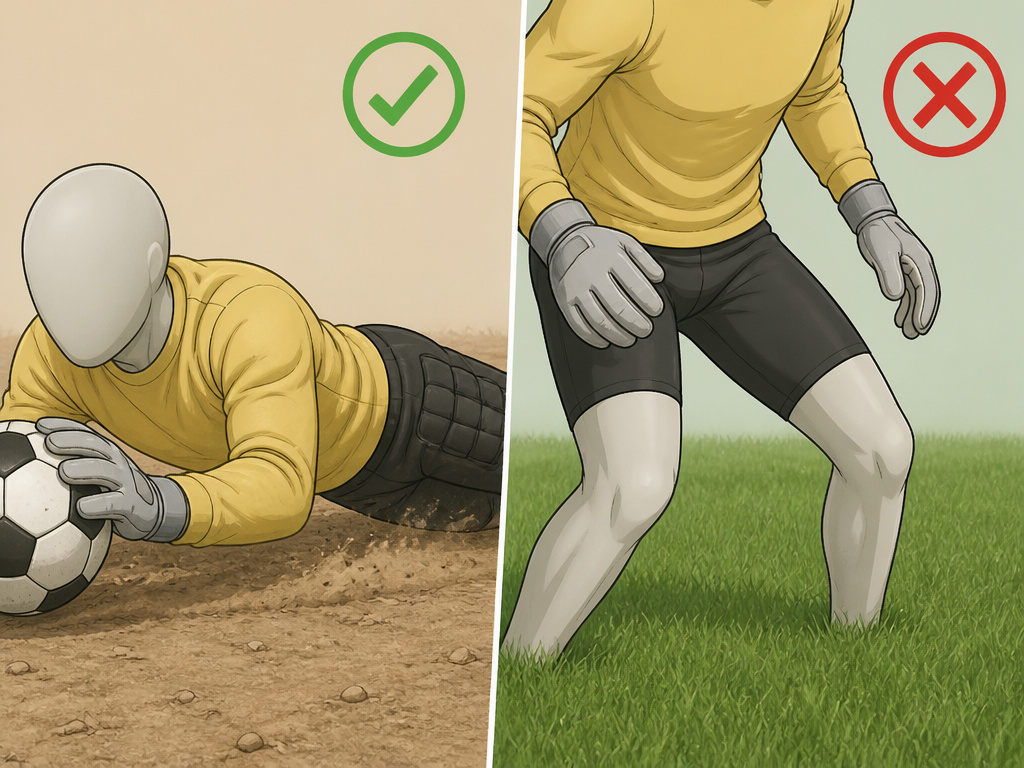
The utility of padded shorts is almost entirely situation-dependent. They are a tool for specific conditions, not mandatory kit for every session.
Wear them when:
- You are doing high-volume diving practice. High-volume diving practice on a hard surface can leave you bruised without padding.
- The ground is firm and dry or you are playing on abrasive artificial turf (3G, 4G). This is their primary use case.
- You have lingering tenderness or bruising from a previous session and need to train through it comfortably (not through sharp pain).
Skip them when:
- You are training on soft, lush grass. The natural give of the surface does most of the cushioning work.
- It is a very hot day. The added insulation can lead to overheating and faster fatigue.
- You are in a low-volume technical session with minimal diving. They are just extra laundry.
Common mistake: Assuming they are needed for match day. Many keepers prefer the unrestricted feel and cooler temperature of standard compression shorts or leggings for actual games, saving the padded pair for the harder, repetitive training sessions.
A good practice is to test the garment wet as well as dry. Sweat and rain change the fabric’s weight and how it grips your skin or base layer. What feels secure when dry might slide when soaked.
Fit, Care, and Knowing When to Retire Them
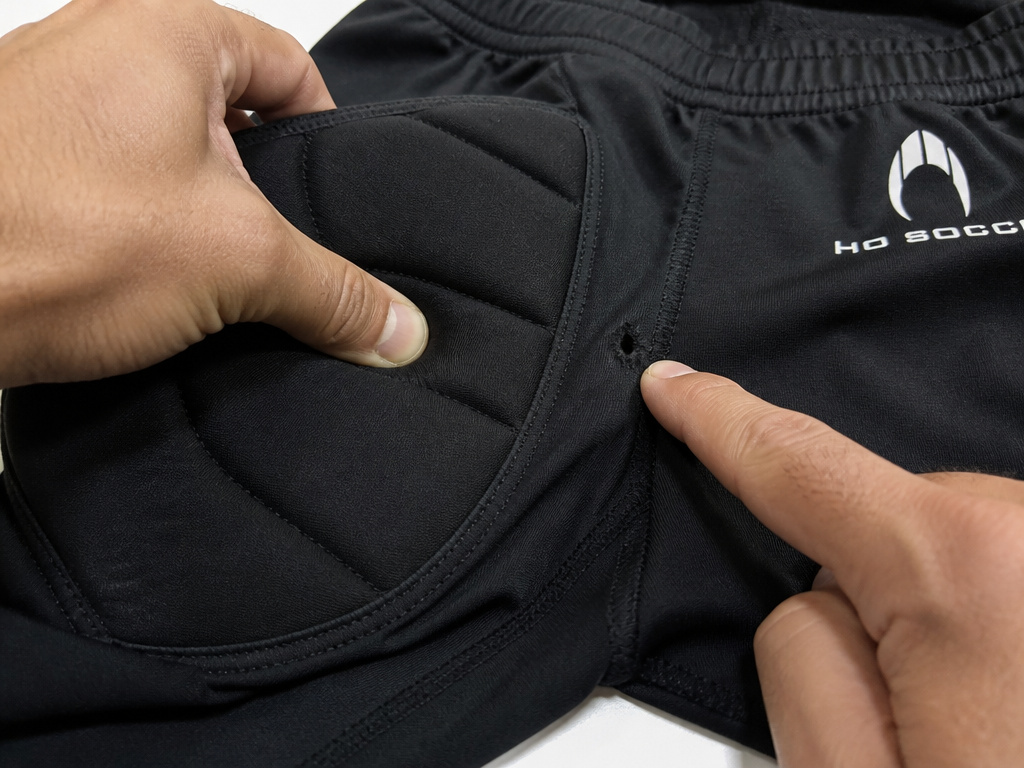
Fit is everything. If the shorts are not compression-tight, the pads will migrate. Look for numbness, tingling, deep pressure marks, or a waistband that rolls. These all indicate the wrong size or cut. The pad must remain over your hip’s real landing point through every phase of movement, squat, dive, roll, and stand.
Cleaning is a noted point of conflict between manufacturers and users.
- Reusch explicitly states for its Compression Short 3/4: ‘Do not machine wash.’
- A user review of Slazenger ROBO pants notes the official method is to remove padding and hand-wash the shell, but admits, “Or just put it in the machine with the pants as I always do.”
Machine washing can accelerate foam degradation, which is why some manufacturers advise against it.
Speaking of longevity, the gear does not last forever.
Replace the shorts when the foam:
- Remains flattened after use and no longer returns to its original shape.
- Shows visible cracks or starts to separate from the lycra shell.
- The fabric at the hips shows significant wear or holes from sliding.
A Slazenger ROBO reviewer noted the outside Lycra showed “signs of a hole forming due to sliding.”
How They Compare to Other Goalkeeper Protection
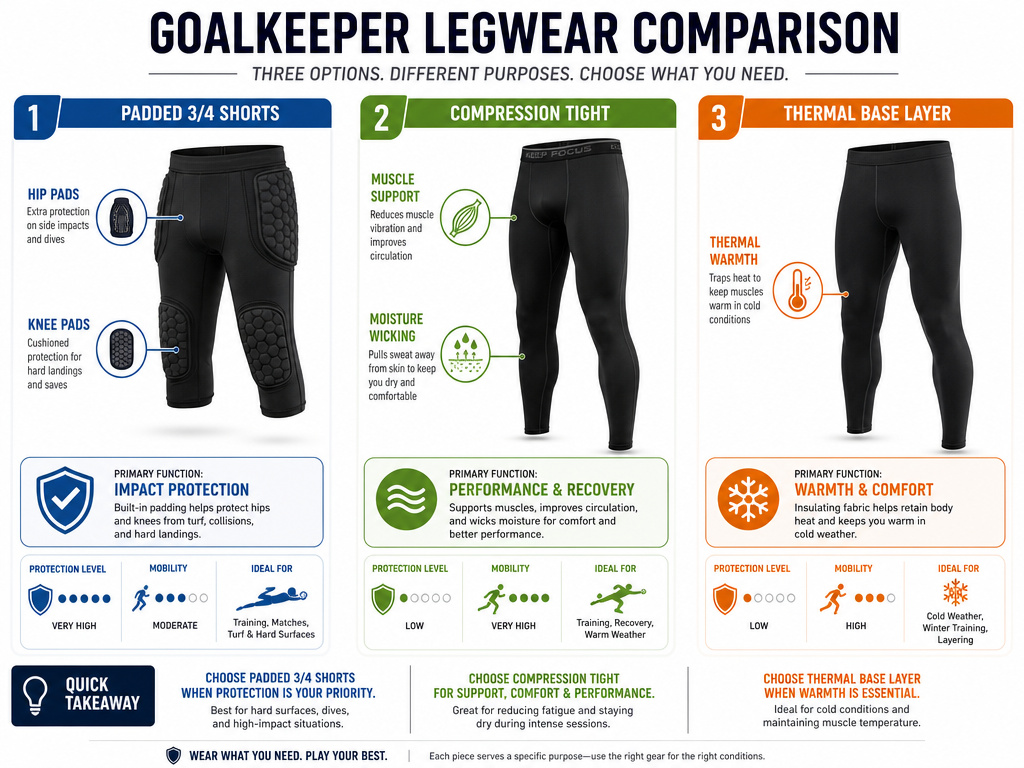
Padded shorts are one node in a protection ecosystem. You need to know where they fit.
Vs. Padded Pants/Leggings: Shorts like the Reusch Padded Eco Short 3/4 include hip and knee protection. It is also much warmer.
Vs. Compression Gear: Standard compression gear offers muscle support and moisture wicking with zero impact protection. It is for recovery and temperature management, not for cushioning dives.
Vs. Base Layers: A base layer is for warmth and moisture control. Some base layers have light padding, but they are not designed for the repeated high-impact of goalkeeping.
Your choice should be the lightest, least intrusive option that solves the specific problem you have. If only your hips are getting bruised, shorts are perfect. If your knees and hips are both battered, look at 3/4 pants.
What are the best goalkeeper padded shorts brands?
Specific brands offer different features. Some models advertise specific padding thicknesses, such as 7mm for Elite BaDS shorts or 16mm for One Keeper USA shorts. Some products, like the Reusch Padded Eco Short 3/4, are constructed from recycled polyester and include hip and knee protection. A key design trade-off exists between ventilation and hip protection, with some designs using an open crotch to reduce heat at the expense of less side padding. For junior goalkeepers training several times each week, shorts like the J4K Skin Shield are marketed as particularly useful. Always check the manufacturer’s cleaning instructions, as some explicitly forbid machine washing, while others may allow it unofficially. The pad must stay over your landing point during dives to be effective.
Are goalkeeper padded shorts worth the money?
Their value depends entirely on your situation. A peer-reviewed study found no difference in injury risk between keepers who wear them and those who do not, so they are not a safety guarantee against injury. Their real worth is as comfort equipment for managing impact and friction. They are most useful during high-volume diving practice, on firm dry ground, or when artificial turf irritates the hip. On soft grass, during low-volume sessions, or on very hot days, lighter protection may be preferable. Consider durability; replace shorts when the foam flattens, cracks, separates, or loses its shape.
Frequently Asked Questions
What are the disadvantages of wearing padded shorts?
The main disadvantages are heat retention and potential bulk. The foam insulation can make you overheat in warm conditions. Poorly designed shorts can also restrict your full range of motion, making explosive movements feel slightly hindered. They also represent an extra cost and an extra item to maintain and wash.
Do professional goalkeepers wear padding?
Some do, some do not. It is a matter of personal preference and match conditions. Many pros use padded shorts extensively during training on artificial turf to manage wear and tear. On match day, especially on natural grass, they often opt for standard compression shorts for a less restricted feel. There is no universal rule.
What are the best padded shorts for goalkeepers?
There is no single “best” pair, as fit is personal. However, models that use visco-elastic foam (as identified in the 2022 study) are likely more effective at energy absorption. Brands like Reusch, Storelli, and One Keeper USA are reputable. The best pair for you is the one that fits perfectly, keeps its pads in place, and is appropriate for your usual training surface.
Are goalkeeper padded shorts legal?
Yes. IFAB Law 4 permits “non-dangerous protective equipment” made from “soft, lightweight padded material.” If the padded undershorts are visible beneath your match shorts, they must be the same colour as the main shorts, and all teammates with visible undershorts must wear the same colour.
How should I wash my padded shorts?
Follow the manufacturer’s label to avoid voiding any warranty. Reusch, for example, explicitly advises against machine washing. The safest method is to hand-wash in cool water with a mild detergent and air dry flat. Many keepers machine wash on gentle anyway, but this will likely accelerate the breakdown of the foam and adhesives.
Before You Go
Treat goalkeeper padded shorts like a specialized training aid, not essential match kit. The evidence shows they are better at managing comfort and abrasion than preventing clinical injury. Your first investment should always be in technique, learning to roll and distribute impact.
If you do buy a pair, prioritise fit over advertised thickness. A 7mm pad that stays glued to your hip is worth ten times a 16mm pad that slides to your thigh. And just like your gloves or your shin guards, inspect them regularly. Flattened, cracked foam is just dead weight.
For most amateur keepers training once or twice a week on grass, you can probably skip them. For the juniors putting in high-volume sessions on abrasive turf, they can make a major difference for confidence and skin integrity. Know what you are buying, and why.
