
Back Pass Rule in Football Explained
This post contains affiliate links. As an Amazon Associate, we earn from qualifying purchases.
Here’s the back pass rule in football explained: a goalkeeper can’t handle the ball inside their own penalty area after a team-mate deliberately kicks it to them, or straight from a team-mate’s throw-in. Break it and the opponents get an indirect free kick. Headers, chest and knee passes stay legal unless they’re a trick.
That word “deliberately” carries most of the weight. A defender who slices a clearance and sends it looping toward their own keeper hasn’t committed anything, and the keeper can gather it like any loose ball. The referee decides what counts as deliberate, and that’s where most touchline arguments start.
What follows: the three checks a referee runs, the dull World Cup that started it all, the Verratti booking that still splits opinion, and the eight-second count that grew out of the same war on time-wasting.
Key Takeaways
- The name misleads you. The ball doesn’t have to go backwards, and it doesn’t even have to be aimed at the keeper.
- A keeper who clearly tries to kick it first and fluffs the attempt is then allowed to pick it up.
- A flick-up-and-header trick earns a booking plus an indirect free kick, whether or not the keeper ever touches the ball, according to the referee who booked Marco Verratti in 2017.
- Sources split on who gets cautioned for a trick: the current IFAB text names the keeper if they started it, while the FA wording quoted in 2017 targets the player who carried it out.
- The related holding limit is now eight seconds, and breaking it hands the opponents a corner kick.
The Back Pass Rule in Football Explained: Three Checks, in Order
Law 12 holds the whole rule, and it’s shorter than you’d expect. IFAB’s current Law 12 text lists it among the indirect free kick offences a goalkeeper commits inside their own penalty area.
The back-pass restriction sits in Law 12 of the IFAB Laws of the Game. A goalkeeper commits an indirect free kick offence by handling the ball in the penalty area after a team-mate deliberately kicks it to the goalkeeper, or straight from a team-mate’s throw-in. A clear attempt to kick the ball into play cancels the offence.
It’s one clause buried among all 17 Laws of the Game, yet it reshaped how every team defends. Referees run three checks, in this order. Ask A Soccer Referee, a long-running US referee Q&A column, sets them out cleanly, and the Wikipedia summary of the law uses the same three:
- A team-mate kicks it with the foot. Knee, thigh and shin don’t count as a kick. Skip this check and you’ll punish a knee deflection that the law treats as perfectly fair.
- The kick is deliberate. A deflection or a miskick isn’t an offence. Get this one wrong and you’ve handed the opponents a free kick in front of goal for a defender’s bad touch.
- The keeper handles it directly. No touch in between. If an opponent gets a toe on it first, the keeper’s free to pick it up.
Only when all three line up is there an offence.
I think the nickname has done more damage than any referee ever has. The ball doesn’t need to be “passed,” doesn’t need to travel “back,” and the team-mate’s play doesn’t need to be “to” the keeper. A defender who deliberately plays it square, only for it to roll into the keeper’s arms, has still met the conditions in the referee’s eyes.
What Can a Defender Legally Play Back to the Keeper?
Anything played with a body part other than the foot. Wikipedia’s summary of the law lists the head, chest, shin and knee as legal, because the Laws define a kick as using the foot. Simple enough.
| Situation | Keeper can handle it? | Restart if not |
|---|---|---|
| Header back from a defender | Yes | Play on |
| Chest or knee pass back | Yes | Play on |
| Deliberate pass with the foot | No | Indirect free kick |
| Throw-in straight to the keeper | No | Indirect free kick |
| Miskick or deflection off a foot | Yes | Play on |
| Flick-up then header back | Irrelevant, it’s a trick | Booking plus indirect free kick |
These limits sit on top of the wider goalkeeper handling rules that already confine a keeper’s hands to their own penalty area. Step outside it and the keeper falls under the ordinary handball rule like every outfield player.
Where a Fluffed Clearance Changes Everything
On a wet pitch a back-pass skids and picks up pace off the surface. The keeper who planned a calm first touch ends up stabbing at it. Here’s the useful part: Law 12 says there’s no offence if the goalkeeper has clearly kicked or tried to kick the ball to release it into play. So a keeper who swings, misses, and then dives on it is legal. The word “clearly” matters, though. A half-hearted toe-poke won’t satisfy a referee who suspects play-acting.
Leaving the Box and Coming Back
A keeper is allowed to leave the penalty area, collect the ball, dribble it back in and pick it up. According to Ask A Soccer Referee, that only works if the ball was last played by an opponent in any manner, or legally by a team-mate. Dribbling a deliberate back-pass out and back in doesn’t wash it clean.
Restarts That Catch Teams Out
A few situations sit at the edges of the law:
- Free kicks count. A deliberate pass with the foot from a free kick is still a deliberate kick.
- Throw-ins straight to the keeper have been covered since 1997.
- Dropped balls changed in 2019-20. The ESPN report on IFAB law changes explains that a dropped ball inside the penalty area now goes to the goalkeeper’s feet, and outside it goes to the team that last touched the ball.
- Opponent’s touch in between? Fair game.
Easy to miss: A keeper who scoops up a deliberate back-pass from a team-mate’s quick free kick commits the same offence as from open play. The referee awards the indirect free kick on the spot, and the defending team has seconds to organise a wall on its own goal line.
1990 to 1992: How 2.2 Goals a Game Forced FIFA’s Hand
Two point two. That’s how many goals per game the 1990 World Cup averaged, an all-time World Cup low according to Sky Sports. The Wikipedia entry on the back-pass rule says that tournament was widely criticised as dull, rife with back-passing and keepers holding the ball to waste time.
The idea came from France. Daniel Jeandupeux, then manager of Caen, wrote to FIFA’s technical committee in December 1990 proposing the rule. I love that detail.
| When | What happened | Source |
|---|---|---|
| 1990 World Cup | 2.2 goals per game, a record low | Sky Sports |
| December 1990 | Jeandupeux writes to FIFA | Wikipedia |
| 1991 | Rule trialled at U17 World Championship | Wikipedia |
| May 1992 | IFAB and FIFA formally adopt it | Wikipedia |
| 1997 | Throw-ins to the keeper added | Wikipedia |
| 2025/26 | Holding limit set at eight seconds | IFAB |
Euro 1992 was the last tournament played under the old freedom, and Sky Sports says time-wasting back-passes played a large part in Denmark winning it. Honestly, I can’t think of a better farewell for a loophole. The champions of Europe used it to run down the clock, weeks before it vanished.
One date stays fuzzy. Wikipedia gives May 1992 as the formal adoption by IFAB and FIFA. Another source in my research says the rule became binding law on 1 July 1992, and I couldn’t confirm that against IFAB’s own records. So I’d treat May as the adoption date and leave the exact day it went live as unconfirmed.
The Ball Boy, the Red Card and a Story I Checked Twice
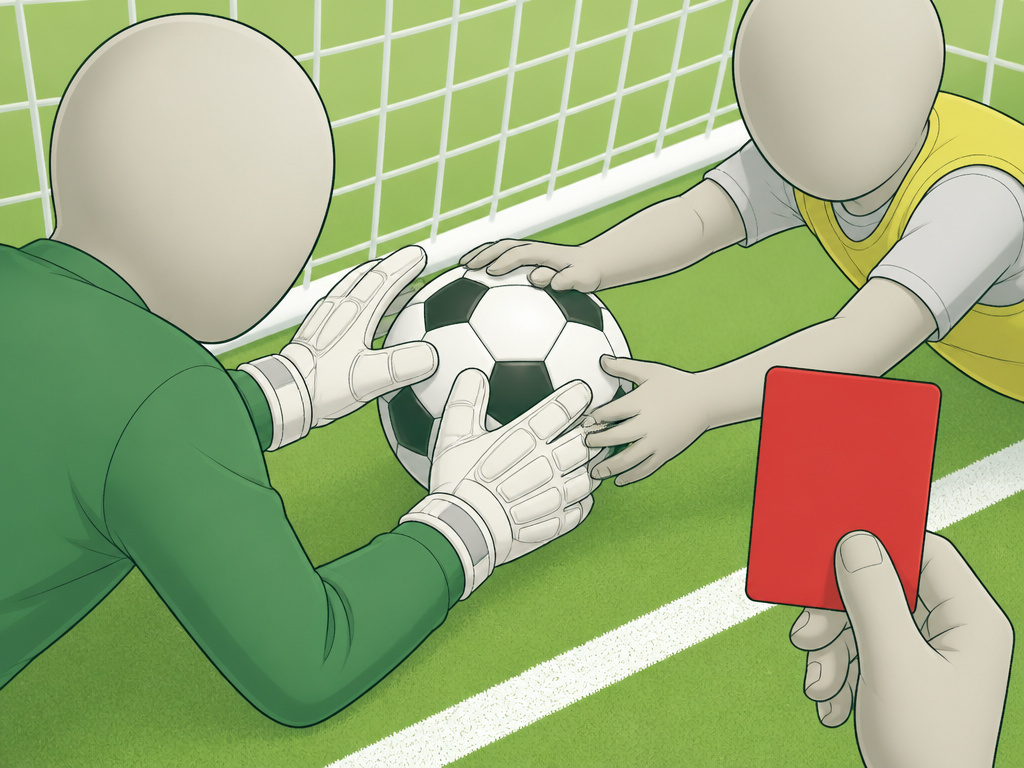
Less than a month into the Premier League’s first season, at White Hart Lane, a ball was rolled back to Sheffield United keeper Simon Tracey. What happened next sounds invented. He mishandled it, wrestled the ball from a ball boy, and pulled down Tottenham’s Steve Sedgley. Red card.
That’s exactly the kind of tale I don’t trust on first hearing. I made myself a rule years ago: if a football story has a punchline this neat, check it twice. It came after I passed on a too-perfect anecdote that turned out to be embellished, and I still cringe about it.
So I checked. The Sky Sports back-pass rule retrospective tells it straight, ball boy and all. Every detail checks out.
The comedy hides a serious point. Keepers had spent whole careers collecting back-passes into their arms, and overnight the job demanded a first touch under pressure. Sky’s piece puts it bluntly: goalkeepers just couldn’t cope at first.
I treat the early-chaos stories as coaching evidence. They show what happens when a law demands a skill nobody trained for: the first season exposes it in public, and the second season fixes it.
The rule didn’t stay comic, either. Wikipedia records that Bayern Munich scored from a back-pass indirect free kick late against Hamburg, and that goal was decisive in Bayern winning the 2000-01 Bundesliga. A title, settled by one foot in the wrong place.
Why Did Verratti Get Booked for a Header?
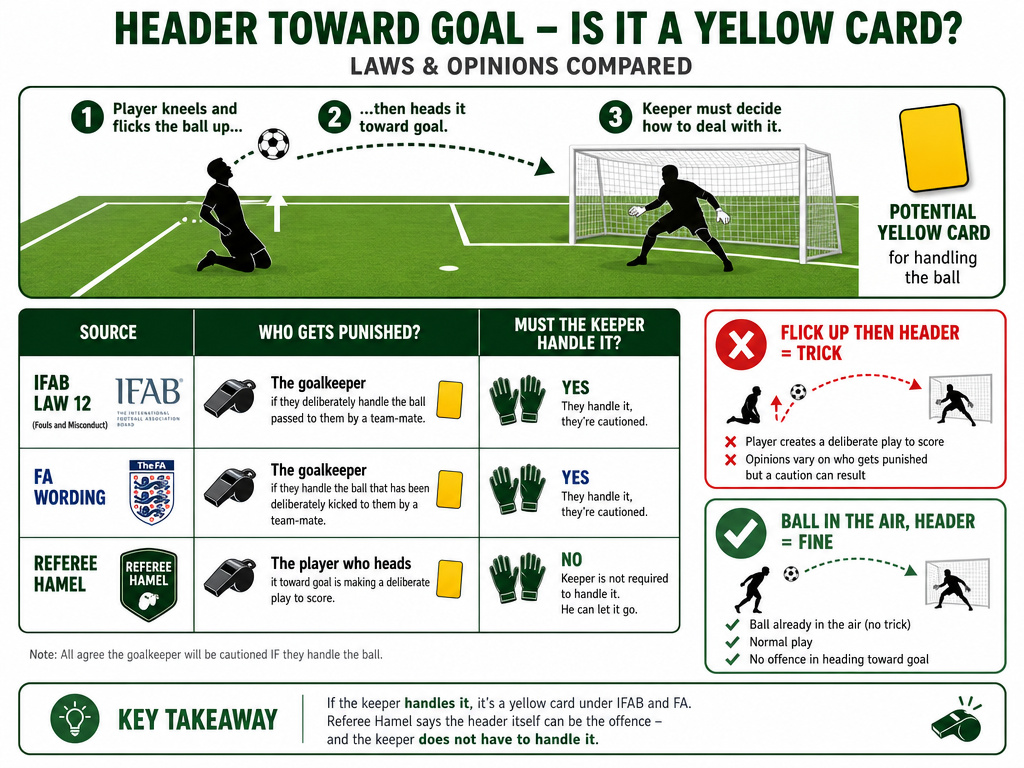
Marco Verratti broke no handling law at all, and he still went into the book. On 21 January 2017, in PSG’s league game against Nantes, he dropped to his knees on the edge of the area and headed the ball to keeper Kevin Trapp. According to the AP report carried by SI, no opponent was within 20 metres of him.
Referee Johan Hamel booked him on the spot. Afterwards Hamel went on Canal Plus to explain: “The player deliberately bypassed the laws of the game. This is trickery whether the goalkeeper collects the ball or not.”
He’s right on the law. Sky Sports quotes FIFA’s position that “no trickery may be used to get around the terms of the amendment to Law 12.” Wikipedia lists the classic tricks referees watch for:
- Flicking the ball up with the foot, then heading it back to the keeper.
- Heading a ball on the ground that would otherwise be playable with the foot. That’s the Verratti move, more or less, with added kneeling.
- Using the head, chest or knee from a free kick to get around the law, which the FA’s own wording names.
Where the sources split is on who pays. Here’s how each one puts it:
| Source | Who gets punished | Must the keeper handle it? |
|---|---|---|
| IFAB Law 12 (current) | Keeper too, if they started the trick | Separate caution applies |
| FA wording (Goal, 2017) | Player who uses the trick | No |
| Referee Hamel (SI, 2017) | The outfield player: IFK and booking | No |
The common fan belief is that the offence is the keeper’s handling. For a plain deliberate kick, that’s true. For a trick, Hamel and the FA wording both punish the setup itself. My read? The current IFAB text adds the keeper to the list when they’re the one who initiated it, rather than replacing the outfield player.
If the ball had to be lifted, knelt over or set up to avoid a foot, the header is a trick. If it arrived in the air and a header was the obvious play, it’s fine.
Where this goes sideways: Teaching young defenders to flick the ball up and nod it back to the keeper as a “clever” escape. Referees book it as unsporting behaviour, and the team concedes an indirect free kick inside its own box in the same moment.
Skip that drill entirely. Teach kids to take a back-pass on their instep instead, because that skill lasts a career.
The Indirect Free Kick Inside the Six-Yard Box
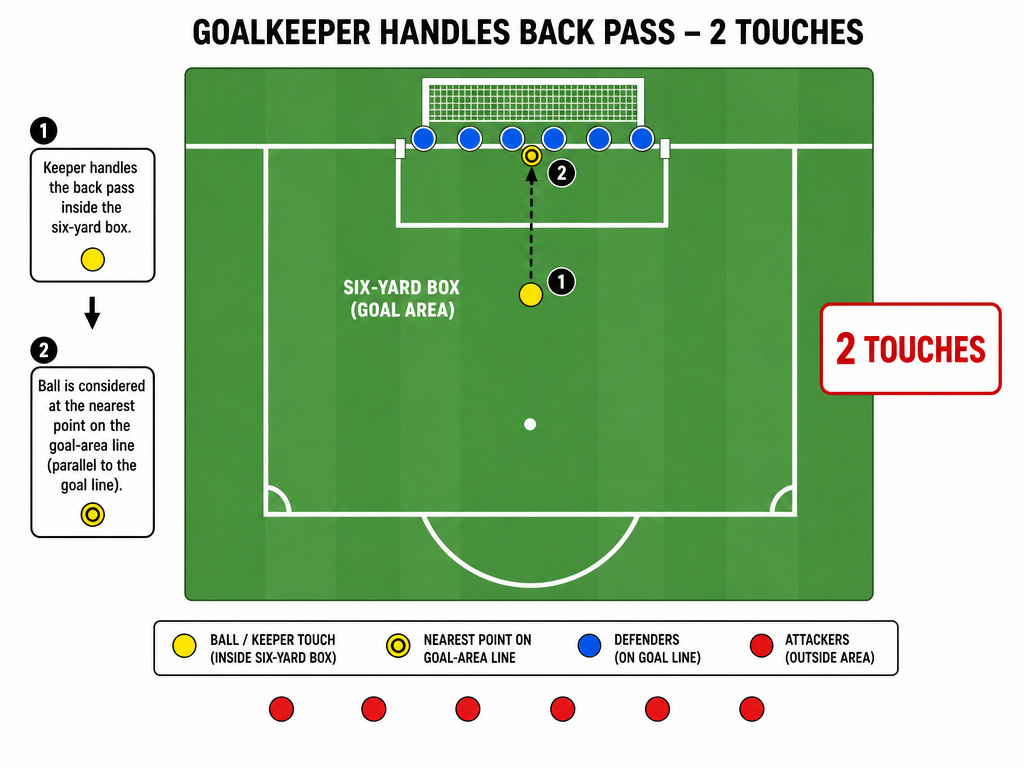
It’s the strangest set piece in the game. An indirect free kick is taken from where the keeper handled the ball. If that spot sits inside the goal area, IFAB’s Law 12 moves it to the nearest point on the goal-area line that runs parallel to the goal line.
The result looks like a playground scramble. Defenders pack shoulder to shoulder on the goal line between the posts, and the attackers need a second touch before anyone can shoot. Wild.
I’ve never seen solid numbers on how often these get scored. I’m wary of anyone who quotes one. Data isn’t my strong suit anyway; I watch with a notebook, and a tracking model would probably spot patterns I miss.
The Eight-Second Count: The Back-Pass Rule’s Younger Sibling
Eight seconds. Since the 2025/26 change, that’s how long a keeper may control the ball in their hands before the referee gives the opponents a corner kick. The old six-second rule carried an indirect free kick as its sanction. Same enemy as 1992: time-wasting.
IFAB’s change document defines “control” in four situations. The keeper controls the ball when it’s:
- between their hands or arms;
- between hand or arm and any surface, such as the ground or their own body;
- held in an outstretched open hand;
- bounced on the ground or thrown in the air, which shuts the old loophole of dribbling with the hands.
Watch the referee during the count. Under IFAB’s Law 12 they count down the last five seconds with a raised hand. Under the US high school code (NFHS Rule 12-3-3, per a Texas referee association interpretation), the last five seconds are counted visually and verbally with the arm fully extended above the head. The first three seconds tick silently.
The part nobody mentions: Bouncing the ball doesn’t stop or reset the count. Bouncing the ball doesn’t stop or reset the count, and the corner is taken from the side closest to where the keeper was penalised.
The trial evidence surprised me. IFAB says it cut the trial short because there were only five offences in over 400 matches. In its survey of coaches, keepers and referees, 63.7% said the change had a positive impact, 72.5% said the game was faster, and 87.6% found the referee’s five-second countdown helpful. No shock there.
NFHS adds one wrinkle. If an attacker slows the keeper’s release, the referee is allowed to pause the count or award an indirect free kick. I think the handling limits do more to kill time-wasting than any rule fans actually argue about. Keepers creeping off the line at penalties gets endless airtime, and it affects a handful of matches a season.
How the Back-Pass Rule Turned Keepers into Playmakers
The rule’s biggest effect sits far from the six-yard box. Wikipedia calls it one of the most popular and successful rule changes and notes it pushed goalkeepers to improve their foot skills. I’d go further. It’s still underrated tactically.
Look at what it did to the back line. Before 1992, a pressed centre-back had a free reset button: roll it to the keeper, who picks it up. After 1992, the keeper became an extra passer who had to be found with the right weight, at the right angle. The whole defensive unit had to move together to offer angles.
I’d rank the back-pass rule above almost every law change since. It turned the goalkeeper into the first passer in the team, and every build-up pattern you admire today starts there.
Good build-up play works like joinery. A dovetail holds because of how each piece meets the next, and a back four plus keeper passing out under pressure holds for the same reason. Trust the shape, not the hype.
Coming from him, that’s quite a concession.
One honest caveat. My view of this evolution is built mostly on European football. I can’t speak with the same confidence about how keepers in Asia, Africa or the Americas adapted.
Frequently Asked Questions
What is the back pass rule in the NFL?
There isn’t one. A backward throw in American football is a lateral and remains a live ball, which is a completely different idea. The back-pass rule belongs only to association football’s Laws of the Game.
What happens if a keeper handles a back pass?
The opponents get an indirect free kick from the spot where the keeper handled it. If that spot is inside the goal area, the kick moves to the nearest point on the goal-area line parallel to the goal line.
Can a goalkeeper pick up a header from a teammate?
Yes. The law only counts kicks, so a header, chest or knee pass back is fine. The exception is a deliberate trick, such as flicking the ball up with the foot and then heading it back, which earns a booking and an indirect free kick.
Does the back-pass rule apply to throw-ins?
Yes, since 1997. A keeper can’t handle a ball received directly from a team-mate’s throw-in.
Can the keeper pick it up if an opponent touches it first?
Yes. Any touch by an opponent breaks the chain, and the keeper is free to handle the ball inside the penalty area.
Who gets the yellow card for a back-pass trick?
Sources differ. Referee Johan Hamel booked Marco Verratti, the outfield player, in 2017, and the FA wording quoted that year targets the player using the trick. The current IFAB Law 12 text says the goalkeeper is cautioned if they were responsible for initiating it.
The Bottom Line
The back pass rule in football explained in one test: foot, deliberate, hands. If all three happen with no touch in between, it’s an indirect free kick. If any one is missing, play on, except that Referee Hamel and the FA wording punish a deliberate trick whether or not the keeper handles the ball.
Try it this weekend. Every time a keeper picks up a ball near their own box, run the three checks before the referee reacts. You’ll catch the miskicks, the headers and the intervening touches that send whole stands into a rage for no reason.
One limitation stands. The trick clause is where the sources still disagree, especially on whether the keeper, the outfield player, or both get cautioned. If you’re refereeing a youth game, follow your own association’s current handbook over anything you read online, this page included.
Was Hamel right to book Verratti, or did he punish a player for being too clever by half?
