
Goalkeeper Six Second Rule Explained: Why It’s Now Eight
This post contains affiliate links. As an Amazon Associate, we earn from qualifying purchases.
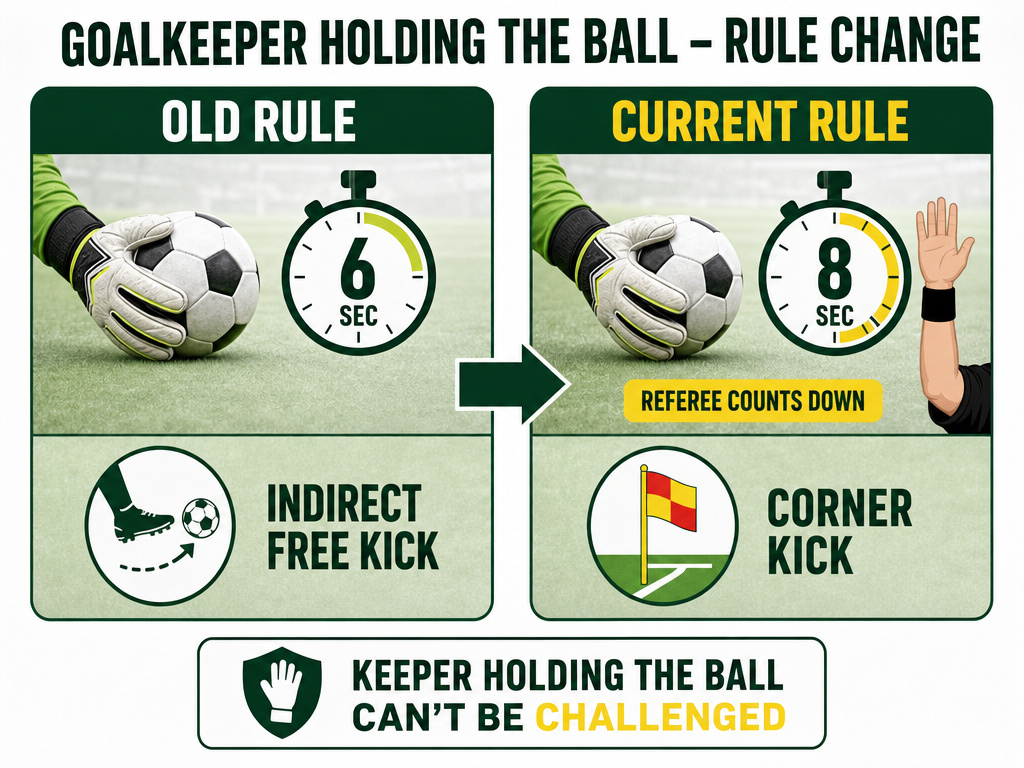
The goalkeeper six second rule explained in one line: IFAB retired it for 2025/26. A keeper who controls the ball with the hands for more than eight seconds now concedes a corner, and the referee counts down the last five seconds with a raised hand. Under the old law, six seconds earned an indirect free kick.
That swap from a free kick to a corner is the part worth understanding. The old punishment was so heavy that referees hardly ever gave it, so the six-second limit sat in the Laws mostly as decoration. US high school soccer, run under NFHS rules, held on to six seconds until its 2026 rules changes, which is why the old number still turns up in conversation.
What follows: the old wording, why referees ignored it, the 400-game trial, how the count runs now, where the sources split on yellow cards, and which competitions lagged behind.
Key Takeaways
- Bouncing the ball or tossing it in the air still counts as control, so neither trick buys a keeper extra time.
- If an attacker pressures or blocks the release during the count, the Premier League’s guidance gives the keeper’s team an indirect free kick.
- The corner goes on the side nearest the goalkeeper, wherever the keeper was standing when penalised.
- Repeat-offence cards differ between the IFAB trial and the Premier League. Check your own competition’s guidance before you argue with a referee.
The Goalkeeper Six Second Rule Explained, Clause by Clause
Law 12 used to give a goalkeeper six seconds with the ball in the hands. A referee who counted past that could award an indirect free kick from where the keeper stood.
Under the pre-2025/26 Laws of the Game, a goalkeeper could control the ball with the hand(s) for no more than six seconds. A breach was punished with an indirect free kick. The IFAB amendment for 2025/26 raised the limit to eight seconds, swapped the free kick for a corner kick, and added a visual five-second countdown from the referee.
IFAB’s trial paper spells out why the limit exists at all. A keeper holding the ball can’t be challenged, so the other team has no way to win it back. Holding on is a free pause button, and IFAB calls it an unfair tactic as well as time-wasting.
The count only applies inside the keeper’s own penalty area. Step outside it and the gloves stop mattering, which is why goalkeepers handling outside the penalty area get pulled up for handball instead.
I’ll be honest about my bias here. I think the handling limits are the most underrated goalkeeper laws in the book, far more interesting than the annual row about keepers creeping off the line at penalties. (As a Sunday full-back, I knew all about waiting for a keeper to give the ball back.)
Why Did Referees Let Six Seconds Slide for So Long?
Picture the scene. A keeper has the ball tucked under one arm well past six seconds, and the referee has clearly noticed.
Blowing the whistle meant setting up an indirect free kick a few yards from goal. If the kick sat 9.15 m (10 yds) or closer to goal, the defenders had to line up on the goal line between the posts. IFAB’s trial paper calls managing that restart extremely difficult.
The second problem was fairness. IFAB noted that some felt the free kick handed the attacking team “too great an advantage.” The attackers didn’t even have the ball when the offence happened, and suddenly they had a high-percentage chance to score.
So referees looked away.
A law that’s too harsh to use is like a clamp that crushes the wood: you stop reaching for it, and the joint never gets glued. That’s what happened to six seconds. Everyone knew the number, and almost nobody enforced it.
I’ve come around to thinking the six-second rule failed because the punishment didn’t fit the offence. Referees could see the dawdling. They just wouldn’t trade a few wasted seconds for a goalmouth scramble that might decide a match.
The back-pass rule came from the same instinct: stop the keeper’s hands becoming a hiding place for the ball. To my mind it reshaped tactics more than almost any other law, and its effect still gets undersold. It’s also narrower than fans assume. A keeper can’t handle a deliberate kick or a throw-in from a team-mate, and that’s the specific offence, not every pass.
The 400-Game Trial That Ended With Three Corners
Across more than 400 trial games, referees gave just three corners for a keeper holding the ball too long, and all three came in England. Malta’s matches produced none. Italy trialled a throw-in as the punishment instead, and it was given once, according to an ESPN report on goalkeeper time-wasting.
Three corners plus one throw-in makes four sanctions in total. That’s tiny.
The timeline was slow and careful. IFAB’s advisory panels talked through options towards the end of 2023 and approved the eight-second trial in March 2024. The final vote at the 139th AGM, hosted by the Irish FA in Belfast on 1 March 2025, was unanimous, according to IFAB’s announcement of the change.
Why eight and not six? IFAB studied how long keepers hold the ball and found three distinct groups.
| Keeper’s situation | Typical hold time | Effect of the 8-second limit |
|---|---|---|
| Quick release to start a counter | Well under 6 seconds | No change |
| Wants to release, legitimately blocked | Around 6 to 8 seconds | Protected; the reason eight was picked |
| Deliberate time-wasting | Well over 6, up to 20+ seconds | Corner kick to opponents |
That middle row is the whole design. Six seconds punished keepers who were trying to play but had no team-mate free. Eight seconds leaves them alone and still catches the keeper who drops to the turf after a routine catch, stays down, and climbs up slowly. IFAB describes that exact behaviour, and anyone who’s watched a late lead being protected knows the sight: knees in the grass, ball cradled, eyes on the clock.
Here’s where I have to admit a limit. I watch games with a notebook, not tracking data, so I can’t tell you whether so few corners means keepers changed their habits or referees stayed shy. The trial numbers alone can’t settle it either.
How the Eight-Second Count Runs, From Catch to Corner
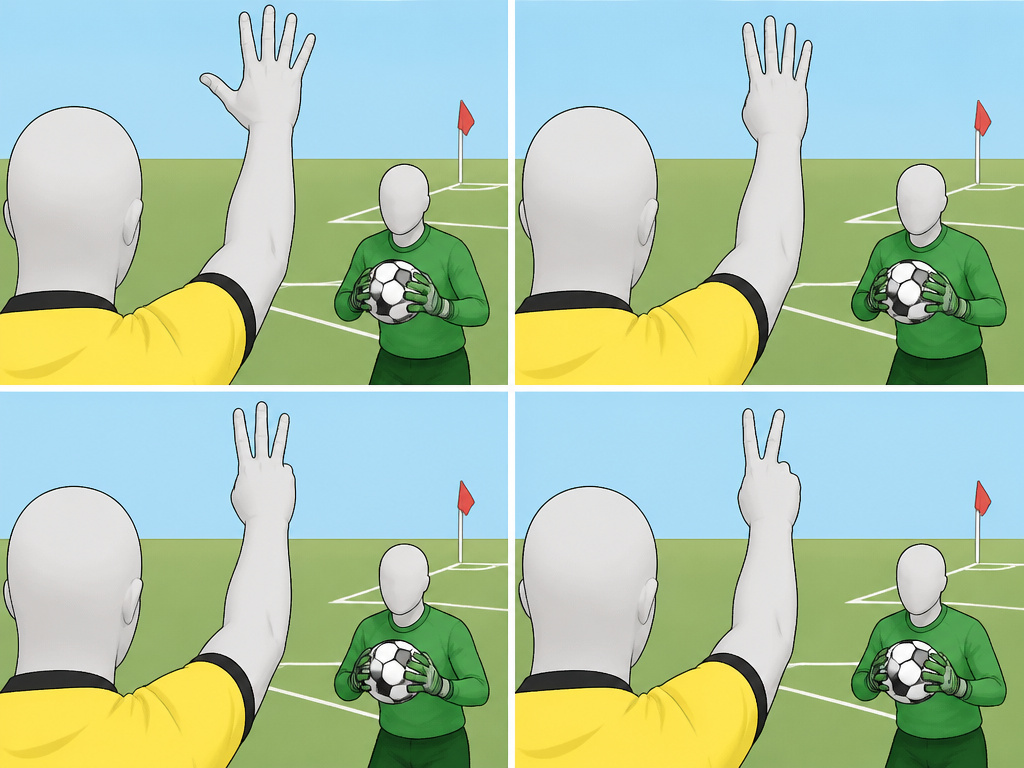
The referee decides when the keeper has control and the eight seconds begin, according to the Premier League’s 2025/26 guidance. Nobody holds a stopwatch to it.
From the stands, the signal is easy to spot. One arm goes up and the fingers drop away as the last five seconds run out, the same style of count futsal and beach soccer use for their four-second limit.
- The keeper gains clear control inside the penalty area, and the referee starts the count with no signal. If a save or a rebound comes first, the clock hasn’t started yet.
- The raised hand appears for the last five seconds. A keeper who ignores it has nobody else to blame.
- The keeper releases before zero, and play goes on as normal.
- The ball is still in the hands at zero. The opponents get a corner on the keeper’s side of the pitch.
What counts as control
The definition is broader than it looks. A keeper is in control when:
- holding the ball in the hands or arms
- the ball is pinned between a hand and any surface, such as the ground or the keeper’s own body
- it sits on an outstretched open hand
- bouncing it on the ground, which plenty of fans assume pauses the count (it doesn’t)
- throwing it in the air
The trial protocol excludes a ball that rebounds off the keeper or a save. That’s why a parried shot doesn’t start the clock.
Easy to miss: Bouncing the ball counts as control, so a keeper who dribbles it in the six-yard box is still on the clock. Five quick bounces won’t reset anything; the corner arrives at eight seconds all the same.
When an attacker gets in the way
The Premier League’s guidance covers the obvious loophole. If an attacking player pressures the keeper or stops the release during the count, the referee awards an indirect free kick against the attacker. Standing in front of the keeper to drain the clock backfires.
Where the corner goes, and why that restart
The corner is taken from the side of the pitch nearest where the keeper stood when penalised. IFAB chose it because the keeper’s team loses possession without handing the opponents a close-range free kick. A corner hurts. It rarely kills you.
Keepers with sharp goalkeeper distribution habits will barely notice this law exists. IFAB’s own analysis shows a quick release to start an attack comes in well under six seconds.
Is a Repeat Offence a Warning or a Yellow Card?
I once published a history piece with a date a full year out. I knew the right answer and trusted memory over checking. Every date I write now gets a second look, and that habit paid off here, because the two main sources on repeat offences don’t match.
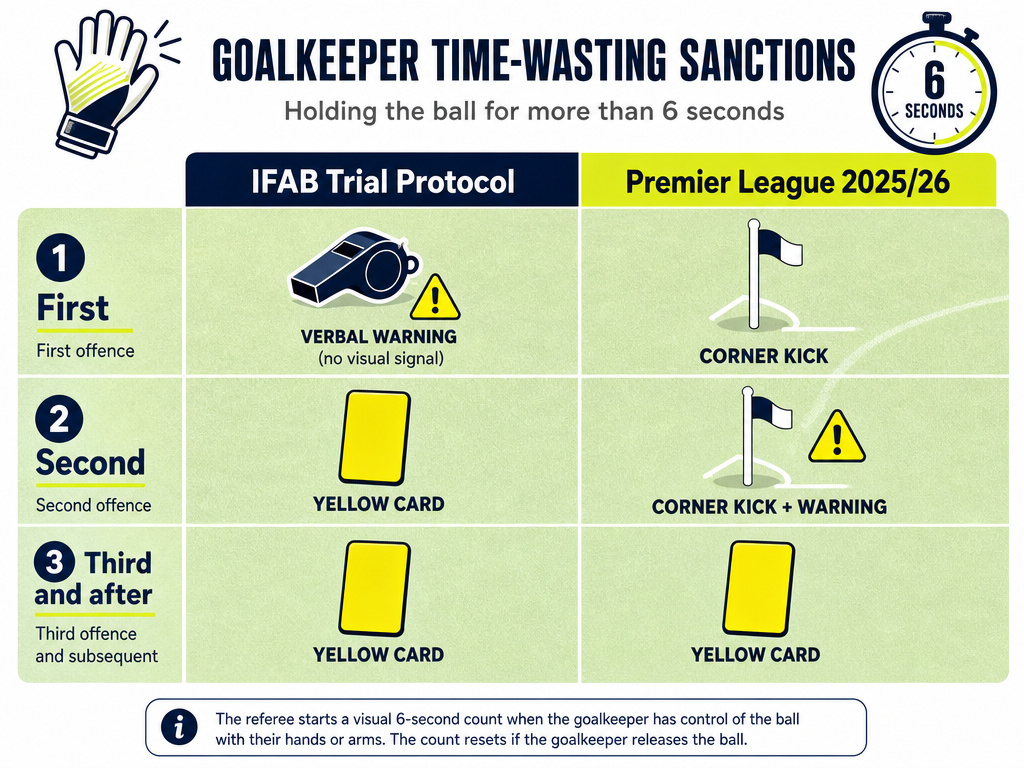
The IFAB trial protocol says the keeper is warned for the first offence and cautioned for any after that. The Premier League’s 2025/26 guidance puts the card a step later.
| Offence | IFAB trial protocol | Premier League 2025/26 guidance |
|---|---|---|
| First | Restart plus a warning | Corner on keeper’s side |
| Second | Yellow card | Corner, plus a warning added |
| Third and after | Yellow card | Yellow card |
Which one applies to your Saturday match? Honestly, it depends on what your competition has published, and I can’t give you one answer for every league. The trial wording was written for trial competitions, and the Premier League sets its own guidance on top of the Laws.
The law reference wobbles too. IFAB’s news release says it amended Law 12.2, the indirect free kick section, while FIFA’s write-up calls it an amendment to Law 12.2a. Separately, Law 12 has always let referees caution any player for delaying the restart of play, so a keeper isn’t immune from a booking on the general rule either.
Where this goes sideways: Quoting the trial protocol as if it were the Law. In a league following Premier League-style guidance, a keeper on a second offence gets a warning, not a card, and the argument is lost before it starts.
Does the Six-Second Rule Still Apply Anywhere?
Under IFAB’s Laws, no. The six-second limit and its indirect free kick were replaced for 2025/26.
US high school soccer was the holdout. NFHS rules kept six seconds and an indirect free kick, and the change only arrived in the NFHS 2026 rules changes. The NJSIAA NFHS soccer rules changes document lists rule 12-3-1 thru 3: the possession limit goes from six to eight seconds, and the penalty moves from an indirect free kick at the point of the offence to a corner kick.
The NFHS reasoning reads almost word for word like IFAB’s. The change makes the punishment less severe and gives officials clearer authority when a keeper clearly goes over the limit. The same document keeps the old protection in place: a keeper holding the ball can’t be charged or challenged.
If the game runs under IFAB’s Laws, forget six. Eight seconds, a raised hand, then a corner.
My knowledge thins out once you leave Europe, and the US college game is a gap I can’t fill from what I’ve checked. If you’re watching or playing NCAA soccer, read that rulebook directly instead of trusting a summary.
Bounou, Dubravka and the Rule in Real Matches
Collina’s verdict was blunt. After the 2025 Club World Cup, the chairman of the FIFA Referees Committee said only two goalkeepers were punished all tournament and that the tempo of games improved. “The purpose was 100% achieved,” he told FIFA.
His point is worth sitting with. The goal was never to hand out corners. It was to get keepers releasing the ball, and two punishments across a whole tournament suggests they listened.
The named cases so far, both reported by Goal.com:
- Yassine Bounou of Al Hilal conceded a corner against Real Madrid at the Club World Cup for holding on past eight seconds.
- Martin Dubravka became the first Premier League keeper penalised, in Burnley’s opening game against Tottenham.
Treat those as press reports, not official records. Goal.com is a secondary source, and I’d check a match report before building an argument on either.
Funny thing. My eye still goes to keeper shirts before keeper habits, and nineties goalkeeper kits look like nobody supervised the designers: neon, zigzags, patterns straight off a screensaver. Anyway. The eight-second law now sits alongside the other rules for goalkeepers as one of the few with a visible countdown, and that visibility is the reason it works.
Throw-Ins, Goal Kicks and Ten-Second Substitutions: The Countdown Spreads
Three things came out of IFAB’s 140th AGM, announced in a FIFA media release dated 28 February 2026:
- Throw-ins and goal kicks get a countdown. If the referee thinks either is being delayed, a five-second visual count starts. A late throw-in goes to the opponents, and a late goal kick becomes a corner to the opponents.
- Substituted players get 10 seconds to leave after the board goes up or the referee signals. Miss it and the substitute can’t come on until the first stoppage after one minute of running clock.
- Trials on tactical injury delays by goalkeepers. IFAB wants options to deter the keeper who goes down to buy time.
The keeper’s hold was the test case, and the countdown has now spread to the restarts most often milked for time. Which tells you how IFAB sees the eight-second result: as a template to copy.
When did the goalkeeper eight-second rule start and where does it apply?
IFAB passed the change at its 139th AGM in Belfast on 1 March 2025, and it applied from the 2025/26 season. The first big stage was the 2025 Club World Cup. Pierluigi Collina said only two goalkeepers were punished there and called the purpose “100% achieved”. Al Hilal’s Yassine Bounou conceded a corner against Real Madrid after holding the ball for more than eight seconds.
League football followed. The Premier League uses the rule in 2025-26, and Martin Dubravka was the first keeper penalised there, in Burnley’s opening game against Tottenham.
The change sits in Law 12 of the Laws of the Game, so it is not tied to one competition. Some governing bodies run on their own calendar, though. US high school soccer under NFHS only moved from six to eight seconds, with a corner kick replacing the indirect free kick, in its 2026 rules changes. For a specific league or school level, check its own rule notice for the exact start date.
Frequently Asked Questions
Does the 6 second goalkeeper rule still apply?
Not under IFAB’s Laws of the Game. It was replaced for 2025/26 by an eight-second limit with a corner kick. US high school soccer under NFHS kept six seconds until its 2026 rules changes moved it to eight seconds and a corner.
What is the 8-second rule in soccer?
Goalkeeper inside their own penalty area who controls the ball with the hands for more than eight seconds concedes a corner. The referee shows the last five seconds with a raised hand. The corner is taken on the side nearest where the keeper stood.
Can a goalkeeper get a yellow card for holding the ball too long?
Yes, though the timing depends on the competition. The IFAB trial protocol warns on the first offence and cautions after that. Premier League guidance gives a corner first, adds a warning on the second, and shows a yellow card on the third.
Does throwing the ball in the air stop the count?
No. Throwing the ball in the air and bouncing it on the ground both count as control. The count keeps running until the keeper releases the ball into play.
Does the countdown apply to goal kicks now?
Yes, since IFAB’s 140th AGM. A referee who thinks a goal kick is being delayed starts a five-second visual countdown, and if the ball isn’t in play at zero, the opponents get a corner.
Before You Go
One practical step for this week: if you coach, play or referee at grassroots level, find your league’s handbook and check which repeat-offence sequence it follows. The IFAB trial wording and the Premier League guidance disagree on when the yellow card comes, and that’s the exact detail that starts touchline rows.
A concession, too. The goalkeeper six second rule explained here is the IFAB version, and US high school soccer only caught up in 2026. If you’re following college football in the States, I haven’t verified that rulebook, so read it yourself.
My own take, for what it’s worth: the corner is the cleverest punishment IFAB has picked in years, because it’s mild enough that referees will actually give it.
So which restart will the countdown reach next?
