
Can a Goalkeeper Handle the Ball Outside the Box?
This post contains affiliate links. As an Amazon Associate, we earn from qualifying purchases.
A goalkeeper can’t handle the ball outside the box any more than a defender can. Law 12 gives keepers the same handling limits as every other player beyond the penalty area, so a handball there is a direct free kick. What counts is the ball: if any part of it sits on the line, the keeper can use their hands.
That ball-first test explains most of the calls that look wrong from the stand. A keeper with both boots over the line can still legally catch a ball resting on it. A keeper who catches cleanly inside and then carries it out has committed an offence. The card is a separate question, and it turns on what the handball actually stopped.
What follows: the three boundary calls that settle most arguments, the escalation for a keeper who carries the ball over the line, why Joe Willis only saw yellow, a quick table of restarts and cards, and where US high school and college rules split from IFAB.
Key Takeaways
- Judge the release point, not the kick: a keeper who releases the ball inside the area can legally volley it from outside.
- Carrying the ball over the line is a direct free kick offence, and US referee guidance says warn first, call the foul second, caution third.
- A deliberate handball outside the box that denies a goal or an obvious chance is a red card for keepers too.
- Handling a team-mate’s deliberate kick or throw-in inside the box brings an indirect free kick and no card.
- NFHS high school keepers now get 8 seconds instead of 6 to release the ball, and holding it longer gives away a corner.
Can a Goalkeeper Handle the Ball Outside the Box?
IFAB’s Law 12 settles it in one flat sentence: the goalkeeper has the same restrictions on handling the ball as any other player outside the penalty area. Step over that line and a keeper’s hands are worth about as much as mine were at right back on a muddy Sunday. Which is to say, nothing legal.
Under IFAB Law 12, a goalkeeper outside the penalty area has the same handling restrictions as any other player. A handball there is a direct free kick offence. Denying a goal or an obvious goal-scoring opportunity with a deliberate handball outside the area is a sending-off offence, because the only exception covers a goalkeeper within the penalty area.
The current IFAB Law 12 on fouls and misconduct and The FA’s 2026-27 Law 12 text carry the same wording. So this is today’s law, not a stale reading of an old rulebook. Every one of the goalkeeper handling rules further down hangs off that sentence.
The handball test outside the box is the same one used on outfield players. The Law puts the upper boundary of the arm at the bottom of the armpit, so a keeper who blocks a ball with the shoulder outside the area hasn’t handled it.
The restart is always a free kick, and the reason is mechanical. A penalty kick only exists for a direct free kick offence committed inside the offender’s own penalty area. A handball outside the area can never become a penalty, however close to the line it happens.
I’ll keep this part short. The real arguments live at the line itself.
Line, Release Point, Goal Area: The Three Calls That Settle Most Arguments
Three questions decide nearly every one of these incidents: where the ball is, where it left the hands, and which box you’re actually looking at. Get those three right and you’ll out-referee half the stand.
Part of commanding your penalty area as a goalkeeper is knowing where that line runs without glancing down. By February on a grassroots pitch it’s a grey smear of paint half-buried in mud. The keeper has to know it anyway.
Any Part of the Ball on the Line Counts as Inside
A USSF-sourced answer on Ask a Soccer Referee puts it plainly: if any part of the ball is on the penalty-area line, the ball is within the area and the keeper can handle it. The ball is treated as one whole object. It’s either in or out, and touching the line means in.
Feet Outside, Ball Inside Is Legal
A keeper standing with both boots beyond the line can still catch a ball that’s on or inside it. The test runs on the ball’s position alone. This is the edge case crowds howl at most, and the keeper is in the right.
Released Inside, Kicked Outside Is Also Legal
The same answer deals with the punt. If a keeper releases the ball inside the area and only strikes it once it’s outside, no offence has occurred. Its own example is a toss from inside the box and a strike 2-3 feet outside.
Legal. Completely.
Why does the release point win? The offence is handling, and the hands stop handling the moment the ball leaves them. Where the boot meets the ball is a kicking question. The source takes a swipe at assistant referees who judge by where the foot meets the ball, which can be well outside the area with no offence at all. It’s an easy mistake from a stand too, because your eye follows the boot.
Judge the hands, never the boot. If the ball left the keeper’s hands inside the area, the volley that follows can land anywhere it likes.
The Goal Area and the Arc Sit Outside This Rule
Two other markings muddy things. The goal area, the small box inside the big one, has nothing to do with handling: the keeper’s zone is the whole penalty area. The arc at the top of the box sits outside the penalty area, so a keeper handling there faces a free kick from that spot.
What Happens When a Keeper Carries the Ball Over the Line?
The keeper claims a cross cleanly, jogs forward to clear it, and takes one stride too many. You hear it before you see it: the snap of the assistant’s flag, then the whistle. The keeper stands there with the ball still against the chest, staring down at the turf.
The USSF-sourced guidance admits this offence is often debatable and usually trifling. It still calls it an infringement the referee must treat as one, and it sets out an escalation:
- Warn the first carry. The referee overlooks the first one without punishment but clearly tells the keeper to honour the line. Skip the warning and the next whistle looks harsh, even though it’s correct.
- Call the foul on the repeat. The restart is a direct free kick from the point just outside the area where the keeper still had the ball in hand. Give the wrong restart here and the defending team gets off lightly.
- Caution for persistent infringement if it happens again. Leave the card in the pocket and the keeper learns the line is a suggestion.
That warn-first step comes from referee guidance rather than the Law text itself, and the answer is old. I wouldn’t expect every referee in every country to follow it to the letter.
The restart is where sources pull in different directions. The FA’s 2026-27 text says illegal handling inside the keeper’s own area brings an indirect free kick and no card. The USSF-sourced answer says a carry over the line belongs in a different category, and it calls an indirect free kick for it incorrect.
I’d back the direct free kick. Once the ball is outside the box in the keeper’s hands, the FA’s own first sentence applies: same restrictions as any other player.
Where this goes sideways: Restarting with an indirect free kick because “it was the keeper.” That restart belongs to illegal handling inside the area. Once the ball crosses the line in the keeper’s hands, it’s a direct free kick from that spot, and a second offence invites a caution.
Why Joe Willis Saw Yellow, Not Red, From 55 Yards Out
Approximately 55 yards from goal is where Nashville SC keeper Joe Willis stopped a shot with his hands in a Week 1 match against Atlanta United. He was that far upfield because Nashville were chasing a stoppage-time equalizer. It never came. He got a yellow card, and plenty of fans wanted red.
Rewind a second. PRO, the referees’ body for the US and Canadian pro leagues, agreed the Laws demand a sending-off when a player deliberately handles to deny a goal or an obvious goal-scoring opportunity. It said that includes a goalkeeper outside the penalty area. Its point was that neither condition applied to Willis.
The test for denying an obvious goal-scoring opportunity runs on four factors in Law 12. Here’s how PRO’s explanation lines up against them:
- Distance between the offence and the goal. The shot came from near the halfway line.
- General direction of play. A shot on goal is heading the right way, so this one didn’t help Willis much.
- Likelihood of keeping or gaining control of the ball. A Nashville defender was chasing back and sat in position to reach the ball first if the shot lacked the pace or direction to arrive.
- Location and number of defenders and attackers. No Atlanta player was ahead of the ball to run onto it.
Denying a goal outright is a separate route to red. For that, the referee has to be sure the keeper stopped the ball going in. PRO’s words: “At 50 yards out, it’s impossible to know this with certainty.” Its own explanation slips between “approximately 55 yards” and 50 yards, which tells you nobody was pacing it off. The point stands either way.
That logic flips close to goal. PRO said the call is much easier to make when the handball happens nearer the target. A keeper who strays a few yards out and palms a goalbound shot away has no distance to hide behind.
Honestly, I think PRO got it right. A red there punishes the keeper for a goal nobody could prove was coming. The yellow fits too: Law 12 cautions any player who handles to stop a promising attack.
One older strand of referee commentary argued the DOGSO-handball red was written for outfield players and shouldn’t touch keepers at all. That reading has aged badly. Current IFAB wording carves out only “a goalkeeper within their penalty area,” and PRO applied the red-card test to a keeper outside it.
Six Keeper Handling Situations, With the Restart and Card for Each
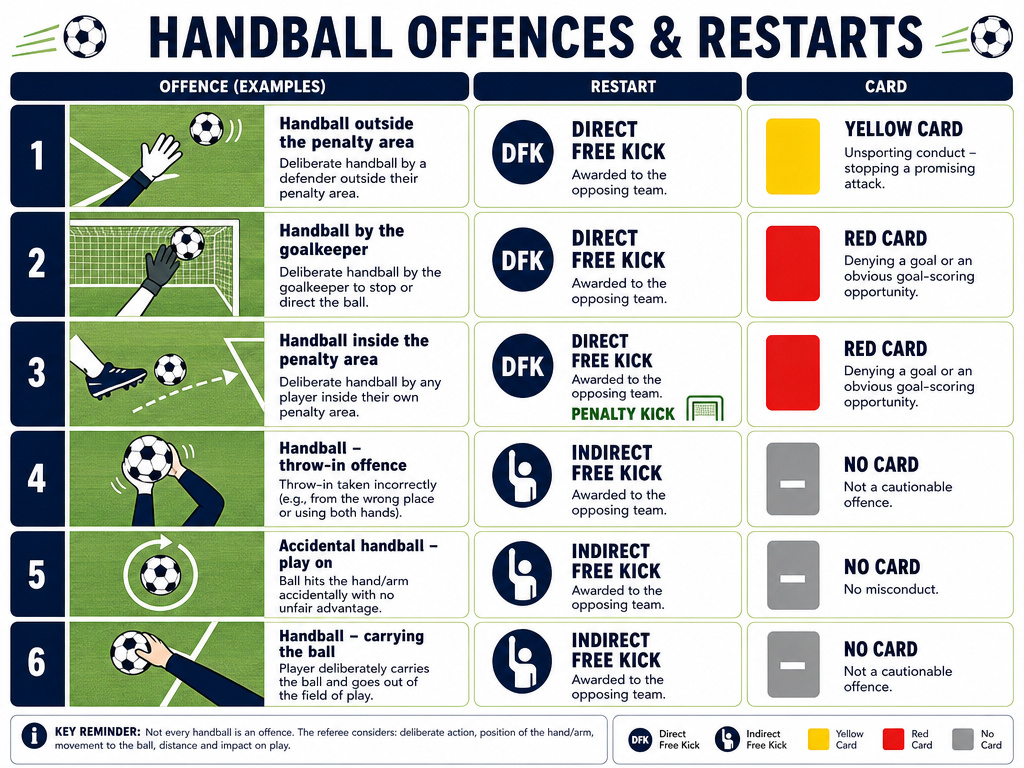
Six situations cover nearly every keeper-handling argument you’ll hear on a matchday. The first two come from the sending-off and caution lists in Law 12. The next three come from the keeper’s restrictions inside the area, and the last from the USSF-sourced guidance on the line.
| Situation | Restart | Card |
|---|---|---|
| Handles outside area, stops a promising attack | Direct free kick | Yellow |
| Deliberate handball outside area denies goal or DOGSO | Direct free kick | Red |
| Handles a team-mate’s deliberate kick inside area | Indirect free kick | None |
| Handles a team-mate’s throw-in inside area | Indirect free kick | None |
| Plays ball again after a restart, before anyone touches it | Indirect free kick (inside area) | If it stops an attack or chance |
| Carries ball over the line in hand | Direct free kick (after a warning) | Yellow if persistent |
The team-mate rows trip up the most fans, and I hear the misreading in the stands constantly.
What most people get wrong: Thinking a keeper can never pick up a pass from a team-mate. Only a deliberate kick or a throw-in from a team-mate is off limits. A header or chest pass back is fine, unless it’s a deliberate trick to dodge the Law. Then the player who started it is cautioned, and the keeper too if the keeper set it up.
I’d argue the back-pass rule reshaped the game more than almost any law change, and we still underrate it. It pushed keepers to play with their feet. A lot of today’s patient build-up from the back grows out of that one restriction.
Two more Law 12 details round this out. A keeper who handles in an unsuccessful attempt to prevent a goal is still cautioned, so a desperate fingertip outside the box that fails to stop the shot still earns a yellow. And a keeper can’t score by throwing. Scoring directly from the hand or arm in the opponents’ goal is an offence, even if it’s accidental.
Rare, but it’s in there.
The Last Stride Before the Line Is Where Sweeper Keepers Get Caught
Years ago I got into the habit of watching one player without the ball for several minutes at a stretch. It shows you everything the ball-following eye misses: the runs, the cover, the space somebody’s quietly guarding. Point that habit at a goalkeeper while the ball is at the other end and you start to see where the keeper really lives.
Modern keepers live high. That’s the job. The sweeper-keeper role in football only works because the back four step up together and the keeper sweeps the space behind them. Think of it as joinery: the keeper can roam because the defensive line is cut to fit around him, and if one piece is off, the whole frame wobbles.
The risk sits in the last stride before the line. A ball dropping awkwardly at the edge invites the hands, and that reflex is what costs keepers cards. Here’s what I’d drill into any keeper who plays high:
- Feet or head once the ball is beyond the line. Hands are off the table.
- Catch, plant, release. If you claim a ball near the edge, stop and let it go from inside the area. The release point protects whatever volley follows.
- Don’t stretch a glove over the line to tidy up a ball you could hack clear. Handle it to stop a promising attack and it’s a yellow. Handle it to deny a clear chance and your side plays the rest of the match a player short.
- Learn the line by landmark during the warm-up, so you never need to look down mid-play.
Keepers who already know how goalkeepers play with their feet rarely face this choice at all. The clearance is their first instinct, and the catch is their second.
One more thing to avoid: walking the ball to the edge of the box to buy a few seconds before a punt. Do it twice and, under the guidance above, the second carry is a direct free kick.
I’d rather see a keeper hack a ball into the stand from outside the box than watch one reach a glove over the line for a tidier catch. The hack costs a throw-in. The glove can cost a red card and a long, lonely walk off.
Do High School and College Rules Treat Keepers Differently?
Coaching or watching a US high school match this season? A few of the numbers you know from elsewhere have changed there. I’ll hold my hand up first: my feel for the game outside Europe is thinner than I’d like, and that includes American school and college rulebooks. So everything here comes straight from the governing bodies’ own documents.
The headline change sits in the NFHS 13 soccer rule changes for 2026-27. Goalkeepers get eight seconds instead of six to release the ball. Holding it longer now gives away a corner kick instead of an indirect free kick, so the old six-second rule no longer applies at that level.
The NFHS rules editorial changes document published by the OSAA fills in the detail. The referee decides when the count starts and can begin it once the keeper clearly has uncontested possession. Control covers three cases: the ball between the hands or against any surface, held in an outstretched open hand, or bounced or tossed in the air.
That third case answers the dribbling question. A keeper bouncing the ball with one hand is still in possession, and still on the clock. Put it on the ground, though, and the keeper gives up goalkeeper privileges.
Rule 12-1-2c bars any player from charging or challenging a keeper who is controlling the ball with their hands, and the penalty is a direct free kick. It then adds: “Outside the penalty area, the goalkeeper has no more privileges than any other player.” Same principle as IFAB, different book.
| Situation | Rulebook | Outcome |
|---|---|---|
| Keeper handles outside the penalty area | NFHS Rule 12-1-2c | No extra privileges; direct free kick |
| Keeper holds the ball too long | NFHS, before 2026-27 | 6 seconds; indirect free kick |
| Keeper holds the ball too long | NFHS, 2026-27 | 8 seconds; corner kick |
| Non-deliberate handball denies DOGSO, penalty given | IFAB Law 12 | Yellow card |
| Non-deliberate handling in the area denies a goal | NCAA committee proposal | No red; red kept for deliberate handling |
| Keeper’s first penalty-kick offence | NFHS, 2026-27 | Warning, not a caution |
The college picture is less settled. In a release on NCAA soccer rules committee proposals, the committee recommended dropping the red card for non-deliberate handling in the penalty area that denies a goal or goal-scoring opportunity. Red inside the area would be kept for “deliberate, cynical handling.” That was a recommendation, and I couldn’t confirm from the release whether it was adopted. Check your conference’s current book.
For keepers in their own area that proposal changes little, since IFAB already exempts them from the handball red. It matters far more for the defender on the line.
The NFHS also now gives keepers a warning for a first penalty-kick offence instead of an instant caution, reasoning that those infractions often stem from mis-anticipation. Fine by me. Keepers creeping off the line at penalties decide very few matches, and that debate gets far more airtime than it deserves.
Youth and recreational leagues are another story. Many write their own age-group modifications, and I won’t pretend to know yours. Check the league handbook before you argue with a teenage referee.
Frequently Asked Questions
Can a goalkeeper handle the ball outside the box if their feet are inside?
Only if the ball itself is still on or inside the line. The test looks at the ball’s position alone. A ball fully beyond the line is a handball like any other, even with both of the keeper’s boots inside the box.
What happens if a goalie touches the ball with their hands outside the box?
The opponents get a direct free kick from where the handball happened. A yellow card follows if it stopped a promising attack, and a red follows if a deliberate handball denied a goal or an obvious goal-scoring opportunity. It’s never a penalty kick.
What happens if a goalkeeper carries the ball out of the box?
US referee guidance says warn the keeper the first time, call the foul on a repeat, and caution for persistent infringement after that. The restart is a direct free kick from the point just outside the area where the keeper still had the ball in hand.
What are goalkeepers not allowed to do inside their own box?
They can’t handle a deliberate kick or a throw-in from a team-mate. They also can’t play the ball a second time after a restart before another player touches it. Each of these brings an indirect free kick, with a card only if a second touch stops a promising attack or denies a goal or obvious chance.
Can a goalkeeper score by throwing the ball into the other goal?
No. Scoring in the opponents’ goal directly from the hand or arm is an offence under Law 12, even if it’s accidental. The keeper has to kick it in like everyone else.
Before You Go
So, can a goalkeeper handle the ball outside the box? Not legally, and the rulebook leaves almost no room to argue about it. The real arguments live at the edges: the line, the release point, and the distance from goal.
Here’s one thing to try at your next match. When the flag goes up on a keeper near the edge, ignore the boot and ask where the ball left the hands. Get that right and you’ll call it better than some assistant referees do.
One caveat. If you’re watching US high school soccer, swap in 8 seconds and a corner kick for holding the ball too long, and check your league’s book for anything below school level.
Should the Laws give keepers a one-stride grace zone beyond the line, or would that just reward lazy footwork?
