
How to Distribute the Ball as a Goalkeeper: Step-by-Step
This post contains affiliate links. As an Amazon Associate, we earn from qualifying purchases.
To distribute the ball as a goalkeeper, you must first secure possession, then choose a technique, roll, throw, or kick, based on distance, pressure, and your team’s tactical plan. The primary governing bodies, The FA and UEFA, define specific techniques for specific ranges: the ‘Whip’ pass for 20-40 yards, and the ‘Drive’ for the longest distances. Your core job is to turn defence into attack within the six seconds you’re allowed to hold the ball.
That six-second window is your tactical breather. It’s the only time in open play the opponent can’t touch the ball, letting you dictate the pace. What you do next decides whether you gift possession back or launch a genuine attack. A key part of this is knowing how to distribute the ball as a goalkeeper.
This guide walks through the techniques, the decision-making engine behind them, and the common mistakes that turn a simple lesson in how to distribute the ball as a goalkeeper into a counter-attack against you. By the end, you’ll know not just how to punt, but when to pass, and why the choice matters more than the power.
Key Takeaways
- You have six seconds from the moment you secure the ball to release it, use this time to scan and decide, not just to hold on.
- According to some grassroots coaching plans, for young goalkeepers (ages 7-12), rolling or passing out with the feet is often the most accurate method, as overarm throws can be difficult to execute quickly at that age.
- The ‘Dribble and Drive’, where the keeper dribbles out of the box before kicking, is cited by The FA and Leighton United as the most accurate and favoured technique in the modern game, while other sources highlight the side volley for long, low distribution.
- On a back-pass played on the ground, you must use your feet; picking it up concedes an indirect free kick in the box.
- Wind changes everything: use a low-trajectory Half Volley or Drop Kick when playing into a strong wind to maintain accuracy and distance.
The Goalkeeper’s 5-Step Decision Engine
Before your arm cocks back or your foot swings through, your brain has already run a process. UEFA’s coaching manual breaks it down into five steps: observe, collect information, select key features, decide how to act, and execute. This isn’t academic theory. It’s the difference between a clearance to nowhere and a pass that starts a winning move.
You’re observing the whole pitch, which is the first step in learning how to distribute the ball as a goalkeeper. Where are your teammates? Is the opponent’s press high or broken? What’s the score, and how much time is left? You collect all that data and compare it to your experience. The selection step is where you filter out the noise, ignoring a waving striker to spot the full-back making a smart, late run into space. Then you decide. A quick throw to that full-back, or a long kick to the striker? Finally, you execute the technique you’ve drilled a thousand times.
Where this goes sideways: New keepers often freeze at the ‘decide’ stage, holding the ball for the full six seconds before panicking and booting it long. That hesitation tells the opposing team you’re unsure, and they’ll press you twice as hard next time. Make your decision in the first three seconds.
The best keepers make this look instinctive. It’s not. It’s trained pattern recognition. That’s why distribution drills under pressure aren’t a luxury, they’re how you feed your brain the game scenarios it needs to make faster, better choices.
The Throw: Your Short-Range Weapon
When a striker fires over from 20 yards and you make the catch, the game is in your hands. Literally. Throwing is a fast and accurate method for distributions under 40 yards. It keeps the ball on the ground and at a teammate’s feet, maintaining possession. There are two main types, and the choice is about distance and disguise.
The Underarm Bowl (or Roll)
This is your bread and butter for playing out from the back. The coaching resource Versus specifies its game use: distributing the ball 10-15 yards to a right, centre, or left back. The mechanics are simple but unforgiving. Get low, bring the ball back in your dominant hand, and roll it like a bowler in cricket, aiming for your teammate’s leading foot.
Try not to bounce an underarm bowl, as this is less accurate than keeping it on the ground.
The ball should travel smoothly along the turf. A bounce introduces a random variable, a bobble that your full-back has to adjust for, which breaks their rhythm and gives a marker half a second to close in. Practice this until you can consistently hit a target from a short distance.
The Overarm (or Baseball) Throw
When you need more distance and a bit more pace, you sling it. This is for hitting a winger or midfielder over a medium distance, ideally before the opposition can reorganise. The key is to deliver the throw with accuracy and pace. You’re not just throwing it near your teammate; you’re throwing it to them, with enough zip on the pass that they can control it in one touch.
Your technique will have its own texture. Some keepers throw sidearm for a bending trajectory; others go over the top. The common thread is a strong, fluid motion from the shoulder, using your core for power, not just your arm. A weak, looping throw hangs in the air forever and is a defender’s dream to intercept.
| Throw Type | Best For Distance | Key Coaching Point | Common Mistake |
|---|---|---|---|
| Underarm Bowl | 10-15 yards | Roll along the ground, don’t bounce it. | Bouncing the ball, making it unpredictable for the receiver. |
| Overarm Throw | 20-40 yards | Focus on accuracy and pace to feet. | Slow, looping trajectory that allows defenders to adjust. |
A quick, accurate throw can turn a routine save into a dangerous counter-attack. It’s the first sign of a keeper who is thinking like an attacker.
The Kick: Power, Distance, and Deception
Kicking is for distance, for changing the point of attack, and for when you need to clear your lines. It’s about choosing the right kick for the conditions and the tactical picture. The terminology here is messy, so we will clarify it using the official sources.
The Half Volley / Drop Kick
This is where the language diverges. The FA and Leighton United manuals define a Half Volley as delivered from the hands and struck as the ball ‘hits the floor’. Other sources, like Versus, describe a similar action for a Drop Kick, creating a terminology conflict where the same physical action has different names. This kick is useful for long distribution, especially into a strong wind due to its lower trajectory. Its lower trajectory, as noted by the manuals, makes it especially useful when playing into a strong wind.
The Volley and Side Volley
For a pure Volley, the ball is struck before it bounces. The FA states it “lacks accuracy” but covers long distance. The Side Volley (or Sidewinder) is a different beast. The Side Volley is kicked before the ball hits the ground and from the side to keep the trajectory low. Versus notes it can send the ball 40-45 yards low on a rope, perfect for a forward to run onto.
The Drive and Dribble and Drive
The Drive is your max-distance kick, used for goal kicks and long diagonals. The Dribble and Drive, however, is the gold standard for accuracy. Here, the keeper dribbles the ball out of the penalty area before driving it. Why is this better? You’re kicking a stationary ball from the ground, like an outfield player, which allows for superior technique and placement. The FA doesn’t mince words: this is “the most accurate and probably the most favoured technique used by today’s goalkeepers.”
The Fly Kick
This is your emergency clearance. Used when playing a moving ball first-time, like clearing a risky back-pass or charging out to meet a through ball. It’s about power and safety, not precision. You’re launching it long to relieve immediate pressure.
Playing With Your Feet: The Non-Negotiable Modern Skill
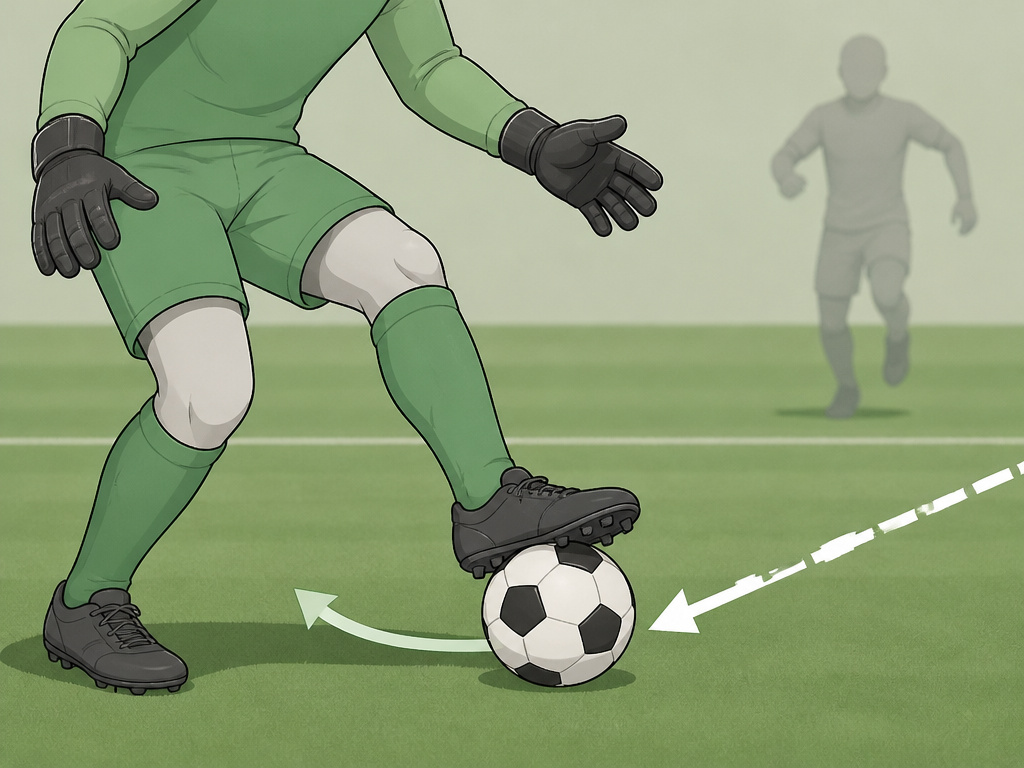
The back-pass rule changed goalkeeping forever. A ball deliberately passed to you by a teammate’s foot cannot be picked up. You must use your feet. This isn’t just a rule to remember; it’s a fundamental skill. A keeper who can’t pass reliably with both feet is a massive tactical liability, inviting pressure every time a defender needs an outlet.
Your first touch is everything. It has to be clean, away from your body and into space, setting up your next move. Are you playing a short pass to a centre-back? A longer switch to the opposite full-back? The principles from UEFA are clear: “deal with the back pass and deliver long and accurate passes to progress into the opponent’s half when required” and “create options for a back pass to play together effectively.”
This is where your fundamentals for playing with your feet are tested. Can you receive the ball on your back foot and open your body to see the whole pitch? Practising under pressure is essential. Have a teammate or coach close you down as you receive a pass. The feel of a defender’s shadow forces better, quicker decisions than any unopposed drill.
Common mistake: Taking a bad first touch that pops the ball up. Now you’re dealing with a bouncing ball under pressure, which drastically increases the chance of a miskick or a tackle. Your first touch must kill the ball’s momentum, not add to it.
Mastering this turns you from a shot-stopper into the first attacker, the cornerstone of any team that wants to build-up play from the back.
Training Distribution: Drills for Game Speed
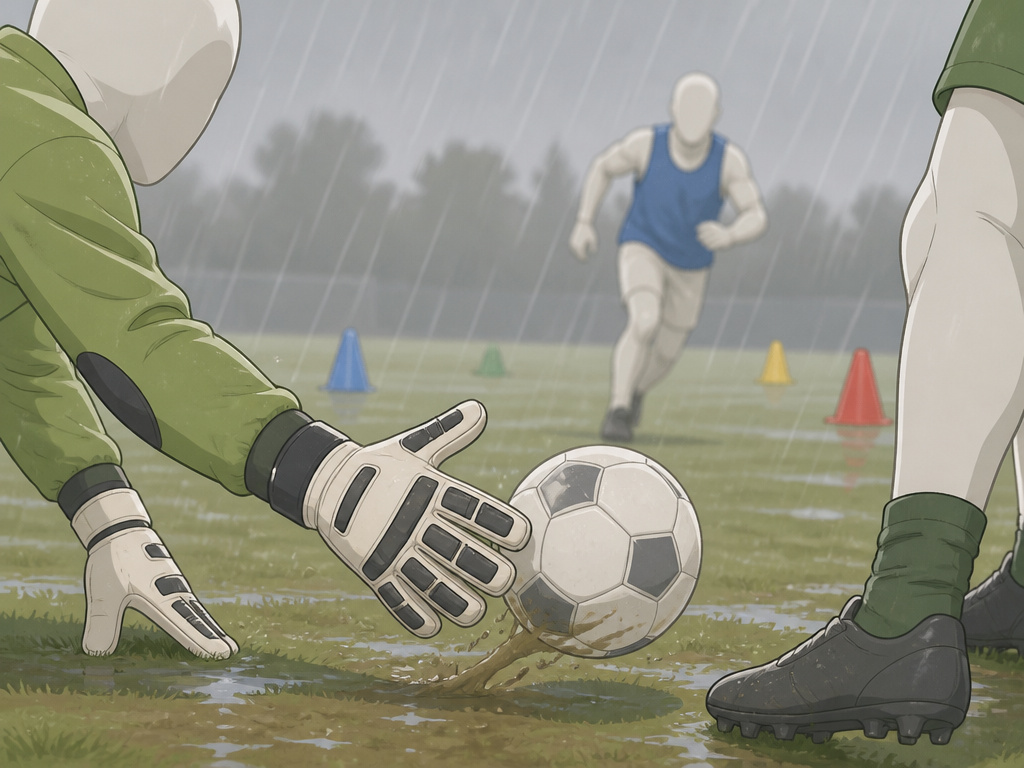
You can’t learn distribution by just kicking balls into an empty net. Training must mirror the chaos of a match. It needs pressure, decision-making, and consequences. Start with the basics of technique, hitting a target from a stationary position, but you must progress quickly.
The Pressure-Progress Drill
Set up three cones at 15, 30, and 45 yards. Have a teammate play you a variety of balls (catches, back-passes, loose balls). As you receive, a second teammate (the “presser”) starts closing you down from 10 yards away. Your job is to identify the best option and execute the right technique before the presser reaches you. Start with light pressure, then increase the intensity to simulate a game situation.
The Four-Goal Game
Play a small-sided game in a confined area with multiple small goals. You’re in goal. Every time you save it or receive a back-pass, you must distribute to a teammate who is now attacking one of the four goals. This drill trains your scanning and quick decision-making under realistic, chaotic conditions. It also highlights the value of a quick roll or short pass versus a hopeful long kick.
Wind & Condition Training
If you always train on a calm day, you’ll struggle when it matters. On a windy day, spend extra time on your kicking. Practice the low Half Volley into the wind. Notice how much more power you need to get distance. Practice your throws with a wet ball. Does your grip hold up, or do you need to adjust your techniques for catching the ball for security first? This is how you build a toolkit for every scenario, a key part of overall goalkeeping development.
Special Situations and Youth Considerations
Not every distribution fits the standard menu. The game throws curveballs, and your age changes what’s possible.
Futsal vs. Football
This is a legal edge case. In futsal, the FIFA manual states a “goal clearance” must be thrown with the hand from inside the penalty area. However, if you receive a back-pass, you must play it with your feet. The technique is completely bifurcated by the Laws of the Game, a crucial distinction for any keeper transitioning between the formats.
The Youth Keeper’s Reality
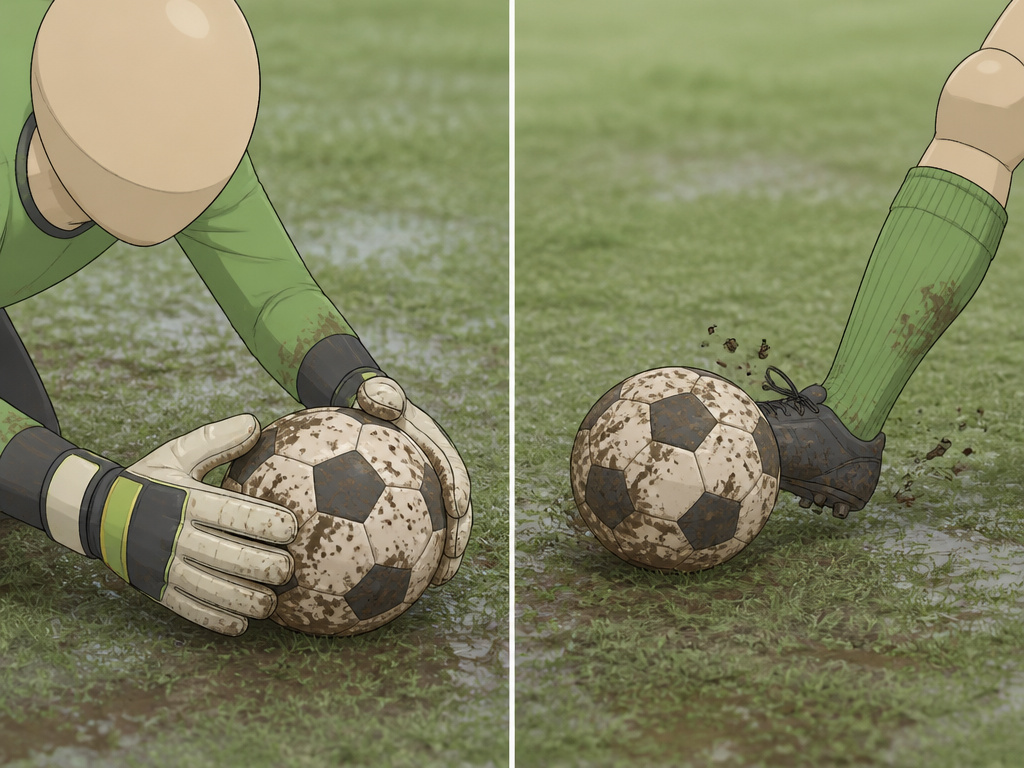
For a young goalkeeper, the technical manuals present an ideal curriculum. The reality on a muddy pitch with a size-4 ball is different. A grassroots coaching plan from Bucklebury Wolves offers a vital, grounded insight: “Most goalkeepers in the seven to twelve age range will be most accurate if they roll or pass the ball out.” It also notes that overarm throws “are difficult for young goalkeepers to execute quickly and accurately.”
The lesson is to prioritize techniques appropriate for the goalkeeper’s age and development level. Build their confidence and fundamental positioning principles with short, successful distributions. Let them master the roll and the short pass with their feet. The power and the throws will come as they grow stronger. Their focus at that age should be on foundational skills like stopping shots and making simple distributions.
Communicating before you distribute
Effective distribution starts with clear communication. Before you even receive a back pass, you should be talking, organizing your defenders, and dictating the team’s shape. Use this time to give clear, concise instructions. Tell a teammate to show for a short pass or direct a runner to stretch the field for a long ball. Your voice helps create the options you need to make a smart decision, turning a moment of possession into a deliberate attack.
Frequently Asked Questions
What is the most accurate goalkeeper distribution technique?
According to The Football Association’s technical manual, the Dribble and Drive is “the most accurate and probably the most favoured technique used by today’s goalkeepers.” By dribbling the ball out of the penalty area before kicking it from the ground, the keeper achieves the same controlled striking action as an outfield player, leading to superior placement over kicks from the hand.
How long can a goalkeeper hold the ball?
Goalkeeper can hold the ball for six seconds after gaining full control. This is stipulated in the Laws of the Game. Holding it longer risks an indirect free kick being awarded to the opposition. This six-second window is when the keeper should scan the pitch and decide on their distribution, not delay.
Can a goalkeeper score from a distribution?
Yes, a goalkeeper can score directly from a goal kick or any other distribution, provided the ball is in play and no other infringement occurs. Yes, a goalkeeper can score directly from a goal kick or any other distribution, provided the ball is in play and no other infringement occurs.
What should a goalkeeper do with a back-pass?
If a teammate deliberately passes the ball to you with their foot, you cannot pick it up with your hands. You must play it with your feet. Your options are to control it and pass to another teammate, or if under immediate pressure, clear it long and safely out of danger. Picking up a deliberate back-pass from a foot results in an indirect free kick inside your penalty area.
Is the ‘Drop Kick’ the same as a ‘Half Volley’?
The physical technique is the same, but terminology differs by source. The FA and other official technical manuals typically call it a Half Volley, defined as striking the ball as it hits the floor after being dropped from the hands. Many coaches and players colloquially call this a Drop Kick. Both refer to the kick executed after one bounce.
The Bottom Line
Distribution is what separates a reactive keeper from a proactive one. It’s the skill that transforms you from the last defender into the first attacker. Forget just booting it. The modern game demands you catch, think, and pass.
Start with the six-second rule. That’s your operating window. Use the first three to scan and decide, the next three to execute. If you’re young or new to the position, master the roll and the short pass with your feet, that’s your foundation. As you grow, layer in the kicks: the low Half Volley for wind, the Side Volley for a flat, fast counter, and the Dribble and Drive for when you need pinpoint accuracy over distance.
Your distribution is your voice on the pitch. A panicked kick screams uncertainty. A calm, rolled pass to a full-back tells your team you’re in control. Next time you train, don’t just work on distance. Work on decision-making under pressure. That’s how you become the player your team trusts to start the move that wins the game.
