
How to Become a Better Goalkeeper: Step-by-Step
This post contains affiliate links. As an Amazon Associate, we earn from qualifying purchases.
To become a better goalkeeper, you must master a blend of technical skills, sharp decision-making, and physical conditioning, grounded in modern, game-realistic training. Modern goalkeeper training progresses from isolated, high-repetition technical drills to integrated game scenarios, all while building a robust mental model through constant scanning and communication.
Look past the highlight-reel saves. The real work happens in the quiet moments between the posts: the slight shuffle into the perfect line, the early read of a striker’s hips, the calm decision to play short when everyone expects a long boot. It’s a position of patience and pre-emption. This is the core of how to become a better goalkeeper.
What follows is a breakdown of the modern keeper’s toolkit for how to become a better goalkeeper, drawn straight from official coaching manuals and recent expert studies. This section details the essential technical foundations, the two main training philosophies, and the decision-making cues that distinguish a reactive shot-stopper from a proactive game-controller.
Key Takeaways
- Master the “Set Position” as your default stance, feet shoulder-width apart, weight forward on the balls of your feet, hands ready in front, to be balanced for any shot.
- For low balls, use the “Scoop” technique: collapse at the knees to a ‘K’ position, lead with soft hands and strong wrists, and bring your shoulders over the ball to secure it into your chest.
- Your distribution is your first attack; the “Drill” pass (20–40 yards, low and fast) and the “Wedge” pass (same distance, lofted) are essential tools to bypass pressure and launch counters.
- Feed your brain with game scenarios; according to UEFA’s model, consistent decision-making relies on recognising “situational cues” from past experience to avoid hesitation in critical moments.
- While a 2025 expert study notes a preference for keepers over 186cm, the unanimous verdict is that elite performance requires excellence in all four areas: athleticism, technical skill, mentality, and decision-making; height alone is not a definitive barrier.
The Foundational “Set Position” Explained
Watch any top keeper before a shot. They’re not standing upright. They’re coiled, like a spring loaded about two-thirds of the way. That’s the “Set Position,” and it’s the platform for everything that follows, dives, blocks, quick steps.
According to The FA’s coaching manual, the specifics are precise. Your feet should be approximately shoulder width apart, giving you a stable base. Your weight needs to be on the front half of the feet, body slightly forward, knees slightly flexed. This posture allows you to push off explosively in any direction. Your head stays still, eyes locked on the ball, with your elbows tucked in and your chest facing the play. Most critically, your hands are in front of your bodyline and roughly a ball’s width apart. Prepare them early. A keeper whose hands are by their hips is already a half-second late.
The “Set Position” is the goalkeeper’s ready stance: feet shoulder-width apart, weight forward on the balls of the feet, knees slightly flexed, elbows narrow, and hands prepared in front of the bodyline. This balanced, athletic posture enables rapid movement in any direction to deal with shots, crosses, or through balls.
That half-second is the difference between a comfortable catch and a desperate parry. I learned this the hard way playing Sunday league. A low, skidding shot from the edge of the box. I was flat-footed, hands low. I got a weak palm to it, straight back into the mixer for a tap-in. My coach just shouted one word: “Set!” Now, it’s a constant mental check: “Am I set?” before every potential trigger.
Mastering the Core Handling Techniques
Once you’re set, the ball is coming. How you receive it decides whether you start an attack or gift a rebound. For shots rolling along the ground, the “Scoop” technique is your bread and butter.
The FA manual breaks it down into a kinetic chain. You collapse at the knees to the ‘K’ position, dropping your centre of mass. Open your palms up to face the ball with fingers spread, and lead with your hands, which pulls your bodyweight forward. Keep your head still, eyes on the ball, and bring your shoulders forward over your hands. The impact is cushioned by slightly flexed elbows, and the ball is scooped securely into the chest. The Leighton United manual adds the crucial mantra: “Soft hands – Strong wrists.” The hands give to absorb pace; the wrists stay firm to control.
For shots arriving between waist and chest height, the “Cup” technique takes over. Here, lateral footwork adjusts your position so you can receive the ball square-on. As the Leighton United guide states, keep your chest square to the ball and bring your hands forward in front of your bodyline early. Your elbows are tucked in, palms up, fingers spread. The ball is taken firmly into the midriff. The common mistake? Jumping up or leaning back as you catch, which kills your balance. Stay grounded.
These aren’t just safe catches; they’re statements of control. A clean gather sucks the momentum out of an attack and gives you that precious six-second window under the Law of the Game 12 to dictate what happens next.
Distribution: Your First Attack
This is the area where the modern game has changed the position. Holding the ball is your one moment of total control. What you do with it defines you.
The FA manual outlines a menu of passes. For short to medium-range build-up, the “Drill” pass is key. It’s used to pass the ball over distances between 20 and 40 yards, drilled just off the ground to arrive at a teammate’s feet below the shins. It’s accurate, fast, and hard to intercept. When you need to bypass a pressing forward, the “Wedge” pass covers the same range but is lofted to arrive without bouncing, ideal for hitting a full-back in space.
Where this goes sideways: Always choosing the spectacular long kick. Choosing the simple, drilled pass to a free full-back retains possession and tires out the opposition far more effectively.
My own playing philosophy solidified here. I used to panic under a high press, my only instinct to launch it. After a match where we lost despite my many long clearances, I spent a summer drilling short- to medium-range passes with my left and right foot against a wall. It changed my entire game. Suddenly, I was an option, not an exit.
For longer switches or clearances, the “Drive,” “Volley,” and “Side Volley” techniques come into play. The most accurate for longer distances, as noted by The FA, is often the “Dribble and Drive,” where the keeper advances out of the box and strikes it like a field player. This level of distribution skill is no longer a bonus; it’s a prerequisite.
The Goalkeeper’s Brain: Decision-Making and Scanning

Shot-stopping is a physical skill. Goalkeeping is a cognitive one. UEFA’s coaching manual frames it perfectly: a keeper’s actions are mostly automatic, triggered by the brain recognising “situational cues” from past experience.
Think of it this way. You’re not consciously deciding to come for a cross. Your brain sees the flight of the ball, the positioning of your centre-back, the run of the attacker, and matches it to a thousand training-ground repetitions. If the match is good, an automatic response fires: “Claim.” If no clear cue is found, hesitation creeps in, the fatal “stop-and-go” on a through ball. You’re stuck thinking while the game moves.
The solution, per UEFA, is to accumulate game experience and game-related training content. You must feed your memory with a vast library of cues and appropriate responses. This is why the old-school method of just taking hundreds of shots from the spot has limits. It builds a reflex, but not a decision.
This is where the major debate in modern goalkeeper coaching on how to become a better goalkeeper happens. A 2025 study in Sage Journals capturing the views of 14 expert coaches revealed a split. The majority (11 of 14) follow a model like UEFA’s: start with isolated technical training, lots of repetitions to build “unconscious competence,” then gradually integrate complexity and game context. A minority (3 of 14), alongside manuals like the FIFA Futsal guide, argue for integrating technique with tactical understanding from the start, especially for kids, believing keepers “learn best through training in game play.”
| Training Philosophy | Proponents | Core Approach | Best For |
|---|---|---|---|
| Analytical / Isolated | UEFA, Majority of Expert Coaches | High-volume repetition of specific actions in simplified settings before adding complexity. | Building deep technical foundations and automaticity for core skills. |
| Integrated / Game-Based | FIFA Futsal, Minority of Expert Coaches | Teaching technique within tactical scenarios and game-like problems from the outset. | Developing tactical awareness and decision-making concurrently with technique, especially in youth development. |
So which is right? Honestly, it depends on the player and the stage of development. A young keeper learning the basic “Scoop” needs those clean, repetitive drills. An experienced academy keeper needs drills where the coach shouts “Left!” as they shoot, forcing a split-second choice.
Building the Complete Athletic Profile

You can have the brain of a chess master and the hands of a jeweller, but if you can’t move explosively or withstand the physical grind, it’s for nothing. The athletic demands are unique: explosive power for diving, vertical leap for crosses, lower-body strength for driving kicks, and preternatural agility.
A 2021 study in the Journal of Sports Sciences found expert coaches unanimously agree on four essential skill sets: decision-making skills, athleticism, mentality, and technical skills. Notice athleticism sits squarely there. Your footwork isn’t just about being light on your feet; it’s about efficient, explosive movement to always be in the optimal position, making saves easier. This is why dedicated agility drills and reaction drills that mimic match intensity are non-negotiable.
Then there’s the elephant in the room: height. The 2025 Sage study is illuminating. Seven of the fourteen expert coaches interviewed stated a preference for a minimum goalkeeper height exceeding 186 cm, citing data that the average in top leagues is over 190 cm. Four even reported using hand and wrist X-rays to predict future height in academy selection. However, three other coaches pushed back, acknowledging height’s importance but not seeing it as a definitive factor, pointing to legendary shorter keepers.
The study’s ultimate conclusion is the one to internalise: all fourteen coaches agreed that to reach the highest level, a goalkeeper must excel in every aspect. You can’t have a weak link. If you’re on the shorter side, you compensate with other superpowers: faster off your line, quicker distribution, sharper reflexes. The debate is a data point, not a destiny.
Crafting Your Development Path
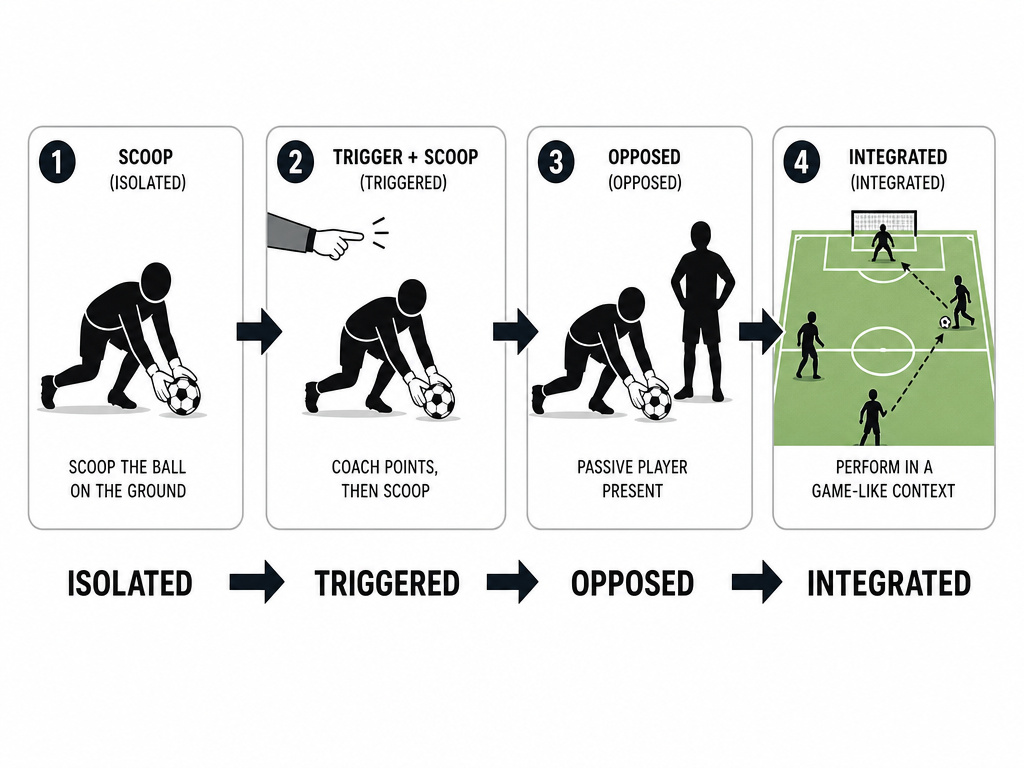
Knowing the components is one thing. Assembling them into a coherent plan is another. That 2021 study of expert coaches showed the majority apply a steady progression from simple to complex tasks. Your weekly training should reflect that.
Start with the raw technique. A session might begin with 15 minutes of pure “Scoop” technique off a soft roll from a coach. Then, add a trigger: the coach points left or right before rolling. Then, add a passive attacker to navigate. Finally, put it in a small-sided game where coming to claim a low cross is an option among many. That’s the progression: isolated → triggered → opposed → integrated.
Common mistake: Only training what you’re good at. It’s satisfying to nail dive after dive to your strong side. But the improvement is in the weak side, the weaker foot, the less comfortable scenario. Seek out the drills that make you slightly awkward.
Age dramatically changes the focus. For a young keeper, the FIFA Futsal manual’s emphasis on fun, game-based learning is perfect. It’s about joy and basic coordination. For a teenage academy keeper, the balance shifts toward the intense technical repetition of the UEFA model, building that vast library of movement. For an adult amateur, it’s about shoring up weaknesses and tailoring training to the specific demands of your league, maybe more cross-handling and less playing out from the back if your team doesn’t practice it.
Periodization matters, too. The Sage study noted training must adapt to the significant differences in game nature between age categories. Every block of training should have a clear goal related to specific technical or tactical aspects of goalkeeping.
How to Save a Penalty Kick
Your starting position is everything. Adopt a strong set position: feet shoulder-width apart, weight on the front half of your feet and slightly forward, with knees slightly flexed. Keep your head still, your chest square to the ball, and your hands in front of your bodyline, approximately ball-width apart. Prepare your hands early. As the striker runs up, watch the ball closely. You must decide quickly. Commit fully to your chosen side with a powerful dive, leading with your hands to bring your bodyweight forward. The key is a explosive, decisive movement from a perfectly balanced base.
Frequently Asked Questions
What is the most important skill for a goalkeeper?
According to a 2025 study of 14 expert coaches published in Sage Journals, there is no single most important skill. All coaches agreed that to reach the highest level, a goalkeeper must excel in all four key areas: athleticism, technical skill, mentality, and decision-making. Being world-class in one area cannot compensate for a deficiency in another.
Is 5’10” too short to be a professional goalkeeper?
While a 2025 expert study noted a preference among many professional academies for keepers over 186cm (about 6’1″), height is not an absolute barrier. The same study recorded coaches who argued talent and performance can override height, citing iconic shorter professionals. The modern game values explosive power, passing ability, and decision-making alongside reach. Excellence in multiple domains can overcome a perceived height disadvantage.
How do I improve my decision-making as a keeper?
You improve decision-making by expanding your library of game experiences, both real and simulated. As the UEFA Goalkeeper Coaching Manual explains, consistent decisions rely on the brain automatically recognizing “situational cues” from past practice. Train in game-realistic scenarios where you must read the passer’s posture, the positioning of attackers, and the flight of the ball to choose whether to come, stay, dive, or deflect. Over time, these decisions become instinctual.
What should a beginner goalkeeper practice first?
Beginner should first master the “Set Position”, the balanced, ready stance, and the basic “Scoop” catching technique for low balls. These fundamentals, outlined in The FA’s coaching manual, form the platform for every other skill. Focus on quality repetitions in a low-pressure environment to build confidence and muscle memory before adding complexity or power.
How often should a goalkeeper train?
The frequency depends on age and level. A youth keeper will have multiple technical sessions a week alongside team practices. An academy or professional keeper will have a high-frequency, periodized training schedule. The key principle from expert studies is progressive overload: steadily increasing the complexity and demand of training tasks to force adaptation without causing burnout or injury.
Before You Go
The path to becoming a better goalkeeper isn’t found in a single magic drill or a secret stance. It’s in the commitment to a layered process. It’s in the patience to do the simple footwork drills until they’re automatic, so in a game, your brain is free to scan the striker’s hips. It’s in the courage to practice your weak-side diving technique until it’s as reliable as your strong side, removing a tell for penalty-takers.
Start with your next training session. Pick one gap. Maybe it’s the positioning as a cross comes in, are you a step too deep? Maybe it’s the first touch from a back-pass. Work on that one thing with the same intensity you’d work on a spectacular dive. The beautiful game rewards that kind of patience.
Then, watch a match differently. Don’t just watch the keeper when the shot flies. Watch them in the 20 seconds before. Watch their feet, their head, their constant, quiet dialogue with their defenders. You’ll start to see the art in the anticipation, the strategy in the silence. And you’ll know exactly what to work on next.
