
How to Catch a Football as a Goalkeeper: Step-by-Step
This post contains affiliate links. As an Amazon Associate, we earn from qualifying purchases.
To catch a football as a goalkeeper, you master three techniques by ball height: the W catch for waist height and above, the Cup (or basket) for mid-height, and the Scoop for low balls. The core principle is ‘soft hands, strong wrists’, cushioning the ball’s pace with your arms and body, making contact 15–18 inches in front of you, and keeping your eyes on the back of the ball until it’s secured.
That “15–18 inches” spec from the FA and Leighton United manuals is the whole game. It’s the difference between the ball hitting your locked-out fingers and spilling forward, and it arriving into a prepared, shock-absorbing frame. Get that distance wrong, and everything else, the hand shape, the footwork, becomes a scramble. This principle is fundamental to how to catch a football as a goalkeeper.
What follows is the breakdown of each catch: when to use it, the exact mechanics from primary coaching manuals on how to catch a football as a goalkeeper, and the specific, physical mistakes that turn a clean catch into a rebound goal. We’ll also tackle where the experts disagree, because even the basics have a debate at their core.
Key Takeaways
- Use the W catch for anything waist-high and above, forming the ‘W’ with thumbs and index fingers behind the ball and making contact 15–18 inches in front of your body to allow your elbows to flex as shock absorbers.
- For mid-height balls, use the Cup (basket) technique with elbows tucked, palms facing up, and pinkies close together, taking the ball securely into your midriff on impact.
- On low balls, employ the Scoop technique, collapsing at the knees into a ‘K’ position to get your body behind the ball and forming a basket with your hands to guide it into your chest.
- JB Goalkeeping advises that catch and protect should be two distinct actions. Secure the ball with your hands first; only then bring it into the protected position (forearms vertical, hands curled over the ball) to avoid bobbles.
- A common, critical error is jumping up or letting your weight fall backwards as you catch. Stay grounded, move forward into the ball, and keep your head still, watching it right into your hands.
The W Technique: For Balls Chest-High and Above
This is your bread and butter. The ‘W’ or contour catch, as defined by The FA and JB Goalkeeping, is for any ball from about waist height up to crosses and diving saves. It looks simple from the stands. Up close, it’s a geometry problem solved with timing.
Your hands need to be prepared early, with palms facing the ball, fingers spread, a fundamental step in how to catch a football as a goalkeeper. Your thumbs and index fingers form the ‘W’ shape behind it, this cradles the ball’s contour. The FA and Leighton United manuals are precise: contact needs to be made approximately 15–18 inches in front of your body. Why? This gives your slightly flexed elbows room to bend and act as ‘shock absorbers’, killing the ball’s momentum. If you catch it flush against your chest, the impact is harsh and the ball can bounce out.
For the W catch, the hands should be prepared with the palms facing the ball with the fingers spread and the thumbs forming the ‘W’ shape. The elbows need to be slightly flexed to act as ‘shock absorbers’ when contact is made. – The Football Association (FA) Technical Manual
Your eyes stay on the back of the ball all the way in. A common problem is the head retracting as you catch, which throws your whole balance off. Another error is not bending the elbows enough. This flattens the hand shape and allows the ball to hit the fingertips. You’ll hear that slap. Make contact with the ball approximately 15 – 18 inches in front of the body.
Where this goes sideways: Not adjusting for hand size. JB Goalkeeping points out that younger keepers or those with smaller hands should bring their wrists closer together, with thumbs almost parallel, for more stopping power. It’s a subtle shift from the classic wide ‘W’, but it closes the gap. It’s the kind of practical adjustment you won’t find in a one-size-fits-all guide.
The Cup Technique: Securing Mid-Height Balls
Balls arriving around your waist are awkward. They’re too low for a comfortable W catch and too high for a simple scoop. This is where the Cup or basket technique takes over. The mechanics are different, built for security over contour.
As the ball travels, get your body behind it with your chest square. Your hands prepare with palms facing up and fingers spread, your elbows tucked in close to your body. Think of making a basket with your hands, your pinkies almost touching. On impact, the ball is taken directly into your midriff, with your palms and body wrapping around it. The FA’s cue here is ‘soft hands – strong wrists’, you’re cushioning it, but also sealing it against you.
Common mistake: Trying to use the Cup (basket) technique for a high ball at your waist. JB Goalkeeping is adamant: keepers must get to the ball above their heads. Waiting for it to drop is an invitation for an attacker to nod it away.
The footwork beforehand is essential. Your feet need to be planted solidly just before the catch. A frequent error is the goalkeeper jumping up as they catch, or their bodyweight going backwards. Both make you unbalanced the moment the ball arrives. JB Goalkeeping advises moving forward into the ball and staying grounded, while The FA emphasizes avoiding unnecessary movement once the ball is struck.
The Scoop Technique for Low Balls
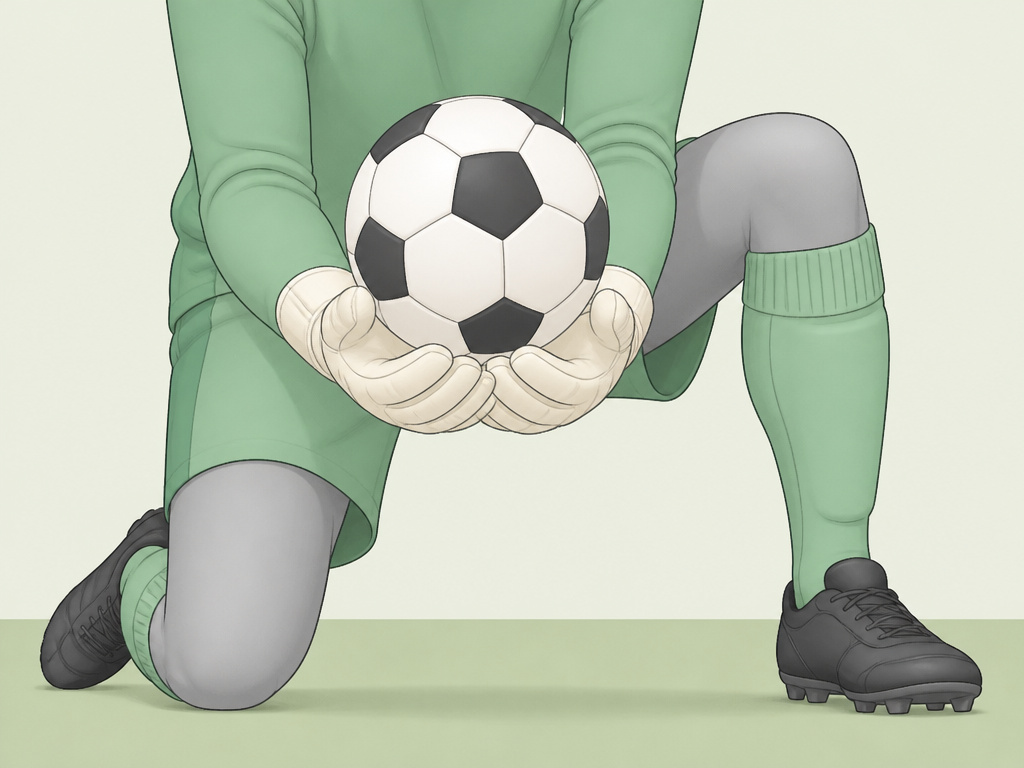
Low drives, hard passes along the ground, and shots that take a last-second bounce, these are the ones that squirm through. The scoop technique is your answer, and it starts with your legs, not your hands.
For a ball rolling or bouncing toward you, you collapse at the knees, dropping into what’s often called the ‘K’ position, one knee on the ground, the other foot planted, forming a ‘K’ shape with your legs. This gets your entire body behind the ball as a barrier. Your hands form a basket, similar to the Cup technique but lower, with your pinkies together and palms up, to guide the ball up into your chest and secure it.
For very hard, low shots, JB Goalkeeping notes the technique shifts for advanced keepers to a ‘front smother’, where you attack the ball more aggressively. But for the vast majority of situations, the controlled collapse of the scoop is the safe, repeatable play. The key is to get low early. If you’re still standing upright as the ball arrives, you’re just bending over, and that’s when it slips through your legs.
Hand Shape, Soft Hands, and the Cushioning Debate
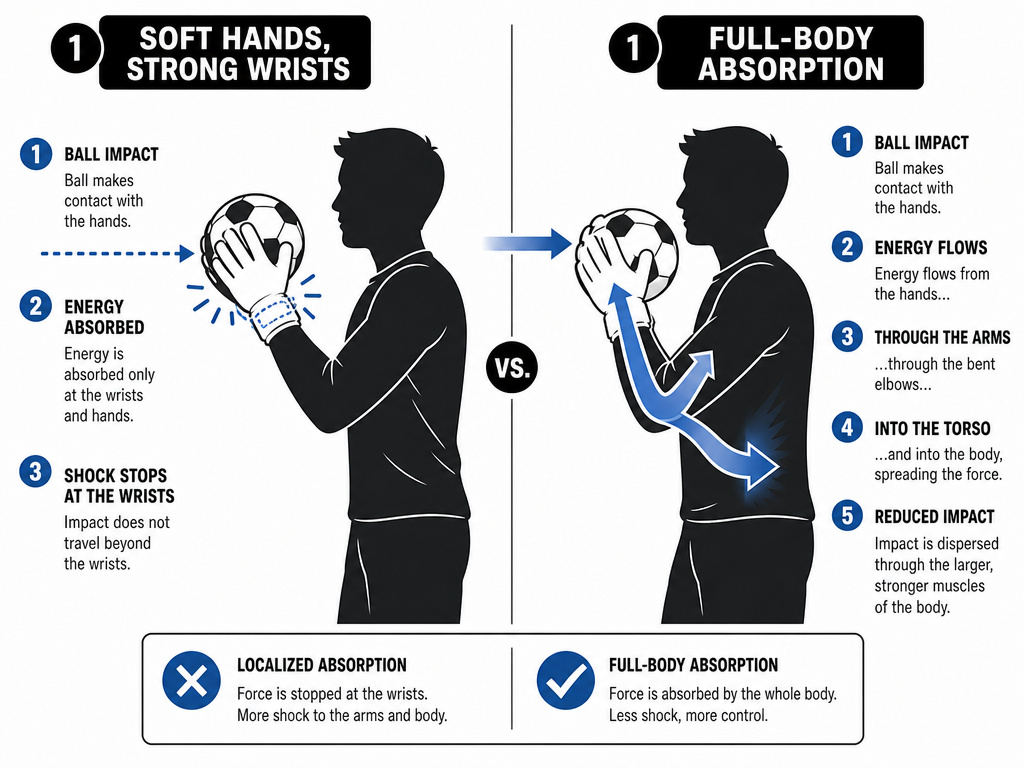
Everyone says you need ‘soft hands’. The disagreement is in how you achieve it. The FA’s mantra is ‘soft hands – strong wrists’. JB Goalkeeping expands it: a keeper must use their arms, back, and legs to cushion the ball, absorbing its energy. This isn’t just semantics; it points to two philosophies on absorbing pace.
One school emphasizes the immediate ‘stick’, catching the ball cleanly in the hands with a giving motion. The other acknowledges a fuller body absorption. The table below lays out the core disagreement and its practical implications.
| Point of Disagreement | The FA / Leighton United Position | JB Goalkeeping Position | Practical Implication |
|---|---|---|---|
| Cushioning Method | ‘Soft hands – Strong wrists’ (focus on hands/wrists) | Use arms, back, and legs to cushion (full-body absorption) | Younger keepers may need the full-body focus to understand the concept of ‘giving’ with the ball. |
| Catch vs. Protect | For the Cup technique, the ball is taken into the midriff (combined motion). | Catch/protect should be two distinct actions and sounds. | Rushing the protect action causes bobbles. Secure first, then protect. |
| Stepping Back | Once the ball is struck, avoid as little body movement as possible. | Don’t allow the keeper to take steps backwards to cushion. | Drills should emphasize moving forward onto the ball, not retreating. |
Another clear rule from JB Goalkeeping: do not bat the ball forward before catching it. You should be able to ‘stick’ the catch with your palms securing the ball into the midriff right away. Batting it is a panic move, a sign you weren’t ready or your positioning was off.
Catch First, Protect Second
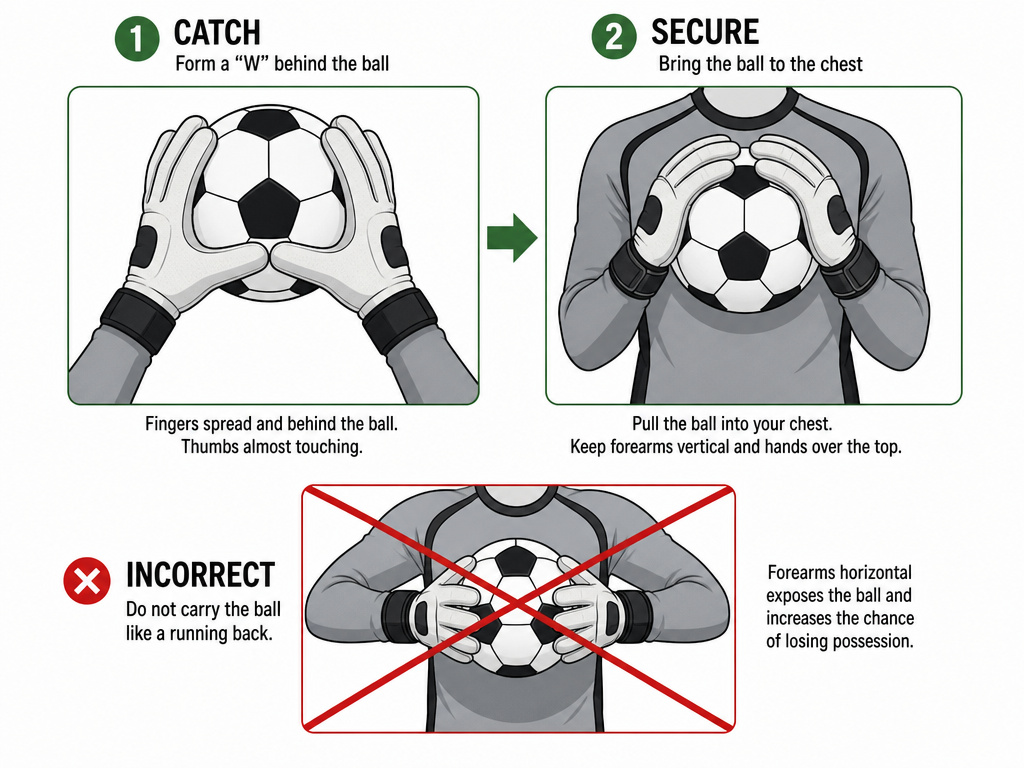
This is the most common technical flaw I see at grassroots level. A keeper makes a clean W catch on a lofted ball, and in one frantic motion, they immediately claw it down into their chest, often while still off balance. That’s how spills happen.
JB Goalkeeping is explicit: catch/protect should be two distinct actions. After making a clean catch, the next action should be to bring the ball to a protected position. The protected position itself is specific: both forearms vertical, with hands curled over the top of the ball. Your forearms should never be horizontal like a running back.
Why does this matter? Protecting too soon means you’re trying to control the ball with your chest and arms before your hands have fully secured it. The ball can ricochet away.
Drills to Build Unshakeable Hands
Theory is useless without the muscle memory. The best drills isolate a skill, then gradually add complexity. You can do most of these alone with a wall and a ball.
Start on your knees. Throw the ball against a wall and catch the rebound with the proper W or basket shape. Being on your knees removes your legs, forcing you to focus solely on hand shape, giving with your arms, and watching the ball in. From there, progress to sitting, then standing, and finally, incorporate footwork by moving side-to-side along the wall before playing it.
Worth knowing before you start: For high-ball practice, never get stuck catching at waist height. Insist on getting to the ball at its highest point, even in drills.
Partner drills are next. Have a server roll, throw, and eventually kick balls at you from various angles and heights. A great foundational drill is lying on your stomach; have a partner roll passes to you, forcing you to lift your hands and catch with proper technique before you can even think about using your legs.
These specific goalkeeper reaction drills are the bridge between static technique and match speed.
Adapting for Pressure, Weather, and Your Own Game
Technique is a blueprint. You modify it for the conditions on the pitch. On a wet day, the ball is slick. Your technique needs to be even more precise, catching the ball in the ‘sweet spot’ of your hands becomes critical.
Under physical pressure, like contesting a cross, the technique adapts. JB Goalkeeping advises that for high balls with pressure, the goalkeeper can raise the knee nearest the challenge for a boost in height and as a protective barrier. The crucial caveat? A goalkeeper should never raise their knee with intent to injure or ‘send a message’. It’s a tool for protection and elevation, not intimidation.
And your physique dictates your style.
Warm-up drills for catching/handling
Start every session by preparing the hands early. A simple warm-up involves a partner throwing the ball at you from a short distance. Focus on the core mechanics: keep your chest square to the ball, bring your hands forward of your bodyline, and make contact with the ball in front of you. Use soft hands with strong wrists. Practice both the ‘W’ shape for waist-high balls and the ‘cup’ with elbows tucked in for low shots.
Practice progressions (kneeling to standing, throws to kicks)
Begin on your knees to eliminate footwork and focus purely on upper-body form. A partner throws balls directly at you, allowing you to concentrate on making the catch with slightly flexed elbows acting as shock absorbers. Once this is consistent, move to a standing position from a short distance. Start with gentle throws to the chest, then progress to harder throws at various heights. Finally, incorporate kicks from a short distance, ensuring you adjust your footwork slightly laterally while in a set position to stay behind the ball before each catch.
Step-by-step or progressive catching drills
A foundational drill is the ‘catch and protect’ sequence. First, receive a thrown ball and focus solely on sticking the clean catch. Do not bat the ball forward first. Only after the ball is secured in your hands, perform the second, distinct action of protecting it by bringing your forearms vertical with your hands curled over the ball. Another drill addresses high balls: have a partner serve balls you must claim at the highest, safest point above your head, not waiting for it to drop to your waist.
Frequently Asked Questions
What is the most important thing for a goalkeeper to remember when catching?
Get your body behind the ball and make contact 15–18 inches in front of you. This allows your elbows to flex and absorb the pace. Everything else, hand shape, footwork, supports this one principle.
How can I stop the ball from bouncing out of my hands?
You’re likely not cushioning it effectively or are protecting it too soon. Focus on ‘soft hands’, let your arms, back, and legs give with the impact. Ensure your elbows are slightly bent on the W catch. And remember, catch first. Secure it with your hands completely before you try to bring it into your body.
Is it better to catch or punch a cross?
It’s a split-second decision based on traffic and pressure. If you can catch at the highest point cleanly, that’s ideal, it retains possession. But in a crowded box with bodies flying, a strong, two-fisted punch to clear height and distance is the safer, smarter play.
I have small hands. Will I always struggle?
Not at all. Adjust your technique. Bring your wrists closer together on the W catch, making your thumbs almost parallel. This closes the gap and gives you more stopping power. It’s a practical adjustment noted by JB Goalkeeping for younger keepers or those with small hands.
How do I practice catching on my own?
Find a wall. Start on your knees, throwing the ball against it and practicing your W and basket catches. Progress to standing, then add movement. You can also drop the ball from waist height and practice the scoop technique as it bounces back up. Consistency with these solo reaction drills builds unshakeable habits.
Before You Go
The real secret isn’t in the fanciest dive; it’s in the mundane repetition of a clean catch, thousands of times, until your hands do the thinking. That 15–18 inch cushion? Drill it until it’s muscle memory. The distinct catch-then-protect rhythm? Make it a habit in low-pressure practice so it holds up when the pressure’s on.
One rule I’ve come around on: if you’re consistently parrying shots in training that you could catch, stop. You’re building the wrong reflex. In matches, you’ll default to what you practice. Train to hold everything you can. That’s how you go from being a shot-stopper to a goalkeeper who owns their area.
