
Goalkeeper Substitution Rules in Football: The Edge Cases
This post contains affiliate links. As an Amazon Associate, we earn from qualifying purchases.
Under the goalkeeper substitution rules in football, a keeper can be replaced by a substitute or swapped with an outfield player during any stoppage, once the referee is told. Swap during play without telling the referee and both players get booked when the ball next goes out. Penalties carry one special exception: a keeper who can’t continue can be replaced.
That “once the referee is told” clause carries more weight than it looks. Skip it while the ball is moving and Law 3 books two players for one admin slip, even if the new keeper makes a brilliant save a few seconds later.
What follows: the ten-second exit clock, the shirt swap, the red-card scramble, the shootout loophole Louis van Gaal used, and England’s new keeper injury trial that the World Cup didn’t adopt.
Key Takeaways
- An outfield player can swap into goal at any stoppage, including after a penalty is awarded, as long as the referee knows first.
- A keeper being subbed has ten seconds to leave; miss it and the replacement waits for the first stoppage after a minute of play.
- The concussion protocol has no goalkeeper-specific clause, so it works for keepers exactly as it works for everyone else.
- England’s 2026-27 trial sends an outfield player off for at least a minute when play stops for keeper treatment. The World Cup had no sanction at all.
How Do Goalkeeper Substitution Rules in Football Actually Work?
A keeper comes off the same way as any other player, with one extra condition: the referee has to know before the change happens.
A goalkeeper substitution follows Law 3 of the IFAB Laws of the Game. The referee must be informed before the change, which takes place during a stoppage. The replaced goalkeeper becomes a substituted player and takes no further part, except where return substitutions are permitted. The change is complete only once the substitute enters the field.
That referee-first condition holds even in the tensest moments. IFAB’s own Law 3 FAQ covers a coach who wants a penalty-saving specialist on after a spot kick is awarded. It’s allowed, provided the team still has substitutes and substitution opportunities left and the referee is told before the swap.
Squad limits are a competition matter. The wider substitution rules for each tournament set how many subs you get, how many windows you get to use them in, and what extra time adds. Check the competition’s regulations, because they differ.
Keepers used to get special treatment here. Substitution rules, including how goalkeepers can be replaced, have changed over the years. The Wikipedia entry on football substitutes lays out that timeline if you fancy the history.
Here’s the procedure, in order:
- Tell the referee or fourth official first. Skip this with an outfield swap during play and both players are cautioned at the next stoppage.
- Wait for a stoppage in play.
- The outgoing keeper leaves within ten seconds of the board going up, at the nearest point on the boundary line unless the referee allows another exit. Late, and the replacement is stuck waiting for a minute of play.
- The replacement enters only on the referee’s signal. Until they actually step onto the field, the substitution isn’t complete, so the team can still change which sub it uses.
I find that last point catches fans out more than anything else. The board going up is a request, and the change only counts once the new player crosses the line.
One more wrinkle, and it’s my favourite. Return substitutions exist only in youth, veterans, disability and grassroots football, and only when the national FA, confederation or FIFA agrees. I think that’s exactly right for junior football. A nervous kid in goal sometimes just needs a few minutes on the bench to stop shaking.
Ten Seconds to Leave, One Minute to Wait
Ten seconds. That’s how long a player being substituted has to get off the field once the board goes up, according to IFAB’s Law 3 FAQ.
For a goalkeeper, this creates an odd bit of geometry. The keeper leaves at the nearest point on the boundary line, which is the goal line a few strides behind them. The replacement is waiting near halfway. So the goal sits empty during the long jog in, and that’s the bit worth watching next time it happens.
Ten seconds also goes quicker than it sounds. When the fourth official’s board lights up, a keeper peeling off his gloves on the walk has burned half of it before reaching the line.
Easy to miss: Missing the ten seconds doesn’t book the slow walker. Play restarts, and the substitute can come on only at the first stoppage after one minute has passed since the restart. A ten-second dawdle can cost a full minute or more.
There’s no caution for being late unless the delay is excessive. IFAB’s law changes list “delaying leaving the field of play when being substituted” among the ways a player gets booked for holding up a restart.
So who keeps goal during that minute, if the slow walker was the keeper? Honestly, I can’t give you a clean answer. None of the sources I worked from spell it out, and I’d rather admit that than guess.
The same exit clock now runs in England too. World Soccer Talk reports a maximum of ten seconds to exit as part of the package English competitions adopted this season. By its account, that package debuted on Saturday 1 August in the Carabao Cup preliminary-round tie between Tranmere Rovers and Rochdale.
Swapping an Outfield Player Into Goal Without Two Yellow Cards
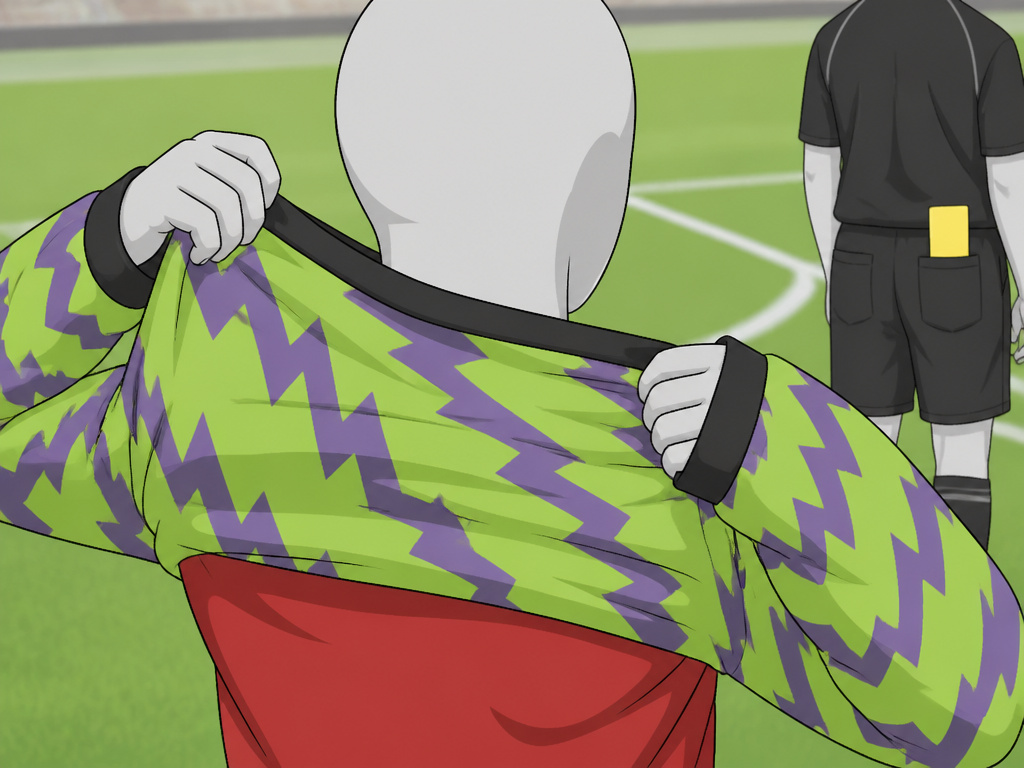
A centre-back pulls the keeper’s shirt over his own, sleeves flapping past his knuckles, and jogs to the six-yard box. Whether that ends in a booking depends entirely on when it happened and who knew.
With the Referee Told, During a Stoppage
This is the clean version. Any player can change places with the goalkeeper if the referee is told beforehand and the change happens during a stoppage. That includes after a penalty is awarded and before it’s taken, so a team that fancies an outfield player’s reflexes at a spot kick is allowed to try.
Mid-Play, Without a Word
The referee allows play to continue, then cautions both players at the next stoppage when the ball goes out of play. If the referee wrongly stops the game to deal with it, play restarts with a dropped ball.
The IFAB FAQ gives a lovely example. The new keeper tips a shot over the bar, so the restart is a corner, and both players see yellow before it’s taken. My reading of why play continues: stopping it would hand the rule-breaking team a free breather.
At Half-Time
A swap made during the interval without telling the referee, and only spotted after the second half starts, gets no yellow cards. Play continues and the matter is reported to the appropriate authorities.
| Situation | What Law 3 says | Cards? |
|---|---|---|
| Swap announced, during a stoppage | Allowed, even before a penalty | None |
| Swap mid-play, referee not told | Play continues | Both booked at next stoppage |
| Swap at half-time, spotted later | Play continues, matter reported | None |
| Keeper hurt, no subs left | Outfield player takes over, distinct shirt | None |
| Keeper sent off | New keeper needed before restart | Red already shown |
The shirt matters more than it looks. Law 3 says a stand-in keeper must wear one that clearly distinguishes them from the other players and the match officials, and that’s where goalkeeper kit rules stop being trivia.
I’ve always had a soft spot for keeper shirts from the 1990s. Neon that clashes with itself, zigzags, patterns that belong on an old computer screen. Nobody pulling one of those on mid-match was ever going to be mistaken for a defender.
Red Card or Injury With No Subs Left: Who Goes in Goal?
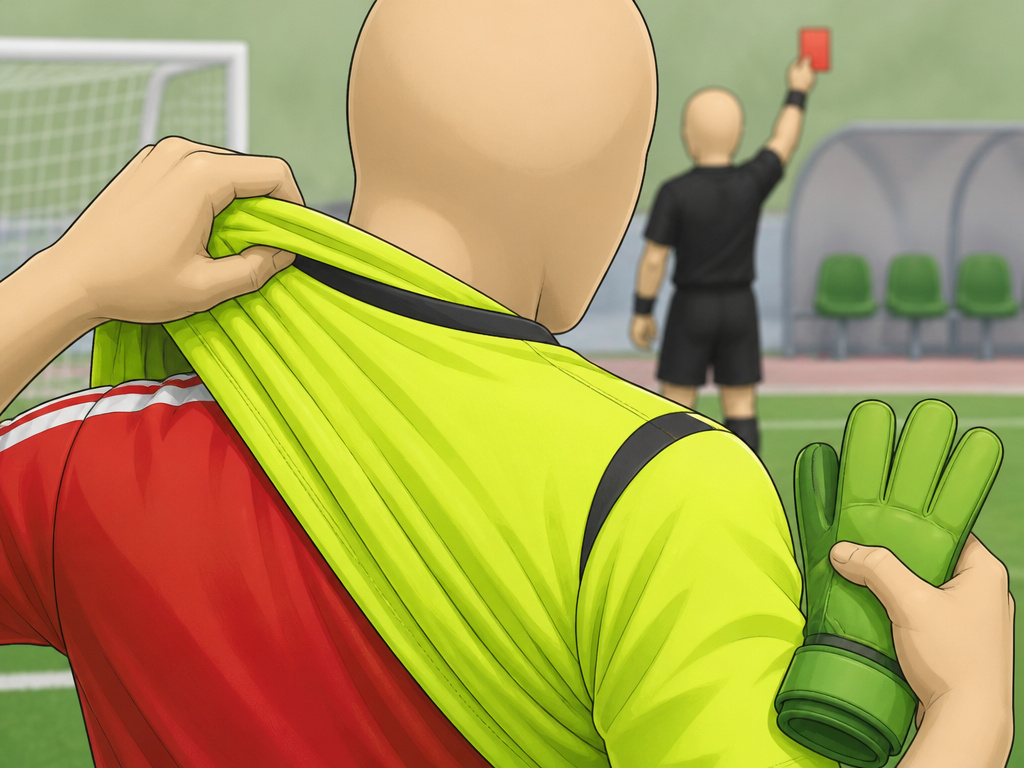
Law 3 doesn’t negotiate on one point: the team must have a goalkeeper.
If the keeper is sent off, the team needs a new one before play restarts. That’s either a substitute or one of the players still on the field. Bring a sub keeper on and an outfield player has to make way, because the sent-off keeper can’t be replaced. My pick is the most attacking player on the pitch. Ten men chasing a game rarely need two forwards.
VAR adds a twist. If the referee downgrades the red card to a yellow after a review, and play hasn’t restarted, the team is allowed to cancel the goalkeeper substitution. The FAQ says this fits both the spirit and the letter of the law, since the swap only happened because of the referee’s error.
Injury with the bench empty is simpler and grimmer. One of the remaining players takes over in goal and changes into a distinguishing shirt.
Brighton lived this against Newcastle. Robert Sanchez was sent off late with every substitute already used, and Lewis Dunk ended up in goal. It shows how much of the role of the goalkeeper is trained instinct a centre-back simply hasn’t built: footwork, catching angles, when to come off the line.
Name your emergency keeper before kick-off. A team that picks one in the middle of a red-card row loses the argument and the clock at the same time.
One small extra. If the new keeper also becomes captain in a competition using the “Only the captain” guidelines, the referee must be told which outfield player will approach the referee instead.
The Penalty Shootout Exception Van Gaal Used (and Couldn’t Repeat)
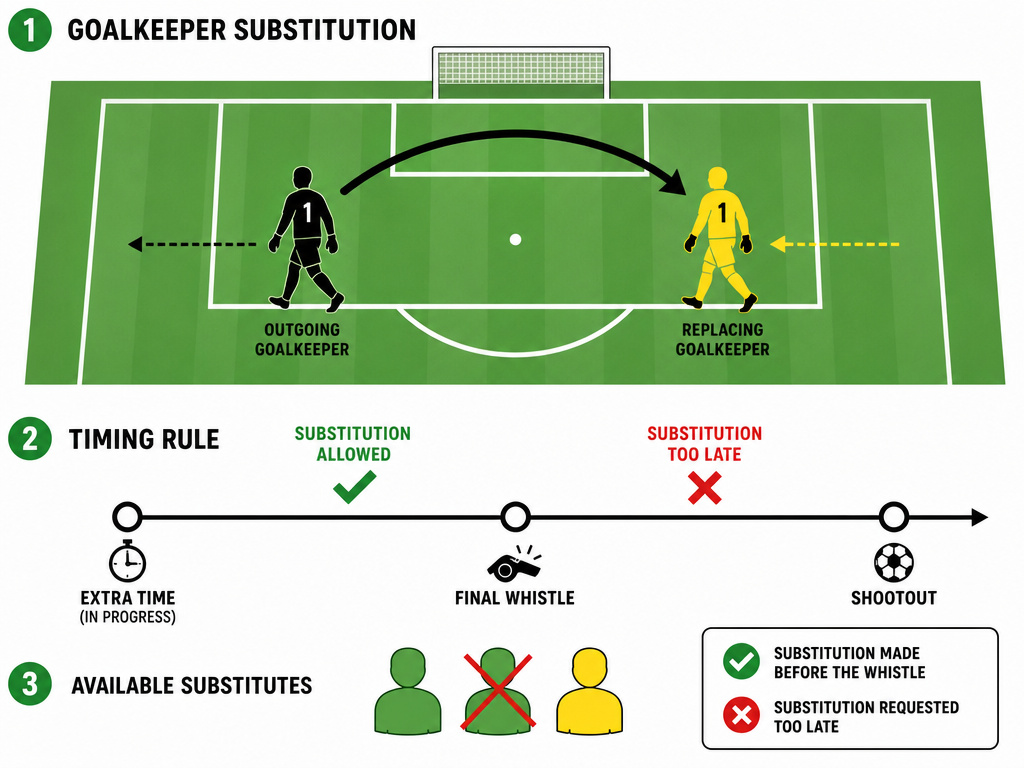
The Tim Krul swap gets retold as tactical genius. The law behind it is narrower than the legend suggests.
The Tactical Shootout Keeper
Rewind a second. At the end of extra time in the World Cup quarter-final against Costa Rica, Louis van Gaal sent Krul on for Jasper Cillessen. Krul saved from Bryan Ruiz and Michael Umana, and the Netherlands went through on penalties. The Al Jazeera Krul substitution match report captures how strange it felt at the time.
The move worked because the Dutch still had a substitute to use. In the semi-final against Argentina, they didn’t, and they lost the shoot-out. Same manager, same idea, no bench left.
Timing is the trap. Only players on the field, or temporarily off it, when the match ends can take part in the penalties. A substitution requested before the final whistle but not made before the end of extra time can’t be made before the shoot-out.
The Injured Shootout Keeper
Law 3 carves out exactly one exception: a substitute for a goalkeeper who is unable to continue. That’s the only person who can join the shootout after the final whistle.
Does that apply when a team has already used every substitute? The FAQ text I worked from doesn’t spell it out, so check the competition’s regulations before you argue it in the pub.
I’d only make a Krul-style swap with a sub definitely in hand and a bench keeper whose penalty record you actually trust. Without both, it’s theatre that leaves your starter cold and insulted.
Honestly, the endless arguments about keepers creeping off the line at penalties get more airtime than they deserve. The swap decision shapes a shootout before a ball is kicked.
Concussion Substitutes: The Keeper Route Nobody Plans For
On 2 March 2024, at the 138th IFAB AGM in Scotland, the lawmakers approved additional permanent concussion substitutions. Competitions choose whether to use them.
The concussion substitutes work like this, per the IFAB protocol:
- A concussion substitution doesn’t count as a normal substitution or substitution opportunity.
- It can be made regardless of how many substitutes are already used.
- The opponent gets an additional substitute plus an additional opportunity, usable only for that extra player.
- A normal change made at the same moment still counts as one of the team’s normal opportunities.
- Once normal opportunities are gone, a team can’t dress up a normal change as a concussion one. The referee or fourth official is ideally told with a substitution card of a different colour.
Now the goalkeeper angle. The protocol has no clause about keepers at all, so a concussed keeper is handled exactly like a concussed winger. That means a team with its normal subs used up still has a route to bring on the bench keeper, rather than shoving a defender into gloves.
I think this is the most underused line in the goalkeeper laws, mostly because it isn’t in the goalkeeper laws. Where a competition hasn’t adopted the protocol, though, that route doesn’t exist.
Why Does England Send an Outfield Player Off When the Keeper Gets Treatment?
Ever watched a keeper sit down, wave for the physio, and every outfield player drift to the bench for a team talk? The Premier League described exactly that habit when explaining its new trial.
For the 2026-27 season, English football has IFAB approval for a goalkeeper injury trial. Per the Pro Ref statement reported by Liverpool FC, when play stops for a keeper injury, the manager must nominate an outfield player to leave for at least one minute from the restart. The stated aim is to keep genuine injuries treated while removing any sporting advantage.
The World Cup went the other way. In Sky Sports coverage of IFAB changes, FIFA’s Pierluigi Collina said referees had no sanctions available and IFAB took no decision. His promise instead: “We will not allow the teams going to the benches when a goalkeeper is lying on the ground injured.”
| Question | World Cup 2026 (Sky Sports) | English trial 2026-27 |
|---|---|---|
| Who leaves when the keeper is treated? | Nobody; referees act proactively | A nominated outfield player |
| How long? | Not applicable | At least one minute (LFC) |
| Sanction available? | None, per Collina | The player’s enforced absence |
| Who runs it? | IFAB, FIFA referees | Pro Ref (LFC) or PGMOL (World Soccer Talk) |
The two English reports don’t fully agree, and you should know where:
- Competitions: Liverpool FC’s report lists Pro Ref, The FA, Premier League, EFL, WSL Football and the National League, across the men’s and women’s professional game. World Soccer Talk names the Premier League, EFL, major FA cup competitions and the WSL.
- Exceptions (Liverpool FC): a foul on the keeper who needs treatment straight away, a keeper colliding with an outfield player, or a bleeding keeper.
- Extra exceptions (World Soccer Talk): the keeper says they don’t need the physio and didn’t cause the stoppage, or a serious injury or concussion forces a substitution.
Where this goes sideways: A team assumes the English trial applies abroad. It’s a national trial, so the same keeper-down routine in a World Cup match brought no forced exit, just a referee keeping players away from the bench.
This sits beside the 2025/26 change to Law 12. A keeper who holds the ball for more than eight seconds, with a visual five-second countdown from the referee, now concedes a corner, replacing the old six-second indirect free kick. IFAB decided it unanimously at the 139th AGM in Belfast. In my view these handling limits shape time-wasting far more than anything that happens on a substitution board.
Can a Goalkeeper Refuse to Be Substituted?
The referee won’t drag anyone off. Law 3’s FAQ answer to a player who refuses is short: play continues.
Kepa Arrizabalaga proved it in a Carabao Cup final, refusing to make way for Willy Caballero late in extra time after cramp. Chelsea fined him afterwards. The laws list delaying leaving the field when substituted among cautionable delays, but an outright refusal simply means the game goes on with the same keeper.
The bench does keep one lever. Since the substitution isn’t complete until the replacement enters, the team can call it off or switch to a different sub before that point.
How many substitutes can a team use, and how often?
The cap on substitutes and the number of substitution opportunities are set by each competition, so check the regulations for the tournament or league you follow. A goalkeeper swap is treated like any other change. It uses one of the team’s substitutes and, if made during play, one of its opportunities. The referee must be told before it happens, and the replaced keeper takes no further part.
If a team has used everything it is allowed and the keeper cannot continue, an outfield player takes over in a shirt that clearly sets them apart. A substitute or substituted player who is sent off cannot be replaced, but that does not reduce the substitutions the team may make.
Concussion substitutions sit outside the normal count. They do not use up a normal substitute or opportunity, and the opposing team gets an additional substitute and opportunity in return.
What are the substitution rules in extra time?
Whether unused substitutes carry into extra time, and whether a team gets an additional one, depends on the competition. The regulations will spell it out, so read them before a knockout tie rather than assuming. Coaches who plan a goalkeeper change should know exactly what is left in the bank.
The Laws do add one firm point for the penalty shoot-out. A substitution that was requested but not made before the end of extra time cannot be made before the shoot-out starts. Only players on the field, or temporarily off it, at the end of the match can take part.
The single exception is a goalkeeper who is unable to continue. In that case a substitute can come on to take over in goal. A specialist shoot-out keeper therefore has to be on the pitch before the final whistle.
How have goalkeeper substitution rules changed over time?
Substitution rules have changed over the decades, so check which edition of the Laws applied if you are reading about an old match. If you are reading about an old match, look up which edition of the Laws applied at the time, because the allowances and the rules around replacing a keeper may differ from today’s.
The changes keep coming. Permanent concussion substitutions were approved by IFAB, with an extra substitute and opportunity for the opposing team. The goalkeeper ball-holding rule was also changed, so a keeper who holds the ball too long now concedes a corner kick instead of an indirect free kick.
English football has also been given approval to trial a rule for goalkeeper injuries, aimed at stopping tactical timeouts. Always check the current Laws and your competition’s rules rather than relying on older articles.
Frequently Asked Questions
Can you substitute a goalkeeper?
Yes. A keeper can be replaced by a substitute during a stoppage if the team has substitutes and opportunities left and the referee is told first. Any outfield player can also swap into goal during a stoppage with the referee’s knowledge.
Can a player refuse a substitution?
Yes, in practice. The IFAB Law 3 FAQ says that if a player refuses to be substituted, play continues. Any punishment beyond a caution for excessive delay comes from the club, as Chelsea showed with Kepa.
Can a team make 6 substitutions?
Only through extra allowances on top of the normal count set by competition rules. A concussion substitution sits outside the normal limit, and the opponent then gets an additional substitute of its own. Whether extra time brings an additional substitute depends on the competition’s regulations.
What are the new rules for substitutes in football?
The headline change is the exit clock: a player being substituted has ten seconds to leave, and a late exit means the replacement waits until the first stoppage after a minute of play. In England, a 2026-27 trial also forces an outfield player off for at least a minute when play stops for keeper treatment.
Can a substituted goalkeeper come back on?
Only where return substitutions are allowed, which means youth, veterans, disability and grassroots football, with approval from the national FA, confederation or FIFA. In senior competitive football, a substituted keeper is done for the day.
Before You Go
If you coach any team, do one thing before your next match: name the outfield player who takes the gloves. Then tell them which shirt they’ll wear, because the referee needs a clearly different colour before play restarts.
The goalkeeper substitution rules in football reward planning more than nerve. Krul’s famous swap worked only because Van Gaal still had a sub in hand, and the same idea failed days later when he didn’t.
One caution on everything above. England’s keeper injury trial is national, and the two reports describing it disagree on exceptions and on who runs it. Watch a match abroad and you’re under a different set of rules entirely.
So who’s your emergency keeper: the tallest centre-back, or the striker who’s sure he’d be brilliant?
