
Concussion Substitutes in Football Explained: Who Decides?
This post contains affiliate links. As an Amazon Associate, we earn from qualifying purchases.
Concussion substitutes in football, explained in one line: a team can replace a player with an actual or suspected concussion without using a normal substitution, and that player can’t return, not even for penalties. Under IFAB’s current protocol each team gets one, the opponent gets an extra sub, and competitions choose whether to use it.
That no-return clause is the part football has argued about ever since. IFAB, the body that writes the Laws of the Game, says permanent removal is the safe option. The Premier League and 28 other leagues and player unions want a temporary version instead, with a 10-15 minute check off the pitch and the chance to come back.
What follows: how the rule runs on a matchday, four worked scenarios that settle the usual “does that count?” rows, who gets the final say, and the evidence each side of the temporary-sub fight leans on.
Key Takeaways
- The protocol is optional for competitions, so a league that hasn’t adopted it has no concussion substitute at all.
- The current Law 3 protocol allows one per team per match.
- The team decides, not the referee. Officials can only report suspected misuse to the authorities.
- The opponent’s extra sub can be used for any reason, but only for that additional player. It can’t hide a normal change.
- A peer-reviewed look at the 2020-21 Premier League season examined how permanent concussion substitutes were used and how often, and for how long, head collision events were medically assessed.
What Does a Concussion Substitute Actually Allow?
IFAB’s protocol allows a team to take off a player with an actual or suspected concussion and send on a replacement without touching its normal allowance. The player who comes off is done for the day.
An additional permanent concussion substitution removes a player with an actual or suspected concussion for the rest of the match, including any penalty shoot-out. The swap doesn’t count as a normal substitution or substitution opportunity. Each team gets one per match, regardless of how many substitutes the team has used, and the opposing team then gains one additional substitute.
Rewind a second, because the wording matters. The word “permanent” does the heavy lifting here. Once the player goes off, there’s no way back, even if he looks perfectly fine ten minutes later.
Here’s what the protocol actually lays down:
- One concussion substitute per team, per match.
- It can be made regardless of how many subs the team has already used, so a side that has emptied its bench still gets one.
- The opponent gets an extra substitute plus an extra substitution opportunity.
- No shoot-out for the removed player.
- Competitions opt in. Nobody is forced to use it, which is the detail that catches out more coaches and fans than any other line in the text.
All of that sits in IFAB’s additional permanent concussion substitutions protocol, a section attached to Law 3. It runs alongside the standard substitution rules instead of replacing them. Mixing the two up starts most of the arguments I hear in the stands.
I’ll admit one clause took me a second read. More on that in the scenarios.
The 17-Day Gap That Spoils the Neat Origin Story
Years ago I passed on a football story with a lovely, tidy ending, and it turned out somebody had polished it. Since then, any tale that lands too neatly gets checked twice. The usual origin story of the concussion sub is exactly that kind of tale.
On 29 November 2020, Arsenal hosted Wolves. Raul Jimenez fractured his skull after the two men clashed heads and needed surgery. David Luiz played on until half-time with a bandage wrapped around his head, and Arsenal said he’d passed the on-field tests. The brain-injury charity Headway said football was “gambling” with players’ safety.
That picture of a defender heading clearances in a blood-stained bandage stuck with a lot of people. It should have.
But look at the calendar. IFAB’s December 2020 trial announcement came on 16 December, 17 days later. The same release says the decision followed “less than a year of detailed consultation” and recommendations from the Concussion Expert Group and IFAB’s advisory panels. You can’t run that process in 17 days. The Arsenal match added urgency. The work was already underway.
Trials began in January 2021, and the rule changed shape before it became law. IFAB approved permanent concussion substitutes as a competition option at its 138th AGM at Loch Lomond, Scotland, on 2 March 2024.
| Detail | 2021 trial (Premier League) | Current Law 3 protocol |
|---|---|---|
| Concussion subs per team | Up to two | One |
| Opponent’s response | Same number of extra subs | One extra sub plus one opportunity |
| Status | Trial | Competition option from 1 July 2024 |
| IFAB approval | 16 December 2020 (trials) | 2 March 2024, 138th AGM |
Easy to miss: Under the current protocol it’s one, so check the date on anything you read before you quote it at a referee.
The Four Reasons IFAB Gave in 2020
IFAB’s principle was simple. Take the player off for good, but don’t leave his team a man down. The release listed four reasons:
- It stops a player picking up a second concussion in the same match, because repeat head injuries can have very serious consequences.
- It tells everyone that withdrawing a doubtful player costs nothing in numbers or tactics.
- Less pressure on medics to make a rushed call.
- It’s simple enough for every level, including the huge amount of football played with no doctor or medically qualified person on site.
That first reason ties into the wider worry about heading and brain health. A brain that has just taken one knock is in no state to take another. Permanent removal shuts that door completely.
Why Three-to-Five Subs Is a Separate Story
The jump from three subs to five came out of the pandemic. At that same December 2020 meeting, IFAB extended a temporary amendment to Law 3. It gave top-level competitions the option of up to five substitutes.
Concussion subs sit on top of whatever normal limit your competition uses. Five, three, it makes no difference.
Concussion Substitutes in Football Explained Through Four Match Scenarios
Four situations cause most of the touchline rows: an empty bench, a double change, a recycled player and late symptoms. Here’s how the protocol settles each one.
| Situation | Concussion sub allowed? | What the protocol says |
|---|---|---|
| All normal subs used, then a head knock | Yes | Allowed regardless of subs already used |
| Normal change made at the same moment | Yes, but the normal change counts | Uses up one normal opportunity |
| Named subs equal the normal maximum | Yes, a subbed-off player can return | Previously substituted player allowed, any time |
| Player assessed, went back on, symptoms later | Yes | Allowed after a return to the field |
The third row is the one that confused me. Picture a competition where you can name five subs and use five. Use all five and your bench is empty, so there’s nobody left to bring on. The protocol fixes that by letting you bring back a player you already took off.
The fourth row matters more than it looks. A player can pass a quick check, go back on and start struggling twenty minutes later. The protocol still allows the team to make the swap at that point.
The opponent’s side of the deal has its own catch. They get an additional substitute and one additional substitution opportunity, usable at the same time as your concussion sub or any time after. That extra opportunity covers only the additional player. A manager can’t fold normal changes into it to save a stoppage.
The protocol closes the other obvious loophole too. Once your normal opportunities are gone, you can’t dress up a tactical change as a concussion sub.
If you’re unsure whether a change counts, ask one question: is a player with a suspected concussion leaving for good? If yes, it’s the concussion sub. Any other change your team makes in that same stoppage is a normal one.
Nothing in the protocol limits the swap by position. If your keeper takes the knock, the concussion sub covers replacing the goalkeeper just the same, which is exactly what happened at the 2022 World Cup.
The 5-Step Touchline Sequence (and the Card Colour That Matters)
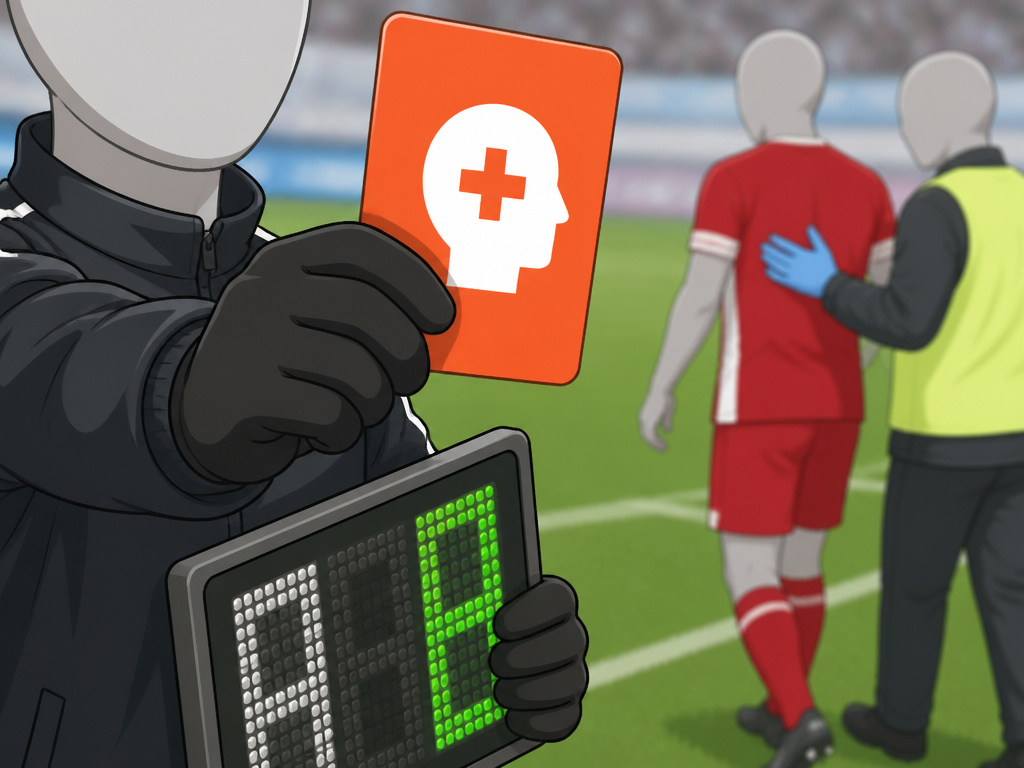
The sequence on the touchline in concussion substitutes in football explained terms is short, and every step has a reason behind it.
- The team decides to make a concussion substitution. If nobody on the bench makes that call, it simply doesn’t happen, because the referee isn’t allowed to make it for them.
- The team tells the referee or fourth official, ideally with a different-colour substitution card or form. The protocol says “ideally”, so it isn’t compulsory. Skip it and the swap looks like any other change to everyone watching.
- The player leaves and, where possible, goes with someone to the dressing room or a medical facility. Leave a groggy player alone on the bench and you’ve undone half the point of taking him off.
- The referee or fourth official tells the opponents they can use an additional substitute and an additional substitution opportunity. Without that message, the other bench has no reason to know the option exists.
- If officials think a concussion sub was made inappropriately, they inform the appropriate authorities. That report is the only check, since nobody on the pitch can block the swap.
A different-coloured card in the fourth official’s hand is a small thing. It tells everyone watching that this change isn’t tactical. Nobody in the stands has to guess.
Who Makes the Call, and Can a Player Refuse?

The referee has no say. Match officials “must not decide whether an actual or suspected injury qualifies” for a concussion substitute, and they aren’t part of the team’s decision-making at all.
So don’t bother shouting at the referee about it. They aren’t allowed to rule either way.
That leaves the team, and that’s where the sharpest criticism lands. Researchers writing in Injury Prevention noted that the decision still relies on team coaches, who may have motivations other than player health. In the NFL, by contrast, independent medical observers can order a player off.
A rule that leans on the people with the most to lose is like a joint held with glue that only works if nobody leans on the table. Fine on a quiet day. Under the pressure of a cup tie, less so.
Can a player refuse? The protocol frames the substitution as something the team decides. It doesn’t describe any sign-off from the player, and it doesn’t describe a player veto either. I’d love to give you a cleaner answer. The text simply doesn’t offer one.
Watch what happens when a player who wants to stay on gets his way. On 21 November 2022, Iran’s goalkeeper Alireza Beiranvand took a heavy blow early against England, had a long spell of treatment and carried on. Not long after, he left on a stretcher, the first concussion substitute in World Cup history. Wales’ Neco Williams also played on after a knock against England later that month before being replaced.
My take: the different-colour card should be the easiest card a manager ever holds up. The rule was written so that taking a doubtful player off costs the team nothing on the scoresheet. When a side still leaves a groggy player on, that’s a choice, and the law can’t make it for them.
Three Uses in a Season: What the 2020-21 Data Shows

Three. The Tarzi et al. Concussion substitution study in Injury Prevention examined how permanent concussion substitutes were used in the 2020-21 Premier League season.
They logged every head collision and whether medics checked the player.
| Measure | Before the rule | After the rule |
|---|---|---|
| Head collisions | 38 | 42 |
| Share medically assessed | 23.7% | 21.4% |
| Median assessment time | 81 seconds | 102 seconds |
None of those changes was statistically significant, meaning the gaps were small enough to be chance. In plain terms, the rule arrived and assessment habits stayed where they were.
Now set that against the tool doctors use for a full check. The Premier League backs temporary substitutes that allow a check-up of around 10-15 minutes off the pitch.
I’m a notebook-and-eyes watcher, not a data man, so I lean on studies like this to correct what I think I saw. Eighty matches is a small sample. Still, it’s the best look we have at whether the rule changed behaviour in its first season, and the answer was no.
Permanent or Temporary? Where Football’s Big Bodies Split
“Zero risk” is a bold phrase to put on any medical decision. It’s how FIFA president Gianni Infantino has described permanent substitutes, and it sits at one end of a long argument.
| Who | Position | Figure they cite |
|---|---|---|
| Gianni Infantino, FIFA president | Permanent subs ensure “zero risk” | None given |
| Dr Andrew Massey, FIFA medical director | Temporary subs return undiagnosed players | 16-25% false negatives |
| IFAB | Permanent subs are sufficient | Rejected trials at March 2023 AGM |
| Premier League plus 28 leagues and unions | Trial temporary subs, 10-15 minute check | 27-53% of diagnosed players not replaced |
| PFA | Temporary subs allow longer checks off the pitch | None given |
In the ESPN report on IFAB trial rejection, a FIFA medical figure put a number on the risk. He said temporary subs carry a false-negative chance of “anything in the region of 16-25%.” In his words, that means returning players whose concussion “hasn’t manifested itself yet.” ESPN also notes that IFAB has four FIFA seats and one each for the English, Scottish, Welsh and Northern Irish associations.
The other side points to different numbers. The Premier League says that under permanent-only rules, between 27% and 53% of players later diagnosed with concussion aren’t replaced straight away. The PFA said in 2022 that temporary subs would “allow for medical staff to conduct more detailed and lengthy checks of the potentially injured player away from the field of play.” FIFPRO, the world players’ union, has pushed for temporary subs for years.
Those two headline figures get mashed together constantly. They measure different things. FIFA’s 16-25% describes players a temporary system would wrongly send back on. The Premier League’s 27-53% describes concussed players left on under the current rule. One is the risk of a new system, and the other is a leak in the existing one.
What Rugby and the NFL Do Differently
Rugby union already uses temporary replacements, built around World Rugby’s head injury assessment (HIA), where a player leaves for a check and can return if cleared. The Premier League says returns to the field in rugby union fell from 58% to 8% after temporary replacements came in. It also says fewer than 2% of NFL players return.
Treat those as the Premier League’s figures, quoted to make its case. Rugby and the NFL have different medical staffing and different collisions, so the numbers don’t prove football would match them.
My view, for what it’s worth: trial temporary subs at the top level, where clubs have doctors on hand, and keep the permanent rule everywhere else. IFAB’s point about matches with no medic on site is the strongest argument in this whole debate. It just carries far less weight at a Premier League ground.
At the time of writing I haven’t been able to confirm what came of it. Be wary of anything claiming a settled answer.
Does the Rule Apply at Your Level?
Saturday morning, an under-12 game on a council pitch. A kid takes the ball full in the face, sits up and says he’s fine. No doctor, no physio, just a parent with a cold bag of ice going soft in the sun.
Whether that coach has a concussion sub depends entirely on the competition. The protocol is optional, and a league that hasn’t adopted it has no concussion sub at all. (My own muddy-pitch years were spent at right back, mostly chasing wingers I never caught, and I can’t remember a single touchline with a doctor on it.)
Where this goes sideways: Assuming the rules you watched on Sunday’s TV apply to your league on Saturday. If your competition hasn’t opted in, the extra sub doesn’t exist. A team with no normal subs left plays the rest of the match a player short.
Before the season starts, check three things:
- Whether your competition has adopted the protocol at all.
- Your normal substitution limit.
- Who on your matchday staff will watch for a dazed player, given there’s no medic.
FIFA committed at the 2024 AGM to a global campaign on recognising concussion symptoms and treating them properly. That matters most exactly here, where nobody medical is watching.
And the match is only the start. A player taken off with a suspected concussion still needs a graduated return to play before training or playing again, which sits outside this protocol entirely.
If you want one rule to carry into a grassroots game: where your competition has the concussion sub, use it the moment a head knock worries you. It costs your team nothing.
How is a concussion assessed during a football match?
Assessment starts the moment play stops after a head knock. The team’s own medical staff come on, check the player where they lie, and decide whether to help them off for a closer look away from the action. Match officials stay out of that call. Under the protocol the team decides, and referees only report a substitution that looks misused. A player who was checked and went back on can still be taken off later if symptoms appear, so a first all-clear is never final.
Video review in the Premier League trial is meant to support the medical team’s view of what happened. Exact working details vary, so check the competition’s own guidance. Research on top-flight football has looked at how often head collisions were assessed and how long the checks lasted, which shows why time pressure matters. A permanent substitute takes some of that pressure off the medical staff.
How do football’s concussion subs compare with rugby and cricket?
Football uses permanent concussion substitutes. The player leaves and does not return, and the opposing team gets an additional substitute option. Rugby union works differently, because players come off for a check and can return if cleared. The Premier League says that since temporary substitutes arrived in rugby union, the share of athletes returning to the field fell from 58% to 8%. That is the league’s own claim, so treat it as one side of the argument. A FIFA medical figure points the other way, citing a false-negative chance of about 16-25% for temporary systems, which means roughly one in four concussed players could go back on.
Cricket also allows a replacement for a concussed player, but the specifics vary by competition, so check the current playing conditions before comparing. Football’s version is simple enough to run in games with no doctor on site, which is the reason IFAB gives for its approach.
Frequently Asked Questions
How does a concussion sub work in football?
Team takes off a player with an actual or suspected concussion and brings on a replacement that doesn’t use a normal substitution. The player can’t return, including for a penalty shoot-out. The opposing team then gets the option of one extra substitute of its own.
Can a player refuse a concussion substitution?
IFAB’s protocol treats the decision as the team’s, and the referee isn’t allowed to rule on whether an injury qualifies. The text doesn’t describe a player veto. In practice, the bench makes the call, not the player or the referee.
Why did football go from 3 to 5 substitutes?
Five subs began as a temporary amendment to Law 3 during the pandemic, giving top-level competitions the option of up to five. IFAB extended it in December 2020. Concussion subs are a separate allowance on top of whatever normal limit a competition uses.
Does a concussion sub count toward a team’s normal substitutions?
No. It’s separate from the normal allowance and can be made even after every normal sub is used. The catch is that any normal change made in the same stoppage still counts as a normal opportunity.
Can the opponent use its extra sub for tactical reasons?
Yes. The opposing team can use its additional substitute for any reason, at the same time as the concussion sub or later. The extra opportunity covers only that additional player, so it can’t be used to bundle in normal changes.
Before You Go
If you coach or run a team, open your competition’s rules before the next fixture and check one line: has it adopted the additional permanent concussion substitutions protocol? If it hasn’t, you have no concussion sub, whatever you watched on television.
Everything here about concussion substitutes in football explained rule by rule assumes the current IFAB protocol. That changes the day IFAB approves a temporary-sub trial, and the 2026 request is the one to watch.
I’ll stick my neck out on the bigger fix. I’d rather see an independent doctor with the power to order a player off than any return window run by a club’s own staff, because the study data says the people making the call haven’t changed their habits.
So which would you change first: the rule, or the person holding the card?
