
Concussion in Football Explained: What Actually Happens
This post contains affiliate links. As an Amazon Associate, we earn from qualifying purchases.
A concussion in football is a traumatic brain injury (called a Sport-related concussion or SRC) caused by a direct blow to the head, neck, or body that transmits an impulsive force to the brain. Symptoms like headache, dizziness, or confusion may appear immediately or evolve over hours, and standardized protocols from bodies like FIFA and the NFL mandate immediate removal from play and a structured return process. The key mechanics are functional, not structural, standard brain scans appear normal, but the brain’s chemistry and communication are disrupted.
That functional disruption is what makes the injury so deceptive. A player can walk off the pitch talking sense, only to develop a crushing headache or memory gaps in the dressing room an hour later. The basic mechanism of a concussion in football explained, the protocols exist to catch that delayed onset, because the brain doesn’t always signal distress on the opponent’s schedule.
What follows breaks down the mechanics, the immediate signs every coach and parent must know, the step-by-step protocols that govern the professional game, and the sobering long-term data on repetitive impacts. You’ll finish with a clear action plan for the sideline and a realistic picture of the risks beyond the final whistle, all stemming from the concussion in football explained.
Key Takeaways
- Remove the player immediately if a concussion is suspected, the “when in doubt, sit them out” rule is mandatory, and both FIFA and NFL protocols ban same-day return.
- Symptoms can develop over several minutes, hours, or even days, so initial clearance on the pitch means nothing. Formal observation for that period is required at the elite level.
- Loss of consciousness is not required for diagnosis. Visible signs like a blank stare, clumsiness, or disorientation are just as significant.
- Multiple concussions increase recovery time, a study of college football players found 30% of those with 3+ concussions took over a week for symptoms to resolve, versus 15% with one.
- Return is a graduated process, not a single medical check. It requires completing a multi-stage, symptom-free protocol under supervision.
What Actually Happens in a Concussion?
Forget the Hollywood image of someone seeing stars. A concussion is a cascade. A hit to the head or a whiplash impact from a shoulder charge makes the brain accelerate and then decelerate inside the skull. This sudden movement stretches and strains the brain’s neurons, triggering a chemical imbalance. Energy production in the cells plummets while the demand for energy to restore balance soars.
This mismatch, a metabolic energy crisis, is why cognitive rest is prescribed. The brain is working overtime to heal while running on empty.
You won’t see this on a standard CT or MRI scan. That’s the defining clinical feature: it’s a functional disturbance, not a structural one like a bruise or bleed. The player might look fine. Their coordination might seem okay. But their brain is trying to recalibrate a suddenly faulty system, and pushing it with physical or mental exertion during this window can prolong symptoms. The initial hit might come from an elbow, a clash of heads going for a aerial ball, or even the whiplash from a heavy fall onto the turf.
Recognizing It: Signs, Symptoms, and the “Red Flags”
The challenge is that concussion presents differently in every person. Some players go quiet. Some get irritable. The most reliable approach is to know the checklist used by professional spotters. The NFL’s 2017-18 protocol, still a cornerstone of sideline evaluation, splits them into observable signs and reported symptoms.
Observable Signs (What You See):
- Loss of consciousness (even brief).
- Impact seizure or posturing of the limbs.
- Being slow to get up after a hit to the head.
- Motor coordination problems: stumbling, tripping, or labored movement.
- A blank or vacant look.
- Disorientation, like not knowing where the bench is.
- Clutching the head immediately after contact.
- Any visible facial injury combined with the above signs.
Common Symptoms (What the Player Reports):
- Headache
- Dizziness or balance issues
- Nausea
- “Feeling foggy” or cognitive slowness
- Sensitivity to light or noise
- Ringing in the ears (tinnitus)
- Visual disturbances
The critical point is that only one sign or symptom is needed to trigger the protocol. A player doesn’t need to be knocked out. That blank, vacant look, where the lights are on but nobody’s home, is one of the most common tells in football. I’ve seen it from the stands: a player gets up, takes two steps, and just stops, staring into the middle distance while play goes on around him. That’s a concussion nine times out of ten.
When It’s an Emergency: The “Red Flags”
Some signs point to a more severe structural injury and require immediate emergency transport. The 2024 FIFA protocol mandates an urgent CT scan on the day of injury if any of the following are present:
- Glasgow Coma Scale score below 13 (or below 15 after two hours).
- Suspected skull fracture.
- More than one episode of vomiting.
- A post-injury seizure.
- Loss of consciousness.
- Persistent inability to form new memories (anterograde amnesia).
- Any focal neurological deficit, like weakness on one side.
| Symptom/Sign | Typical Concussion | “Red Flag” Emergency |
|---|---|---|
| Headache | Common, often worsening | Extremely severe, “worst ever” |
| Vomiting | Possible (once) | More than one episode |
| Consciousness | May be maintained | Loss of consciousness |
| Memory | Temporary confusion | Persistent amnesia |
| Neurological | Dizziness, imbalance | Weakness on one side, seizure |
The 72-Hour Rule: Why Immediate Removal Isn’t the End
Getting a player off the pitch is just the first step. The real protocol begins in the dressing room and continues for days. Here’s where the sources show a clear disagreement on timing, which is important for anyone following the guidelines to understand.
The 2024 FIFA Concussion Protocol states that all players who have suffered a (suspected) concussion should be observed for 72 hours by the team doctor. The logic is that symptoms “can develop with latency.” The doctor is supposed to assess the player daily during this period.
However, a 2022 study focusing on high-level football recommended that a player removed from play or who develops symptoms should be re-evaluated within 72 hours by a physician. It also noted clinical signs can develop over “several minutes, hours, or even days.”
Where this goes sideways: Clearing a player at halftime because they “feel fine.” The metabolic crisis in the brain can take hours to manifest as a debilitating headache or cognitive fog. A player passed fit too early is a player at risk of a second impact.
So, what’s the takeaway for a grassroots coach or parent? The 72-hour observation period from FIFA is the gold standard for a reason. It’s a safety net for that delayed onset. In practical terms,, followed by close monitoring for any symptom flare-ups over the next three days. The return to play process only starts after this period, and only if the player is symptom-free at rest.
Inside the Professional Protocols: NFL vs. FIFA
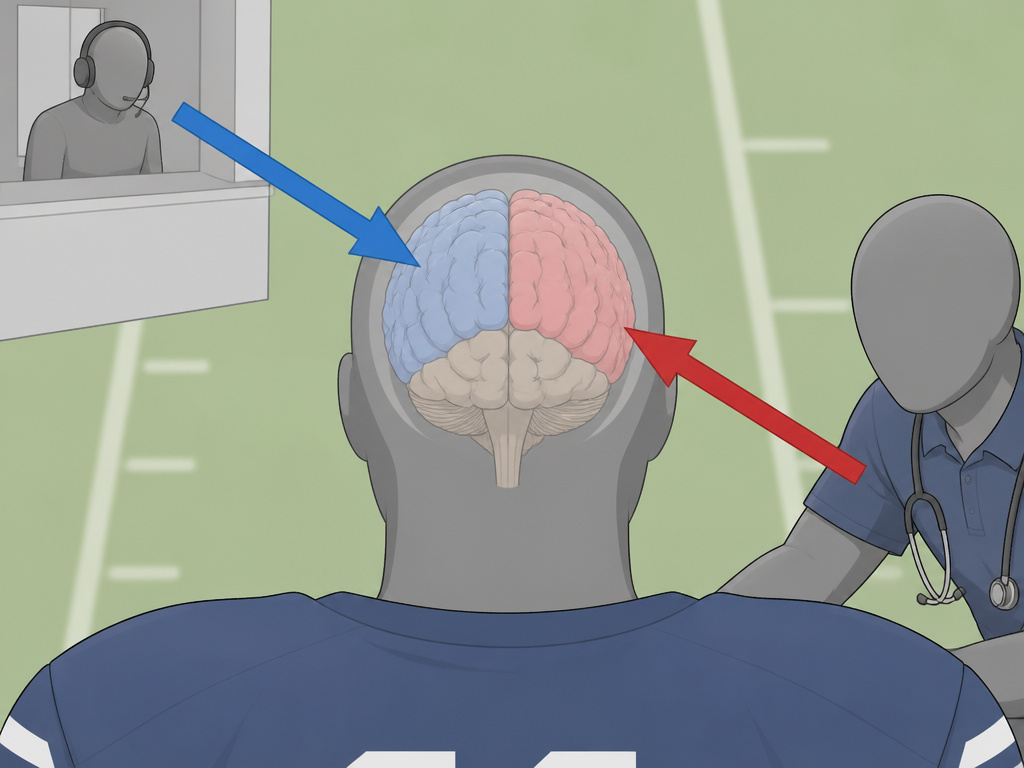
Elite football has built sophisticated systems to catch what the naked eye might miss. While the core principle, “suspect and protect”, is identical, the machinery differs.
The NFL’s Web of Spotters
The NFL system is a network of redundancies. It includes:
- Booth ATC Spotters & Unaffiliated Neurotrauma Consultants (UNCs): Positioned above the field with access to all broadcast angles, they radio down to the sideline if they see a potential concussion mechanism or sign.
- The Medical Timeout: If a player flagged by the booth returns to play before an evaluation is confirmed, the spotters can call an official medical timeout to stop the game and force an assessment.
- The Locker Room Exam: A detailed evaluation done away from the chaos of the sideline, including a neurological exam and cognitive screening.
The entire process is designed to remove reliance on a player’s self-reporting, which is notoriously unreliable in the heat of competition.
FIFA’s Structured On-Pitch Flow
FIFA’s 2024 protocol emphasizes a systematic, seven-stage process managed solely by the team doctor.
A cornerstone of the FIFA protocol is no return to play on the same day. This universal rule ended the era of the “dinger” where players were shaken off and sent back out.
The Long Game: Cumulative Impacts and CTE
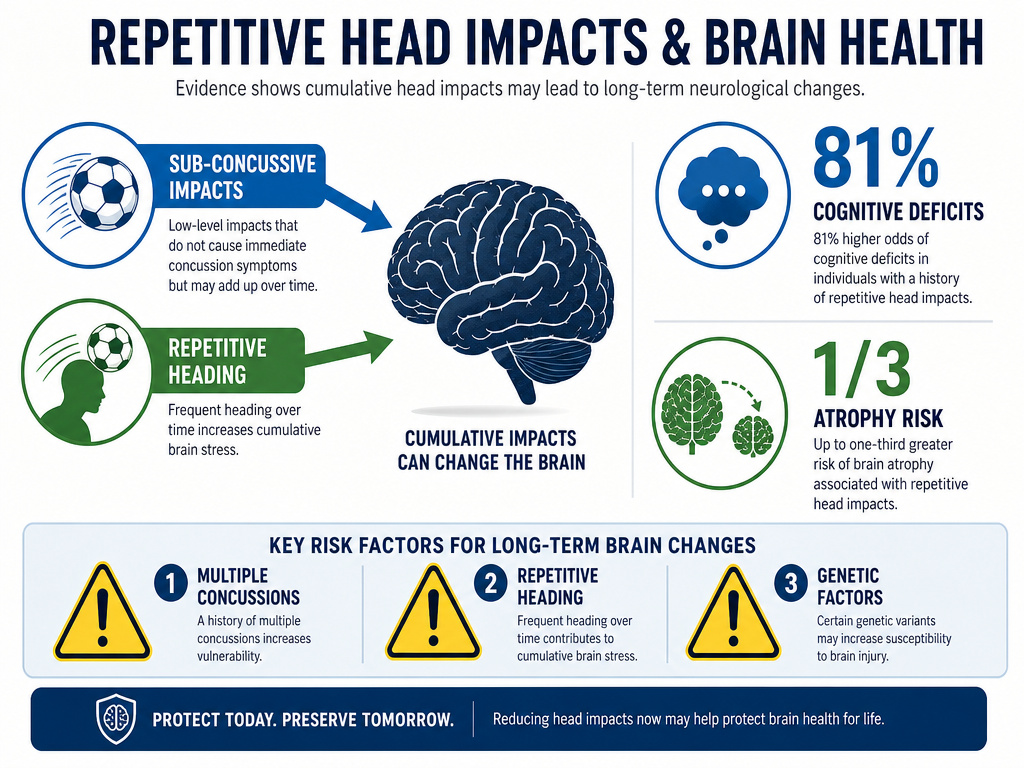
This is the conversation that has changed football. Concussions are acute events, but the concern is the accumulation of sub-concussive impacts, the routine headers, the minor clashes, over a decade-long career.
The data is sobering, if sometimes mixed, even after a concussion in football explained. An older study of 37 former professional soccer players found 81% had mild to severe deficits in attention, concentration, and memory. Another found central brain atrophy in one-third of 33 former pros. Modern studies using advanced imaging like Diffusion Tensor Imaging (DTI) have shown changes in white matter integrity in athletes with high exposure to heading, even without a diagnosed concussion.
The specter hanging over this is Chronic Traumatic Encephalopathy (CTE), a neurodegenerative disease linked to repetitive head trauma. It’s important to state clearly: CTE can only be diagnosed posthumously. Not everyone with a history of head impacts develops it, but its presence in retired footballers has been confirmed.
| Risk Factor | What the Evidence Suggests | Uncertainty |
|---|---|---|
| Multiple Concussions | Recovery time lengthens with each; 3+ concussions linked to longer symptom duration. | Not all studies show baseline cognitive deficits. |
| Repetitive Heading | Older studies show strong links to impairment; newer studies are more equivocal. | Effect of modern, waterproof balls vs. Old, waterlogged ones is significant. |
| Genetic Factors | May influence susceptibility to severe or long-term outcomes. | Still an active area of research, not a diagnostic tool. |
The so-called “3 Concussion Rule”, the idea that three concussions should end a career, is a myth. There’s no magic number. Decision-making is individual, based on recovery time, symptom severity, and the advice of a neurologist. The real rule is that each concussion may make the next one easier to sustain and harder to recover from.
Prevention: What Actually Works?
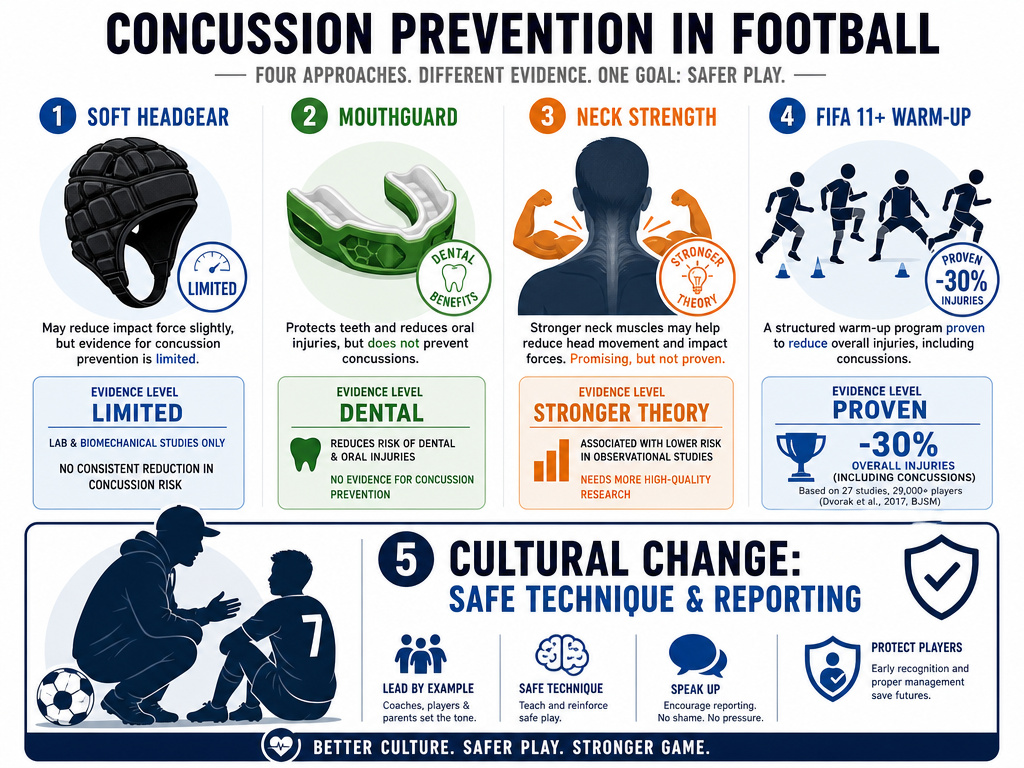
This is where hope meets evidence. Not all prevention gear is created equal.
- Headgear: Soft protective headgear may reduce the risk of lacerations and may soften the force of some impacts, but it does not prevent the brain from moving inside the skull. It is not a concussion-proof helmet.
- Mouthguards: They are essential for protecting teeth and preventing dental injuries. Some manufacturers claim concussion-reduction benefits, but the independent scientific evidence for this is limited. Their primary job is oral protection.
- Neck Strengthening: This has a stronger theoretical basis. A stronger neck may better stabilize the head upon impact, reducing the rotational forces that are particularly damaging to the brain. It’s a low-cost, high-upside addition to training.
- The FIFA 11+: This is the most effective program for injury prevention. This standardized warm-up program, proven to reduce all injuries by about 30%, includes plyometric and strengthening exercises that improve control and stability. Every team should adopt it.
The most effective prevention tool is cultural. It’s coaching safe technique for heading (using the neck, not just the head), enforcing rules against dangerous play, and creating an environment where a player feels safe to report “feeling fuzzy” without losing their place in the team.
How common are concussions in football?
Head injuries are a frequent occurrence in the sport. In high-level international football, one head injury occurs in every third match. The consequences of these impacts can be significant. A study of former professional soccer players found that 81 percent had mild to severe deficits in attention, concentration, memory, and judgment. Brain scans of another group of former professionals identified central brain atrophy in one-third of the participants. This data highlights that concussions are not rare events and that their effects can be long-lasting.
What are the concussion risks for young players?
For youth and high school athletes, the risk from concussion is heightened because their brains are still developing. While the fact sheet lacks specific youth statistics, the general principles of brain injury are critically important. Symptoms can evolve over minutes or hours after a hit, so a player who seems fine initially must be watched closely. A key finding is that players with a history of multiple concussions tend to have longer recovery times. Any young player with a suspected concussion must not return to play on the same day and requires careful medical evaluation and a structured return-to-play process supervised by a healthcare professional.
Frequently Asked Questions
What is the NFL’s concussion protocol?
The NFL protocol is a multi-layered system involving sideline team doctors, independent neurological consultants, and spotters in the booth who monitor video feeds. If a potential concussion is identified, the player is immediately removed to the sideline or locker room for a mandatory evaluation. They cannot return to the game that day and must pass a five-step, symptom-free Return-to-Play progression before being cleared.
How serious is a concussion in football?
It is a serious traumatic brain injury. While most players recover within weeks, the potential for delayed symptoms, prolonged recovery (post-concussion syndrome), and long-term cumulative effects like cognitive impairment or CTE elevates it beyond a simple “knock.” Its seriousness is why protocols are so strict.
What is the 4-hour rule for concussion?
There is no universal “4-hour rule” in official medical protocols. This may be a misinterpretation of advice to monitor someone closely in the first few hours after injury, as symptoms often evolve during that window. The critical rules are the same-day return prohibition and the recommended 72-hour observation period.
Can heading the ball cause a concussion?
Yes, a forceful header can certainly cause a concussion if the impact is sufficient. The greater concern is the cumulative effect of thousands of sub-concussive impacts from heading the ball over a career. This repetitive trauma is a primary focus of long-term brain health research in football.
Before You Go
Watch the back line. Not just for tactical shape, but for that moment after a clash. The player who gets up a half-second too slow, who shakes his head like he’s clearing water from his ears, who doesn’t quite track the run he should be covering. That’s your signal.
The biggest lesson from all the protocols and studies is that concussion management is an exercise in patience over instinct. The instinct is to shake it off. The protocol is to wait, watch, and be sure. The data on common injuries shows that while muscles and ligaments heal, the brain’s timeline is less predictable. Your single most important job on the sideline is to protect that timeline, even, especially, when the player wants to fight you on it.
