
Goalkeeper Role in Football Explained
This post contains affiliate links. As an Amazon Associate, we earn from qualifying purchases.
The goalkeeper’s role in football is to defend the goal as the only player allowed to handle the ball within the penalty area, but a modern professional is equally a tactical playmaker who starts attacks, commands the defensive line, and must now be as skilled with their feet as with their hands. This evolution from pure shot-stopper to key distributor is driven by rule changes and tactical shifts over the past three decades.
The shift isn’t subtle. A goalkeeper who spends 98% of a match at low intensity still makes the game’s most decisive actions, and their pre-match ritual is an isolated, intense 45-60 minute warm-up, a stark contrast to the team’s collective routine. To understand this, consider the goalkeeper role in football explained: the position’s physical and mental demands are unique, blending long periods of observation with sudden, explosive interventions that require flawless technique and decision-making under extreme pressure.
What follows is a breakdown of the goalkeeper’s core duties, the specific rules that govern them, the physical and technical skills required, and how the “sweeper-keeper” has become a tactical necessity. We’ll also look at common mistakes amateurs make and what the data says about how the best in the world actually play.
Key Takeaways
- According to the UEFA Goalkeeper Coaching Manual, the goalkeeper can hold the ball for six seconds.
- Effective communication is essential; a silent goalkeeper is a defensive liability, regardless of their shot-stopping ability.
- The 2019 goal-kick rule change, allowing passes inside the area, fundamentally reshaped build-up play and made foot skills essential.
- Modern analysis defines three levels of involvement (Regular, High, Ball), debunking the simple “active or passive” view of a keeper’s game.
- Physical demands are unique: covering 4-6 km per match but requiring explosive power for the 2-10 decisive saves that define performance.
The Goalkeeper’s Primary Responsibilities
Forget the simple idea of just stopping shots. A goalkeeper’s job is a layered set of tasks that change with every phase of play, and the goalkeeper role in football explained clarifies this complexity. The core, of course, is preventing goals. Peer-reviewed analysis puts this into numbers: one study found about 19.42% of a goalkeeper’s match actions involve protecting the goal, averaging 7.75 actions per game, while another suggests a range of 2-10 saves per match. Another 7.39% of actions are dedicated to defending crosses and sweeping, averaging 2.95 actions per game.
This 50–60 word, third-person, pronoun-free technical blockquote covers the specific breakdown of a goalkeeper’s defensive actions as quantified by sports science research, detailing the percentage and average frequency of goal-protection and cross-defense duties during a match.
Those numbers tell a story of selective explosiveness. The goalkeeper is not constantly in motion like a midfielder. Instead, they operate in bursts, punctuating long periods of watchful positioning with split-second, high-stakes decisions. This is where the UEFA coaching manual’s framework becomes essential. It breaks involvement into three distinct states a goalkeeper cycles through:
- Regular Involvement: The default state. The keeper is observing, communicating, and positioning themselves in relation to the ball and defensive line. No imminent ball contact is expected, but every minor adjustment is a prepared decision.
- High Involvement: The game is entering the keeper’s zone. They are organizing a defensive wall for a free-kick, positioning for an incoming cross, or anticipating a through-ball. The body is coiled, ready to transition to ball involvement.
- Ball Involvement: Direct contact. This is the save, the catch, the punch, the clearance. Everything in the previous two states was preparation for these few seconds of tangible action.
The best goalkeepers make their most visible work, the spectacular saves, look effortless because their regular and high involvement work was perfect. They were already in the right place, reading the cues before the shot was even taken.
Commanding the Defense and Organizing
A goalkeeper has the best view on the pitch. Their first responsibility is to use it. Shouting instructions to center-backs about marking, directing fullbacks to push up or drop, and alerting midfielders to runners they can’t see, this constant chatter is the defensive nervous system, a key part of the goalkeeper role in football explained. A silent keeper forces defenders to make decisions blind, creating gaps and confusion. This role in commanding the box is a skill separate from shot-stopping, honed through experience and vocal confidence.
Rules Specific to Goalkeepers
The laws of the game carve out a special, and restrictive, space for the goalkeeper. The most famous is the right to handle the ball, but it’s heavily fenced.
- The Handling Privilege: Only within your own penalty area. Step outside, and it’s a handball offense. This seems basic, but the pressure of a high press has seen professionals make this costly error.
- The Six-Second Rule: Law 12 states a goalkeeper can hold the ball for six seconds. This isn’t a suggestion; it’s a strict limit. Referees count. Exceed it, and the punishment is an indirect free-kick inside your area, a gift to the opposition.
- The Back-Pass Rule: Introduced in 1992, this law changed goalkeeping forever. If a teammate deliberately passes the ball to you with their feet, you cannot pick it up. You must play it with your feet. This single rule forced a generation of keepers to become footballers, not just shot-stoppers.
Common mistake: Taking too many steps with the ball in hand before releasing it. Referees watch for this as a time-wasting tactic, and it often leads to a rushed, poor clearance that gifts possession straight back.
The 2019 amendment to the goal-kick rule further accelerated the tactical evolution. Previously, the ball had to leave the penalty area from a goal-kick before a teammate could touch it. Now, a keeper can pass directly to a defender standing two yards away. This invited the high press and made a goalkeeper’s foot skill and composure under pressure a primary weapon, not just a handy extra.
Essential Skills and Attributes
Shot-stopping is the headline act, but it rests on a foundation of other critical skills. You can have the reflexes of a cat, but if you can’t command your area or pass a ball five yards, you won’t play at the highest level.
| Skill Category | Key Components | Why It Matters |
|---|---|---|
| Technical | Handling, Diving, Footwork, Distribution (Throwing/Kicking) | Safe hands prevent rebounds and goals. Clean footwork enables explosive saves. Distribution starts attacks. |
| Physical | Explosive Power, Acceleration, Agility, Vertical Jump | Enables reach for top-corner saves, quick closings of angles in 1v1s, and command of the six-yard box. |
| Tactical | Positioning, Reading the Game, Understanding of Team Shape | Minimizes the need for spectacular saves by being in the right place. Organizes the defense. |
| Psychological | Concentration, Composure, Resilience, Leadership | Maintains focus during low-activity periods. Shakes off mistakes instantly. Drives the defensive unit. |
The physical profile is unique. Outfield players cover significantly more distance; a goalkeeper covers 4-6 km per match. The load isn’t about distance; it’s about repeated, maximal-intensity efforts. A study in the Bournemouth University goalkeeper performance review notes they must be conditioned for a full 90 minutes, or potentially 120 minutes plus penalties in tournaments. Their pre-match warm-up is an extended, isolated 45-60 minute process focused on activating this specific explosive capacity.
Communication is the glue. It’s a tactical and psychological skill. A goalkeeper who barks clear, concise orders cuts through the noise of the stadium and organizes the chaos in front of them. It’s the difference between a defender stepping up to catch an attacker offside and being caught flat-footed.
The Modern Goalkeeper: Sweeper-Keeper and Distribution
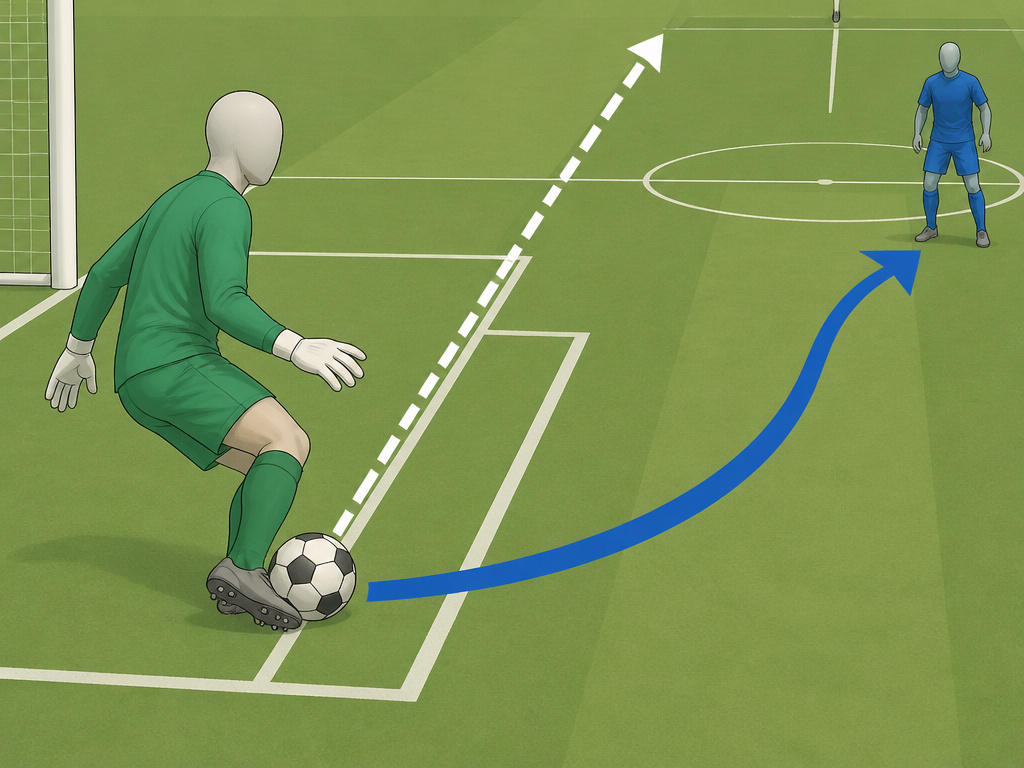
The archetype of the modern goalkeeper was crystallized by Pep Guardiola’s arrival in the Premier League. Replacing Joe Hart with Claudio Bravo, and then signing Ederson at Manchester City, sent a clear message: the goalkeeper is the first attacker. Ederson’s passing range is as celebrated as his shot-stopping. The stats bear out the trend. After his 2017 signing, the percentage of goal-kicks landing in the opposition half, steady at about 75% for years, dropped to 67.8% the next season.
The 2019 rule change turbocharged this. Teams now routinely play short from goal-kicks to draw the press and exploit space behind it. Aston Villa’s goal against Manchester City in December 2023 took just 14 seconds from goalkeeper Emiliano Martinez’s pass to the ball in the net. This high-risk, high-reward play defines the sweeper-keeper role.
But it’s not universal. Data from the 2023-24 season shows nuances: Liverpool play 85% of goal-kicks into their own half, Manchester City 83%. Yet Nottingham Forest, a tactical outlier, send 60% long. Arsenal employ a mixed approach from goal-kicks. The choice depends on the team’s tactical blueprint and the players available.
| Club (2023-24) | Style from Goal-Kicks | Tactical Rationale |
|---|---|---|
| Liverpool | 85% into own half | Extreme build-up play to beat the press and control midfield. |
| Tottenham | 4 long kicks from 145 total | Total commitment to short, possession-based build-up. |
| Nottingham Forest | 60% into opposition half | Direct play to target striker Chris Wood, bypassing midfield. |
| Arsenal | ~50/50 split | Pragmatic mix, adapting to the opposition’s press each week. |
This evolution means training has transformed. Drills now heavily integrate passing under pressure, receiving back-passes with both feet, and reading when to go long versus short. The goalkeeper’s decision-making, as outlined in the UEFA manual, follows a loop: Observe, collect information, select key features, decide, execute. This happens constantly, not just when making a save.
Common Goalkeeping Mistakes (And How to Avoid Them)
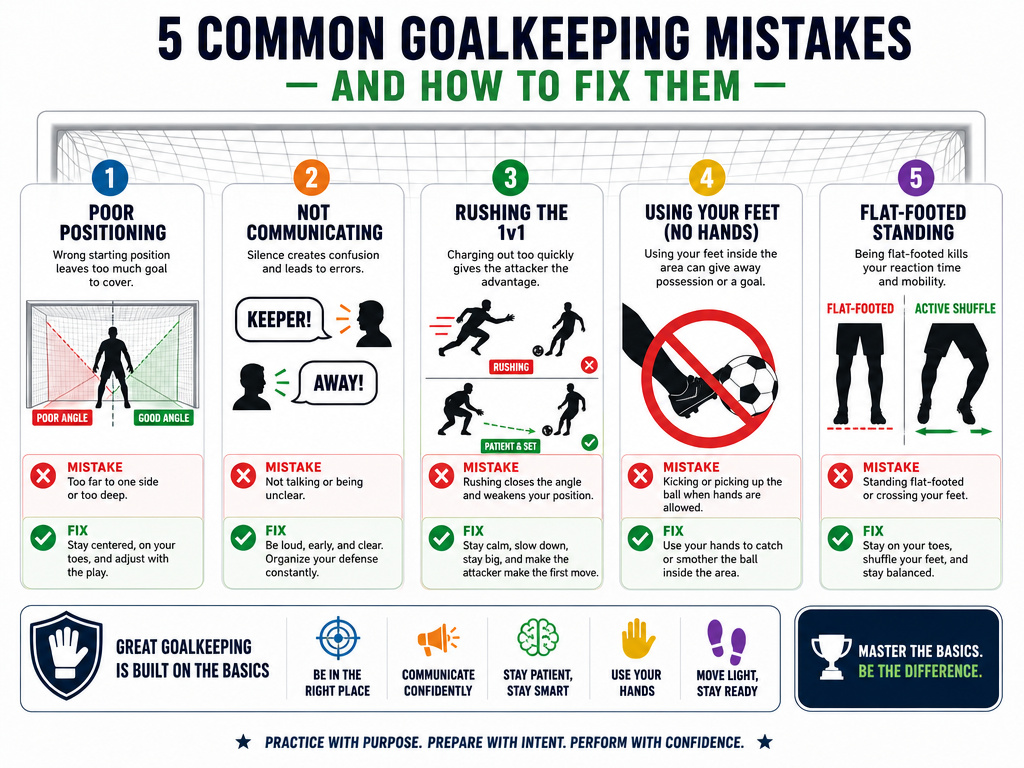
Amateur goalkeepers often fail on fundamentals that professionals treat as religion. These aren’t failures of talent, but of habit and understanding.
- Poor Starting Position: Standing too deep in the goal. This gives the shooter more net to aim at. Fix: Position to cut down angles, adjusting based on the ball’s location. This cuts down angles.
- Silent Game: Not communicating with defenders. This leads to unmarked attackers and defensive disorganization. Fix: Develop a clear, loud vocabulary of shouts. Call “Keeper!” for crosses, “Away!” to clear, “Step up!” to hold a line.
- Rushing Decisions in 1v1s: Charging out without controlling speed or angle, making it easy for the attacker to round you. *Fix: Narrow the angle by approaching in a slight crouch, staying big, and forcing the attacker to make the first move.
- Ignoring the Back-Pass Rule: The instinct to grab a comfortable back-pass is strong. Fix: Drill foot reception and clearance until it’s automatic. Know that if it’s a deliberate pass from a teammate’s foot, your hands are off-limits.
- Neglecting Footwork: Being flat-footed or crossing feet when moving laterally. This slows the dive. *Fix: Use quick, sharp shuffle steps to adjust position. Never turn your back to the play; always face the ball.
I played in goal for years, which is a polite way of saying nobody trusted me with the ball. My biggest mistake was always the first one. I’d retreat into my goal on crosses, afraid of missing. You end up palming a ball into your own net that you should have caught on the six-yard line. Courage in positioning isn’t optional.
The specific rules exist for a reason, and violating them is a direct path to conceding. The six-second rule, in particular, is a trap for keepers trying to manage the game’s tempo. Count mentally, then release.
Goalkeeper Development Through the Ages
The pathway for a young goalkeeper is distinct from outfield players. Governing bodies like FIFA outline age-specific priorities. For ages 6-12, the focus is on fun, learning basic techniques (catching, diving), and a lot of work on coordination, stability, movement, and suppleness with and without the ball. The goal is to build athleticism and a love for the position.
From 13-18, the player adapts to the full-sized pitch. The FIFA manual suggests a careful assessment of potential, noting qualities and faults to focus individual work. It recommends working progressively on the four general preparation programmes: technical, physical, tactical, and mental. A practical tip is to work in short 2-week cycles where technical and physical qualities are paired, like practicing aerial balls and jumping together.
For the veteran after age 35, the game changes again. Daily work maintains performance, but the focus shifts. Experience in reading the game and anticipation compensates for the natural reduction in speed and jumping capacity. The keeper and coach must draw up an adapted programme, and listening to one’s body becomes paramount. This is where the mental and tactical accumulations of decades pay the highest dividends.
Talent identification research, like that in an NCBI study on goalkeeper attributes, highlights what coaches look for beyond shot-stopping: coachability, communication, decision-making, and mental resilience. The modern pathway values these “soft” skills as highly as pure shot-stopping talent, because the role demands a complete footballer.
What Equipment Does a Goalkeeper Need?
Goalkeepers wear specialized gear designed for protection and performance. The most distinctive item is the pair of gloves, which provide grip and cushioning when catching or parrying the ball. Beyond gloves, attire typically includes padded shorts and jersey for protection during dives, along with studded boots for traction on the pitch surface. While the core gear is standardized, the choice of specific items should prioritize safety, comfort, and suitability for the playing conditions.
How Has the Goalkeeper Role Changed Over Time?
The goalkeeper’s role has evolved significantly due to rule changes. Historically, goalkeepers could handle back-passes from teammates anywhere on the pitch. This changed in 1992 with the introduction of the back-pass law, which restricted handling to passes made with the feet, forcing goalkeepers to improve their foot skills. A more recent shift occurred in 2019, when a new rule allowed goalkeepers to pass to teammates inside their own penalty area from goal-kicks. This change has encouraged teams to build play from the back, making the goalkeeper a key initiator of attacking moves.
What Are the Different Types of Goalkeepers?
Modern goalkeepers are often categorized by their primary style of play. The traditional shot-stopper focuses predominantly on protecting the goal, a set of actions that form a significant part of their match involvement. The modern sweeper-keeper actively defends space outside the penalty area, engaging in actions like intercepting through balls and defending crosses. A third type emphasizes ball-playing, using distribution to launch attacks from the back. Coaches analyze a goalkeeper’s potential, noting their qualities and faults, to tailor training across technical, physical, tactical, and mental programmes that suit their intended role.
Frequently Asked Questions
What is the main role of a goalkeeper in football?
Their primary role is to prevent the opposing team from scoring by legally handling the ball within their penalty area and using any part of their body to make saves outside of it. Their secondary, and now equally critical, role is to act as the first attacker by distributing the ball effectively to launch their team’s attacks.
What are goalkeepers not allowed to do?
They cannot handle the ball outside their penalty area (a handball offense). They cannot hold the ball for more than six seconds once in control. They cannot handle a deliberate pass from a teammate’s foot (the back-pass rule). They also cannot move off their goal line before a penalty kick is taken.
Is goalkeeper the hardest position in football?
It’s the most psychologically isolated and technically specialized. The margin for error is zero, and mistakes are almost always punished with a goal. While outfield positions have different physical and tactical demands, the unique combination of prolonged concentration, explosive reaction, and public accountability makes it uniquely challenging.
Do goalkeepers get paid a lot?
At the elite professional level, top goalkeepers are among the higher earners on a team, though they rarely reach the astronomical wages of superstar strikers or midfielders. Their value is recognized, but the market premium is often slightly lower than for elite outfield creators or scorers. Their career longevity, however, can be greater.
Who is considered the greatest goalkeeper of all time?
Debates rage, but Lev Yashin (USSR), Gianluigi Buffon (Italy), and Manuel Neuer (Germany) are perennial candidates. Buffon holds the unique distinction of being the only goalkeeper to win the UEFA Club Footballer of the Year Award. Neuer is widely credited with redefining the modern sweeper-keeper role for the current era.
Before You Go
The goalkeeper’s art is a study in controlled contradiction: immense power held in reserve, long stillness shattered by explosive action, solitary responsibility within an eleven-player unit. The next time you watch a match, don’t just watch the saves. Watch the thirty seconds before.
Watch where the keeper stands during a goal-kick, are they inviting the press? Watch their constant, small shuffles as the ball moves, the foundation of the positioning fundamentals that make the spectacular possible. Watch their mouth; if they’re not talking, their defense is playing blind.
The position has evolved from a designated shot-stopper to the team’s tactical orchestrator from the back. That evolution is written in the rules, the 1992 back-pass law, the 2019 goal-kick amendment, and played out every week in leagues around the world. The gloves and the jersey may be different, but the modern goalkeeper is, first and last, a footballer.
