
How VAR Works in Football: Every Step Explained
This post contains affiliate links. As an Amazon Associate, we earn from qualifying purchases.
How VAR works in football: a video team checks every goal, penalty, red card (including a wrong second yellow) and mistaken-identity call automatically, then advises the referee only on clear and obvious errors. Factual calls like offside are normally settled by the VAR alone. Subjective calls go to a pitchside monitor, and the referee always makes the final decision.
That second-yellow clause is new. IFAB’s 140th Annual General Meeting, held in Hensol, Wales, on 28 February 2026, added it alongside yellow cards for mistaken identity, with the changes in force from 1 July 2026. So any explainer still listing four review categories is a season behind.
What follows: who sits in the video room, the exact order a review runs in, why some checks take a minute and others take seconds, what the accuracy numbers say, and the cases where nobody can fix a wrong call at all.
Key Takeaways
- There are five review categories now: a clearly wrong second yellow that led to a red is reviewable, and mistaken identity covers yellow cards as well as reds.
- Once play restarts, the call stands, apart from mistaken identity and serious red-card offences such as violent conduct, spitting or biting.
- On-field reviews are slow: one cited study put the median at 62.0 seconds, against 15.0 seconds for a VAR-only check.
- Semi-automated offside validates the line within a few seconds, according to FIFA, but the referee still judges whether an offside player interfered.
- FIFA reported 2018 World Cup decision accuracy rising from 95.60% to 99.35% with VAR, a figure cited in a 2022 peer-reviewed study.
Who Is Actually Sitting in the VAR Room?
A goal goes in. The scorer is still sliding on his knees, and somewhere away from the stadium a small team in a video hub is already rewinding the build-up.
A VAR team works from a separate video room and has three core roles: the video assistant referee, who leads the check; the assistant VAR, who supports it; and the replay operator, who finds and plays the camera angles. If any of the three cannot continue and no qualified replacement is available, the match continues without VAR.
That check happens on every goal, whether or not anyone on the pitch complains. The VAR checks automatically, and the referee hears about it only if there’s something worth hearing. Communication runs through an audio link to the referee’s headset.
Here’s a detail I love. Under the IFAB protocol, a match is never invalidated because VAR broke down, made a wrong call, chose not to review something, or reviewed something it shouldn’t have. The result stands. Football protects the scoreline from its own gadgets.
The VAR officials in that hub are still, in England at least, mostly referees doing a second job. PGMOL, the body that runs Premier League referees, has said it has a number of FIFA-recognised VARs and is working to build a dedicated pool of VAR specialists. It also started a training programme focused on the separate roles of VARs, AVARs and replay operators.
I’d argue the replay operator is the most underrated seat in the room. In the most famous VAR blunder in Premier League history (more on that below), it was the replay operator who spotted the mistake first.
The Five Calls VAR Can Review Now (and the Ones It Can’t)
Almost every explainer online says VAR covers four kinds of decision. That list is out of date.
The 2018 Laws of the Game brought VAR in with four categories: goal or no goal, penalty or no penalty, direct red card, and mistaken identity. The current IFAB VAR protocol adds a fifth: a clearly incorrect second yellow that results in a red card. The live IFAB page, at the time of writing, literally reads “four five categories” where someone edited the old number. Even the lawmakers are mid-update.
| Situation | Can VAR step in? | Where the rule comes from |
|---|---|---|
| Goal / no goal | Yes | IFAB protocol |
| Penalty / no penalty, incl. Keeper or kicker offences at the kick | Yes | IFAB protocol |
| Direct red card | Yes | IFAB protocol |
| Wrong second yellow that led to a red | Yes | IFAB 140th AGM, 2026/27 |
| Missed offence that would’ve been a second yellow | No | IFAB protocol FAQ |
| Wrong player carded (red or yellow) | Yes, yellows added 2026/27 | IFAB 140th AGM |
Notice the asymmetry in rows four and five. VAR can cancel a second yellow the referee wrongly showed. It can’t add one the referee missed. I’ll admit that pleased me, because it keeps VAR correcting mistakes rather than refereeing the game from a screen.
There’s also an optional extra. From 2026/27, each competition can choose to allow review of a clearly wrongly awarded corner, but only if it’s done immediately and without delaying the restart. So two leagues running the same Laws can look different on a Saturday.
Easy to miss: The restart is the cut-off. Once play has stopped and restarted, the referee can’t go back to review, except for mistaken identity or a possible sending-off for violent conduct, spitting, biting or extremely offensive, insulting or abusive actions. A wrong offside call that survives one goal kick survives forever.
Simulation shows how much the categories can unwind. If a penalty is given and the review shows the attacker dived, the penalty is cancelled, the defending team gets an indirect free kick, and the attacker is booked. One clip, three decisions reversed.
How VAR Works in Football, From First Whistle to TV Signal
Six things happen, in this order, every time. Skip one and the whole chain wobbles.
- The referee makes a first decision. That includes waving play on. IFAB’s protocol forbids giving “no decision” and handing the call to VAR, so a referee who freezes leaves the system with nothing to review except a serious missed incident.
- The VAR checks silently. No time limit applies; IFAB’s protocol puts accuracy ahead of speed while asking for efficiency. If the check finds nothing clear, nobody on the pitch hears a word.
- The VAR looks for a clear and obvious error. In the Premier League’s wording, the VAR needs factual evidence that differs from the on-field decision. If the replays aren’t conclusive, the original call stands.
- The VAR confirms the outcome with the assistant VAR. PGMOL added this step after a check was closed without it in 2023. Skip it and one tired official can wave through a mistake that the rest of the room saw.
- The referee stops play at a neutral moment and makes the TV signal. The review is then either VAR-only or on-field, depending on the type of call (next section).
- The referee gives the final decision. Always the referee. Players or staff who keep making the TV-screen signal themselves get a yellow card for it.
Rule of thumb: if the referee made a decision and play hasn’t restarted, VAR can still reach it. If either condition fails, the moment has gone.
Step four is the one I’d tattoo on every hub wall. It’s a single sentence of procedure, and it was missing on the worst day VAR has had in England.
Which Calls Go to the Pitchside Monitor, and Which Don’t?
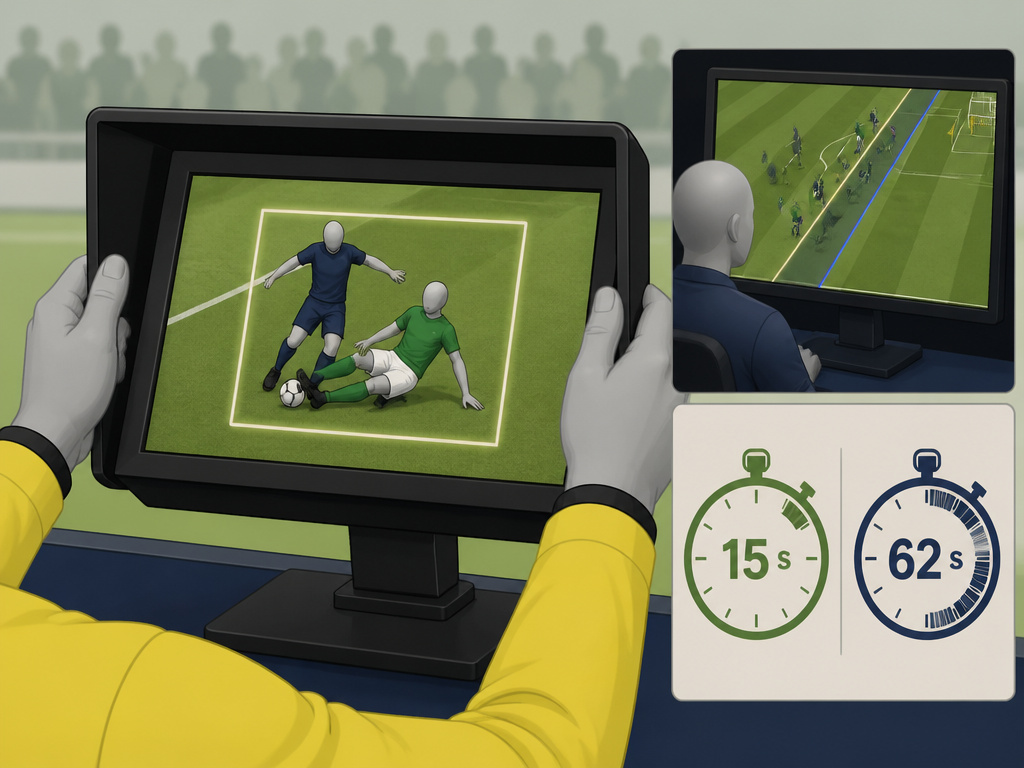
15.0 seconds against 62.0. Those are the median review times for a VAR-only review and an on-field review, from a 2021 study by Spitz and colleagues across 13 men’s national leagues. That gap explains most of the waiting you sit through.
Factual calls stay in the hub
IFAB’s guidance treats a VAR-only review as the normal route for factual decisions: whether a foul was inside or outside the box, offside, or the ball going out of play. The VAR tells the referee what the replays show, and the referee makes one TV signal just before announcing the decision. The Premier League adds handball by the goalscorer to that factual list.
Subjective calls are different. Handball by a defender, the severity of a challenge, whether a player interfered: these go to an on-field review at the referee review area. The referee watches the footage personally before deciding.
| Feature | VAR-only review | On-field review |
|---|---|---|
| Typical call | Offside, ball out, foul location | Handball, tackle severity |
| Who watches the footage | VAR team | Referee at the monitor |
| Median time (Spitz et al. 2021) | 15.0 seconds | 62.0 seconds |
| Final say | Referee, on VAR’s evidence | Referee, after own viewing |
The on-field review is the bit you feel in the stands. The referee draws the rectangle, jogs to the monitor, and a ring of players follows at a distance, hands on hips. A full ground makes a low, impatient hum the whole time, and it rises every time the referee leans closer to the screen.
My verdict, and I’ll stand by it: the VAR-only route wins on facts every time, and the monitor is a second opinion on interpretation, nothing grander. A fact can still go to the monitor so the referee can “sell” the decision to the crowd. That’s theatre, and I don’t mind it.
Where this goes sideways: Judging a review from the broadcast angle. The TV director picks the replay that looks most dramatic, while the VAR works from the protocol and every camera in the hub. Arguing a handball from one slow-motion clip at home is how you end up furious about a call that followed the rules exactly.
Can the referee ignore VAR?
Yes, at the monitor. The Premier League states that the VAR can’t recommend a yellow card, but the referee keeps all options when reviewing an incident. IFAB goes further: the decision must be based on what the referee sees. If a review starts for a possible red and the referee judges it a caution, the referee must show a yellow.
Semi-Automated Offside: 12 Cameras, 29 Points per Player, a Few Seconds
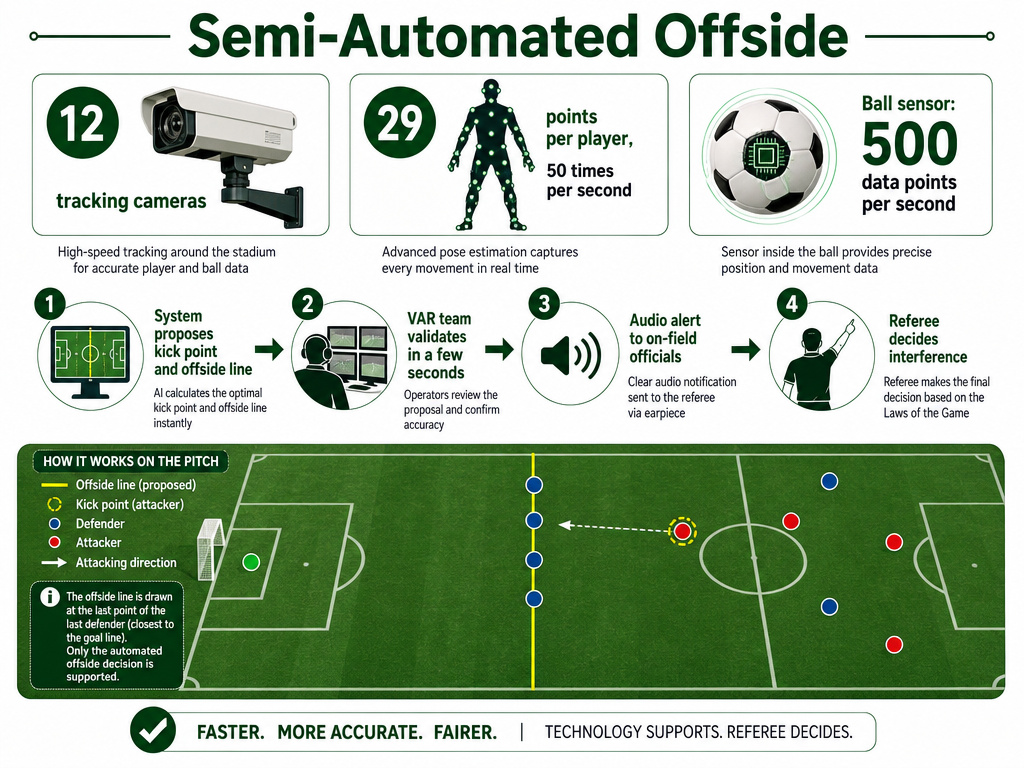
Semi-automated offside went live in the Premier League from Matchweek 32, on 12 April 2025, after a late-2024 target slipped. The semi-automated offside rollout delay frustrated fans who’d sat through years of lines being drawn by hand.
FIFA’s own spec sheet is the clearest description. Twelve tracking cameras follow the ball and up to 29 points on each player, 50 times per second. A sensor inside the ball sends data 500 times per second to find the exact kick point, which is where connected ball technology earns its keep. FIFA first tried the system live at the Arab Cup 2021 and the Club World Cup 2021.
What the system does, and what it leaves to humans:
- It proposes the kick point and offside line. The VAR team validates both by eye, which FIFA says takes a few seconds.
- If the VARs disagree with the proposal, they pick the kick point manually and draw the line with the old tools.
- It flags when an attacker in an offside position receives the ball.
- It doesn’t judge interference. Whether an offside player affected an opponent stays the referee’s call.
- In very tight cases, the VARs use the ball sensor’s data to pin the exact first touch.
- If it fails, crosshairs and triangulation come back.
Under Law 11, the offside rule sets the line at the second-last defender’s closest body part that can legally score, or at the ball if that’s nearer the goal line. The system also sends an automated audio alert to the on-field officials for clear offsides. FIFA is the sole owner of all the tracking and ball data, which is a detail worth knowing before anyone calls it neutral infrastructure.
I’ll defend semi-automated offside to anyone. It fixes the one slow, fiddly job that dragged checks out, and it hands interference straight back to the referee, where judgement belongs. That’s the right split.
Here’s why I care so much. A back four stepping up together to catch a striker is joinery: four pieces fitting so tightly the gap disappears. For years that skill was judged by someone squinting at a freeze-frame. Now the line is drawn from tracked limbs, and the defenders who got the timing right get the credit.
The wait still has a sound, though. A ground holding its breath for an offside check goes strangely flat, half-standing, nobody sure whether to celebrate yet. Shorter now. Still there.
Two caveats. The Premier League projected an average saving of 31 seconds per offside check, but that was a projection, and I haven’t seen a measured result to set against it. I judge every piece of referee tech the way I judge goal-line technology: by the one job it was built to do.
Is VAR Working? What 13 Errors and a 99% Figure Actually Tell You
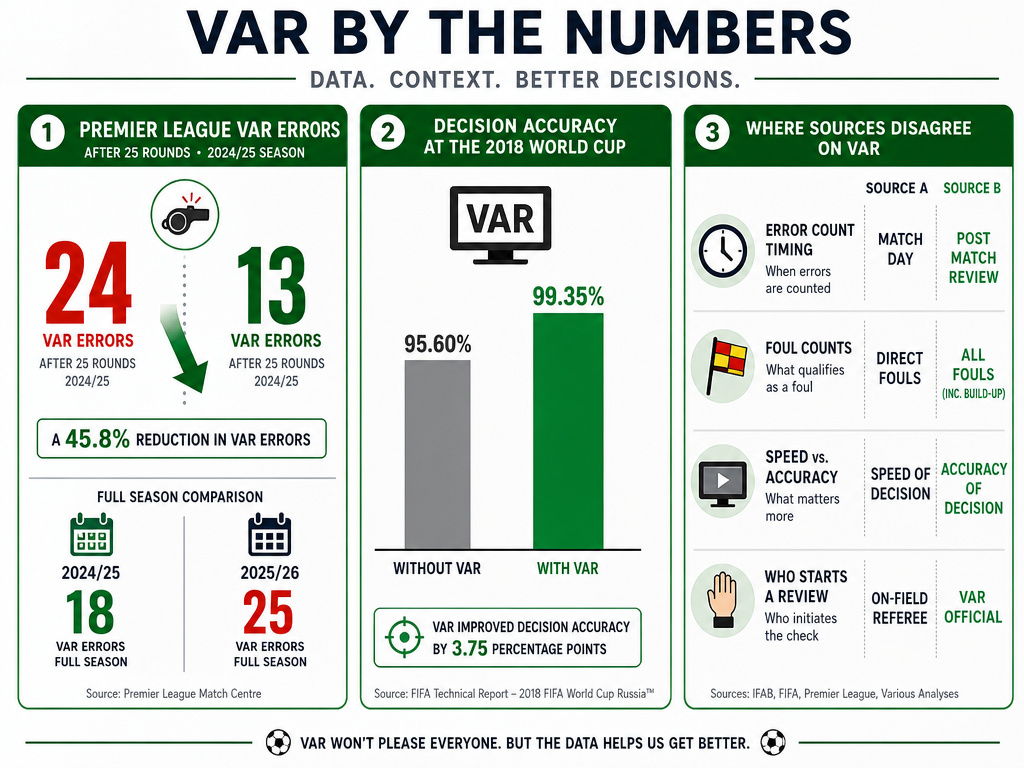
The answer depends on who’s counting, and when.
My history work keeps teaching me this. Old matches get retold with different scores depending on which book you open, so I go back to a match report from the time before I print anything. VAR error counts deserve the same suspicion, because they’re already drifting between sources.
The Premier League’s own release says its Key Match Incidents panel counted 13 VAR errors in the first 25 match rounds of 2024/25, down from 24 at the same point the season before. SI attributes the same 13 to after 19 matches. I go with the league’s release on its own panel’s numbers. The same panel, five members deciding by majority vote, counted 18 errors for the full 2024/25 season and 25 in 2025/26, as reported by the BBC via SI.
The wider research looks better for VAR. FIFA reported decision accuracy at the 2018 men’s World Cup of 95.60% without VAR and 99.35% with it. Spitz and colleagues found accuracy rose from 92.1% to 98.3% across 13 men’s national leagues. Referees make about 137 observable decisions per international match, per Helsen and Bultynck, so even small percentages hide real incidents.
Where the studies split, they split cleanly:
| Question | One source says | Another says |
|---|---|---|
| When were the 13 PL errors counted? | After 25 rounds (Premier League) | After 19 matches (SI) |
| Did VAR change foul counts? | Fouls fell (Lago-Penas et al. 2019, 1,024 matches) | No significant change (Frontiers 2022, Women’s World Cups) |
| Speed or accuracy first? | No time limit, accuracy first (IFAB) | Delay cut to 40s from 65s per match, an efficiency win (Premier League) |
| Who starts a review? | VAR checks automatically (IFAB) | Coach challenges (FIFA’s FVS) |
The Frontiers in Psychology VAR study compared all 52 matches of the 2015 Women’s World Cup with all 52 of 2019. Playing time rose significantly in both halves and overall. Penalties, offsides, fouls, goals, corners and cards didn’t change significantly. That last finding cuts against the men’s-league results, and nobody has settled why.
There’s also a LaLiga referee decisions VAR study by Lago-Penas, Gomez and Pollard. I haven’t been able to read its full results, so I won’t put words in its mouth.
Honesty time: I’m a notebook-and-eyes analyst, not a data scientist. Tracking data could show patterns I’d never spot from the stands. What I can say is that the accuracy gains are documented and the Premier League’s panel counted fewer errors after 25 rounds of 2024/25 (13) than a year earlier (24), although 25 errors were reported for 2025/26, which is why the VAR debate has moved from “does it work” to “is it worth the wait.”
What Happens When VAR Gets It Wrong and Nobody Can Fix It?
The protocol answers that with a shrug. Nothing happens. Three episodes show what that costs.
Spurs v Liverpool, 30 September 2023
Luis Diaz scored and was flagged offside. The VAR, Darren England, ran the check correctly: PGMOL said the kick point and the single 2D line on the defender’s foot were both accurate, and the image showed Diaz clearly onside. Then England said “check complete”, confirming the wrong on-field call, without speaking to his assistant VAR, Dan Cook.
Play restarted at once. Within seconds the replay operator and then the AVAR queried it, and England is heard saying he “can’t do anything.” He was right, by the rules. The restart rule had closed the door. The Diaz offside VAR error review from ESPN gives a further account of the incident.
PGMOL admitted “significant human error” and committed to three fixes:
- Restating that efficiency never comes at the expense of accuracy.
- A new VAR Communication Protocol to make the on-field decision clear to the hub.
- The VAR confirming the check outcome with the AVAR before telling the referee, which became step four above.
The VAR and AVAR were taken off their remaining Round 7 fixtures and left out of Round 8.
Wolves, Sweden and the clubs that said no
At the Premier League AGM on 6 June 2024, Wolves proposed scrapping VAR. The motion lost 19-1; it needed 14 votes. Their argument was that “the price we are paying for a small increase in accuracy is at odds with the spirit of our game.”
Sweden went further. Swedish clubs rejected VAR in April 2024, and the Allsvenskan is the only league in UEFA’s top 30 without it. Malmo’s chief executive framed the refusal as “leadership.” My European bias shows here, I know, but Sweden is the case I’d watch for anyone arguing the game is better off without screens.
FIFA’s cheaper version lets the coach ask
FIFA’s Football Video Support flips the IFAB principle that players and coaches can’t request reviews. Each team gets two challenges per match plus one in extra time, and a successful challenge isn’t used up. There’s no off-pitch VAR, just a replay operator, and it’s designed for about 4-5 cameras. For competitions that can’t afford a full hub, that’s the realistic future, and it’ll feel nothing like the Premier League.
When was VAR introduced in football?
VAR did not arrive all at once. It was trialled in competitions first, then written into the Laws of the Game by IFAB, the body that owns the rules. Only after that could leagues choose to switch it on, which is why different competitions started using it at different times. The Premier League adopted it once the Laws allowed it, and its early seasons were a learning exercise for officials, players and fans alike.
The scope has moved since. The early protocol focused on incidents that decided matches: goals, penalties, direct red cards and mistaken identity. The current protocol is wider. It covers a clearly incorrect second yellow card that leads to a red, and IFAB has approved further adjustments to how mistaken identity is handled. Clubs have also tested the appetite for scrapping it. Wolves brought a motion to abolish VAR in the Premier League, and it lost by a wide margin, so the system stayed. Anyone reading older match reports should check which version of the protocol applied at the time.
Frequently Asked Questions
Can a referee ignore VAR?
At the pitchside monitor, yes. The Premier League says the referee keeps all options when reviewing, and IFAB says the final decision must rest on what the referee sees. The VAR recommends; the referee decides, and can stick with the original call.
Is VAR a success or a failure?
On accuracy, the evidence points to success: FIFA reported 2018 World Cup accuracy rising from 95.60% to 99.35%. On time and atmosphere, it’s contested. Wolves lost their 2024 vote to scrap it 19-1, while Swedish clubs rejected it outright.
Why do VAR reviews take so long?
There’s no time limit, because IFAB ranks accuracy above speed. On-field reviews take longest, with one study finding a median of 62.0 seconds against 15.0 seconds for VAR-only checks. With semi-automated offside, VARs only validate the automatically selected kick point and offside line, which FIFA says takes a few seconds.
Can players or managers ask for a VAR review?
Under the IFAB protocol, no. The VAR checks incidents automatically, and players or staff who keep making the TV-screen signal get booked. FIFA’s Football Video Support is the exception, giving coaches two challenges per match.
How much do VAR officials get paid?
None of the official sources behind this article publish VAR pay figures, so I won’t guess. What PGMOL has said is that it’s building a dedicated pool of VAR specialists, which suggests the job is moving beyond a referee’s second role.
Before You Go
Next time a check drags on, ask two questions before you start shouting: did the referee make a first decision, and has play restarted? Those two answers tell you whether VAR can touch the call at all. Then ask whether it’s a fact or an opinion. That tells you whether to expect a quick nod or a walk to the monitor.
One concession. Everything above describes how VAR works in football under the IFAB protocol, and competitions bend it at the edges. Corner reviews are optional, stadiums without roof cameras lose semi-automated offside, and a league running coach challenges plays by a different logic entirely.
So my stance holds, softened by the evidence: VAR is close to flawless on lines and facts, and every serious row has come from interpretation or from humans skipping a step.
Would you trade a slightly less accurate game for a goal you could celebrate the second it went in?
