
VAR Pros and Cons in Football: Is It Worth It?
This post contains affiliate links. As an Amazon Associate, we earn from qualifying purchases.
VAR pros and cons in football start with one trade: a KU Leuven study for IFAB found accuracy on reviewable decisions rose from 93% to 98.8%, at an average cost of 55 seconds of playing time. The downside is delay, lost celebrations and judgement calls that still split fans.
That 98.8% figure is at its strongest on factual calls, and that’s where the var pros and cons in football argument splits. Offside, ball out of play, a foul inside or outside the box: replays settle those. Handball and “clear and obvious” fouls are opinion with a slow-motion button, and extra camera angles don’t turn opinion into fact.
What follows: how a review actually runs, the numbers on both sides (including where the sources disagree with each other), the errors VAR couldn’t undo, and the leagues that voted to keep it or keep it out.
Key Takeaways
- VAR is strongest on factual calls like offside and offence location; IFAB itself sends subjective calls to the pitchside monitor.
- The Premier League’s KMI panel logged 38, 31, 18 and then 25 VAR errors across four seasons, so the improvement isn’t a straight line.
- Once play restarts, most errors stand. IFAB allows a later review only for mistaken identity and certain violent or abusive conduct.
- Clubs still disagree: Premier League sides kept VAR 19 votes to 1, while Swedish clubs blocked it from the Allsvenskan.
How Does VAR Actually Decide a Call?
IFAB gives the video assistant referee a narrow job: check a decision the referee has already made, or flag a serious incident the officials missed. The IFAB VAR protocol sets out every step.
The IFAB protocol uses two review types. A VAR-only review suits factual decisions such as offside, ball out of play or offence location. An on-field review suits subjective decisions such as handball, with the referee watching replays at the pitchside monitor. Apart from missed serious incidents, VAR only reviews a decision the referee has already made.
Most rows about how VAR works fall apart once you see the order of events. It runs like this:
- The referee makes a first decision. Waving play on counts. IFAB doesn’t let a referee give “no decision” and pass the job to the screen, so a hesitant official can’t hide behind the monitor.
- The VAR checks the footage. On a factual call, the VAR tells the referee what the replay shows. Get this step wrong and the error is locked in the moment play restarts.
- Subjective calls go to the monitor. The referee stops play once the ball is in a neutral zone, then walks to the review area. Miss that window and only mistaken identity or violent and abusive conduct can still be reviewed.
- The referee decides on what they saw. If a review started for a possible red shows only a caution, the referee must show yellow. Deciding the outcome before watching breaks the protocol.
Can a referee ignore VAR? Yes. The Isin and Yi study describes the referee as always having the final decision to accept or reject the VAR’s advice. The screen advises. The referee decides.
VAR-only review vs on-field review: which one deserves your trust?
VAR-only wins, and it isn’t close. A factual call is like checking a joint with a square: it fits or it doesn’t, and two carpenters will agree. A handball call is more like judging whether a finish looks right. You can stare at it for a week and still argue.
IFAB’s technical director David Elleray made the case for the monitor in 2018. On subjective calls, he said, “the players tend to accept the referee looking at the replay himself.” That’s about acceptance, not accuracy, and I think it’s an honest admission of what the monitor is for.
Four categories or five? The sources disagree
Here’s the bit people skip.
| Category | What it covers | Who lists it |
|---|---|---|
| Goal / no goal | Offside and fouls in the build-up | Isin and Yi; IFAB |
| Penalty / no penalty | Includes keeper or kicker offences at the kick | Isin and Yi; IFAB |
| Direct red card | Now includes a clearly incorrect second yellow | IFAB |
| Mistaken identity | Still reviewable after a restart | Isin and Yi; IFAB |
| Wrongly awarded corner | Optional, competition by competition | IFAB (per research brief) |
The Isin and Yi study, citing the 2023 protocol, lists four situations. The current IFAB page, as summarised in my research brief, lists five. The IFAB VAR protocol confirms the second-yellow change: VAR can step in when a referee shows a clearly incorrect second yellow, but not when a second-yellow offence was missed entirely.
The Accuracy Case: 93% to 98.8%, and a Figure Worth Checking Twice
Years ago I passed on a football story that was too perfect, and it turned out to be embellished. Since then, any figure with a suspiciously tidy finish gets checked twice. VAR’s headline accuracy number earned that treatment.
Two versions exist. In January 2018, trade outlet Inside World Football reported researchers giving 98.9% decision accuracy from interim figures. At the FIFA briefing on the KU Leuven study in March 2018, the final figure was 98.8%, up 5.8 points from 93%.
Small gap. Still worth showing, because the March number is the one with the full sample behind it.
That sample was big: 972 competitive matches plus 693 friendly, training and youth matches, across more than 20 member associations and competitions. Professor Werner Helsen put the initial accuracy before VAR at 93%. FIFA president Gianni Infantino called them “some fantastic numbers.” IFAB approved VAR unanimously at its 132nd AGM on 3 March 2018.
A 98.8% accuracy figure only covers the decisions VAR is allowed to review. It says nothing about the calls VAR never touches.
The doubts back then were real, too. Inside World Football noted the trials in Germany and Italy hadn’t been flawless, with serious questions over readiness for the World Cup. One senior IFAB figure told the outlet that “if it doesn’t work at the World Cup all hell will break loose.” Pierluigi Collina’s line at the March briefing was simpler: “Quality comes first.”
Why Does VAR Feel So Slow From the Stands?
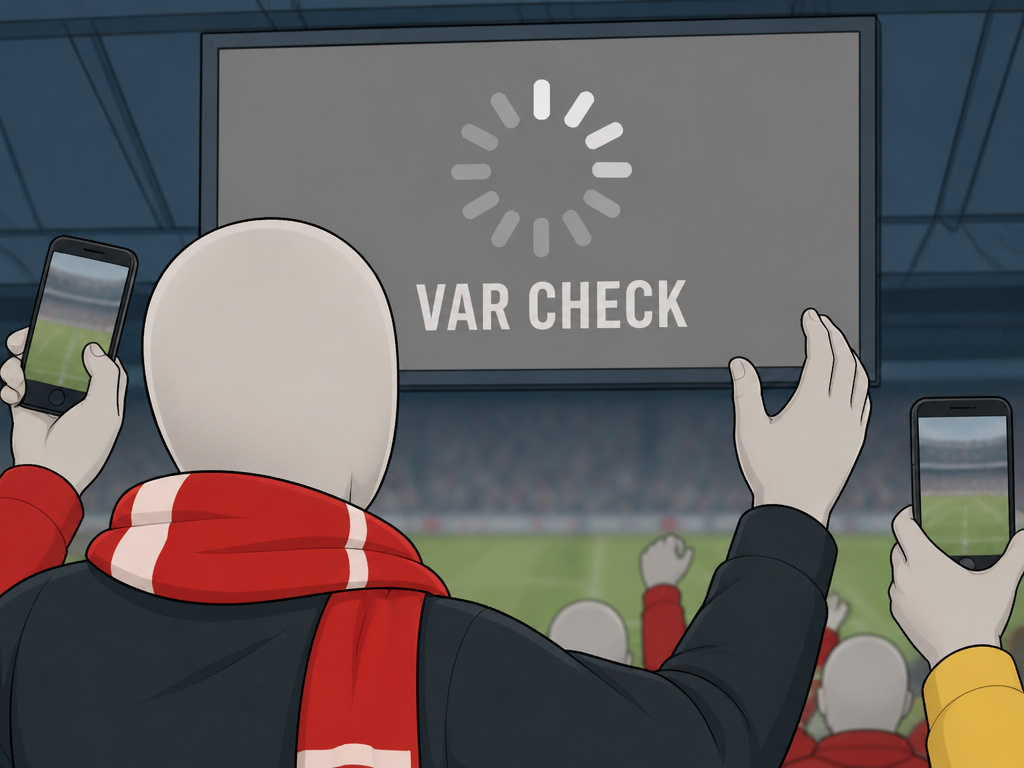
Fifty-five seconds sounds like nothing on paper. That was the average playing time lost to VAR in the Leuven study. Sit in a stadium during a check, though, and the clock stretches.
Anyone who’s stood through a long one knows the sound. The roar drops to a low murmur, phones come out, and a few thousand fans squint at a big screen that tells them almost nothing. Then the celebration arrives late and half-hearted (or not at all, which is worse). I’ve lost count of the goals I’ve only half-celebrated with my arms already in the air.
The Premier League numbers have moved, but the sources don’t agree on how far.
| Source | 2024/25 average delay | Season before |
|---|---|---|
| Refsplaining, citing Premier League data | 39 s | 64 s |
| Howard Webb, mid-season (as reported) | about 25 s | about 70 s |
| Goal.com, incl. Stadium announcements (as reported) | 48 s | 64 s |
I’d trust the 39-second figure most, since it’s tied to league data. All three point the same way. The checks got quicker.
IFAB won’t cap reviews, and its protocol says why: “accuracy is more important than speed.” FIFA’s refereeing director Massimo Busacca said much the same in 2018: “It’s clear that it takes time.”
Communication is the bigger gripe. Premier League clubs approved referees explaining overturns to the crowd, which mostly applies to monitor visits. That happened 66 times the season before. VAR audio still can’t be included.
The part nobody mentions: stadium announcements don’t cover checks where the VAR never sends the referee to the screen.
Mistakes VAR Made Anyway (and Couldn’t Undo)
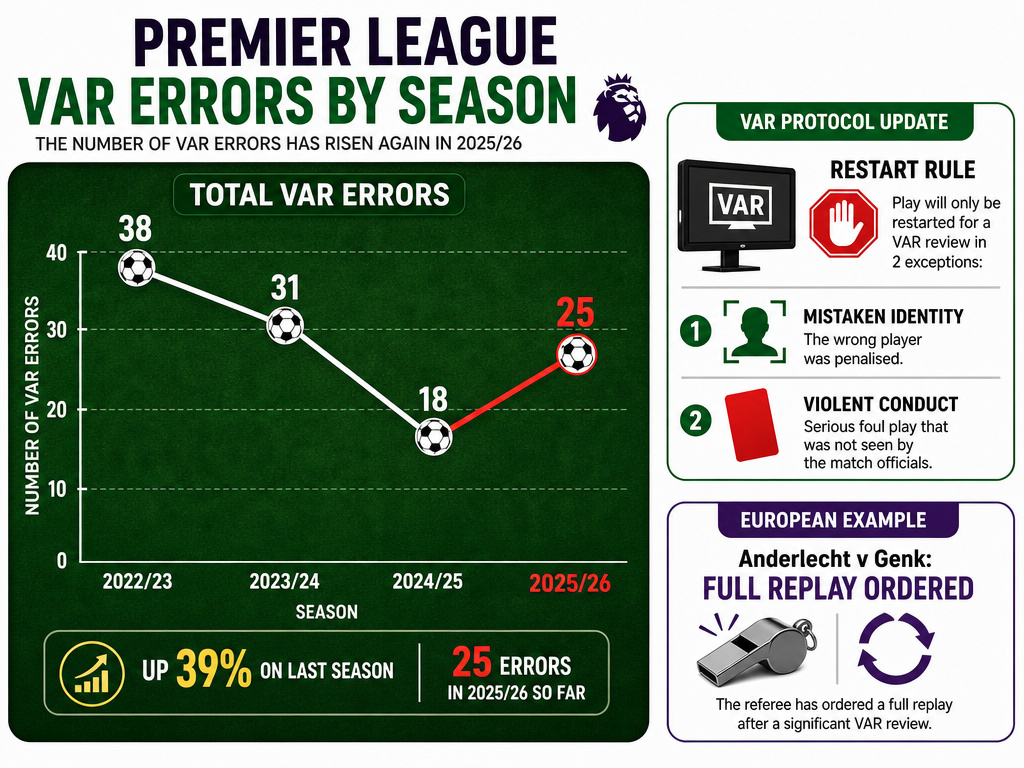
Accuracy studies make VAR sound close to finished. The Premier League’s Key Match Incidents panel tells a messier story.
According to BBC Sport tallies republished by Adom Online, the panel logged 38 VAR errors in 2022/23, then 31, then 18. Then 25 in 2025/26. A clean downward line would have been the neat story. The real one bends back up.
The Diaz goal at Tottenham
The most famous recent error wasn’t a judgement call at all. In Tottenham v Liverpool, Luis Diaz’s goal was wrongly disallowed, and PGMOL admitted a “significant human error.” It then released the full hub audio, and the Sky Sports PGMOL VAR audio release shows how a communication slip, not a camera angle, did the damage.
Play restarted. The protocol shut the door.
That’s the restart rule in action. After play restarts, a review is only allowed for:
- mistaken identity
- a potential red for violent conduct, spitting, biting, or extremely offensive, insulting or abusive actions
Everything else stands, however obvious the mistake looks on the replay the next morning.
Anderlecht v Genk: the replay nobody expected
Rewind a second to Belgium. In the 23rd minute, Genk’s Yira Sor scored after Bryan Heynen’s missed penalty. VAR’s involvement ended in what the Disciplinary Council for Professional Football called a misapplication of the Laws.
Belgium’s refereeing body first treated it as a VAR error and let the result stand. The disciplinary council overturned that and ordered a full replay. Two bodies, two routes, opposite answers.
Common mistake: judging a VAR call from the broadcast angle instead of the protocol. A replay can make a decision look wrong when the protocol never allowed a review in the first place, and the post-match fury lasts days over something the rules wouldn’t have fixed.
Does VAR Make Referees Fairer?

The Turkish Super League offers one of the cleaner tests, because VAR has run there since 2018-19. Isin and Yi’s peer-reviewed study on VAR referee bias compared seasons with and without it.
Only one thing moved. Fouls fell for both teams after VAR came in. Goals, shots and cards showed no significant change, and home advantage and referee bias stayed put. Away teams still faced more yellow cards and penalties against them.
The authors are honest about the limits. It’s one league, and they say it may not reflect VAR’s general impact. A Bundesliga study, as reported in my research brief, concluded that VAR influences outcomes “to a fairer degree,” but I couldn’t see its penalty figures. So the fairness evidence is split, and anyone claiming it’s settled is overselling.
I’d stop selling VAR as a fairness machine. I work from my eyes and a notebook rather than tracking data, so I lean hard on studies like the Turkish one. That study found the old home bias walked straight through the new technology.
Discipline is where VAR earns a cleaner win. IFAB’s protocol is blunt about punishing simulation: if a review shows a penalty was won by a dive, the penalty is cancelled, the defending team gets an indirect free kick, and the attacker is booked. The rules on simulation and diving haven’t changed much, but the odds of getting away with it have.
Accountability improved too. PGMOL releasing hub audio after the Diaz error would’ve been unthinkable before VAR existed.
VAR Pros and Cons in Football, Weighed Side by Side
This is my verdict. VAR earns its keep on facts and loses the room on opinions.
| Issue | The case for VAR | The case against |
|---|---|---|
| Accuracy | 93% to 98.8% in the Leuven study | Only covers reviewable calls |
| Time | Premier League delays fell to 39 s | No time limit under IFAB |
| Fairness | Fouls fell in Turkey | Home bias unchanged in Turkey |
| Errors | KMI errors fell to 18 | Rose again to 25 |
| Matchday feel | Overturns now explained to crowds | Delayed, muted celebrations |
Put the two review types head to head and the winner is obvious. On offside and offence location, VAR-only review wins, because two officials looking at the same frame reach the same answer. On handball and contact in the box, the on-field review mostly buys acceptance, and I’d set the bar for those interventions higher than it is now.
So: back the factual reviews, be sceptical of the subjective ones.
Premier League, Norway and Sweden Voted Three Different Ways
Three votes show how split the game is: 19-1, 321-129, and a flat no.
England first. Wolves argued that “the price we are paying for a small increase in accuracy is at odds with the spirit of our game.” They needed 14 of 20 clubs. The Premier League clubs vote 19 to 1 on 6 June 2024 kept VAR, and clubs agreed improvement points instead, including a high threshold for intervention.
Norway is stranger. Clubs in the top two tiers voted 19 to 13 against VAR, then the NFF congress kept it 321 votes to 129. Fresh reports say Norwegian top-flight clubs are pushing again to phase it out. I haven’t been able to confirm where that stands, so treat it as live.
Sweden never let it in. Clubs in the top two divisions voted not to introduce VAR in the Allsvenskan, and many of those clubs are fan-owned.
My knowledge thins out once you leave Europe, so I won’t pretend to know how this argument plays out in Asia or the Americas. Within Europe, though, the pattern is clear. The clubs closest to their supporters push back hardest.
Semi-Automated Offside and the Fixes Worth Backing
Can technology fix what technology made slower? On offside, I think it can. Premier League clubs voted to bring in semi-automated offside with supplier Second Spectrum, with the launch delayed until after an autumn international break for more testing.
I’d love to credit it for the drop from 64 seconds to 39. I can’t, honestly. Announcements, a higher intervention threshold and new training all landed around the same time, and the numbers don’t separate them.
Offside work also overlaps with connected ball technology, which tries to pin down the moment the ball is played. That moment is the whole offside call, so it matters.
The fixes on the table, roughly from strongest to weakest:
- Semi-automated offside. Factual, fast, and it doesn’t ask anyone for an opinion.
- Referees explaining overturns to the crowd, already approved in England.
- A higher threshold for subjective interventions, which the Premier League has committed to.
- Live audio during reviews. The Premier League says it will keep lobbying IFAB for the flexibility to broadcast video and audio live, and IFAB’s Laws hold it back for now.
- Hard time limits on checks.
Skip that last one. IFAB’s position that accuracy matters more than speed is right on factual calls, and a clock would just push officials into rushed guesses.
Does VAR make football more exciting or just slower?
The wait for a verdict is a mixed experience, and fans split on it. A goal now comes with a pause, and some supporters hold back the celebration until the check is done. Others enjoy the tension of a crowd watching a big screen while the referee listens to the video room. A late winner under review can feel like a second kick of drama.
The cost is measurable. The KU Leuven study put the average playing time lost to VAR at 55 seconds. Premier League data cited by Refsplaining shows the average delay fell from 64 seconds in 2023/24 to 39 seconds in 2024/25, so the pause is getting shorter. Clubs also approved referees announcing the reason for an overturn to the crowd, which helps the suspense end with some clarity. The Premier League also said it would keep lobbying IFAB to allow live video and audio during reviews, which could make the wait feel more like part of the show.
Does VAR reduce arguments and controversy after matches?
VAR has cut the number of clear mistakes, but it has not ended the arguing. The KU Leuven study found accuracy of reviewable decisions rose from 93% to 98.8% with VAR, which removes many of the obvious errors that fuelled old grievances. Fewer clear errors means fewer cases that fans and managers can point to afterwards.
The disputes have shifted rather than vanished. Wolves argued that the price paid for a small gain in accuracy was at odds with the spirit of the game. PGMOL admitted a significant human error over Luis Díaz’s wrongly disallowed goal against Tottenham and released the full VAR hub audio, which opened the process to scrutiny. In Belgium, a VAR error in Anderlecht against Genk led to a full replay of the match. Because reviews after a restart are barred apart from mistaken identity and violent or abusive conduct, most errors cannot be fixed on the day. A study of the Turkish Super League also found no significant change in home advantage or referee bias, so some complaints about fairness continue.
Frequently Asked Questions
Can a referee ignore VAR?
Yes. The referee always has the final decision to accept or reject the VAR’s advice. On subjective calls, the referee usually goes to the pitchside monitor and decides after watching the replay.
What are the disadvantages of VAR?
The main ones are delays, muted goal celebrations and poor communication with fans in the stadium. Errors still happen too: the Premier League’s KMI panel logged 25 VAR errors in 2025/26. And once play restarts, most mistakes can’t be fixed.
Why don’t fans like VAR?
Fans in the ground often wait without knowing what’s being checked, and a goal can be cancelled after they’ve celebrated it. Wolves made this case in 2024, arguing the small gain in accuracy wasn’t worth the cost to the game.
Does VAR stop diving?
It makes diving riskier. If a review shows a penalty was won by simulation, the penalty is cancelled, the defending team gets an indirect free kick and the attacker is booked.
Which leagues don’t use VAR?
Sweden’s Allsvenskan is the notable one, after clubs in the top two divisions voted against it. Norwegian clubs also voted against VAR, but the national federation’s congress kept it.
The Bottom Line
One test settles most VAR arguments for me. If a decision can be checked with a line or a location, let VAR make it and stop complaining. If it needs an opinion, the bar for intervening should be higher than it is today.
A concession, though. The best fairness study I can point to covers one league, and the second one I’d want to cite, I couldn’t fully read. If better multi-league data shows VAR does reduce bias, I’ll change my mind on the subjective calls.
Next time a goal gets checked, ask which kind of decision is under review before you decide whether VAR got it right. Half the anger fades once you know whether the protocol even allowed the fix.
So where would you draw the line: offside only, or handball too?
